
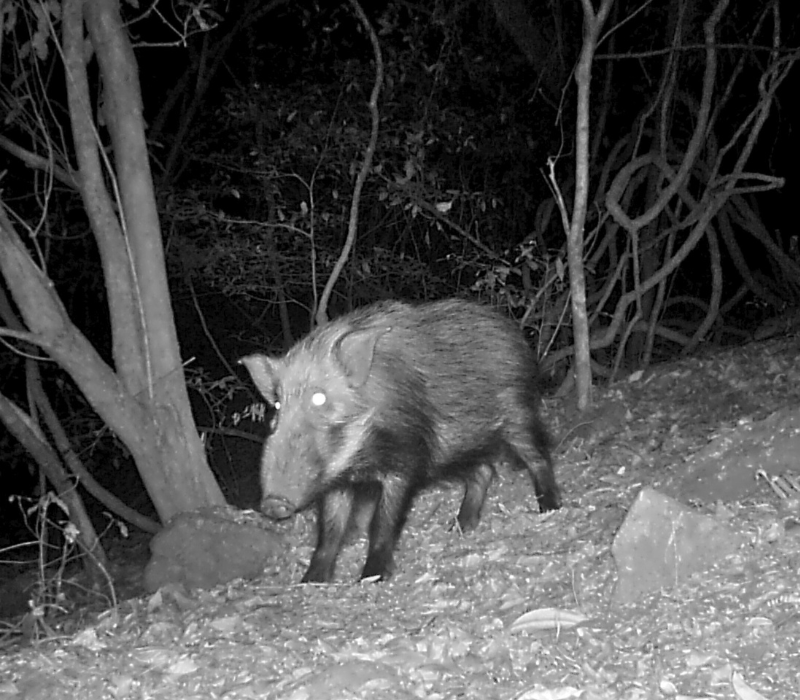
Bushpig
Potamochoerus larvatus

2025 Red list status
Least Concern

Regional Population Trend
Stable
change compared
to 2016
No Change
Overview
Potamochoerus larvatus – (F. Cuvier, 1822)
ANIMALIA – CHORDATA – MAMMALIA – ARTIODACTYLA – SUIDAE – Potamochoerus – larvatus
Common Names: Bushpig (English), Bosvark (Afrikaans), Ingulungundu, Ifarigi yommango, Isavakukazana sommango (Ndebele), Kolobê (Sepedi, Setswana), Kolobê-sodi, Kolobê-ya-thaba (Sepedi), Kolobe, Sodi, Kolobe ya thaba, Moru, Holobe-moru, Kolobe-moru (Sesotho), Kolobê yanaga, Kolobê wanaga, Kotola, Nkotola, Kolobê-nkotola, Kolobêsôdi, Kolobêtôpô (Setswana), Ingulube (Swati, Xhosa, Zulu), Ingulube ye siganga, Ihhontji (Swati), Khumba, Nguluve m’hlati (Tsonga), Nguluvhe, Nguluvhe ya daka (Venda), Ingulube yasahlathini (Zulu), Buschschwein (German), Potamochère, Potamochère du Cap (French)
Synonyms: No Synonyms
Taxonomic Note:
The genus Potamochoerus includes two species: the Red River Hog (P. porcus), which occurs in the forests from Senegal to Nigeria and the Congo and the Bushpig (P. larvatus), which occurs from the savannahs of East Africa to the forests of the Western Cape Province in South Africa (Grubb 1993). Three subspecies are currently recognised: the White-face Bushpig (P. l. hassama) from East Africa, the Somali Bushpig (P. l. somaliensis) from northeastern Kenya and Somalia and the Southern Bushpig (P. l. koiropotamus), which is widespread across southern Africa (Grubb 1993).
| Red List Status |
| LC – Least Concern, (IUCN version 3.1) |
Assessment Information
Assessors: Ehlers-Smith, Y.1 & Russo, I.M.2
Reviewer: Patel, T.3
Institutions: 1Ezemvelo KZN Wildlife, 2Cardiff University, 3Endangered Wildlife Trust
Previous Assessor: Venter, J.
Previous Reviewer: Seydack, A.H.W.
Previous Contributors: Page-Nicholson, S., Child, M.F. & Relton, C.
Assessment Rationale
Considering its relatively widespread distribution, ability to utilise agricultural landscapes, and common occurrence (occurring at 0.3–0.5 individuals/km² in Cape forests), the Bushpig is listed as Least Concern within the assessment region. No major threats have been identified that may be causing significant declines in the population. The southern Eastern Cape range is no longer considered effectively isolated from the northern KwaZulu-Natal (KZN) Province. Given the versatility of Bushpigs (for example, their utilisation of agricultural landscapes), and their capacity to conduct long-range movements, it is expected that conditions for dispersal are still largely similar to those that prevailed in the past. However, the effects of local threats such as persecution and bushmeat hunting should be monitored, as local declines or extinctions may be occurring.
Regional population effects: There is presumably immigration from southern Mozambique into northeastern KZN and also across the transfrontier areas in northern Limpopo. However, a sink situation is likely to occur should extra-regional areas be overpopulated. The dispersal capacity of the species is good, so rescue effects are possible.
Reasons for Change
Reason(s) for Change in Red List Category from the Previous Assessment: No change
Red List Index
Red List Index: No change
Recommended citation: Ehlers-Smith Y & Russo IM. 2025. A conservation assessment of Potamochoerus larvatus. In Patel T, Smith C, Roxburgh L, da Silva JM & Raimondo D, editors. The Red List of Mammals of South Africa, Eswatini and Lesotho. South African National Biodiversity Institute and Endangered Wildlife Trust, South Africa.
Regional Distribution and occurrence
Geographic Range
The African distribution of this species is shown in Seydack (2013). It is largely continuous, with some isolated patches in western central Africa (mainly in Angola). Bushpigs have an extensive distribution across much of eastern and southern Africa, but aside from the Caprivi Strip, are absent from Namibia (Skinner & Chimimba 2005). Generally, their distribution in South Africa mostly follows the eastern seaboard and forested highlands and has expanded in KZN in association with the advance of sugar cane fields. Recent records show a more western range in the Western Cape Province than that recorded by Friedman and Daly (2004). Similarly, Figure 1 shows scattered records from the interior of the Free State Province that were not reflected in the 2004 national assessment (Friedmann & Daly 2004). It is unclear whether this represents a range expansion or previously undetected subpopulations. The species are generally found in the northern and eastern parts of the country (and neighbouring eSwatini) to southern KZN and the Western Cape Province.
There was a perception that there is a gap in the distribution of the species between KZN and East London in the Eastern Cape Province and that the population in the Eastern and Western Cape Provinces was isolated (Grubb 1993; Seydack 2013). However, there are sufficient recent data that indicate that the species occurs in several forests throughout this perceived distributional gap (de Villiers 2002; Hayward et al. 2005; Eastern Cape Parks and Tourism Agency unpublished camera trap records). Therefore, the assumption that the Western and Eastern Cape population is isolated from the rest of the population is probably inaccurate. It can also be as a result of under-reporting in this area, rather than a true distributional gap.
Elevation / Depth / Depth Zones
Elevation Lower Limit (in metres above sea level): (Not specified)
Elevation Upper Limit (in metres above sea level): (Not specified)
Depth Lower Limit (in metres below sea level): (Not specified)
Depth Upper Limit (in metres below sea level): (Not specified)
Depth Zone: (Not specified)
Biogeographic Realms
Biogeographic Realm: Afrotropical
Map
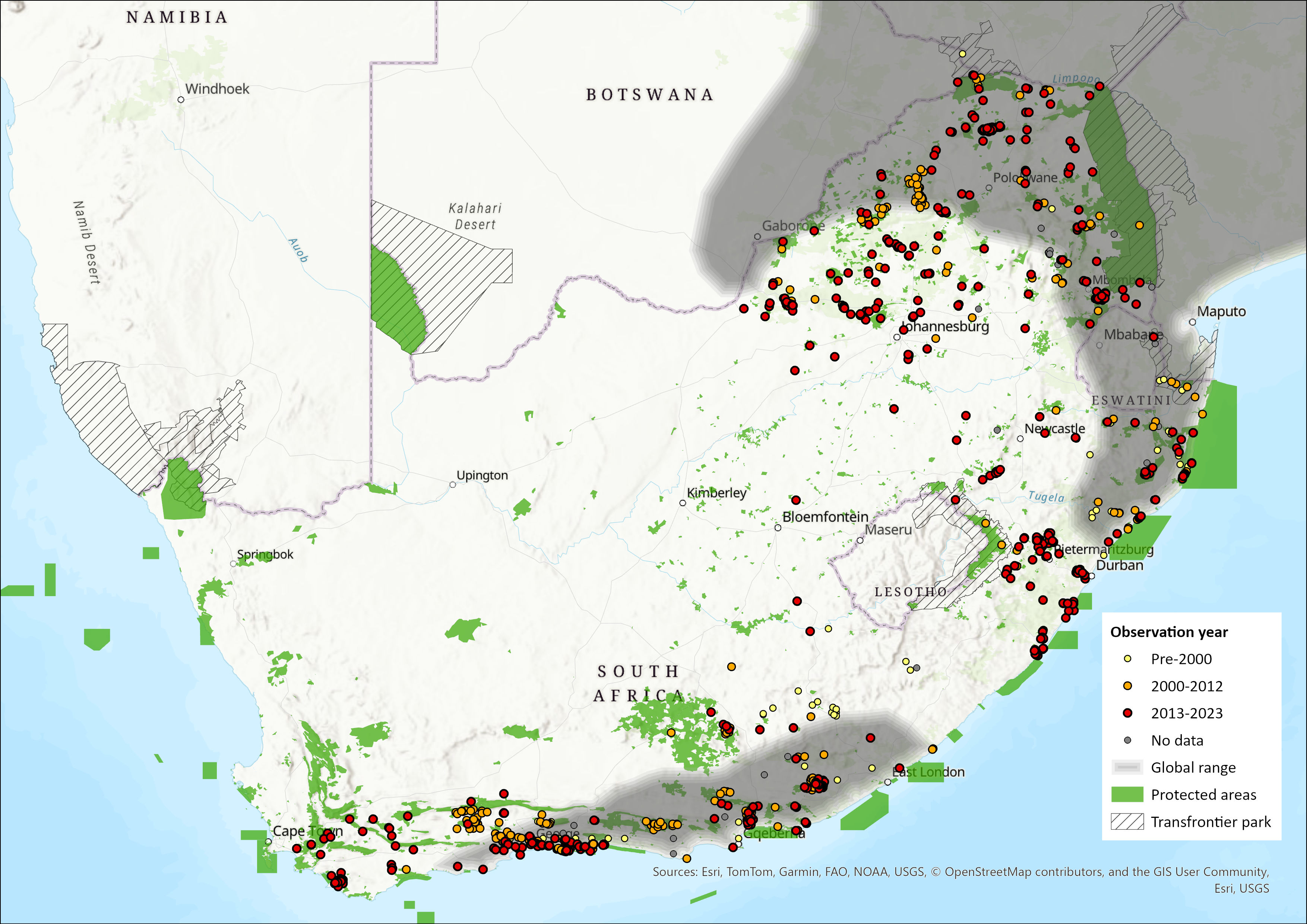
Figure 1. Distribution records for Bushpig (Potamochoerus larvatus) within the assessment region (South Africa, Eswatini and Lesotho). Note that distribution data is obtained from multiple sources and records have not all been individually verified.
Countries of Occurrence
| Country | Presence | Origin | Formerly Bred | Seasonality |
| Angola | Extant | Native | – | – |
| Botswana | Extant | Native | – | – |
| Burundi | Extant | Native | – | – |
| Comoros | Extant | Introduced | – | – |
| Congo, The Democratic Republic of the | Extant | Native | – | – |
| Eswatini | Extant | Native | – | – |
| Ethiopia | Extant | Native | – | – |
| Kenya | Extant | Native | – | – |
| Madagascar | Extant | Introduced | – | – |
| Malawi | Extant | Native | – | – |
| Mayotte | Extant | Introduced | – | – |
| Mozambique | Extant | Native | – | – |
| Namibia -> Caprivi Strip | Extant | Native | – | – |
| Rwanda | Extant | Native | – | – |
| Somalia | Extant | Native | – | – |
| South Africa | Extant | Native | – | – |
| Sudan | Extant | Native | – | – |
| Tanzania, United Republic of | Extant | Native | – | – |
| Uganda | Extant | Native | – | – |
| Zambia | Extant | Native | – | – |
| Zimbabwe | Extant | Native | – | – |
Large Marine Ecosystems (LME) Occurrence
Large Marine Ecosystems: (Not specified)
FAO Area Occurrence
FAO Marine Areas: (Not specified)
Climate change
There is no research on the effects of climate change on this species.
Population information
Population density estimates of Bushpig in the Western Cape forests of South Africa have been recorded at a range of 0.3–0.5 animals/km² (Seydack 1990, 2013). There are suspected to be three major subpopulations: Eastern/Western Cape, KwaZulu-Natal (KZN), and Mpumalanga/Limpopo Provinces. Population estimates for KZN have yet to be calculated. Given their wide extent of occurrence (EOO), it has been argued that there are over 10,000 mature individuals within the assessment region. However, this should be estimated more accurately through camera trap studies and field surveys.
Population Information
Current population trend: Stable
Continuing decline in mature individuals: Locally due to persecution and bushmeat hunting.
Number of mature individuals in population: Possibly > 10,000
Number of mature individuals in largest subpopulation: Unknown
Number of subpopulations: 3
Severely fragmented: No. Bushpigs can utilise agricultural landscapes and have good dispersal capacity.
Extreme fluctuations in the number of subpopulations: (Not specified)
Continuing decline in number of subpopulations: (Not specified)
All individuals in one subpopulation: (Not specified)
Quantitative Analysis
Probability of extinction in the wild within 3 generations or 10 years, whichever is longer, maximum 100 years: (Not specified)
Probability of extinction in the wild within 5 generations or 20 years, whichever is longer, maximum 100 years: (Not specified)
Probability of extinction in the wild within 100 years: (Not specified)
Population genetics
A phylogenetic analysis of concatenated mitochondrial DNA (mtDNA) sequences (cytb and dloop) and non-concatenated mtDNA genes showed that bushpigs from mainland Africa and Madagascar form a monophyletic clade and the divergence between these clades has been estimated at 0.49 MYA (million years ago; Lee et al. 2020). The mainland bushpig samples from Zimbabwe and Tanzania appear to be a sister clade to the Madagascar bushpigs followed by samples from South Africa and the remaining samples from Zimbabwe. Concatenated mitochondrial DNA (mtDNA) sequences (cytb and dloop) identified one haplotype each from the KwaZulu-Natal Province, and the Soutpansberg in the Limpopo Province of South Africa (only one sample from each of these localities). Based on nuclear MHC class II SLA-DQB1 sequences, one haplotype was identified from the KwaZulu-Natal Province and two haplotypes were shown from the Soutpansberg locality in South Africa (Lee et al. 2020).
A more recent genomic study has indicated that the population size in South Africa has been relatively constant until about 10,000 years ago after which fluctuation in population size has been observed for this species (Balboa et al. 2020). The number of mature individuals for the assessment region has been estimated at 10,000 mature individuals. A conversion ratio of 0.1 or 0.3 between Nc (mature individuals) and Ne (effective population size, mature individuals contributing to breeding) will result in Ne of 1,000-3,000 which are both above the recommended number of 500 individuals per population to ensure long-term survival of the species.
Habitats and ecology
Bushpigs are commonly associated with dense vegetation types including xeric scrub forests, thickets and riverine habitats, where food, shelter and water are readily available. They adapt easily to transformed landscapes, such as agricultural areas, and may become a problem species within croplands, specifically maize, peanuts, beans and sugar cane fields (Seydack 2013). In the Western Cape Province, Bushpig habitat includes southern Afrotemperate evergreen forest, fynbos and commercial pine plantations and in the Eastern Cape Province the preferred habitat includes Sundays Noorsveld, southern Afrotemperate forest, Albany thicket, eastern valley bushveld and southern coastal forest (Seydack 1990; Seydack & Bigalke 1992). The species is broadly distributed within coastal thicket/dense bush, low canopy forest, scarp and mistbelt forests in the KwaZulu-Natal Province. Camera trap surveys have quantified occupancy rates within habitat patches nestled in various land-use classifications.
Bushpigs forage both alone and in groups (Seydack 1990; Skinner & Chimimba 2005). Group sizes range from 1–11, with a mean group size of 3.2 (Ghiglieri et al. 1982). Bushpigs are monogamous and territorial with family groups consisting of one breeding female, one alpha boar and one or two generations of offspring (Seydack 1990, 2013). Females can conceive at approximately 21 months and litters can be up to six in size, but typically 2–4. The thermoneutral zone of juvenile Bushpigs (10 kg) is between 13–30 °C, and mother sows build nests when it is cold and wet (Seydack 1990). Bushpigs are omnivorous and eat anything from insects, roots, seeds and fruits, that they find by dismantling rotten logs, moving rocks and by picking up leftovers from other forest animals (Ghiglieri et al. 1982). Although they are considered to be nocturnal, diurnal activity is not unusual (Ghiglieri et al. 1982; Seydack 1990). In summer, Bushpigs rest during the warmer hours of the day and, during winter, increased resting also occurred from midnight to dawn (Seydack 1990, 2013). Bushpigs occupy an average home range of 7.2 km2 (3.8–10.1 km2), which they traverse every 1–4 days as part of territory patrolling (Seydack 1990, 2013). Divergence in characteristics of population dynamics between Western (low population turnover; nutrient-poor habitat) and Eastern (high population turnover; nutrient-rich habitat) Cape Province populations was revealed (Seydack & Bigalke 1992).
Ecosystem and cultural services: Bushpigs are important seed dispersers in forest ecosystems (Brodie et al. 2009; Abernethy et al. 2013) and, due to the presence of the species in many of South Africa’s coastal and forested/thicket vegetation types, the ecosystem service they provide in this regard cannot be under-emphasised. Bushpigs also are an important source of bushmeat for many rural people in Africa (Lindsey et al. 2012; Abernethy et al. 2013).
IUCN Habitats Classification Scheme
| Habitat | Season | Suitability | Major Importance? |
| 1.6. Forest -> Forest – Subtropical/Tropical Moist Lowland | – | Suitable | – |
| 1.9. Forest -> Forest – Subtropical/Tropical Moist Montane | – | Suitable | – |
| 3.6. Shrubland -> Shrubland – Subtropical/Tropical Moist | – | Suitable | – |
| 14.1. Artificial/Terrestrial -> Artificial/Terrestrial – Arable Land | – | Marginal | – |
| 14.3. Artificial/Terrestrial -> Artificial/Terrestrial – Plantations | – | Marginal | – |
| 14.4. Artificial/Terrestrial -> Artificial/Terrestrial – Rural Gardens | – | Marginal | – |
Life History
Generation Length: (Not specified)
Age at maturity: female or unspecified: (Not specified)
Age at Maturity: Male: (Not specified)
Size at Maturity (in cms): Female: (Not specified)
Size at Maturity (in cms): Male: (Not specified)
Longevity: (Not specified)
Average Reproductive Age: (Not specified)
Maximum Size (in cms): (Not specified)
Size at Birth (in cms): (Not specified)
Gestation Time: (Not specified)
Reproductive Periodicity: (Not specified)
Average Annual Fecundity or Litter Size: (Not specified)
Natural Mortality: (Not specified)
Does the species lay eggs? (Not specified)
Does the species give birth to live young: (Not specified)
Does the species exhibit parthenogenesis: (Not specified)
Does the species have a free-living larval stage? (Not specified)
Does the species require water for breeding? (Not specified)
Movement Patterns
Movement Patterns: (Not specified)
Congregatory: (Not specified)
Systems
System: Terrestrial
General Use and Trade Information
This species is used at a subsistence level for food, both legally and illegally (bushmeat). It is a sought-after species to be hunted in the southeastern KZN and the Eastern Cape Provinces and has value for both local hunters and as trophies. Wildlife ranching and the private sector have generally had a positive effect on this species as it has been widely reintroduced onto private properties (or has naturally recolonised wildlife ranches) within its natural distribution. The subpopulations on wildlife ranches are normally self-sustaining and free roaming with little management intervention required.
|
Subsistence: |
Rationale: |
Local Commercial: |
Further detail including information on economic value if available: |
|
Yes |
Bushmeat |
Yes |
Trophies and meat |
National Commercial Value: Yes
International Commercial Value: No
|
End Use |
Subsistence |
National |
International |
Other (please specify) |
|
1. Food – human |
true |
true |
– |
– |
Is there harvest from captive/cultivated sources of this species? Yes
Harvest Trend Comments: Trophies and meat
Threats
Within the assessment region, expanding human settlements are destroying habitat within this species’ range. Similarly, deforestation and the resulting loss of habitat along the Indian Ocean Coastal Belt Forest is increasing with expanding development and increased farming activities. Additionally, settlements bring Bushpigs into contact with agricultural areas where they are often persecuted. In some cases, agriculture (for example, sugar cane) may have led to an increase in its range and numbers, while in others (for example, dairy and beef farming) it may have led to a decline. This species is also regarded as a pest on some maize, sugar cane and tree nut production farms, and is therefore persecuted. As such, they may be subject to localised declines and range contractions in some areas due to large-scale habitat destruction or as a result of hunting for crop protection and local consumption (Vercammen et al. 1993).
Even though Bushpigs are occasionally vulnerable to persecution and official population control measures in agricultural areas, due to crop damage they are particularly difficult to eliminate considering their preference for sheltered, densely vegetated habitats, nocturnal habits and high reproductive potential (Seydack 2013).
In the southeastern part of the KwaZulu-Natal Province an escaped feral population of Wild Boar (Sus scrofa) of unknown size exists and is interbreeding with the local Bushpig population which will lead to a hybrid population.
Current habitat trend: Declining due to anthropogenic disturbance, in the form of expanding human settlements, firewood and charcoal production, as well as dairy and beef agriculture. These disturbances have altered habitat structure; however, certain farming practices, such as sugar cane farming, may represent positive habitat components for Bushpig. Firewood and charcoal production decreases habitat quality and is also more likely to bring this species into contact with humans who might persecute them or hunt them for bushmeat. Draining and filling in wetlands also severely affects the persistence of local subpopulations, as Bushpigs frequently lie up in wetlands.
Conservation
This species occurs within a number of protected areas across the assessment region, including Mpenjati Nature Reserve, Oribi Gorge Nature Reserve, Vernon Crookes Nature Reserve, Umtamvuna Nature Reserve, Mbumbazi Nature Reserve, Mkambati Nature Reserve, Silaka Nature Reserve, Hluleka Nature Reserve, Dwesa-Cwebe Nature Reserve, East London Coast Nature Reserve, Addo Elephant National Park, Garden Route National Park, Mountain Zebra National Park, Mpofu Nature Reserve, Fort Fordice Nature Reserve, Thomas Baines Nature Reserve, Groendal Nature Reserve, Baviaanskloof Nature Reserve, Isimangaliso Wetland Park, De Hoop Nature Reserve and Swartberg Nature Reserve. The protected areas below the Mpumalanga escarpment and Magoebaskloof area are specifically important for this species.
While no specific interventions are necessary at present, private landowners should be encouraged to create conservancies that protect natural forests which form integral habitat for this species. Given the low densities and recruitment rates of Bushpig, it is unlikely that this species is a suitable candidate for the sustainable, wildlife-based rural economy. Additionally, the introduction of non-native wild pig species should be monitored and prevented as much as possible to avoid hybridisation.
Recommendations for land managers and practitioners:
- Conservation management agencies should institute effective and accurate long-term Bushpig population monitoring programmes.
Research priorities:
Previous research was conducted on the impacts of changing land-use on biodiversity, particularly mammals such as Bushpig, using camera trapping, metapopulation dynamics of forest mammals in the fragmented sub-tropical coastal forests of the southern KwaZulu-Natal Province (University of KwaZulu-Natal in collaboration with Ezemvelo KZN Wildlife; June 2014–June 2016). Additionally, an internal monitoring project on the camera trapping of forest mammals in the Eastern Cape Province was being conducted by the Eastern Cape Parks and Tourism Agency.
- Monitor population density and trends, specifically in areas where this species is hunted.
- Evaluate the extent of hybridisation with non-native wild pig species in existing subpopulations, especially on private land.
- The effects of wildlife ranching on this species across bioregions.
- Methods to reduce conflict between Bushpig and people, especially within agricultural areas.
Encouraged citizen actions:
- Landowners should create forest conservancies for this species.
- Report sightings of free-roaming animals on private lands or protected areas on MammalMAP, iNaturalist and KZN Wildlife Watch.
Bibliography
Abernethy, K.A., Coad, L,. Taylor, G., Lee, M.E. and Maisels, F. 2013. Extent and ecological consequences of hunting in Central African rainforests in the twenty-first century. Philosophical Transactions of the Royal Society of London B: Biological Sciences 368: 20120303.
Balboa RF, Bertola LD, Brüniche-Olsen A, Rasmussen MS et al. 2024. African bushpigs exhibit porous species boundaries and appeared in Madagascar concurrently with human arrival. Nature Communications 15 (172), https://doi.org/10.1038/s41467-023-44105-1.
Brodie JF, Helmy OE, Brockelman WY, Maron JL. 2009. Bushmeat poaching reduces the seed dispersal and population growth rate of a mammal-dispersed tree. Ecological Applications 19: 854-863.
Friedmann, Y. and Daly, B. 2004. Red Data Book of the Mammals of South Africa: A Conservation Assessment. Conservation Breeding Specialist Group (SSC/IUCN) and Endangered Wildlife Trust, Parkview, South Africa.
Ghiglieri MP, Butynski TM, Struhsaker TT, Leland L, Wallis SJ, Waser P. 1982. Bush pig (Potamochoerus porcus) polychromatism and ecology in Kibale Forest, Uganda. African Journal of Ecology 20: 231-236.
Grubb, P. 1993. The Afrotropical Suids Phacochoerus, Hylochoerus and Potamochoerus – Taxonomy and Description. In: W.L.R. Oliver (ed.), Pigs, peccaries and hippos. Status survey and conservation action plan, pp. 66-75. IUCN/SSC Pigs and Peccaries Specialist Group and IUCN/SSC Hippo Specialist Group, Gland, Switzerland.
Hayward MW, White RM, Mabandla KM, Bukeye P. 2005. Mammalian fauna of indigenous forest in the Transkei region of South Africa: an overdue survey. South African Journal of Wildlife Research 35: 117-124.
Lee C, Day J, Goodman SM, Pedrono M et al. 2020. Genetic origins and diversity of bushpigs from Madagascar (Potamocheorus larvatus, family Suidae). Scientific Reports 10:20629.
Seydack AHW. 2016. Potamochoerus larvatus. The IUCN Red List of Threatened Species 2016: e.T41770A44140926.Seydack AW, Bigalke RC. 1992. Nutritional ecology and life history tactics in the bushpig (Potamochoerus porcus): Development of an interactive model. Oecologia 90: 102-112.
Seydack AW. 1990. Ecology of the Bushpig Potamochoerus porcus Linn. 1758 in the Cape Province, South Africa. Ph.D. Thesis. University of Stellenbosch, Stellenbosch, South Africa.
Seydack, A.H.W. 2013. Bushpig Potamochoerus larvatus. In: J. Kingdon and M. Hoffmann (eds), Mammals of Africa, pp. 32-36. Bloomsbury, London.
Skinner, J.D. and Chimimba, C.T. (eds). 2005. The Mammals of the Southern African Subregion. Cambridge University Press, United Kingdom, Cambridge.
Vercammen, P., Seydack, A.H.W. and Oliver, W.L.R. 1993. The Bush Pigs (Potamochoerus larvatus and P. porcus). In: W.L.R. Oliver (ed.), Pigs, Peccaries, and Hippos: Status Survey and Conservation Action Plan, pp. 93-101. IUCN/SSC Pigs and Peccaries Specialist Group – IUCN/SSC Hippo Specialist Group, Gland, Switzerland.
de Villiers DJ. 2002. Impacts of human and biological factors on distributions of indigenous mammals in Transkei, with perticular emphasis on the forest dwelling bushbuck (Tragelaphus scriptus), blue duiker (Philantomba monticola), and bushpig (Potamochoerus porcus). M.Sc. Thesis. University of Transkei, Mtatha, South Africa.