
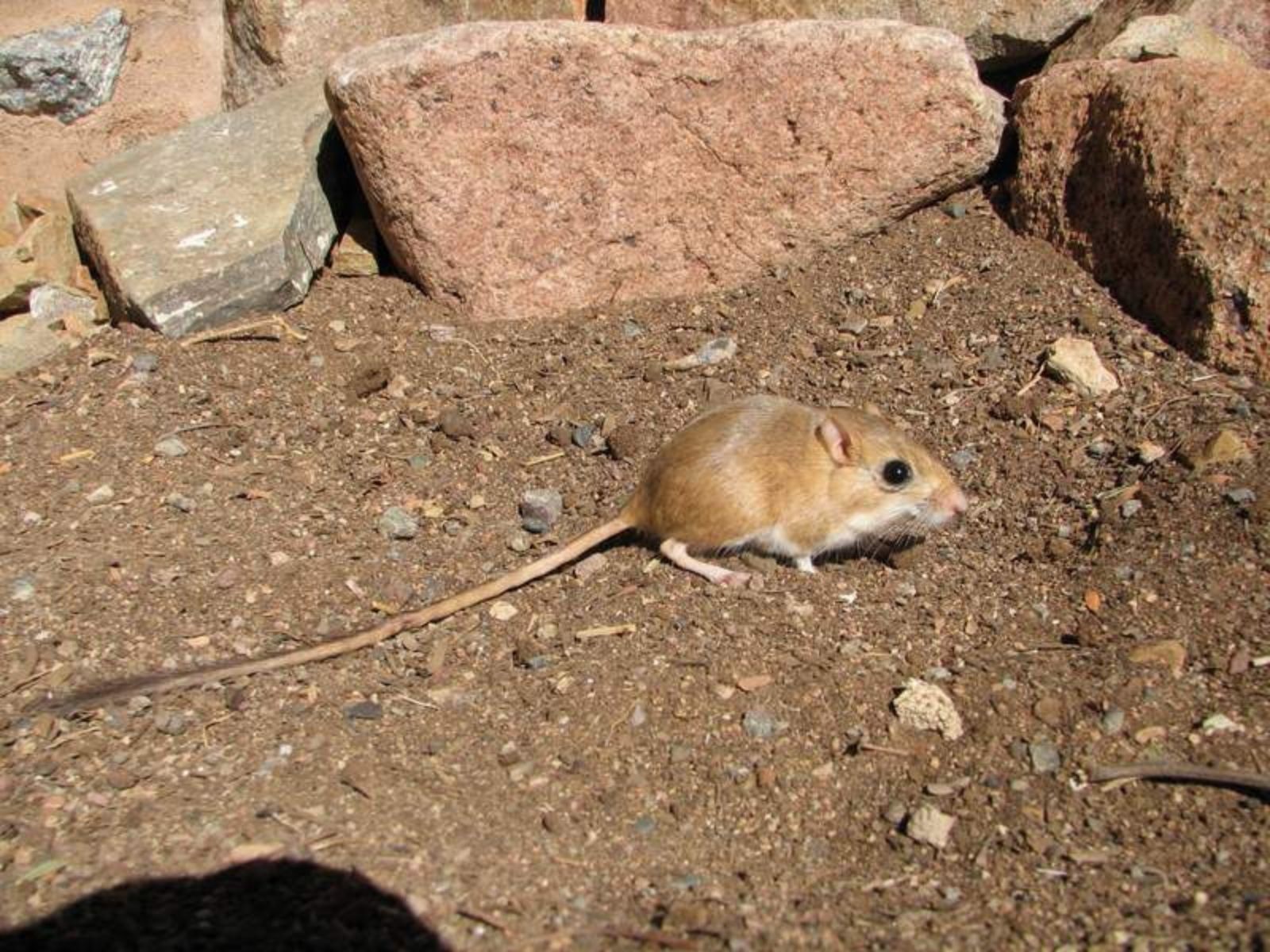
Brush-tailed Hairy-footed Gerbil
Gerbilliscus vallinus

2025 Red list status
Least Concern

Regional Population Trend
Stable

Change compared
to 2016
No Change
Overview
Gerbilliscus vallinus – (Thomas, 1918)
ANIMALIA – CHORDATA – MAMMALIA – RODENTIA – MURIDAE – Gerbillurus – vallinus
Common Names: Brush-tailed Hairy-footed Gerbil, Brush-tailed Gerbil (English), Borselsterthaarpootnagmuis, Borselstertnagmuis (Afrikaans).
Synonyms: No Synonyms
Taxonomic Note: South Africa
Gerbilliscus vallinus was formerly described under the genus Gerbillurus. However, based on morphological differences (for example, larger body size, darker pelage colour, and naked hindfoot soles) between the Gerbilliscus species and those of Gerbillurus, these groups were separated (Monadjem et al. 2015). Based on chromosomal and molecular data, G. setzeri is this species’ closest relative (Qumsiyeh et al. 1991; Granjon et al. 2012). Two subspecies have been recognised, namely G. v. vallinus from the Northern Cape Province and G. v. seeheimi from the Namib Desert, Namibia (Skinner & Chimimba 2005).
Red List Status: LC – Least Concern
Assessment Information
Assessors: Smith, C.1 & da Silva, J.2
Reviewer: Taylor, P. 3
Institutions:1Endangered Wildlife Trust,2South African National Biodiversity Institute, 3University of the Free Sate
Previous Assessors: Palmer, G. & Perrin, M.
Previous Reviewers: Relton, C.
Previous Contributors: Avenant, N., Avery, M., Baxter, R., Child, M.F., MacFadyen, D., Monadjem, A., Taylor, P. & Wilson, B.
Assessment Rationale
Listed as Least Concern in view of its wide distribution within the assessment region, presumed long-term stable population, and because there are no major threats that could cause rapid population decline. Populations are subject to natural fluctuations. However, extensive overgrazing may result in local habitat deterioration and the effects of climate change on this species are currently unknown. Both potential threats need to be monitored systematically.
Regional population effects: The range extends across South Africa and Namibia and there is contiguous habitat, so dispersal is possible.
Reasons for Change
Reason(s) for Change in Red List Category from the Previous Assessment: No change
Red List Index
Red List Index: No change
Recommended Citation: Smith C & da Silva JM. 2025. A conservation assessment of Gerbilliscus vallinus. In Patel T, Smith C, Roxburgh L, da Silva JM & Raimondo D, editors. The Red List of Mammals of South Africa, Eswatini and Lesotho. South African National Biodiversity Institute and Endangered Wildlife Trust, South Africa.
Regional Distribution and occurrence
Geographic Range
This species occurs in southern Namibia and northwestern South Africa where it inhabits gravel plains or shallow sandy soils (Dempster et al. 1999). It occurs predominantly on the gravel plains north of the Kuiseb River in southwestern Namibia; and the Nama-Karoo and Succulent Karoo biomes of South Africa. An isolated population of the subspecies, G. v. seeheini, is located on the flood plain of the Tsondab River, Namibia (Griffin 1990).
Elevation / Depth / Depth Zones
Elevation Lower Limit (in metres above sea level): (Not specified)
Elevation Upper Limit (in metres above sea level): (Not specified)
Depth Lower Limit (in metres below sea level): (Not specified)
Depth Upper Limit (in metres below sea level): (Not specified)
Depth Zone: (Not specified)
Map
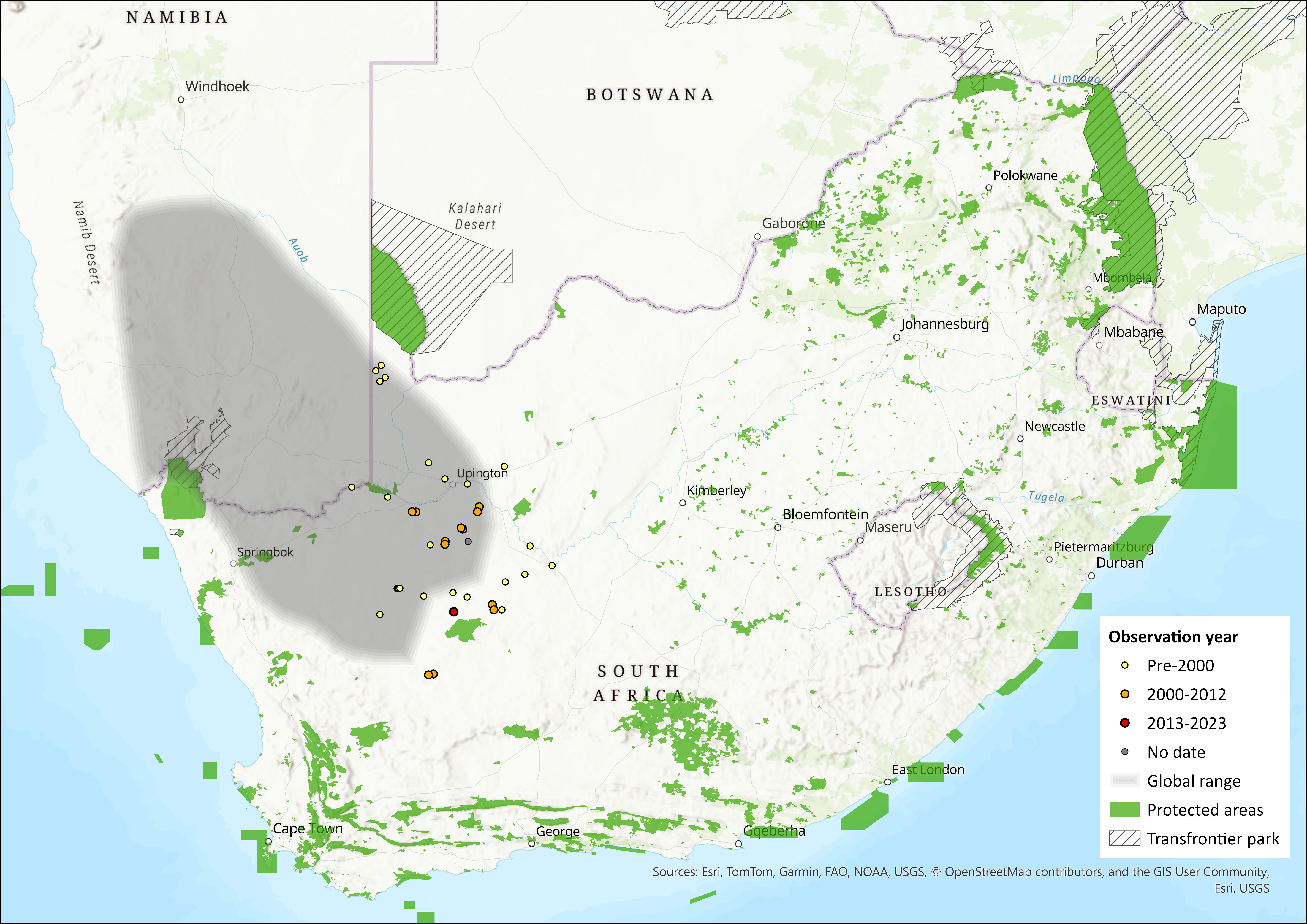
Figure 1. Distribution records for Brush-tailed Hairy-footed Gerbil (Gerbilliscus vallinus) within the assessment region (South Africa, Eswatini and Lesotho). Note that distribution data is obtained from multiple sources and records have not all been individually verified.
Biogeographic Realms
Biogeographic Realm: Afrotropical
Occurrence
Countries of Occurrence
| Country | Presence | Origin | Formerly Bred | Seasonality |
| Namibia | Extant | Native | – | – |
| South Africa | Extant | Native | – | – |
Large Marine Ecosystems (LME) Occurrence
Large Marine Ecosystems: (Not specified)
FAO Area Occurrence
FAO Marine Areas: (Not specified)
Climate change
Results from a Climate Change Species Distribution Model indicates that at least for South Africa, general impacts of climate change do not appear to be a threat to the species habitat (Cowan 2025).
Population
It is considered fairly common, but exhibits naturally fluctuating populations. It is the most abundant small mammal in some areas, such as Brukaros-Berseba in Namibia (Perrin and Dempster 2013). It is difficult to monitor population trends owing to its patchy distribution and low population densities which vary widely between years (not because it is difficult to sample). No abundance or density estimates are available for this species.
Population Information
Current population trend: Stable
Continuing decline in mature individuals: Unknown
Number of mature individuals in population: Unknown
Number of mature individuals in largest subpopulation: Unknown
Number of subpopulations: Unknown
Severely fragmented: No
Quantitative Analysis
Probability of extinction in the wild within 3 generations or 10 years, whichever is longer, maximum 100 years: (Not specified)
Probability of extinction in the wild within 5 generations or 20 years, whichever is longer, maximum 100 years: (Not specified)
Probability of extinction in the wild within 100 years: (Not specified)
Population Genetics
While this genus has been investigated in a phylogenetic context (Qumsiyeh et al. 1991), no population genetic assessment has been undertaken on the species, nor have the subspecies been investigate using molecular techniques. Assuming their validity, only one occurs in the assessment region, and it is abundant and seemingly connected across its range; therefore, is assumed to exist as a single metapopulation. Given no subpopulations are known to have gone extinct, it can be assumed that all known subpopulations (i.e., the metapopulation) remain. Consequently, the Convention on Biological Diversity’s Global Biodiversity Framework’s complementary genetic indicator – proportion of populations maintained (PM) – would receive a value of 1.0 (1/1 population remaining). However, hidden structure might be revealed upon investigation considering this species patchy distribution. Given the limited information known about this species, such a study would be highly informative.
Because the species is locally abundant it is assumed to number in excess of 10 000 individuals throughout its range, hence exceeding the Ne 500 threshold stipulated by the CBD’s headline genetic diversity indicator (assuming a 0.1 conversion ratio of effective population size [Ne] to census size). While the 10 000 value is not an actual census count, the quantity can still be used as a proxy for quantifying the proportion of populations with an Ne > 500 indicator, which is valued at 1.0 (1/1 subpopulation with Ne > 500). These proxy metrics would benefit from validation against actual DNA-based genetic diversity metrics to ensure the genetic health of the species is sufficiently accounted for. Moreover, a population genetic study would help fill in many knowledge gaps associated with the species.
Habitats and ecology
This species is typically restricted to areas of consolidated soils, bare gravel plains, dry riverbeds or shallow sand overlying gravels with scant vegetation (Perrin and Dempster 2013), in regions typically receiving less than 150 mm of rainfall. This gregarious species lives in sandy, complex (branched) burrows reaching depths of 1.5 m (Roberts 1951). Burrows are found in areas with fine surface gravel and constructed in mounds of loose soil around the base of bushes, especially Phaeoptilum spinosum and Rhigozum trichotomum (Downs 1989, Dempster et al. 1999, Skinner & Chimimba 2005). They have also been reported to occur in tree and shrub savanna (Kapala 2021). The vegetation provides a diet of insects, spiders, seeds and the leaves of grasses. A litter size of 3.4 (range 1–5) was recorded in captivity (Dempster and Perrin 1991). They are adapted to live in arid and hot environments (Perrin and Dempster 2013). They flourish in disturbed habitats caused by drought, fire, overgrazing and cultivation (Kapala 2021).
Ecosystem and cultural services: Rodents are both predators and dispersers of plant seeds in the environment. Since these gerbils are hoarders, they may serve in a limited capacity as seed dispersers. Seeds taken into the burrows are likely to be consumed, but some of the seeds scatter-hoarded in caches or buried are often forgotten or abandoned, and if these escape other seed predators, they may germinate and establish seedlings. Additionally, this species is a valuable food source for small nocturnal carnivores and owls.
IUCN Habitats Classification Scheme
|
Habitat |
Season |
Suitability |
Major Importance? |
|
2.1. Savanna -> Savanna – Dry |
– |
Suitable |
– |
|
4.4. Grassland -> Grassland – Temperate |
– |
Suitable |
– |
|
8.1. Desert -> Desert – Hot |
– |
Suitable |
– |
Life History
Generation Length: (Not specified)
Age at maturity: female or unspecified: (Not specified)
Age at Maturity: Male: (Not specified)
Size at Maturity (in cms): Female: (Not specified)
Size at Maturity (in cms): Male: (Not specified)
Longevity: (Not specified)
Average Reproductive Age: (Not specified)
Maximum Size (in cms): (Not specified)
Size at Birth (in cms): (Not specified)
Gestation Time: (Not specified)
Reproductive Periodicity: (Not specified)
Average Annual Fecundity or Litter Size: (Not specified)
Natural Mortality: (Not specified)
Does the species lay eggs? (Not specified)
Does the species give birth to live young: (Not specified)
Does the species exhibit parthenogenesis: (Not specified)
Does the species have a free-living larval stage? (Not specified)
Does the species require water for breeding? (Not specified)
Movement Patterns
Movement Patterns: (Not specified)
Congregatory: (Not specified)
Systems
System: Terrestrial
General Use and Trade Information
This species is not known to be traded or utilised in any form.
Local Livelihood: (Not specified)
National Commercial Value: (Not specified)
International Commercial Value: (Not specified)
End Use: (Not specified)
Is there harvest from captive/cultivated sources of this species? (Not specified)
Harvest Trend Comments: (Not specified)
Threats
No major threats have been identified for this species. However, overgrazing of arid vegetation and increased drought spells from climate change may potentially be causing a decline in habitat quality. Mining and wind or solar farms could impact this species along its range. The effects of climate change, however, cannot be verified without investigation as some of the changes may in fact be beneficial for this desert-adapted species.
Current habitat trend: Stable
Conservation
No conservation interventions are currently necessary for this species. It is present within several protected areas within the assessment region, including Augrabies Falls National Park and the Kgalagadi Transfrontier Park.
Recommendations for land managers and practitioners:
- The species would benefit from suitable land management practices: land owners should leave corridors of grassland between grazed areas and decrease stocking rates.
Research priorities:
- Effects of climate change on habitat quality and distribution.
- Threats associated with livestock farming practices, and the current status of overgrazing in the NamaKaroo Biome.
- Threats associated with mining and wind or solar farms.
- Continued studies into the general ecology and current population status of this species.
Encouraged citizen actions:
- Report sightings on virtual museum platforms (e.g., iNaturalist and MammalMAP), especially outside protected areas.
- Barn Owl (Tyto alba) pellets should be collected and deposited at an appropriate museum.
Bibliography
Cowan, O.S. 2025. Modelling the change in potential species distribution of Brush-tailed Hairy-footed Gerbil (Gerbilliscus vallinus) under predicted future climate change scenarios. Technical Report, Endangered Wildlife Trust.
Dempster, E.R. and Perrin, M.R. 1989. A comparative study of agonistic behaviour in hairy-footed gerbils (Genus Gerbillurus). Ethology 83: 43–59.
Dempster, E.R. and Perrin, M.R. 1989. Male-female interactions in hairy-footed gerbils (Genus Gerbillurus). Ethology 83: 326–334.
Dempster, E.R. and Perrin, M.R. 1991. Neonatal development of Gerbillurus vallinus and G. setzer. Madoqua 18: 51–53.
Dempster, E.R., Dempster, R. and Perrin, M.R. 1992. A comparative study of the behaviour of six taxa of male and female gerbils (Rodentia) in intra- and interspecific encounters. Ethology 91: 25–45.
Dempster, E.R., Perrin, M.R. and Downs, C.T. 1999. Gerbillurus vallinus. Mammalian Species 605: 1–4.
Downs, C.T. 1989. The ecophysiology of four Gerbillurus species with special reference to their temperature and water relations. Ph.D. Thesis. University of Natal, Pietermaritzburg.
Downs, C.T. and Perrin, M.R. 1989. An investigation of the macro-and micro-environments of four Gerbillurus species. Cimbebasia 11: 41–54.
Granjon L., Colangelo, P., Tatard, C., Colyn, M., Dobigny, G. & Nicolas, V. 2012. Intrageneric relationships within Gerbilliscus (Rodentia, Muridae, Gerbillinae), with characterization of an additional West African species. Zootaxa 3325: 1-25.
Griffin, M. 1990. A review of taxonomy and ecology of gerbilline rodents of the central Namib Desert, with keys to the species (Rodentia: Muridae). In: Seely, M.K. (ed.), Namib Ecology: 25 Years of Namib Research, pp. 83–98. Transvaal Museum Monograph No. 7, Transvaal Museum, Pretoria.
Kapala, S., 2021. The effect of habitat type on rodent, shrew and sengi species abundance, richness, diversity and composition at farm Karachas, Outjo, Namibia (Doctoral dissertation, University of Namibia).
Matson, J.O. and Blood, B.R. 1994. A report on the distribution of small mammals from Namibia. Zeitschrift für Säugetierkunde 59: 289-298.
Monadjem, A., Taylor, P.J., Denys, C. and Cotterill, F.P.D. 2015. Rodents of Sub-Saharan Africa – a biogeographic and taxonomic synthesis. De Gruyter, Berlin/Munich/Boston.
Perrin, M.R. and Dempster, E.R. 2013. Gerbillurus vallinus Brush-tailed Hairy-footed Gerbil. In: Happold, D.C.D. (ed.), Mammals of Africa. Volume III: Rodents, Hares and Rabbits, pp. 293–295. Bloomsbury Publishing, London.
Qumsiyeh, M.B., Hamilton, M.J., Dempster, E.R. and Baker, R.J. 1991. Cytogenetics and systematics of the rodent genus Gerbillurus. Journal of Mammalogy 72: 89–96.
Roberts, A. 1951. The Mammals of South Africa. Central New Agency, Johannesburg, South Africa.