
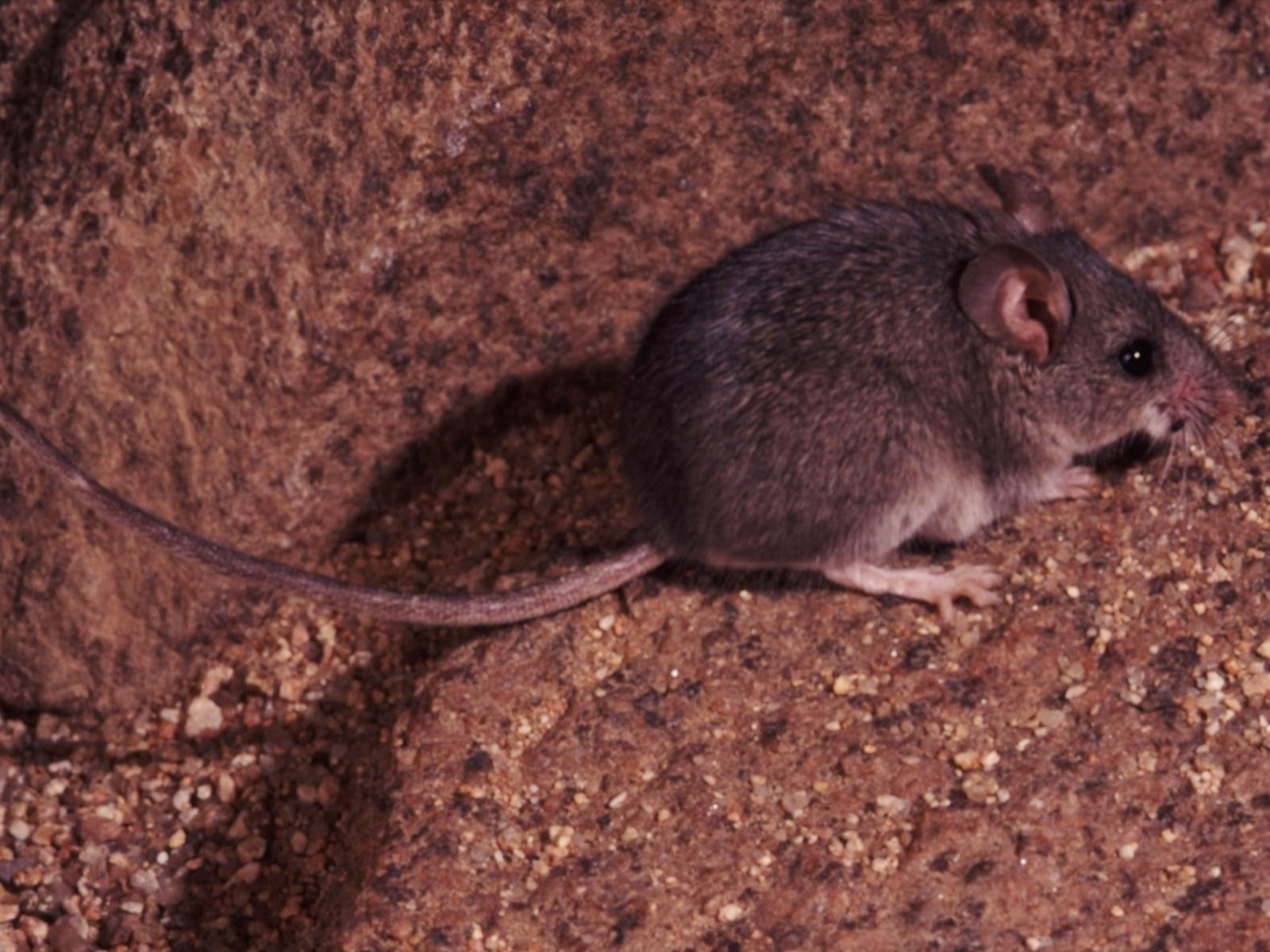
Brukkaros Pygmy Rock Mouse
Petromyscus monticularis

2025 Red list status
Least Concern

Regional Population Trend
Stable

Change compared
to 2016
No Change
Overview
Petromyscus monticularis – (Thomas & Hinton, 1925)
ANIMALIA – CHORDATA – MAMMALIA – RODENTIA – NESOMYIDAE – Petromyscus – monticularis
Common Names: Brukkaros Pygmy Rock Mouse, Brukkaros Rock Mouse, Short-eared Pygmy Rock Mouse (English), Brukkaros-dwergklipmuis, Brukkaros Klipmuis (Afrikaans)
Synonyms: No Synonyms
Taxonomic Note:
The taxonomic status of this genus has been historically controversial, however, Petromyscus was listed under the family Nesomyidae, along with its closest relatives Mystromys and Delanymys (Schenk et al. 2013). The phylogenetic relationships between each species of this genus are unknown, thus urgent molecular analysis and revision of the Petromyscus genus is needed. Within the assessment region P. monticularis occurs sympatrically with P. collinus, from which the Brukkaros Pygmy Rock Mouse can be distinguished by its shorter tail (slightly less than its combined head and body length) and smaller ears (less than 13 mm) (Monadjem et al. 2015). Currently, there are no recognised subspecies of P. monticularis (Skinner & Chimimba 2005)
Red List Status: LC – Least Concern
Assessment Information
Assessors: Smith, C.1 & da Silva, J. M.2
Reviewer: Patel, T.1
Institutions:1Endangered Wildlife Trust,2South African National Biodiversity Institute
Previous Assessors & Reviewers: Wilson, B. & Relton, C.
Previous Contributors: Child, M.F., Avenant, N., Avery, M., Baxter, R., MacFadyen, D., Mondajem, A., Palmer, G. & Taylor, P.
Assessment Rationale
The Brukkaros Pygmy Rock Mouse is listed as Least Concern because of its relatively wide distribution (although only scattered records are available) including a few protected areas, presumed large population, and because its population is not believed to be declining at present. Very little research or studies have been done on this species in recent years. It occurs on flat plains or open rocky areas and is not found in mountainous terrain. There are no major threats as its habitat is unlikely to be rapidly transformed. However, climate change and renewable energy projects in some areas may represent emerging threats. Additionally, habitat disturbance by domestic sheep and goats may be a problem, particularly during drought periods. More research needs to be conducted, and further field surveys are required to estimate extent and occupancy more accurately. This species should be reassessed once its taxonomy has been resolved.
Regional population effects: Occasional dispersal of this species across the Orange River between South Africa and Namibia is likely, thus rescue effect is possible.
Reasons for Change
Reason(s) for Change in Red List Category from the Previous Assessment: No change
Red List Index
Red List Index: No change
Recommended Citation: Smith C & da Silva JM. 2025. A conservation assessment of Petromyscus monticularis. In Patel T, Smith C, Roxburgh L, da Silva JM & Raimondo D, editors. The Red List of Mammals of South Africa, Eswatini and Lesotho. South African National Biodiversity Institute and Endangered Wildlife Trust, South Africa.
Regional Distribution and occurrence
Geographic Range
This species was originally collected from a rocky koppie at the base of the Great Brukkaros Mountain in southern Namibia, from where it gets its name (Skinner & Chimimba 2005). Although the extent of its range is uncertain, this species is probably limited to arid, rocky habitats of southern Namibia, extending into the Northern Cape Province of South Africa (Skinner & Chimimba 2005; Monadjem et al. 2015). Further vetting of museum records is necessary to delimit distribution more accurately. For example, Monadjem et al. (2015) only list one verified record within South Africa. It is predicted to occur from 100 m to 2,000 m asl.
Elevation / Depth / Depth Zones
Elevation Lower Limit (in metres above sea level): 100
Elevation Upper Limit (in metres above sea level): 2000
Depth Lower Limit (in metres below sea level): (Not specified)
Depth Upper Limit (in metres below sea level): (Not specified)
Depth Zone: (Not specified)
Map
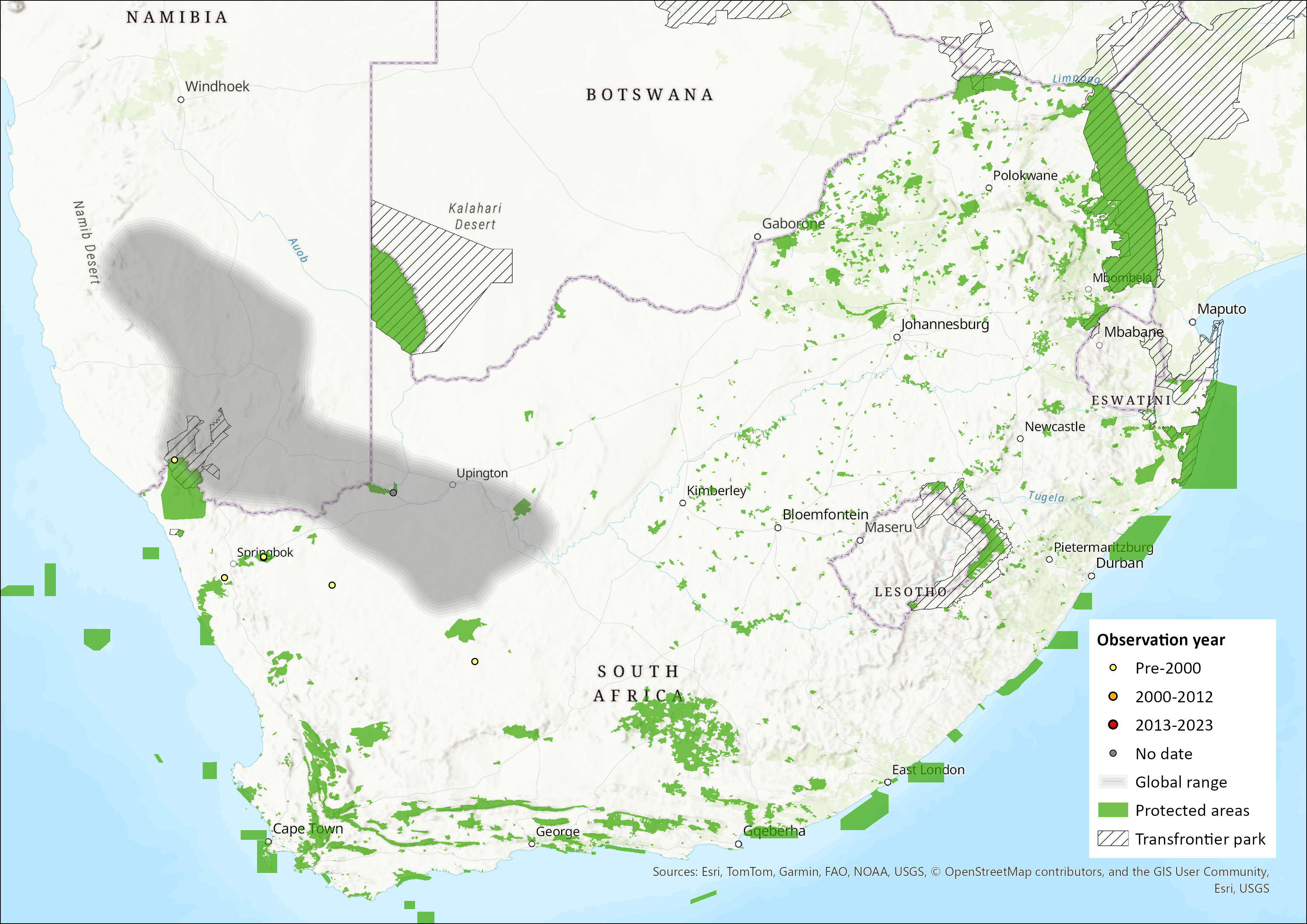
Figure 1. Distribution records for Brukkaros Pygmy Rock Mouse (Petromyscus monticularis) within the assessment region (South Africa, Eswatini and Lesotho). Note that distribution data is obtained from multiple sources and records have not all been individually verified.
Biogeographic Realms
Biogeographic Realm: Afrotropical
Occurrence
Countries of Occurrence
|
Country |
Presence |
Origin |
Formerly Bred |
Seasonality |
|
Namibia |
Extant |
Native |
– |
– |
|
South Africa |
Extant |
Native |
– |
– |
Large Marine Ecosystems (LME) Occurrence
Large Marine Ecosystems: (Not specified)
FAO Area Occurrence
FAO Marine Areas: (Not specified)
Climate change
This species only occurs in the Northern Cape province, South Africa. There is a possibility that it might be affected by the 1.5-4°C increase in temperature predicted under various climate change scenarios (Engelbrecht et al. 2024). Rainfall is predicted to decrease in its range. These changes will result in a more arid and drought-prone habitat which could affect food availability in the species distribution range.
Population Information
Although originally considered to be rare when it was known from only one locality in southern Namibia (Coetzee 2013), this species is now believed to be relatively common in some portions of its range. No population estimates are available for this species.
Population Information
Current population trend: Stable
Continuing decline in mature individuals: Unknown
Number of mature individuals in population: Unknown
Number of mature individuals in largest subpopulation: Unknown
Number of subpopulations: Unknown
Severely fragmented: No
Extreme fluctuations in the number of subpopulations: (Not specified)
Continuing decline in number of subpopulations: (Not specified)
All individuals in one subpopulation: (Not specified)
Quantitative Analysis
Probability of extinction in the wild within 3 generations or 10 years, whichever is longer, maximum 100 years: (Not specified)
Probability of extinction in the wild within 5 generations or 20 years, whichever is longer, maximum 100 years: (Not specified)
Probability of extinction in the wild within 100 years: (Not specified)
Population Genetics
To date, no population genetic studies have been undertaken on this species. While its dispersal capabilities are unknown, it is possible for the species to exist as a single metapopulation, connected with individuals from Namibia. Although no census (Nc) or population densities exist for this species, it is presumed to have a large population size and therefore may very well exceed 10,000 individuals. Even though the 10 000 value is not an actual census count, the quantity can still be used as a proxy for quantifying the Convention on Biological Diversity’s Global Biodiversity Framework’s (GBF’s) headline genetic indicator – proportion of populations with an Ne > 500. Based on the assumption that the species is likely to occur as a single metapopulation, the Ne of the species is ~1000-3000 individuals, based on a Ne/Nc conversion ratio of 0.1-0.3. Having the 1 population above Ne 500, translates to an indicator score of 1.0 (1/1 population with Ne > 500).
Habitats and ecology
Very little information regarding the life history of this species is available, although it is known to favour rocky outcrops within semi-arid shrubland habitats. It is sympatric (and probably syntopic) with the Pygmy Rock Mouse (P. collinus). It is nocturnal and mainly granivorous, but more than half of the stomachs examined also contained insects (Skinner & Chimimba 2005). Grass seeds blowing in from the plains and accumulating amongst stones are an additional source of food, apart from the local plants (Coetzee 2013).
Ecosystem and cultural services: Aside from the prospect of small-scale seed dispersal, it may be a prey item of several other snake, owl or mammal species such as mongooses.
IUCN Habitats Classification Scheme
|
Habitat |
Season |
Suitability |
Major Importance? |
|
3.5. Shrubland -> Shrubland – Subtropical/Tropical Dry |
– |
Suitable |
– |
|
6. Rocky areas (e.g. inland cliffs, mountain peaks) |
– |
Suitable |
– |
Life History
Generation Length: (Not specified)
Age at maturity: female or unspecified: (Not specified)
Age at Maturity: Male: (Not specified)
Size at Maturity (in cms): Female: (Not specified)
Size at Maturity (in cms): Male: (Not specified)
Longevity: (Not specified)
Average Reproductive Age: (Not specified)
Maximum Size (in cms): (Not specified)
Size at Birth (in cms): (Not specified)
Gestation Time: (Not specified)
Reproductive Periodicity: (Not specified)
Average Annual Fecundity or Litter Size: (Not specified)
Natural Mortality: (Not specified)
Does the species lay eggs? (Not specified)
Does the species give birth to live young: (Not specified)
Does the species exhibit parthenogenesis: (Not specified)
Does the species have a free-living larval stage? (Not specified)
Does the species require water for breeding? (Not specified)
Movement Patterns
Movement Patterns: (Not specified)
Congregatory: (Not specified)
Systems
System: Terrestrial
General Use and Trade Information
This species does not appear to be utilised or traded in any form.
Local Livelihood: (Not specified)
National Commercial Value: (Not specified)
International Commercial Value: (Not specified)
End Use: (Not specified)
Is there harvest from captive/cultivated sources of this species? (Not specified)
Harvest Trend Comments: (Not specified)
Threats
No major threats have been identified for this species. However, as mentioned above, the projected vegetation shift in the semi-arid Succulent Karoo may represent a threat to this species due to climate change (Rutherford et al. 1999). Increased temperatures, in conjunction with an enhanced frequency and duration of drought, is predicted to have negative effects on resource availability for small herbivorous mammals in the arid regions of southern Africa (Hoffman et al. 2009). Similarly to P. collinus, prolonged droughts and concomitant shortages of food resources during summer, such as climate change-exacerbated droughts, are likely to have severe energetic consequences for this species (Bragg 2000).
The rapidly expanding construction of renewable (in particular solar) energy projects in the Northern Cape may signify an emerging threat to this species as its range partially overlaps with earmarked areas (van der Westhuizen 2013). Additionally, habitat degradation through overgrazing by domestic sheep and goats may be a threat, particularly during drought periods (Coetzee 2013).
Conservation
No specific conservation initiatives have been identified for the Brukkaros Pygmy Rock Mouse. The range of this species extends into a number of protected areas, including Augrabies Falls National Park, Richtersveld National Park, and possibly into Namaqua National Park. Further research is needed into the potential threat of enhanced aridity associated with climate change, and how this may affect food resources, as well as potential habitat loss from renewable energy projects.
Recommendations for land managers and practitioners:
- Systematic field surveys needed to gather information on population size and trends.
Research priorities:
- Population size, distribution and trends.
- Analysis of potential impacts of renewable energy projects.
- Taxonomic resolution using molecular techniques and vetting of museum records.
- Analysis of potential impacts of increased resource constraints and increased temperature extremes on energetics of the species under climate change scenarios.
- Ecological niche modelling to identify areas to focus sampling.
Encouraged citizen actions:
- Report sightings on virtual museum platforms (for example, iNaturalist and MammalMAP), especially outside protected areas. However, due to their morphological similarities, misidentification of this species with other Petromyscus species is common. See Taxonomic notes for distinguishing characteristics.
- Encourage the inclusion of mitigation measures specific to the species in the Environmental Management Plans for new renewable energy developments overlapping with this species’ distribution.
Bibliography
Bragg CJ. 2000. Thermoregulation and torpor in the pygmy rock mouse, Petromyscus collinus – energy-conservative traits in a desert subject to the unpredictability of El Nino Southern Oscillations. Honours Thesis. University of KwaZulu-Natal.
Coetzee CG. 2013. Petromyscus monticularis Brukkaros Pygmy Rock Mouse. In: Happold DCD (ed.), Mammals of Africa. Volume III: Rodents, Hares and Rabbits, pp. 207–208. Bloomsbury Publishing, London, UK.
Engelbrecht, FA., Steinkopf, J., Padavatan, J. & Midgley, GF. 2024. Projections of future climate change in southern Africa and the potential for regional tipping points. In: von Maltitz, G.P., et al. Sustainability of Southern African Ecosystems under Global Change. Ecological Studies, vol 248. Springer, Cham. https://doi.org/10.1007/978-3-031-10948-5_7
Hoffman M.T., Carrick P.J., Gillson L, West A.G. 2009. Drought, climate change and vegetation response in the succulent karoo, South Africa. South African Journal of Science 105: 54–60.
Monadjem, A., Taylor, P.J., Denys, C. and Cotterill, F.P.D. 2015. Rodents of Sub-Saharan Africa: A Biogeographic and Taxonomic Synthesis. De Gruyter, Berlin, Germany.
Rutherford MC, Powrie LW, Schulze RE. 1999. Climate change in conservation areas of South Africa and its potential impact on floristic composition: a first assessment. Diversity and Distributions 5: 253–262.
Schenk, J., Rowe, K. and Steppan, S. 2013. Ecological Opportunity and Incumbency in the Diversification of Repeated Continental Colonizations by Muroid Rodents. Systematic Biology 62(6): 837-864.