
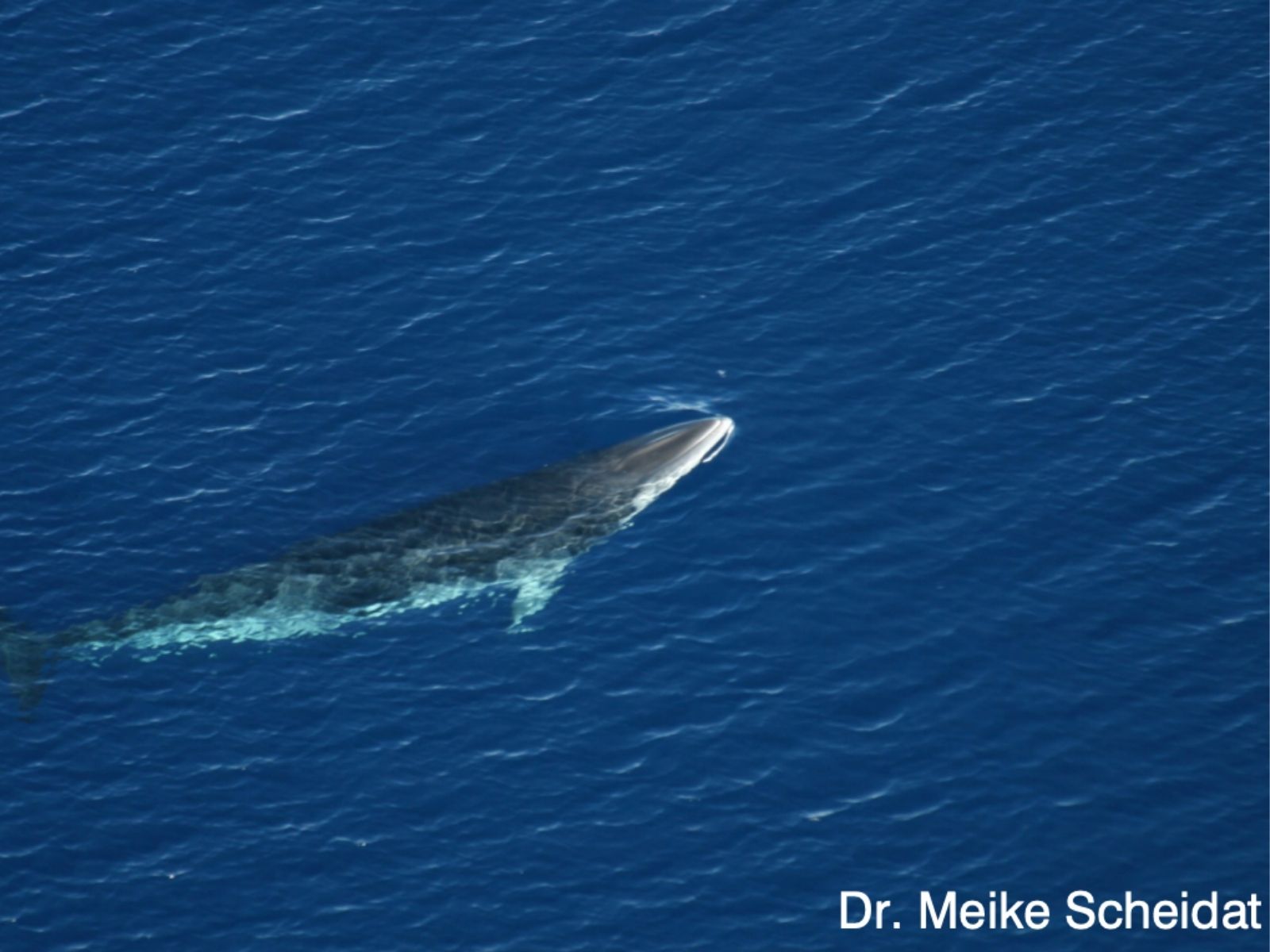
Antarctic Minke Whale
Balaenoptera bonaerensis

2025 Red list status
Least Concern

Regional Population Trend
Declining
Change compared
to 2016
No Change
Overview
Balaenoptera bonaerensis – Burmeister, 1867
ANIMALIA – CHORDATA – MAMMALIA – ARTIODACTYLA – BALAENOPTERIDAE – Balaenoptera – bonaerensis
Common Names: Antarctic Minke Whale (English), Ballena Minke Antártica (Spanish; Castilian)
Synonyms: No Synonyms
Taxonomic Note:
The taxonomic status of Minke Whales is yet to be resolved, and prior to the 1990s only one species was recognised, B. acutorostrata (Lacépède 1804). The most common Minke Whale in the southern hemisphere was found to differ morphologically from those in the North Atlantic and North Pacific, later named the Antarctic Minke Whale, B. bonaerensis (Burmeister 1867). The International Whaling Commission (IWC) Scientific Committee (SC) recently recognised this Antarctic population (B. bonaerensis) as a distinct species from those in the northern hemisphere (IWC 2001). However, further analysis has found that an additional southern hemisphere form exists, which is smaller in size compared to B. bonaerensis. This smaller form, termed the “Dwarf” Minke Whale, may be genetically different from B. bonaerensis, and more closely related to the North Pacific Minke Whales, and thus has been classified B. acutorostrata (Wada et al. 1991; IWC 2001). This taxonomic position, although somewhat controversial, has been accepted by the Convention on International Trade in Endangered Species of Wild Fauna and Flora (CITES), and the Convention on Migratory Species (CMS).
| Red List Status |
| LC – Least Concern, (IUCN version 3.1) |
Assessment Information
Assessors: Shabangu, F.1,2 & da Silva, JM.3
Reviewers: Smith, C.4
Institutions: 1Department of Forestry, Fisheries and the Environment, 2University of Pretoria 3South African National Biodiversity Institute, 4The Endangered Wildlife Trust
Previous Assessor: Relton, C.
Previous Contributors: Butterworth, D.S., Findlay, K., Elwen, S., Meÿer, M., Oosthuizen, H., Plön, S. & Child, M.F.
Assessment Rationale
The current IWC global estimate of abundance of Antarctic Minke Whales is about 500,000 individuals. The abundance estimates declined from about 700,000 for the second circumpolar set of abundance survey cruises (1985/86 to 1990/91) to about 500,000 for the third (1991/92 to 2003/04). Although this decline was not statistically significant, the IWC Scientific Committee does consider these results to reflect a change. However, whether this change is genuine or attributed to greater proportions of pack ice limiting the survey extent, has not yet been determined. More detailed results from an assessment model are available for the mid-Indian to the mid-Pacific region, and suggest that the population increased to a peak in 1970 and then declined, with it being unclear whether this decline has levelled off or is still continuing past 2000. There are no major identified threats within the assessment region. Hence, we retain the listing of Least Concern. If monitoring data and research verify a continuing genuine decline in the Antarctic, this species will need reassessment.
Regional population effects: The Antarctic Minke Whale exhibits seasonal migrations and is wide-ranging across the Southern Hemisphere. There are no barriers to dispersal, thus rescue effects are possible.
Reasons for Change
Reason(s) for Change in Red List Category from the Previous Assessment: No change
Red List Index
Red List Index: No change
Recommended citation: Shabangu F & da Silva JM. 2025. A conservation assessment of Balaenoptera bonaerensis. In Patel T, Smith C, Roxburgh L, da Silva JM & Raimondo D, editors. The Red List of Mammals of South Africa, Eswatini and Lesotho. South African National Biodiversity Institute and Endangered Wildlife Trust, South Africa.
Regional Distribution and occurrence
Geographic Range
The Antarctic Minke Whale is considered a Southern Hemisphere species but is widely distributed from the equator to the ice edge.
During the summer, this species is abundantly distributed throughout the Antarctic waters, usually south of 60°S, and occurs in great concentrations near the ice edge but also to a limited extent within the pack ice and in stretches of open water surrounded by ice. High densities of Antarctic Minke Whales have been sighted in Prydz Bay, and in the Weddell and Ross Seas (Kasamatsu et al. 1997).
Their winter distributions are far more uncertain. There are sighting records of this species off Durban, South Africa, and historically, small numbers of individuals were caught in this region. In South African waters, their seasonal distribution has been described as bimodal, with peaks in April/May and again in September/October, which suggest that these individuals seasonally migrate northwards past the region in spring, and then southwards back to the southern oceans in autumn (Best 1982). Off the west coast of South Africa, Antarctic Minke Whale bioduck calls have been detected from August to February with occurrence peak in September (Shabangu et al. 2020). Around the Prince Edward Islands, Antarctic Minke Whales bioduck calls have been detected between June and November (Shabangu et al. 2024). At least some of the Antarctic Minke Whale population remains in the Antarctic in winter (Ensor 1989; Shabangu et al. 2020), but the proportion has not been quantified.
Elevation / Depth / Depth Zones
Elevation Lower Limit (in metres above sea level): (Not specified)
Elevation Upper Limit (in metres above sea level): (Not specified)
Depth Lower Limit (in metres below sea level): 106
Depth Upper Limit (in metres below sea level): 0
Depth Zone: Epipelagic
Biogeographic Realms
Biogeographic Realm: Afrotropical, Antarctic, Australasian, Neotropical, Oceanian, Palearctic
Map
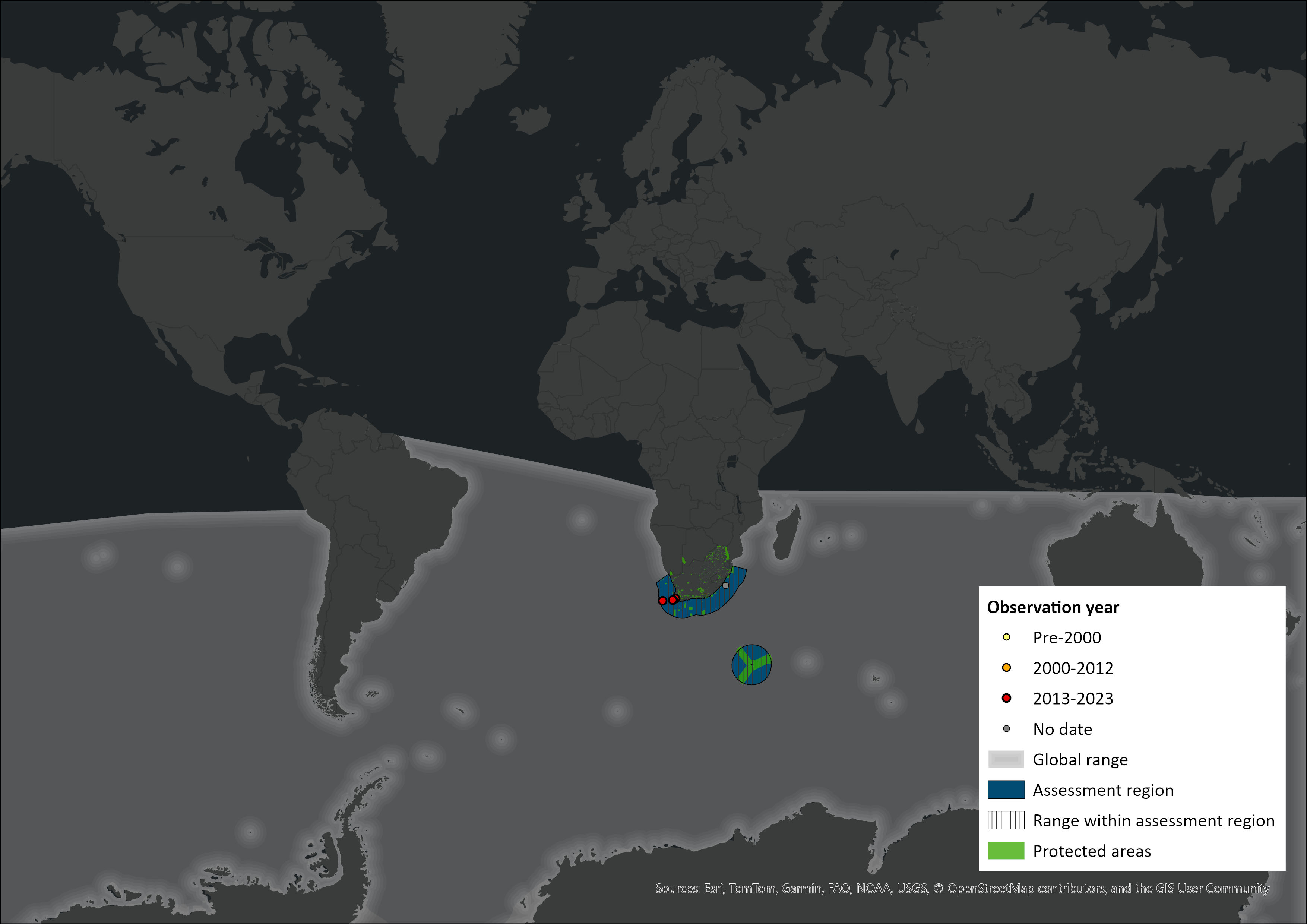
Figure 1. Distribution records for Antarctic Minke Whale (Balaenoptera bonaerensis) within the assessment region (South Africa, Eswatini and Lesotho). Note that distribution data is obtained from multiple sources and records have not all been individually verified.
Countries of Occurrence
| Country | Presence | Origin | Formerly Bred | Seasonality |
| Angola | Presence Uncertain | Native | – | – |
| Antarctica | Extant | Native | – | – |
| Argentina | Extant | Native | – | – |
| Australia | Extant | Native | – | – |
| Brazil | Extant | Native | – | – |
| Chile | Extant | Native | – | – |
| Comoros | Presence Uncertain | Native | – | – |
| Fiji | Presence Uncertain | Native | – | – |
| French Guiana | Presence Uncertain | Native | – | – |
| French Polynesia | Presence Uncertain | Native | – | – |
| French Southern Territories | Extant | Native | – | – |
| Indonesia | Presence Uncertain | Native | – | – |
| Kenya | Presence Uncertain | Native | – | – |
| Madagascar | Presence Uncertain | Native | – | – |
| Mauritius | Presence Uncertain | Native | – | – |
| Mayotte | Presence Uncertain | Native | – | – |
| Mozambique | Presence Uncertain | Native | – | – |
| Namibia | Extant | Native | – | – |
| New Caledonia | Presence Uncertain | Native | – | – |
| New Zealand | Extant | Native | – | – |
| Peru | Extant | Native | – | – |
| Réunion | Presence Uncertain | Native | – | – |
| South Africa | Extant | Native | – | – |
| South Georgia and the South Sandwich Islands | Extant | Native | – | – |
| Suriname | Extant | Vagrant | – | – |
| Tanzania, United Republic of | Presence Uncertain | Native | – | – |
| Uruguay | Extant | Native | – | – |
| Vanuatu | Presence Uncertain | Native | – | – |
Large Marine Ecosystems (LME) Occurrence
| Presence | Origin | Formerly Bred | Seasonality | |
| 1. Polar Biome | Extant | Native | – | – |
| 1.3. Polar Biome -> Antarctic Polar Provinces | Extant | Native | – | – |
| 1.3.1. Polar Biome -> Antarctic Polar Provinces -> Antarctic | Extant | Native | – | – |
FAO Area Occurrence
| Presence | Origin | Formerly Bred | Seasonality | |
| 31. Atlantic – western central | Extant | Native | – | – |
| 41. Atlantic – southwest | Extant | Native | – | – |
| 47. Atlantic – southeast | Extant | Native | – | – |
| 51. Indian Ocean – western | Extant | Native | – | – |
| 57. Indian Ocean – eastern | Extant | Native | – | – |
| 58. Indian Ocean – Antarctic | Extant | Native | – | – |
| 81. Pacific – southwest | Extant | Native | – | – |
| 87. Pacific – southeast | Extant | Native | – | – |
| 88. Pacific – Antarctic | Extant | Native | – | – |
Climate change
No recent studies have been done on the impacts of climate change of this species. Their habitat is possibly declining in quality due to climate change.
Population information
Similar to other baleen whales, the IWC has divided the Southern Hemisphere longitudinally into six key geographical areas (pie slices, which range between 50° and 70° wide). Although biological evidence for these boundaries is generally weak, their delineation is useful in the description of baleen whale distribution and abundance. Recently observed geographic variation in call characteristics of Antarctic Minke Whales suggests that different acoustic populations exist in the Southern Hemisphere (Filun and van Opzeeland, 2023). Antarctic Minke Whales are the most abundant of all Balaenopterid species in the Southern Hemisphere (Skinner and Chimimba 2005). Although the Dwarf Minke Whale is also present within Antarctic waters (as far south as approximately 65°S), they are far less common than the Antarctic Minke Whale, thus Minke Whale estimates of abundance taken south of 60°S, for simplicity’s sake, can be considered B. bonaerensis.
Ship-based summer abundance surveys have been conducted in the Antarctic, south of 60°S, since 1978/1979, covering different geographical areas each year (Matsuoka et al. 2001). It is assumed that the majority of the population occurs between 60°S and the pack ice zone during the survey season (Branch and Butterworth 2001, Shimada and Kato 2006). In 1990/1 a population estimate of 760,000 individuals was suggested (IWC 1991). Subsequent surveys revealed lower population estimates, with numbers estimated between 460,000 and 690,000 individuals in 2003/4 (International Whaling Commission, 2013).
The most likely explanations include a decline in sighting efficiency, variations in the extent of pack ice or a combination of both. Another hypothesis, using multi-species modelling, is that they increased in abundance until the mid-20th century in response to increased krill abundance following the decline in other large baleen species (Mori and Butterworth 2006); and subsequently declined as other baleen species became protected and increased in number (thus competing for krill). Recently, catch data from 1990/1 to 2009/10 from the Japanese Whale Research Programme in the Antarctic revealed a 31% decrease in the weight of Antarctic Minke Whale stomach contents (Konishi et al. 2013), which support the hypothesis that the availability of krill has declined over the past 20 years. This possible decline is specific to Minke Whales, and is not reflected in abundance records for other Antarctic baleen species. Highest densities have been observed near the pack ice (Shimada and Kato 2006). Currently, no abundance estimates are available for Antarctic Minke Whales migrating through the assessment region.
The generation time estimated for Antarctic Minke Whales is 22 years (Taylor et al. 2007).
Population Information
Extreme fluctuations in the number of subpopulations: (Not specified)
Continuing decline in number of subpopulations: (Not specified)
All individuals in one subpopulation: (Not specified)
Number of Subpopulations: (Not specified)
Current population trend: Declining
Continuing decline in mature individuals: No
Number of mature individuals in population: < 500,000
Number of mature individuals in largest subpopulation: Unknown
Number of subpopulations: Unknown
Severely fragmented: No
Quantitative Analysis
Probability of extinction in the wild within 3 generations or 10 years, whichever is longer, maximum 100 years: (Not specified)
Probability of extinction in the wild within 5 generations or 20 years, whichever is longer, maximum 100 years: (Not specified)
Probability of extinction in the wild within 100 years: (Not specified)
Population genetics
A population genetic study using both mitochondrial and nuclear microsatellite DNA on the Antarctic minke whale found significant levels of geographical genetic heterogeneity, structured longitudinally, among whales in the Indo-Pacific region and thus recognised two populations – whales from the Indian Ocean and whales from the Pacific Ocean (Pastene & Goto 2016). According to this study, one population is recognised within the assessment region. The genetic divergence between the two populations is small, however, which likely suggests a short time since population divergence.
Assuming population estimates from IWC (2013; i.e., approximately 500,000 individuals) are reflective today and that each population contains an equal number of mature individuals, it is estimated that approximately 250,000 whales are part of the population within the assessment region, translating to an effective population size between 25,000 and 75,000 individuals (assuming a Ne/Nc conversion ratio of 0.1-0.3).
Habitats and ecology
During the winter months, Antarctic Minke Whales in the Southern Ocean feed predominantly on krill, mostly Euphausia superba (Antarctic Krill), and to a lesser extent E. crystallorophias (Ice Krill, which dominates in the Ross Sea), E. frigida and Thysanoessa macrura (Tamura and Konishsi 2006). Occasionally, copepods are also consumed (Skinner and Chimimba 2005). Whether Antarctic Minke Whales continue to feed during their migrations out of their Antarctic feeding grounds, is largely unknown. Individuals taken off the Durban coast have been reported to have fed on Euphausiids, however the stomach contents were greatly reduced compared to those recorded from Antarctica (Best 1982).
Aside from the Blue Whale (Balaenoptera musculus), no other southern rorqual species is expected to penetrate as deeply into the pack ice, and this species has been observed extending its head vertically to breathe through cracks in the ice (Skinner and Chimimba 2005). They are fast swimmers, documented swimming alongside ships traveling 13–16 knots (24–30 km / hour) (Watson 1981).
Seasonal migrations take place from tropical and subtropical waters in winter to feeding areas in the high latitudes of the Southern Ocean in summer. Breeding is known to occur in warmer waters, and although information regarding the extent of their breeding sites is lacking, Kasamatsu et al. (1995) documented two core breeding areas in the eastern and western South Pacific, and two additional breeding sites in the eastern and western Indian Ocean. In contrast to coastal species, such as Right Whales (Eubalaena glacialis), Humpback Whales (Megaptera novaeangliae) and Gray Whales (Eschrichtius robustus), the breeding populations of Antarctic Minke Whales appear to be relatively widely dispersed in deep waters (Kasamatsu et al. 1995). They appear to move directly southwards from their breeding areas to feeding sites in the Southern Ocean (Kasamatsu et al. 1995).
Generally, males reach sexual maturity at about 7.5 m, while females only at 8.1 m (Skinner and Chimimba 2005). As the only baleen whale known to experience post-partum oestrus, Antarctic Minke Whales have a much shorter calving interval, averaged at 14 months (Best 1982). Average calf length at birth is between 2.7 and 2.9 m (Best 1985).
Ecosystem and cultural services: Marine mammals integrate and reflect ecological variation across large spatial and long temporal scales, and therefore they are prime sentinels of marine ecosystem change; migratory mysticete whales may be used to investigate broadscale shifts in ecosystems (Moore 2008). Some authors suggest that Antarctic Minke Whales are an important prey source for Killer Whales (Orcinus orca) (for example, Pitman & Ensor 2003).
IUCN Habitats Classification Scheme
| Habitat | Season | Suitability | Major Importance? |
| 9.1. Marine Neritic -> Marine Neritic – Pelagic | – | Suitable | Yes |
| 10.1. Marine Oceanic -> Marine Oceanic – Epipelagic (0-200m) | – | Suitable | Yes |
Life History
Generation Length: 8.5 – 9.0 m
Age at maturity: Female or unspecified: 5-7 years
Age at Maturity: Male: 5-7 years
Size at Maturity (in cms): Female: 800-810
Size at Maturity (in cms): Male: 720-760
Longevity: 30 – 50 years
Average Reproductive Age: 5 – 9 years
Maximum Size (in cms): 10.7 m
Size at Birth (in cms): 270-290
Gestation Time: ~10 months
Reproductive Periodicity: Minimum 14 months
Average Annual Fecundity or Litter Size: One
Natural Mortality: 9-10% rate
Breeding Strategy
Does the species lay eggs? No
Does the species give birth to live young: Yes
Does the species exhibit parthenogenesis: No
Does the species have a free-living larval stage? No
Does the species require water for breeding? No
Movement Patterns
Movement Patterns: Daily, Monthly and Seasonal
Congregatory: (Not specified)
Systems
System: Marine
General Use and Trade Information
Major commercial whaling of Antarctic Minke Whales ceased in 1986, but currently under a scientific research permit issued by the Government of Japan, this species is hunted at a reduced level in the Antarctic. During the whaling era, Antarctic Whale blubber and baleen were used for products such as lamp oil, margarine, cooking oil, candles, soaps, cosmetics, corsets, umbrellas and tennis racquets, while whale meat was sold for human consumption, animal feed and fertiliser. Japan still harvests Antarctic Minke Whales for human consumption.
| Subsistence: | Rationale: | Local Commercial: | Further detail including information on economic value if available: |
| No | – | – | – |
National Commercial Value: Yes
International Commercial Value: No
| End Use | Subsistence | National | International | Other (please specify) |
| 1. Food – human | – | true | – | – |
| 14. Research | – | true | – | – |
Is there harvest from captive/cultivated sources of this species? No
Harvest Trend Comments: (Not specified)
Threats
Commercial whaling of this species commenced in the 1970s, and ceased in 1986, when a whaling moratorium was enforced. However compared to other baleen whale species, Minke Whales were far less heavily exploited (Mori and Butterworth 2006) and commercial whaling began much later than it did for other species. Large-scale catches of this species only commenced in 1971, following the depletion of other larger baleen species (IWC 2006); before this, only small-scale experimental catches were conducted.
Approximately 100,000 Minke Whales are reported to have been caught during pelagic whaling expeditions in the Antarctic, and more than 14,000 from Costinha, the Brazilian land station, between 1964 and 1985. After 1987, whaling of this species continued to a lesser extent under a scientific permit, with records of 853 whales caught during the 2005/2006 season (Miyashita and Kato 2006). The current Japanese Scientific permit catch limit is set at 330 individuals.
Additionally, minor threats to Antarctic Minke Whales include bycatch in fishing gear (see van Waerebeek and Reyes 1994), and the effects of anthropogenic climate change. Increased sea temperatures in the Antarctic (Turner et al. 2006), resulting in a substantial loss of sea ice, may result in a substantial decline in food resources available to Southern Ocean baleen whales.
This species is relatively rare within South African waters as they are mostly found offshore and no major threats have been identified within South Africa’s EEZ (Exclusive Economic Zone) although underwater noise from vessel traffic have been shown to negatively affect the acoustic communication off the west coast of South Africa (Shabangu et al. 2022) and Prince Edward Islands (Shabangu et al. unpublished data).
Current habitat trend: Possibly declining in quality due to climate change.
Conservation
Large-scale commercial whaling of Antarctic Minke Whales effectively ceased in 1986 with the implementation of the IWC moratorium on commercial whaling. The summer range of this species also receives protection from the 1994 IWC Southern Ocean Sanctuary, which forbids whaling activity south of about 40°S. However, this does not prevent whales from being caught under a scientific permit.
The Convention on International Trade in Endangered Species of Wild Fauna and Flora (CITES) listed Antarctic Minke Whales on Appendix I, but this does not relate to Japan, who have registered an objection to this listing since July 2000. Additionally, Japan holds a reservation on the Southern Ocean Sanctuary. This species is also listed on Appendix II of the Convention on Migratory Species (CMS).
Although a local systematic monitoring programme would be beneficial for this species, this is not considered a priority, as Antarctic Minke Whales are under no major threat within South African waters. Additionally, no specific conservation interventions have been identified for this species in the assessment region.
Recommendations for managers and practitioners:
- Systematic monitoring: design and implement a monitoring programme (acoustic and sightings) that can distinguish between Minke whale species in the southern hemisphere, in order to estimate population size and trends.
- Ensure that accidental catches (in fishing or shark nets), strandings or collisions of Antarctic Minke Whales are reported, and managed by the relevant authorities, and in the case of mortality, make certain that the remains are made available for ongoing scientific investigation of the life history and genetics of this species.
- Help stop ongoing whaling in Antarctica.
Research priorities:
- Research into the possible reasons behind the detected declining population trend.
- Current population size, distribution and trend estimates.
- Current and future threats which may impact this species, its habitat, or its primary food source.
- Research into the use, trade, livelihoods and harvest trends associated with this species.
Encouraged citizen actions:
- Save electricity and fuel to mitigate CO2 emissions and hence the rate of climate change.
- Report any stranding reports to the relevant local authorities.
- Reduce, re-use and recycle plastics to low amounts of plastics that end up in the ocean.
- Avoid loud watercrafts.
Bibliography
Best P.B. 1985. External characteristics of southern minke whales and the existence of a diminutive form. Sci. Rep. Whales Res. Inst. 36:1-33.
Best, P. B. 1982. Seasonal abundance, feeding, reproduction, age and growth in minke whales off Durban (with incidental observations from the Antarctic). Reports of the International Whaling Commission 32: 759-786.
Branch, T. A. and Butterworth, D. S. 2001. Southern Hemisphere minke whales: Standardized abundance estimates from the 1978/79 to 1997/98 IDCR-SOWER surveys. Journal of Cetacean Research and Management 3(2): 143-174.
Burns WC. 2001. From the harpoon to the heat: climate change and the International Whaling Commission in the 21st century. Georgetown International Environmental Law Review 13: 335–339.
Ensor, P. H. 1989. Minke whales in the pack ice zone, East Antarctica, during the period of maximum annual ice extent. Reports of the International Whaling Commission 39: 219-25.
Filún, D., van Opzeeland, I. Spatial and temporal variability of the acoustic repertoire of Antarctic minke whales (Balaenoptera bonaerensis) in the Weddell Sea. Sci Rep 13, 11861 (2023). https://doi.org/10.1038/s41598-023-38793-4
IUCN (International Union for Conservation of Nature). 2008. Balaenoptera bonaerensis. Available at: http://www.iucnredlist.org. (Accessed: 21 February 2016).
International Whaling Commission. 1991. Report of the SubCommittee on Southern Hemsisphere minke whales. Report of the International Whaling Commission 41: 113-124.
International Whaling Commission. 2001. Report of the Scientific Committee. 11.4. Nomenclature. Journal of Cetcaean Research and Management 3(Suppl.): 37.
International Whaling Commission. 2006. The IWC Summary Catch Database.
Kasamatsu, F., Ensor, P. and Joyce, G. G. 1997. Preliminary investigation on aggregations of minke whales in Ross Sea, Weddel Sea and Prydz Bay. International Whaling Comimission Scientific Committee.
Kasamatsu, F., Nishiwaki, S. and Ishikawa, H. 1995. Breeding areas and southbound migrations of southern minke whales Balaenoptera acutorostrata. Marine Ecology Progress Series 119: 1-10.
Konishi K, Hakamada T, Kiwada H, Kitakado T, Walløe L. 2013. Decrease in stomach contents in the Antarctic minke whale (Balaenoptera bonaerensis) in the Southern Ocean. Polar Biology 37: 205–215.
Matsuoka, K., Ensor, P., Hakamada, T., Shimada, H., Nishiwaki, S., Kasamatsu, F. and Kato, H. 2001. Overview of the minke whale sighting survey in IWC/IDCR and SOWER Antarctic cruises from 1978/79 to 2000/01. International Whaling Commission Scientific Committee.
Miyashita T. and Kato H. 2006. Japan Progress report on Cetacean Research, May 2005 To April 2006, with statistical data for the calendar year 2005. International Whaling Commission Scientific Committee.
Moore SE. 2008. Marine mammals as ecosystem sentinels. Journal of Mammalogy 89: 534-540.
Mori, M. and Butterworth D. S. 2006. A first step towards modelling the krill-predator dynamics of the Antarctic ecosystem. CCAMLR Science 13: 217-277.
Pastene, L.A. and Goto, M., 2016. Genetic characterization and population genetic structure of the Antarctic minke whale Balaenoptera bonaerensis in the Indo-Pacific region of the Southern Ocean. Fisheries science, 82(6), pp.873-886.
Pitman, R.L. and Ensor, P. 2003. Three forms of killer whales (Orcinus orca) in Antarctic waters. Journal of Cetacean Research and Management 5: 131-139.
Shabangu, F.W., Findlay, K. & Stafford, K.M. 2020. Seasonal acoustic occurrence, diel-vocalizing patterns and bioduck call-type composition of Antarctic minke whales off the west coast of South Africa and the Maud Rise, Antarctica. Mar. Mamm. Sci. https:// doi.org/ 10. 1111/ mms. 12669.
Shabangu, F.W., Yemane, D., Best, G., and Estabrook, B.J. 2022 Acoustic detectability of whales amidst underwater noise off the west coast of South Africa. Mar. Pollut. Bull. 184, 114122. (doi:10.1016/j.marpolbul.2022.114122)
Shabangu, F.W., Munoz, T., Van Uffelen, L., Estabrook, B.E., Yemane, D., Stafford, K.M., Branch, T.A., Vermeulen, E., van den Berg, M.A., and Lamont, T. 2024. Diverse baleen whale acoustic occurrence around two sub-Antarctic Islands: A tale of residents and visitors. Scientific Reports 14: 21663. https://doi.org/10.1038/s41598-024-72696-2.
Shimada, H. and Kato, A. 2006. Tentative population assessment of the Antarctic minke whale within ice field using a sighting data on the Ice Breaker, Shirase in 2004/2005. International Whaling Commission Scientific Committee.
Skinner, J.D. and Chimimba, C.T. (eds). 2005. The Mammals of the Southern African Subregion. Cambridge University Press, United Kingdom, Cambridge.
Tamura, T. and Konishsi, K. 2009. Food habit and prey consumption of Antarctic minke whale Balaenoptera bonaerensis in the JARPA research area. Journal of Northwest Atlantic Fisheries Science 42: 13–25.
Taylor, B.L., Chivers, S.J., Larese, J. and Perrin, W.F. 2007. Generation length and percent mature estimates for IUCN assessments of cetaceans. NOAA, Southwest Fisheries Science Center Administrative Report LJ-07-01. La Jolla, California.
Turner, J., Lachlan-Cope, T. A., Colwell, S., Marshall, G. J. and Connolley, M. 2006. Significant warming of the Antarctic winter troposphere. Science 311(5769): 1914-1917.
Van Waerebeek, K. and Reyes, J. C. 1994. A note on the incidental mortality of southern minke whales off western South America. Reports of the International Whaling Commission 15: 521-524.
Wada, S., Kobayashi, T. and Numachi, K. 1991. Genetic variability and differentiation of mitochondrial DNA in minke whales. Reports of the International Whaling Commission 13: 203-215.
Watson L. 1981. Sea Guide to Whales of the World: A Complete Guide to the World’s Living Whales, Dolphins and Porpoises. Penguin Publishing Group, London, UK.