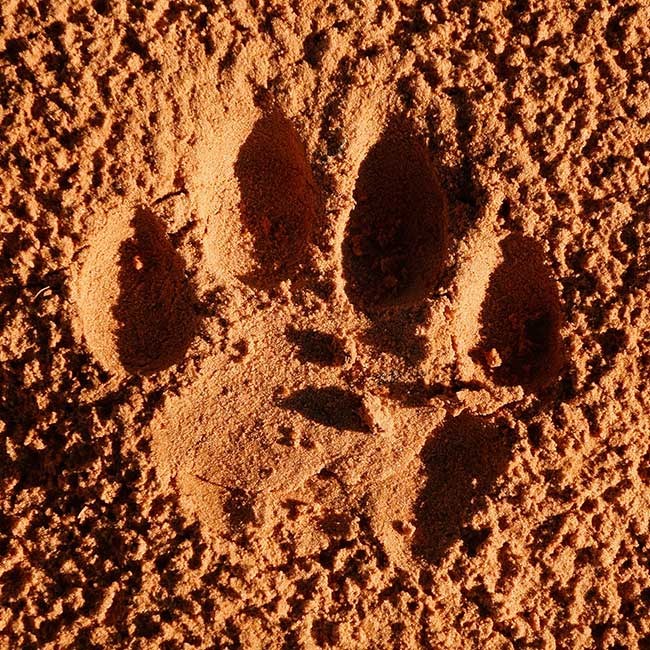
STRIDES IN PROTECTING RIVERINE RABBIT HABITAT
Cobus Theron, Manager, EWT Drylands Conservation Programme
CobusT@ewt.org.za
The EWT is making headway in formally protecting Riverine Rabbits through working with private landowners in the southern population of this Critically Endangered species. Though collaboration with CapeNature and private landowners, we are facilitating the process of declaring three privately owned farms totaling 11,500 hectares as Nature Reserves under the Provincial Biodiversity Stewardship Programme.
The latter is a formal process that is enabled by biodiversity legislation that allows provincial authorities and private landowners to enter into voluntary agreements to create formal protection for their farms. This means that these farms will be declared as formal nature reserves and have the same status as provincial or even national nature reserves.
All three farms are situated in the vicinity of the Anysberg Nature Reserve in the Western Cape and all three farms have Riverine Rabbit presence confirmed. We hope that the addition of these properties to the conservation network will enhance habitat and range protection for the Riverine Rabbits in the southern population. The southern population was only discovered in 2003. Compared to the northern population, individuals in the south are less restricted to the riparian areas and use the habitat more widely. While the EWT conducted some research on the southern population after its discovery, it only started to take concrete conservation action for this population in 2017, when it started to develop capacity to operate in this geographic space. We have developed a novel strategy for the conservation of the species in the northern population which will be implemented in 2020, and we will also start detailed investigations into the Baviaanskloof population this year to inform our conservation approach there.
We are very pleased that CapeNature has confirmed that all three properties qualify as Nature Reserves and we will now start to develop management plans for each farm in consultation with the landowners as is required by law and further pursue the declaration process.
Our aim is to create formal protection or enhanced land management (for the benefit of the species) in both the northern, southern and recently confirmed Baviaanskloof population by 2023. Since the vast majority of the species range is on privately owned land, we cannot achieve this goal without the help of landowners and farmers.
This ambitious goal is supported by the Rand Merchant Bank, The Global Environmental Fund (implemented by the United Nations Development Programme and the Department of Environmental Affairs), the Zoological Society for the Conservation of Species and Populations and a private donor.
REMEMBERING RODNEY SIMMONS
Rodney Simmons, fondly known as Rod, was a UK citizen by birth but a true South African in all other ways.
Rod was born in the UK on the 17 June 1944. He completed his schooling and finished his O & A levels at Dulwich College in South London. In his early twenties, Rod followed a school friend to South Africa, with a mere £200 in his pocket. He married his long-term girlfriend Jean, who came over to Africa with him. They later divorced and Jean has since passed on. Rod never married again. He only ever returned to England twice to visit his parents and friends as he had made his home in South Africa and loved this country passionately. He lived in various places in South Africa during his lifetime, but eventually moved to the KZN South Coast where he lived until his death on the 11 December 2019.
Rod also had an immense love for animals, domestic and wild, and it was for this reason that he wanted to leave a substantial amount to the EWT, saying he wanted to help them to continue the wonderful work that they do.
Thank you Rod, for helping us to continue to protect forever, together.
You can leave a legacy too
The EWT relies on bequests both large and small to ensure that we continue fulfilling our vision of a healthy planet and an equitable world that values and sustains the diversity of all life. None of us can avoid the need to have an up-to-date will, ensuring that our last wishes are carried out and our legacy is continued in the way that we would choose. Including a bequest to an organisation like the EWT that you have supported in your lifetime, or that you would have liked to support, is a way to bring meaning and purpose to a life well-lived, and know that you have left the legacy of a better planet for future generations. We assure you that your legacy will make a lasting impact to the benefit of all who inhabit our beautiful country.
Your bequest will help us to…
- Empower communities to live and work in harmony with nature
- Increase safe space for Cheetahs and Wild Dogs in South Africa and beyond
- Conserve grasslands and wetlands to secure our critical water sources
- Ensure our iconic raptors remain in the skies
- Raise awareness and create connections between young people and their natural environment through our schools programmes, developing the guardians of the future
… and so much more!
We are proud to be working with Capital Legacy to make leaving a legacy even easier. With a wealth of knowledge and expertise, Capital Legacy provides you with client-centric and excellence-driven service when it comes to drafting your Will, taking care of the administration of Trusts and administering your Estate in the event of your death. Capital Legacy are also the innovators of the Legacy Protection Plan™, an insurance product that completely protects your beneficiaries from the legal fees and expenses that arise when you pass away. Capital Legacy is also committed to protecting forever, together, and for every Legacy Protection Plan™ referral they receive from the EWT, they’ll be making a donation to the organisation. Find out more at https://ewt.org/get-involved/get-involved-leave-a-legacy/ or contact TammyB@ewt.org.za
Create a lasting memory
We also invite people to remember their loved ones by planting an indigenous tree of their choice, from a list provided, in the Forever Forest at the EWT Conservation Campus in Midrand. The tree will include a plaque, commemorating the person to be remembered. By planting a tree in the Forever Forest, you’re not just creating an enduring, living memorial for your loved one, but are also giving back to the environment and future generations. The EWT has created a beautiful, serene space where people can gather with family and friends, to pay tribute to and remember their loved ones now passed, and find the tranquillity needed to heal. In time, the space will include walking paths and appropriate nesting logs and boxes to attract indigenous wildlife, and there will be the option of adding a bench, memory rock, or animal sculpture to your memorial. Those who opt to remember their loved ones by planting a tree in the Forever Forest will be invited to a planting ceremony, but if unable to attend, EWT staff will undertake this solemn responsibility on your behalf.
A GIANT LEAP FOR AMPHIBIAN CONSERVATION: SOUTH AFRICA’S “FROG LADY” WINS 2020 WHITLEY AWARD
Dr Jeanne Tarrant, Manager of the EWT’s Threatened Amphibian Programme, and known locally as the “Frog Lady”, has won a prestigious Whitley Award worth £40,000 to support her quest to save threatened amphibians. The EWT is the only NGO in South Africa to include frogs as a conservation focus.
The Whitley Awards, often referred to as ‘Green Oscars’, are awarded annually to individuals from the Global South by UK-based conservation charity the Whitley Fund for Nature. Jeanne is one of six conservationists to be recognised this year for their achievements in nature conservation.
Amphibians are the most threatened group of animals on the planet with 41% of all species at risk of extinction. Almost two-thirds of the country’s 135 frog species are found nowhere else, making South Africa a priority for amphibian conservation.
Despite this, a combination of threats from habitat loss due to mining, agriculture and pollution are putting the country’s frogs at risk.
In some South African cultures, frogs can be associated with witchcraft, making them often feared by locals. Jeanne’s educational work aims to dispel such myths and raise awareness and appreciation of the important role frogs play in the health of the environment and ecosystem. The EWT’s national awareness Leap Day for Frogs has attracted some 15,000 participants over the past five years. Jeanne has inspired school children with her “ Frogs in the Classroom” learning programme, gaining young fans and earning her the title of the “Frog Lady”.
Growing up in the southern Drakensberg mountains of KwaZulu-Natal, Jeanne was surrounded by nature. Following her undergraduate studies, she worked in the UK for five years before returning to her homeland of South Africa to specialise in the research of threatened South African frogs.
Some of the species that Jeanne and her team conserve include the Critically Endangered Amathole Toad, which had not been seen for over 13 years until Jeanne and her colleagues re-discovered it in 2011. Jeanne also works with the Endangered Pickersgill’s Reed Frog, with the number of known localities of this tiny 2cm amphibian on the rise thanks to her efforts.
In addition to education and field work, Jeanne works with government to ensure enhanced protection for frogs on a policy level. Supported by WFN, her team will produce a 10-year conservation and research strategy for South African frogs and protect 20,000ha of amphibian habitat conserving 8 species.
Jeanne said: “While South Africa has excellent environmental legislation, illegal developments continue to destroy frog habitats. Our aim is to not only improve appreciation of frogs through research and education but use our slippery friends as flagships for the wider conservation of vital freshwater and terrestrial areas that are under the increasing threat of humans.
“The fact that almost half of amphibians are experiencing declines should be a massive wake-up call to humanity that all is not right with our planet – most people however are unaware that amphibians are even in trouble.”
Edward Whitley, Founder of the Whitley Fund for Nature, said: “Jeanne is an inspiring leader who tirelessly advocates for amphibians – an often overlooked group. We hope that this Whitley Award will allow her to spread her important message far and wide, and bring about real change for amphibians and their habitat through science, policy, and community education.”
Six conservationists have won Whitley Awards and will each receive £40,000 in funding to support their work with a range of threatened species. While normally presented to winners by charity Patron HRH The Princess Royal at an annual Ceremony in London, the 2020 Whitley Awards Ceremony was postponed due to the COVID-19 pandemic. Whilst the winners will receive their funding now, they will be invited to attend a ceremony and related events in London later this year to celebrate their achievements, should circumstances allow.
This year’s Whitley Gold Award honours Brazilian conservationist Patrícia Medici for her outstanding dedication to protecting South America’s largest land mammal, the lowland tapir, using it as a flagship for largescale habitat preservation. Patrícia is a world expert in the science of tapir conservation and has dedicated her life to shedding light on this unusual looking, yet little-known species. Against a backdrop of political and environmental instability in Brazil, her work is more important than ever. The Whitley Gold Award enables the expansion of her work to the embattled Amazon.
Visit www.whitleyaward.org to find out more.
SEARCHING FOR SANDFISH IN THE TANKWA KAROO
Dr Oliver Cowan, Conservation Scientist, EWT Conservation Science Unit
OliverC@ewt.org.za
An important part of the EWT Conservation Science Unit’s (CSU) project to map and model the distribution of animal species of conservation concern in South Africa is to fill key knowledge gaps. These gaps are identified after consultations with taxon-specific experts – an example of this is a workshop we held with freshwater fish experts from CapeNature and the Freshwater Research Centre (FRC) last year. A key outcome of this workshop was the potential for new populations of the Clanwilliam Sandfish to be found in the relatively unexplored Tankwa River.
Historically, the Sandfish was widespread throughout the Olifants-Doring River System but sadly, like many of our endemic freshwater fishes, it is now Endangered. Sandfish populations have been decimated by the introduction of predatory alien fish, such as bass, and changes to river flow. These reduced numbers are currently fragmented within the Doring River and its tributaries with potentially only a single viable, growing population remaining.
The neighbouring Tankwa River was previously not considered viable habitat as it is non-perennial, drying up during the hot summer months. However, scientists at the FRC had noted on satellite imagery what appeared to be permanent pools dotted along the otherwise dry riverbed. They thought the pools may provide refugia for Sandfish, a haven from the dangers rampant throughout the catchment. Armed with this information, researchers from the CSU and the FRC set out to hunt for Sandfish in the Tankwa in December 2019.
As one drives out of Ceres, one quickly says goodbye to cell signal and tarred roads. The Tankwa at this time of year is a harsh environment and it did not help that it was in the midst of a record-breaking drought. We had been warned, when applying for research permits, of the situation but were unprepared for the sight that met us at Oudebaaskraal Dam in the Tankwa Karoo National Park. What had once been the largest dam in the region was now bone-dry, flamingos replaced by the occasional dust-devil. Somewhat chastened, we spent the next few days trekking around the semi-desert, attempting to locate the pools we had previously identified in air-conditioned offices back in Cape Town. With just GPS coordinates, bakkies and our feet this was no easy task, made more challenging by 40°C temperatures and an inhospitable landscape. After many false dawns we finally got lucky. Water! And water deep enough to be suitable for fish. It appeared the satellite imagery had not deceived us – in certain places, where the bedrock was exposed – groundwater pooled at the surface.
We started off with active searching: trawling our Seine nets through the pools, hoping to snare the elusive Sandfish but with no success. We found plenty of life in the form of hordes of Common Plattanas, their tadpoles, and a few freshwater crabs, but no fish. However, we weren’t too perturbed as this sampling method is imperfect – our hopes were pinned on our Fyke nets. These nets are more reliable as their set-up allows for passive capture throughout the night, extensive wings channelling fish towards concentric ring-nets from which there is no escape. The nets are quite technical to set up and require the use of the dinghy so our decision to manually inflate our aquatic steed on the first day was not in vain. We departed, optimistic about what the next day had in store.The next morning, we were in for a rude awakening. Firstly, our precious dinghy which we had carefully placed on the bank, comforted by the knowledge that it was safe from potential thieves, was now a deflated yellow blob. Upon closer inspection, the valves revealed tell-tale teeth marks. For some reason, the plastic must have been irresistible to members of the local baboon troop, and for a moment we felt less bad about the baboon graveyard we had chanced upon earlier that week. But things were to get even worse. As we waded out to check our nets, we noticed that the final concentric ring in which we were hoping to find Sandfish was ripped and what remained was frog limbs and half-eaten tadpoles. Spoor on the riverbank confirmed our suspicions: a Cape Clawless Otter couldn’t resist the buffet he found the previous night and had swum in to gorge himself. Once satisfied, he made his escape at the expense of our net.
With tails between legs we collected what remained of our equipment and headed back to base to regroup. En route, we bumped into a farmer who bemoaned the drought, claiming that a Tankwa River tributary which once ran through his property had shrunk to a puddle. Not expecting much we went to investigate this puddle and just about convinced ourselves to drag a net through, despite its fetid appearance. Lo and behold, fish! Sure, it was not the Sandfish but rather a population of the indigenous Chubbyhead Barb, which had miraculously survived in this unlikely oasis. This species’ taxonomy is currently being revised and it is not unlikely that the DNA we extracted from this isolated sub-population proves them to be a sub-species and of substantial conservation value. As we headed back to Cape Town later that week, we didn’t consider the trip a failure. Sure, we did not find the Sandfish despite our extensive survey, but this can allow conservation efforts to focus on the regions where it is known to occur. In addition, the miraculous discovery of the Barb population showed that wildlife continues to strive for survival despite the harsh hand that the climate (and, let’s face it, humans) have dealt it.
We would like to sincerely thank the Rand Merchant Bank Foundation for generously funding this project and our collaborators at the FRC for their assistance on this fieldtrip. To stay up-to-date with their continued work regarding the conservation of the Clanwilliam Sandfish, amongst other things, please see their website (www.frcsa.org.za) or find them on Facebook: Freshwater Research Centre.
CONSERVATION NGOS BRING IMMENSE VALUE TO SOCIETY, ECONOMY AND THE ENVIRONMENT
Dr Andrew Taylor, Senior Trade Officer, EWT Wildlife in Trade Programme
AndrewT@ewt.org.za
What value does the conservation NGO sector really bring to our country? Even under normal circumstances, these are fair questions for donors wanting to know how their money contributes to the greater good.
In a lockdown, COVID-19 impacted world, where financial resources are becoming increasingly scarce, the desire for maximum impact of donor funding has become more important than ever. This does not only apply to the biodiversity conservation sector, but also to social welfare and humanitarian causes, where all NGOs should demonstrate the benefits they bring to society.
While most bona fide organisations provide a way to assess their impact through their annual reports, this does not allow for a consolidated assessment across all players within a sector and does not also facilitate a cumulative assessment of different organisations’ impact due to the nature of reports using different methodologies.
However, a recent report funded by the Hans Hoheisen Charitable Trust (managed by Nedbank Private Wealth) assessed the contributions of 13 prominent conservation NGOs (see text box for full list), which has now made this possible. African Conservation Trust, Conservation South Africa, Delta Environmental Centre, Endangered Wildlife Trust, Institute of Natural Resources, Leadership for Conservation in Africa, National Association of Conservancies of South Africa, Peace Parks Foundation, South African Association for Marine Biological Research, Southern African Wildlife College, Wilderness Foundation, Wildlife ACT, and WILDTRUST Although the primary role of the biodiversity NGO sector is to conserve indigenous species and their habitats, the report demonstrates that in the process of doing this, NGOs substantially support the economy through job creation, skills development, public education, and facilitation of small business development. In addition to this, NGOs act as watchdogs for environmentally damaging practices, support the development and enforcement of effective policy and regulations, undertake critical research, develop knowledge and data for improved decision-making, and encourage responsible consumption and business practices. And all this from a small subset of South African biodiversity organisations.
During the 2017/2018 financial year, the 13 participating NGOs, which are of varying size, spent approximately R500 million in South Africa. Of this, more than 79% was spent on direct programme costs (i.e. project expenses) and a considerable portion of all funding was spent on employing people, supporting 962 permanent jobs and 1,650 short-term contract positions. Many of the short-term jobs were created through habitat restoration type work that has direct benefits to the environment and which were supported by government through Public Works programmes.
NGOs also make big contributions to the development of an equitable and suitably skilled workforce to improve conservation and management of biodiversity through training. Between the participating NGOs, more than 3,000 people were trained in one year through SAQA accredited courses and approximately 5,200 through non-SAQA accredited courses, at different levels and in many different fields including conservation farming, rangeland restoration, community development, nature conservation, and game ranging.
Regarding expenditure on different types of conservation work, 35% went towards species conservation, 34% towards habitat conservation, and 31% towards people and conservation.
A key strategy in the conservation, management, and sustainable use of South Africa’s biodiversity is to set aside space for nature to exist under conditions with limited human influence. In addition to protecting wild plant and animal species, which can bring direct economic benefits through tourism, such actions also safeguard ecological infrastructure, which maintains ecosystems services. The latter provide substantial indirect economic benefits through the ‘free’ provision of resources critical to human needs such as clean water and food. If these processes are ignored now, there will be significant economic consequences in the future for the country.
While the expansion and maintenance of natural areas has traditionally been the responsibility of the government, it is increasingly being done by collaborations between state implementing agencies, the private sector and third parties, including NGOs. Biodiversity stewardship is one such mechanism for provincial conservation authorities to secure land of high biodiversity value through voluntary agreements with private, communal, or municipal landowners, and NGOs often make critical contributions to this process. Over the last decade, five of the 13 NGOs assisted in the declaration of 385,600 ha across South Africa, while a further 642,000 ha are under negotiation. It is important to note that this only includes the work of the 13 participating NGOs, and there are many others that have played important roles in the biodiversity stewardship process.
Preserving ecosystem services can also be achieved by investing in ecological infrastructure outside protected areas through maintaining agricultural land that is already in good condition and by restoring degraded land. Eight NGOs invested resources into the improvement of naturally functioning ecosystems and rehabilitated an overall area of approximately 12,000 ha in one year by clearing invasive alien plants, rehabilitating wetlands, and improving rangeland management practices.
Habitat protection is also not confined to terrestrial environments, and participating NGOs played pivotal roles in assisting the government declare 20 inshore Marine Protected Areas (MPAs) in 2019, which increased the area under conservation in South Africa’s Exclusive Economic Zone by 4.5 million ha. These MPAs will contribute substantially towards the county’s economy through tourism, improved fisheries stocks and job creation.
The impact of participating NGOs on people and livelihoods was also found to be wide ranging and significant. In terms of the biodiversity economy, the work of the 13 NGOs has, amongst other things, and over the course of one year, supported 13 SMMEs and 15 cooperative businesses in ecotourism or associated services (such as gardens feeding into ecotourism lodges), been responsible for the development of 130 homestead and school gardens, supported seven farmers’ organisations and 600 farmers using sustainable livestock production, provided financial and operational support for the establishment of community game reserves, and has led research that contributes towards the oceans economy by providing critical data on sustainability of fisheries stocks. These outcomes have supported or created incomes and improved food security.
NGOs also engage widely with the public to raise awareness and understanding around environmental issues and to promote conservation friendly lifestyles. Hundreds of schools and well over 100,000 children were engaged through art projects, recycling projects, and general environmental education, while traditional authorities have also been supported through processes promoting conservation on community land, benefit sharing and the green economy.
Foundational knowledge acquisition on species ecology along with population monitoring was conducted on multiple threatened species that are important not only for maintaining functional ecosystems, but also for supporting tourism. Species included African Elephants, rhinos, Wild Dogs, Leopards, Cheetahs, Lions and Humpback Whales.
This assessment provides donors and the public with a simple and accessible way to recognise the contribution made by NGOs. It provides insights into the progress made by civil society towards protecting South Africa’s national heritage, the contributions made towards socio-economic development and the critical role that funders play in conserving wildlife and the environment in South Africa today. Now, more than ever, in this rapidly-changing and uncertain world, humanity will depend even more on these critical services
These organisations represent a subset of NGOs in South Africa working to conserve biodiversity. We hope to repeat this process using a refined format and wider diversity of local NGOs.
A WORD FROM THE CEO
Yolan Friedmann, EWT CEO
yolanf@ewt.org.za We are living through history, and the only thing one can be certain of right now is that change will continue to define our lives for the foreseeable future. It is safe to say that the world will never be as we knew it to be just a few months ago.
In itself, this may not be a bad thing and we have a unique opportunity to rewrite the story of humankind’s modern colonisation of Planet Earth, and to redefine what it means to live in harmony with each other and sustainably with Mother Nature, going forward.
The Endangered Wildlife Trust is in full support of the measures taken to curb the rapid spread of COVID-19 by our national leadership, despite the significant socio-economic impacts of the lockdown on all South Africans. We too, are not untouched by the pandemic and the economic crisis that has taken hold and threatens to grow in the oncoming months. But we are also determined to be part of developing solutions and to play a big role in rebuilding our economy and reshaping our society.
Conservation and wildlife protection are deemed essential services under the current lockdown regulations, which has allowed the EWT to continue undertaking critical conservation work in the interests of saving some of our most threatened species. Under stringent social distancing and hygienic practices, our staff have used essential work permits to:
- save an entire pack of ten Endangered Wild Dogs from near certain persecution in the Waterberg and relocate to them their new home in the Lapalala Wilderness;
- rescue an injured juvenile Black Sparrowhawk from possible persecution due to repeated chicken killing;
- rescue a Blue Crane entangled in bailing twine on a farm in the Overberg;
- rescue an injured Tawny Eagle and a Cape Vulture;
- screen cargo at our airports through our K9 teams, for wildlife contraband; and
- conduct an investigation on an Eskom transmission line that was responsible for killing several Pelicans.
The EWT’s continued fight to save our wildlife does not just benefit those species. We are working tirelessly to support our rural communities whose livelihoods have been suspended, through the provision of skills development and training resources, online capacity building courses, water provision and even food parcel delivery. Many of our staff members are contributing, in their personal capacity, to food provision for the most vulnerable, and the spirit of Ubuntu runs deep in our culture.
Despite our committed actions in the present, our vision is firmly on the future and we are clear in our purpose. We understand the challenges felt by the tourism industry and the threats posed to the sector by a world under continued lockdown. We know that this won’t end overnight. But we also know this:
Africa with her extraordinary wildlife diversity, vast wilderness, open landscapes, spirit of adventure and unique cultural heritage can present endless opportunities for the emergence of a thriving low touch tourism economy. Wildlife and ecotourism lends itself better than any other form of tourism to low density, social distancing oriented activities and high value experiences, which are rewarding to both the tourist and the communities and conservation areas they support.
We know that tourism can potentially absorb the most unskilled people in South Africa, a large number of entrepreneurs, a high percentage of women and those of a lower mean age than many other sectors. We also recognise the importance of this sector to the upliftment of rural communities and to the continued conservation of our most threatened species. We know that tourism brings much needed funding to maintain the integrity of our protected area network and above all, we recognise the simple truth that tourists largely come to Africa to see and experience wildlife.
What is our role in a COVID world? The EWT’s work ensures that we retain our broad diversity of wild species and wild places for tourists to visit; that we have functioning ecosystems on which rural people can depend and thrive; that we continue to train rural farmers to be resilient and self-sufficient; that the illicit wildlife trade is brought under better control; and that our country emerges from this crisis as a stronger leader in global conservation in a world that has begun to finally understand the impact of undervaluing and under protecting wildlife.
If you would like to support this critical work, please visit https://ewt.org/campaigns/ewt-donations/
Together, apart
Yolan Friedmann
THE WILD DOG RELOCATION DIARIES
Derek van der Merwe, Limpopo Regional Coordinator, EWT Carnivore Conservation Programme
DerekV@ewt.org.za
Recently, Derek van der Merwe and a dedicated team undertook an essential Wild Dog relocation in the Waterberg. This pack has been monitored over the last two years and at first consisted of just two individuals in the Vrymansrust area of the Waterberg. They denned on a property called Kamonande and successfully raised five of their six pups in 2018. We collared the pack in 2018, and have been tracking their progress ever since. Last year, they denned on a property called Thaba Lesodi and had a further eight pups, bringing the pack to 15 strong, before three males dispersed from the pack earlier this year, bringing the pack to 12 members. Due to the size of the pack and the small area they were living in – 22,000 ha compared to two other free roaming packs that we monitor, namely the Melkrivier Pack (90,000 ha) and Mokgalakwena pack (140,000 ha) – the pack’s impact was beginning to be felt financially by local landowners in the area. The pack was travelling further way from their core range and started taking livestock – probably due the to the fact that they were stuck on small farms and nothing else was available. After exhausting all options, including placing livestock guarding dogs, as well as training and using a rapid response team to use telemetry to chase the Wild Dogs off farms where they were not wanted, the Wild Dog Advisory Group decided to capture and relocate this pack to a safer place. Derek shared this incredible experience in his Wild Dog Relocation Diary:
Pre-capture
We had managed to comfortably collar this pack in October 2019, and even while we were working on the darted individual at the time, the rest of the pack continued feeding on the carcass we had used to bait them. However, we knew straight away that this capture would be a difficult exercise. The pack was suddenly very wary of us and did not respond to the first call up. A call up is used to get the target animal for relocation treatment or collaring into an accessible position for a vet to dart/sedate it so that the wild animal can be worked on in a safe and unobtrusive manner. We later found out that the pack had recently been shot at and as a result were very mistrustful of us. Over the next three days, we managed to coax them into a call up and started habituating them to our presence. Eventually, after three days, we got them feeding within 40m of the car.
Unfortunately, the COVID-19 lockdown put an end to our habituation process and we needed to arrange permits in order to complete this critical relocation. We monitored the pack via satellite collars and noticed one of the dogs was stationary. I was concerned that the dog might be in a snare and asked the landowner to go and check. My assumption was correct and Wildefuffi, the first dog we collared in the area, was found dead in a snare on a cattle farm. We immediately realised that this capture needed to be done as soon as possible! The lockdown meant that there would be no more monitoring on the ground and was a good opportunity for landowners to shoot or even poison the entire pack while there was little police presence or conservation officials working in the area. We started planning the capture, but, while the Wild Dog pack was on a property that is very Wild Dog tolerant, unfortunately we could not gain access. So, we had to wait for them to move off…
Day 1
After arranging access to all the surrounding properties, I decided to go and continue the habituation process. While driving up to the Waterberg, the Wild Dogs moved 8km, crossing two farms, and again I had to arrange access. Fortunately, they were close to a property that was tolerant to them, as they had denned on the neighbouring property the year before. I collected three impala carcasses kindly provided by Lapalala Wilderness and made my way to a farm called Vrymansrust. I was met there by farm manager, Timon Dreyer, and his fiancée Alexi Rough. We then drove up the fence line to get as close to the pack as possible, where we proceeded to call them up. We managed to coax them through the fence and the first call up was a success. However, I forgot to bring wire with me and luckily Timon found a small piece lying next to the fence to secure the impala carcass to a tree. That didn’t hold very long and the Wild Dogs ripped the carcass from the tree and dragged it into the bush. There were some very curious giraffes nearby and they came in to investigate the strange noises of the Wild Dogs feeding. I arranged with Timon and Alexi to gain access before first light and continue the habituation process in the morning…[/vc_column_text][vc_single_image image=”5270″ img_size=”full”][vc_column_text]Day 2
04:20 An early start as the property was an hour’s drive from where I was camping, and I didn’t want the pack to start moving. The pack had overnighted not far from where we fed them the previous day and we started calling just before 06:00. While calling the pack in, I warned Timon and Alexi that sometimes the Wild Dogs circle and approach you from behind and after about 10 mins that’s exactly what they did. Alexi got a huge fright as she spotted a dog 15m from her behind in the bushes!
It was such a lovely setting as the mist came in. We were able to spend an hour with these magnificent animals. I was so pleased as the whole pack came in to feed on the carcass. Not only the youngsters, even the grumpy old alpha male came in to steal a leg.
We knew from the start that the alpha male would be the key. If he could be darted, we could get the whole pack. After the pack had eaten their full and played with each other, chasing one another up and down, we got to witness something really special – the alpha pair mating. I had to laugh as the male dropped off some food and then continued to mount her while she was eating.
Waterberg Wild Dogs breed later than their Lowveld and KZN counterparts, usually having their pups in late July. That means we should see some pups in about 70 days which is so exciting.
Confident that the pack was habituated enough to try and dart them, I arranged with Dr Zoe Glyphis and Dr Andy Fraser to try to dart them the following morning. Lapalala Wilderness kindly agreed to provide a bigger carcass (a Wildebeest) to lock the pack down. Our plan was to meet with both vets so that we had the best chance of completing the capture.
We set off at 16:00, this time only using an impala’s hindquarters as bait, as we wanted them to be hungry the next morning. The wind direction was not in our favour and we called for 30 minutes to no avail. We decided to move closer and went to the same spot we left them that morning. As we rounded the bend, all the Wild Dogs jumped up not far from the morning carcass. I quickly turned around and drove off slowly with ten hungry Wild Dogs in tow.
From not responding to the first call up to having the dogs running after my Ford Ranger in just ten days is an amazing achievement. We quickly tied the hindquarters to a tree and watched the pack come into feed. While the alpha male was cautious and stayed in the background, Dr Glyphis, who had spent the previous week with me, could not believe it was the same pack. We left the scene feeling very confident that we could dart at least a large proportion of the pack in the morning.
Day 3
04:00 Another early start as the team set off with our Wildebeest carcass. The dogs had moved to the centre of the farm; we got there early and started calling immediately. I was getting a very weak signal from the telemetry, so we knew that the dogs had already moved off. We later learned that a farm employee had set off at 05:30 on a Sunday morning to go and check the farm’s rain gauges, and that the pack had followed his bakkie. The signal continued to get weaker but fortunately the satellite collar sent us a pin.
We rushed to the location and just below us was a large buffalo herd and we could see that Wild Dogs had disturbed them. Finally, we caught up with them hunting on the ridge and managed to lure them into following the bakkie.
We offloaded the carcass and the dogs came in. They sniffed at the carcass but weren’t interested at all, settling down next to it. We tried to get within darting distance, but the pack just moved off. What a downer – we needed to come up with a new plan and fast.
We radioed Alexi that we required an impala carcass ASAP and she was only too happy to oblige – 30 minutes later the carcass arrived. Andy proceeded to tie the carcass to a nearby tree. This time the dogs were very excited, to our relief they came in and started feeding. Within 15 seconds they had removed the carcass from the tree and Andy had to retrieve it and re-tie it. The various disturbances meant that the alpha male had enough and led the pack off. Unfortunately, the morning just hadn’t run to plan, so we decided to back off. We would have been able to dart perhaps one individual – if we were lucky. So back to the drawing board. We decided to try again that afternoon. Our return to camp saw us a little deflated!
Fortunately, the dogs didn’t wander far, and we were back at 16:00 calling them in. They still took their time coming in, but eventually some started feeding and we decided to just get whatever we could. Zoe shot the first dart, which set the precedent for the rest of the capture. A perfect dart, then Andy quickly let off a second dart. The pack was a bit bewildered and the alpha male clearly did not like what was happening, so he moved the pack off.
We quickly gathered the two darted pack members who had fallen asleep not too far away and moved them both next to the carcass in order to lure the pack in again. We then decided to drive off in the hope that the pack would return to find their pack mates. It worked. Not long after they returned, we were able to get a third individual darted. With the light fading we quickly retrieved the third darted dog and moved off again, with Dr Fraser climbing into a tree to see if he could get one last dog. We were parked a good 100m away when we heard the fourth dart go off. Unfortunately, after a long search we couldn’t find a fourth darted individual, so we called Lapalala Wilderness to inform them that three dogs were on their way.
It was already dark as we drove to Lapalala, with Zoe looking after the dogs on the back of the bakkie. An hour later some very excited Lapalala staff, Glenn Phillips, Herman Muller and Annemieke Muller, joined us at their boma. We waited for the dogs to wake up after their trip and left once we were happy; they would be fine after their immobilisation. Three out of ten dogs meant we were 30% done. We left Lapalala in good spirits arriving back at camp after 21:00. We knew the next morning would be key. We had made real progress but knew there was a lot more to be done.
Day 4
04:00 Day 4 and another early start. After checking the pack’s movement throughout the night, it was clear that they were searching for their missing pack members and were pretty much where we last saw them. We arrived on the farm at 05:30 and placed the impala carcasses in the same spot as the previous day. The pack was on the move early and it seemed as if they were hunting and heading off in the wrong direction. Another pin location showed us that the pack was not far off in an open field. We quickly reloaded a carcass and left Dr Andy Fraser in a tree with the remaining carcass. Alexi spotted the pack moving off up the ridge. We were hoping that the pack would come to the vehicle as they had the previous three days, but they showed little interest and moved off in the opposite direction, led by a very unhappy looking alpha male.
We knew we needed another approach, so we decided to call in aerial support.
Lambert van der Westhuizen from West Dunes Aviation had been on standby over the last two days and was only a 5-minute flight away. We struggled to get cell phone comms but fortunately Timon knew exactly where to go. I set the pin downloads to every 10 minutes. When the first pin came through, the dogs had moved almost 2km west. The chopper was in the air and Lambert, Andy and Alexi were on their way. They located the dogs within minutes and Andy got a few darts off, which unfortunately all missed. Lambert knew they were a little heavy and would need to drop off Alexi in order to increase the performance of the chopper. Alexi was dropped off and joined the ground crew and they set off again and quickly relocated the pack. Andy knew that the alpha male was the key.
While firing a few more missed darts, the chopper flushed a huge leopard male and some bush pigs. A large bush pig boar was running full speed less than a tail length behind the leopard – something you don’t see every day and certainly an added bonus for us!
Finally, we heard the words we had been waiting for – “dart is in”! Wild Dogs are notoriously difficult to dart from the air. Imagine hanging half out of a moving chopper, chasing an animal at 45km/h with a 10 by 10cm target and they turn at 90 degree angle as soon as they feel under pressure! In Andy’s 7th attempt (according to Lambert the first real opportunity he gave to be darted) the dart was in. The ground crew rushed to where the dog was along a pretty challenging farm road. Eventually the alpha went down on the fence line and the air crew informed us where to find him while they continued to try to dart more dogs. When we finally got there, the alpha jumped back to life and Zoe had to put a second dart in from the ground. The next 40 minutes went like clockwork, the chopper located the dogs which had all regrouped, darted another dog and worked the individual onto a road the ground crew could access. Zoe stabilised the dogs on the ground while Andy continued to go locate the pack and dart another two dogs. We managed to get four dogs that morning, all males. It was getting a bit warm, so we decided to transport the four darted males to Lapalala Wilderness and proceed again in the afternoon. We had seven out of ten dogs and were 70% of the way there.
After a great morning we met up again at 16:00. We still needed to get the alpha female, another unknown pup from last year, as well as the collared female. Obviously, we wanted to leave the collared female until last. The remaining dogs had settled in deep kloof and Andy and Lambert located them easily. Andy proceeded to dart the first one in no time at all and eventually shepherded her to a big dam. She went down in some shallow water and Andy made the right call to jump out of the chopper and move her to the road as she could have drowned. Unfortunately, it was the unknown pup, a female, and not the alpha female we were desperate to get.
Then technology started to fail us, so we were having difficulty locating the last two individuals. Andy went up with the telemetry to try locating them from the air. We suspected they had gone underground and were in some warthog burrows. After quite an extensive search with no luck, the chopper landed and then suddenly a pin location came through. Up they went and found the remaining two dogs relatively quickly. Andy darted another dog, and we knew it was the dog we wanted, the alpha female. The chopper followed her until she went down in a dense thicket. They gave us her location and proceeded to try to get the last remaining dog.
We moved into the area where the alpha went down and searched everywhere but could not find her. There was a labyrinth of holes and burrows in the thicket and we had to carefully look for any tracks and disturbed spider webs to see if she had gone into one. The grass was very long and after 20 minutes we still hadn’t located her. Eventually Alexi called from about 200m away, she had found her in the long grass.
In the meantime, the air crew had located the last collared dog and darted her. Andy saw the dart pop out and it probably hit her hip bone. They followed her for a while until she also went into a deep ravine and proceeded to enter a thicket with lots of holes. Lambert made his way back to us and loaded me up with the telemetry to try to locate her on the ground. With virtually nowhere to land, Lambert expertly found a tiny open area and hovered over the ground so I could jump out. There were burrows everywhere and while I was getting a strong signal in the thicket, I couldn’t get a direction. One of the holes smelt of Wild Dog and had fresh tracks – she was in there in my opinion. Unfortunately, we had to return back to the ground crew and we quickly made the decision to fly the two females to the Lapalala boma while the ground crew continued to search for the remaining dog.
We struggled to get the two dogs in the chopper but once they were loaded, we continued the search for the last dog. The location was much further than anticipated, after a 20-minute jog we found the thicket and continued to search for the dog using the telemetry. It became clear that she was in one of the burrows. I climbed into the burrow I felt she had entered. It was too narrow, and I couldn’t see well but the soil had been disturbed and the spider webs indicated something was definitely in there. I tried to access the burrow from another, much larger hole. There was a huge system of tunnels and cavities, one large enough to nearly stand on my haunches. I found an old impala leg and plenty of bones and porcupine quills. It was the one of the den sites that the pack used last year, confirmed by satellite data. We still couldn’t locate her, and the sun was now setting so we made our way back to the vehicle with a single torch. We got there after dark and proceeded to collect Andy who had safely delivered the two dogs at Lapalala. We had now caught nine out of ten dogs and were 90% of the way there. It was a good day, it was just such a pity we could not get the last dog. Alexi informed us that the collared female was calling incessantly when we got to camp. We had to catch her the next morning.
Day 5
04:00 I didn’t get much sleep last night – I kept following “the calling lady’s” (aptly named by Alexi) movements. She hardly rested at all last night, as she moved all over the farm in search of her pack. A few of the locations I received were the exact spots that other individuals had been darted and went down, proving just how amazing their ability to relocate each other is. On the way to the farm, I saw that she had left the property and was heading north at quite a speed. I immediately messaged Timon and sent him the calls and asked him to start calling her in. Three minutes later he was calling her in with a huge speaker. I got a pin location and she was still moving away, almost 3km away. I was stressed and contacted that landowner to gain access. Fortunately, she agreed. Then the next pin came in 10 minutes later and she was right at the farmhouse, 300m away – she had travelled almost 3km in a matter of minutes. Very relieved, I stopped calling knowing that she was nearby. She started hoo calling in the most chilling manner I have ever heard. Her call was horse and desperate, it almost sounded as if she had lost her voice and one knew that she had been calling all night. We all looked at each other as the desperation in her call was noticed by the entire team: we had no option but to capture her today. Lambert arrived three minutes later. The vets were ready, and Andy jumped into the chopper and off they went. By now she knew what the helicopter was all about and started running to the same den site she found refuge in the previous day.
The helicopter was able to locate her rather easily and we heard the news we had all been waiting for “dart is in”. The ground crew were on their way and we moved in under the chopper circling on a rocky ridge. Andy had already jumped out and was on his way to find her 100m from the road. Unfortunately, he startled her, and she started to move deeper into the bush. Andy screamed get the chopper in the air! Lambert and Timon sprang into action and soon the chopper located her. She was moving. Zoe instructed Timon to get another dart in and Lambert expertly hovered into position and the dart went in. What a relief! A capture like this is never over until the fat lady sings. She took a while to finally go down and we were all relieved. Zoe and Andy stabilised her and we loaded her into the bakkie for her final journey to Lapalala. It was quite a surreal feeling driving with one of southern Africa’s most endangered carnivores in the back seat, with Zoe monitoring her progress closely. After an hour, we finally arrived at the Lapalala boma. We offloaded her into the boma, and the vets administered the reversal drug. Shortly afterwards, she got up and stumbled drunkenly to her feet and made her way deeper into the boma where she was excitedly greeted by her pack members. She was finally home safe with her pack.
It was only while leaving Lapalala that finally a feeling of accomplishment started to hit me. We had successfully darted and relocated the whole pack. We could not have done it without such a dedicated and professional team. I cannot think of a better place withing the Waterberg for this pack to call home and am so pleased that we finally have a reserve big enough and willing to house this pack, especially as they are the Waterberg’s own dogs and we need to keep them there where they can now survive and roam free from persecution or human induced threats. This pack is safe at last.
This operation was made possible by Princess Charlene of Monaco, Patron of the Waterberg Wild Dogs, the Elizabeth Wakeman Henderson Fund, Tintswalo at Lapalala, Lapalala Wilderness, Ford Wildlife Foundation, and the incredible team members involved – Dr Zoe Glyphis, Timon Dreyer, Alexi Rough, Dr Andy Fraser, and Lambert van der Westhuizen from West Dune Aviation.
THE FIRST PAN-AFRICAN STUDY ON VULTURE MOVEMENTS
Dr Lindy Thompson, Project Coordinator: Vulture Conservation and Research, EWT Birds of Prey Programme
LindyT@ewt.org.za
Since 2016, we have been working with collaborators across Africa on a study on the movements of the critically endangered Hooded Vulture. This project was the brainchild of Dr Keith Bildstein, a world expert on raptor migration, and previous Director of Conservation Science at Hawk Mountain Sanctuary, USA. Keith brought together scientists working in The Gambia, Kenya, Botswana, Mozambique, South Africa and Ethiopia, who had tagged a total of 30 Hooded Vultures. By pooling their tracking data, these scientists were able to compare the movements of Hooded Vultures in eastern, western and southern Africa, with some very interesting results. We looked at Hooded Vulture home-range size, and whether this was affected by age, breeding season or region. Breeding season didn’t really affect Hooded Vulture home-range size much, but we found big differences between birds in different regions of Africa. Hooded Vultures in southern Africa had massive monthly home-range sizes (12,453 km²), while those in eastern Africa were much smaller (3735 km²), and Hooded Vultures in western Africa had the smallest monthly home-range sizes (only 121 km²). We believe this variation is related to how Hooded Vultures feed in different parts of their range. The birds in West Africa are a different subspecies to the Hooded Vultures we get in southern and East Africa. The northern subspecies in West Africa often feed at rubbish dumps or on scraps left by people at markets, and they can be very relaxed around people. In contrast, the southern subspecies in southern and eastern Africa feed mainly in wild areas, and they do not usually feed close to people. This means that for Hooded Vultures in West Africa, food is predictable, the birds know when and where to find it, so they do not need to spend much time travelling around in search of food, and this translates into comparatively tiny home-range sizes. Our southern African Hooded Vultures on the other hand must travel massive distances in search of food, because there is no way of knowing when or where the next carcass may be found, and this results in enormous home-ranges. We also found that younger birds have much bigger home-ranges than adults, possibly because they are exploring new areas and they aren’t yet tied down to a nest-site. Vultures’ home-ranges overlap international borders, which highlights the need for international cooperation in vulture conservation activities. Our results will be useful for conservation planners when drafting national management plans for vultures.
You can read a summary of the article here https://doi.org/10.1111/ibi.12836, or email Lindy (LindyT@ewt.org.za) to request a copy of the full article. We are grateful to all our funders, including AZA Conservation Grant Fund, Bowling for Rhinos, Denver Zoo, Detroit Zoo, GreenMatter, San Diego Zoo Global, National Geographic Society, Raptors Botswana, The Wallace Research Foundation, The Rufford Foundation, Fulbright, the Wilderness Wildlife Trust, the National Research Foundation, and Wildlife Computers Inc.
AN AFRICAN CONSERVATION HERO – GARTH OWEN-SMITH 1944-2020
Willie Boonzaaier, Programme Director, Integrated Rural Development and Nature Conservation
willieb@irdnc.org.na
Garth Owen-Smith was the inspiration behind many conservationists’ careers, and indeed, two of his nephews, Derek and Vincent van der Merwe, work for the EWT’s Carnivore Conservation Programme today, so we thought it fitting to share these words from Willie Boonzaaier to pay tribute to this icon.
“Garth Owen-Smith, a great African conservation visionary and globally recognised pioneer in community conservation, died on 11 April after a long battle with cancer. His life and work partner of 36 years, Dr Margie Jacobsohn, was at his side. Garth’s vision of community-driven conservation, which he began to put into practice in Namibia’s arid northwest during the 1980s, laid the foundations for the country’s internationally acclaimed communal conservancy movement which now covers roughly 20% of the country and has influenced grassroots conservation efforts as far away as Mongolia, Romania and Montana.
Today there is growing consensus that the people who live in the last remaining wild places on earth are key stewards of the biodiversity found on their lands. Over 50 years ago, when Garth Owen-Smith arrived from South Africa to work as an agricultural extension officer in then South West Africa’s rugged and remote Kaokoland, such notions were revolutionary. At that time, wildlife was the property of the state and nature conservation was the domain of white government officials whose job was to keep unruly locals from poaching state-owned animals. Widespread illegal commercial poaching, much of it by South African officials, combined with the worst drought in living memory, had decimated once rich wildlife numbers. With bare-bones funding from the Endangered Wildlife Trust, Garth understood that safeguarding wildlife required putting local people in the lead and working in partnership with them. Operating against the South African apartheid system, and at great personal risk to himself, Garth worked with traditional authorities and rural communities to appoint community rangers accountable to their own communities, whose aim was to stop poaching and not merely to catch poachers. These men went on to help solve more over 22 serious poaching cases. Within a couple of years, the massive decline of wildlife was halted, and a local vision of wildlife being more valuable alive than in a cooking pot had been nurtured.
In the late 1980s, Garth and Margie built on their pioneering work in the northwest to establish the Namibian NGO, Integrated Rural Development and Nature Conservation (IRDNC), creating what is today Namibia’s leading community conservation NGO. When Namibia gained independence in 1990, a community-based approach to wildlife management resonated with the early idealism of the new government and community-based conservation was integrated into government policy. By this stage Garth had become a Namibian citizen and focused IRDNC’s work in the northwest Kunene Region and later also in the floodplains and woodlands of the Zambezi Region in the northeast, where IRDNC had started working in the early 1990s at the invitation of traditional leaders.
IRDNC was instrumental in implementing the empowering communal conservancy legislation and now supports close to 50 of Namibia’s 86 registered communal conservancies, with some of the conservancies in northwest Namibia hosting the last free-roaming populations of black rhino outside of national parks and state protected areas. In addition to the conservation successes, including desert lions expanding back to their historical range and an almost three-fold increase in the number of elephants in Namibia, the conservancy programme has had a massive socio-economic impact generating GBP 6.5 million returns to local communities.
Over the course of several decades, Garth overturned the traditional conservation establishment with his unwavering conviction that conservation would only succeed if the people who lived alongside wildlife took on the rights – and responsibilities – to manage natural resources. His conservation contributions have been internationally recognised, with Garth and Margie being recipients of numerous distinguished awards, including the 1993 Goldman Environmental Prize for Africa, the 1994 United Nations Global Environmental 500 Award, the 1997 Netherlands Knights of the Order of the Golden Ark Award, and the 2015 Prince Willian Lifetime Conservation Award from Tusk Trust.
Garth and Margie were an extraordinary leadership team, with the ability to translate vision into implementable strategies. Their remarkable partnership (and beautiful romance evident in the sparkle in Garth’s eyes during the robust discussions and warm embraces they regularly shared) steered IRDNC through many difficult years – including funding crises and political turmoil – and they both remained board members deeply concerned for the work of the organisation.
A key to the success of IRDNC was the formidable team he and Margie built up – hiring passionate and committed people who were given the space to take responsibility and be accountable for their work. He developed close collaborations with other visionaries and partner organisations, who were instrumental to what he achieved.
Garth believed that conservation priorities should be dictated by local communities. He fought resolutely against so-called experts, who had limited local knowledge, informing decisions about what IRDNC should do or how its resources should be used. He had earned his expertise the hard way – not through university degrees but by immersing himself in the places where he worked and developing a depth of insight and respect for the local ecosystem and wildlife, and knowledge of the people, built on long-term relationships and trust that could never be learned in educational institutions. He once said: ‘The long-term conservation of wildlife will not be achieved by military tactics, on computer screens or at workshops, but by field conservationists who build relationships with the people living with wildlife or around our national parks.’
After stepping down from the co-directorship of IRDNC, Garth and Margie helped to mentor Conservancy Safaris Namibia, a tourism company owned by five Himba conservancies themselves. When the company experienced financial difficulties, Garth invested a chunk of his limited savings into the initiative, in a gesture that typified his lack of interest in personal financial gain. He was known to kickstart projects by funding them from his own pocket. Hundreds of people have been beneficiaries of his personal generosity when they have been in need.
Garth was an incredibly principled person who made great personal sacrifices based upon his drive to place communities at the forefront of conservation. Bennie Roman (1958-2018) one of the first Namibian community leaders to embrace conservation after independence and a close friend to Garth, once said about him: ‘Garth was somebody that inspired me… It didn’t matter that he was a white outsider. He was like a father figure. He taught me to listen because he was a person who would listen patiently. He came from ‘that’ background and I learnt that not all white people have the same mentality.’
From his home at Wêreldsend (‘end of the world’) in a caravan alongside a tin kitchen, many hours along a bumpy dirt road in Namibia’s dramatic rugged northwest, he hosted a constant stream of colleagues and visitors who usually pitched a tent nearby and stayed for several days at a time. Visitors included traditional elders seeking advice on plans to establish a massive conservation area linking the Skeleton Coast to Etosha National Park, young student interns (many of whom are now in leadership roles across Namibia’s government and private sector) asking for insights into his ecological knowledge, government officials grateful for the diplomacy with which he handled complicated conflicts and members of partner organisations and donors who had become close allies and friends.
He loved Wêreldsend, with its round red basalt rocks, mountains and occasional visits by lions. But he was at his happiest in even more remote locations, along dusty riverbeds where he knew every bend, anticipated each elephant herd, and recognised – and was held in high regard by – Himba pastoralists he encountered as they moved cattle herds between grazing areas. Here he would find a suitably shady spot, safely above the riverbed of seasonal rivers that could roll vehicles when they flowed. Alongside his old Land Rover, perhaps with memories of the time when he had to fire warning shots to scare off a lion that had mauled his foot while he and Margie slept, he would lay down his bedroll on a tarpaulin, and set down a tin ‘trommel’ (trunk) containing basic supplies – a blackened, dented kettle, tea and limited staples. As the kettle bubbled above the flame of a smoking mopane branch, which he would occasionally bend to stoke, he would fill his pipe methodically from a plastic bag of Dingler’s Black and White tobacco. Garth once said in an interview that the most important tools in conservation are your ears, and he had a gift for listening. His eyes would light up and only once others had talked, and if he thought it absolutely necessary, he would slowly begin to speak. The ideas he shared about people and wildlife, usually over countless cups of tea with the small fire and stunning scenery as a backdrop, influenced many people and are among the most memorable moments to those who had the privilege of working with him.
Garth constantly challenged the status quo and never accepted that things should be done a certain way just because that is the way society has come to accept that they should be done. He did not shy away from conflict and often surprised friends and colleagues with his unconventional and iconoclastic views, especially when he felt that principles were at stake. He had an unwavering belief that given the choice, most people would do the right thing. He often saw potential in people that went beyond their mistakes and obvious flaws, and gave them opportunities to restore their honor and dignity.
There was also a quirky side to him that friends remember fondly. He did not think highly of the views of opinionated youngsters – and jokingly claimed that they could only be taken seriously after they reached adulthood, which he considered to be 25 years and sometimes later, especially for men! He had little regard for certain technical advancements, especially social media and mobile phones. He kept meticulous professional records with a pencil in small tattered black notebooks he carried around in his pocket and kept shoe boxes filled with old notebooks. It is perhaps apt that he has left this world during this unprecedented period of confinement when the world is re-awakening to the pleasures of a slower, more simple life with less noise and distractions.
Garth had two sons, Tuareg and Kyle, from his first marriage to June Owen-Smith, and a grandson, Garth Owen-Smith Jr. He did not hide the pain of knowing that his boys paid a price for the drive with which he pursued what became his life’s mission. The community leaders and team members that he mentored also regard him as their father. The chairperson of the Zambezi Regional Council, Beaven Munali, who was the first community ranger in the Zambezi, said when hearing of his death: ‘I miss him the way I miss my Dad’. Another adopted son, John Kasaona, the child of the very first community ranger Garth worked with in the Kunene Region, and now the Executive Director of IRDNC, spent his school holidays as a camp hand to Garth, and later studied nature conservation, and returned to his region to dedicate his own career to community conservation.
It is best to let Garth have the final word to this tribute. His book An Arid Eden that documents the history of conservation in Namibia’s north-west concludes with this passage:
‘My last words are to the younger readers, who can easily be overwhelmed by the magnitude and complexity of the problems the world is facing today. If you believe in a cause and are prepared to stand up for it with passion and perseverance, you can make a difference. Conserving our natural environment will not make you materially rich, but there is no greater satisfaction than having made our planet a better place to live on, even if it is just in a very small way.’
Garth’s impact was enormous. In Namibia and across the world, he has brought communities to the forefront of conservation.
GLOBAL PANDEMICS – WHY THE AMPHIBIAN EXTINCTION CRISIS ALSO NEEDS ATTENTION
Dr Jeanne Tarrant, Manager, EWT Threatened Amphibian Programme
JeanneT@ewt.org.za
Within the space of a month we have all become very familiar with terms associated with disease – epidemiology, infection rate, pathogen, asymptomatic, zoonotic, and so on. ‘Corona’ and ‘COVID-19’ have become household names across the world in a matter of weeks, as a virus invisible to the eye has brought life as we know it to a grinding halt across 210 countries and locking down nearly half the world’s population.
But did you know that frogs have been facing an even worse pandemic for the last twenty years? The chytrid fungus has caused death and species extinction at a global scale. Amphibians by their nature (they use both land and water during their lifecycles and have permeable skins) are very sensitive to changes in the environment. They are the most threatened animals on the planet with currently 41% of 8,000 known species at risk of extinction, largely as a result of loss of habitat, pollution, invasive species, and climate change. But disease is also a significant threat driving declines and extinctions of this group of animals.
In the late 1990s, researchers discovered that a fungal pathogen (Batrachochytrium dendrobatidis, or Bd for short) was responsible for the declines observed in frog populations since the 80s, including in remote areas otherwise not threatened by habitat destruction. Much research has been undertaken to better understand this pathogen, which causes a disease called chytridiomycosis, shortened to chytrid. Chytrid has been declared a notifiable disease according to the World Organisation for Animal Health. The disease threatens more species than any other disease known to science and it is the first wildlife disease known to cause widespread extinction. Recent research shows that it has, or is, causing declines in at least 501 species, with about 90 of these having gone extinct in recent decades. The chytridiomycosis panzootic represents the greatest recorded loss of biodiversity attributable to a disease, largely because of its ability to infect a wide range of hosts.
Chytrid fungus is an aquatic pathogen that causes skin damage in frogs, leading to electrolyte imbalance and cardiac arrest. It spreads through water, from host to host, and can persist without a host for weeks. Its very low host-specificity means it can easily move from one frog species to another, and it has now evolved to also infect salamanders. Chytrid is present in over 60 countries, with the worst affected regions being Australia, and South and Central America.
Just as we are seeing with COVID-19, the rapid spread of disease is a real hazard in our interconnected world. Amphibian chytrid fungus has been spread by globalisation and wildlife trade – particularly the pet and food trade – both legal and illegal. Sound familiar? Transporting and keeping frogs in suboptimal conditions increases their susceptibility to disease and disease transmission is elevated as a result of crowded conditions. The disease is also spread when infected animals escape and shipping materials are incorrectly disposed of. COVID-19 crossed to humans precisely because of the same reasons – inadequate health, sanitation and protection measures in wildlife trade and consumption.
While the amphibian pandemic may not have garnered much attention, there are many parallels between chytrid and COVID-19 that should cause alarm. The emergence of a pandemic that threatens human health has long been predicted by experts, and similar diseases will continue to emerge as long as humans continue to destroy wildlife habitats and harvest wild species for consumption. As we approach nine billion people on the planet, the demand for food, and the space to create it, grows. The opportunities for disease-causing pathogens to pass from wild and domestic animals to people, and vice versa, have never been greater. The consequences of this are now very apparent as healthcare systems become overwhelmed and the world economy faces potential depression.
So, what can we learn from both COVID-19 and chytrid? Not only do we require much stronger regulations on the movement and trade of wild species, but how we treat wildlife and wild spaces also needs more attention and should come from a place of respect. Protecting natural spaces is now more important than ever as we recognise the value of intact nature as a critical step to protecting human health, as well as stemming the massive loss of biodiversity we are currently experiencing. Part of the longer-term response to global diseases needs to include prevention of habitat loss. We can all play a part in this through our everyday consumer and family-size choices and having an empathy towards the other creatures we are still fortunate enough to share this, our only planet, with.
