THE PASSING OF DISTINGUISHED PROFESSOR BOB SCHOLES
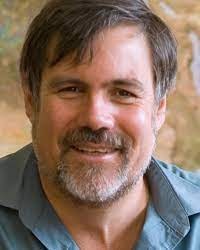
The EWT is deeply saddened by the tragic passing of Professor Bob Scholes, one of the world’s leading scientists on Climate Change.
Professor Bob Scholes passed away on the evening of Wednesday, 28 April 2021, following a hike with friends and colleagues.
The Wits community, in announcing his passing, stated that they are shocked and saddened by the sudden loss of such a giant in the field of climate science, not only in South Africa, but in the world. Professor Scholes was a true leader, a conscientious and dedicated scientist, and a teacher to all. An A-rated scientist and Professor of Systems Ecology at Wits, he served as the Director of the Global Change Institute (GCI). He was among the top 1% of environmental scientists worldwide, based on citation frequency, and published widely in the fields of savannah ecology, global change, and earth observation.
Professor Scholes led several high profile studies and held high profile positions in the fields of climate change and environmental studies globally. He was one of the lead authors in the assessment reports of the Intergovernmental Panel on Climate Change (IPCC) on the present and future impacts of climate change and how we can adapt to, or reduce it. He has also served as a member of the steering committees of several global earth observation bodies.
The EWT and our colleagues and friends far and wide are saddened by the loss of Professor Scholes, and extend our sincere condolences to Mary, his family, friends, and colleagues during this very difficult time.
A WORD FROM THE CEO
Yolan Friedmann, EWT CEO
yolanf@ewt.org.za South Africans and nature lovers around the world celebrated the news that the film My Octopus Teacher won not only a BAFTA award but a much-coveted Oscar as well. A remarkable achievement indeed, and a big congratulations must go to the team – a collaboration between Off the Fence, Netflix, and the Sea Change Project, an NGO raising awareness of the beauty and ecological importance of South Africa’s kelp forest. Directed by Pippa Ehrlich and James Reed, executive produced by Ellen Windemuth, and produced by Craig Foster, My Octopus Teacher is a tribute to the extraordinary relationship between a human being and a species primarily viewed only as food to many.
Amidst a sea of films about the state of our natural world, the loss of biodiversity and the devastating impact that humans are having on the planet, this film stands out for its emphasis on the intimate relationship between two individuals across the species divide, as well as its focus on the power of human connection to nature and other animals. Most conservationists baulk at the idea of naming the subjects of their wildlife research or getting too personally involved with individuals, preferring to focus on systems and processes instead. Most would criticise interspecies friendships as being anti-science. And yet we know that the intimate connection to nature in small bites that we can touch, feel and, yes, name is what attracts and retains most people’s interest in and empathy for those with whom we share our natural world. I can even admit that EWT staff have, on occasion, named some standout individuals, including Wild Dogs, Cheetah, and Leopards, for their resilience, courage, persistence, and of course, the teachings they imparted as their stories were told. So, is it a bad thing for conservationists to name, individualise, and share personal relationships with specific animals when taught to focus on systems and species instead?
Humans need to connect for anything to matter. The COVID pandemic has certainly brought home the suffering that goes with the loss of human connection, and nature keeps paying the price for our increasing disconnect with the natural world characterised by children who think that milk comes from a carton and that waste no longer impacts the planet if it is put into a bin. We also know that human connections with other species have helped prolong lives in care homes and rehabilitate offenders in the prison system. Humans connect to nature in dozens of ways, through experiences like hiking, diving, trail running, camping, and so much more. Mountain ranges are named, and dreams are borne out of a desire to experience and – as humans do – conquer extreme climbs, trails, and ski slopes. It is our own personal relationship with nature and what this does for us on an intimate level that changes us the most – and may well be the saving grace for much of our imperilled natural world in the end. Stories about the natural world that centre around the human-nature connection are more adept at driving home messages about the fragility of our world and our own role in it, as well as the complexity and interdependence of all relationships, human or otherwise.
Craig Foster talks about how his relationship with his Octopus Teacher improved his relationship with his son and many other people, teaching him much more than just lessons about marine biology. This is probably true for many biologists, too, as life lessons about survival, communication, and above all, love are often better learned from our relationship with other species. Should there even be a debate about whether or not anthropomorphism has a place, not just in film-making and storytelling, but also in science-based conservation and the race to save the planet? Or perhaps both are just different sides to the same story after all.
EWT AND BUSINESS FOR NATURE CALL ON COMPANIES TO HELP REDUCE NATURE LOSS IN THIS DECADE.
Dr Gabi Teren, EWT’s Business and Biodiversity Network, Programme Manager gabit@ewt.org.za Healthy societies, resilient economies, and thriving businesses rely on nature. The natural resources that power businesses are under huge strain and the private sector is a major contributor to nature’s depletion. The Endangered Wildlife Trust’s National Biodiversity and Business Network (NBBN) has joined Business for Nature, a global coalition that brings together business and conservation organisations and forward-thinking companies. Together we amplify a powerful leading business voice calling for governments to adopt policies now to reverse nature loss this decade.
The Endangered Wildlife Trust (EWT) recognised the need for a body to assist businesses to integrate biodiversity into their strategies and activities and established the NBBN in 2013, in partnership with the Department of Environmental Affairs (now the Department of Environment, Forestry, and Fisheries), and leading SA companies such as De Beers, Pam Golding Properties, Nedbank Limited, Hatch, Pick n Pay, and Transnet. In 2016, the list of NBBN partners grew to include Woolworths and Eskom. The NBBN aims to reduce the impacts businesses in South Africa have on nature by developing and disseminating relevant tools and guidelines to enable a more positive relationship with nature.
Businesses depend on a healthy planet to provide a stable operating environment, customers, and workforces, and the natural resources necessary for production – food, fibre, water, minerals, building materials, and more.
Nature also provides ecosystem services worth at least US$125 trillion/year globally, from which businesses benefit at no cost through, for example, waste decomposition, flood control, pollination of crops, water purification, carbon sequestration, and climate regulation. Losing nature means losing these services and creating extra costs and vulnerability for businesses. In fact, more than half of the world’s GDP – an estimated US$44 trillion of economic value generation – is moderately or highly dependent on nature and its services.
Leading businesses are making ambitious commitments and taking decisive action for nature. Businesses have a critical role to play in reversing nature loss, protecting biodiversity, and preserving species, and business action is about more than a responsibility – there are real and material risks associated with nature’s decline.
Businesses that act now to achieve net-zero and become nature-positive across their value chains will gain a competitive advantage.
In October this year, a new global agreement on nature called the ‘Global Biodiversity Framework’ is due to be agreed at the 15th Conference of the Parties to the Convention on Biological Diversity (CBD COP15) in Kunming, China. An ambitious, clear, implementable, and enforceable international agreement at COP15 will help realise nature’s true value to livelihoods, society and our economy.
But businesses cannot address this global crisis on their own. To accelerate action, governments must set ambitious nature and climate policies that provide direction and momentum. This gives the private sector clarity to unlock new business opportunities and creates a level playing field and stable operating environment. Hundreds of companies representing trillions in combined revenue are urging governments to adopt policies now to reverse nature loss through the Nature Is Everyone‘s Business Call to Action.
Whether you are a global corporate giant, an SMME or a sole practitioner, you can sign up your company today to the Call to Action, and join over 700 businesses from around the world who are calling for ambitious and collective action for nature. Companies of any size, location or industry can add their voice.
Sign up here: bit.ly/BfNCTA
For more information on the EWT’s National Biodiversity and Business Network, contact Gabi Teren GabiT@ewt.org.za
THE CITY NATURE CHALLENGE
www.iNaturalist.org
The City Nature Challenge is an annual international event organised by the Natural History Museum of Los Angeles County and the California Academy of Sciences and has been taken up by cities worldwide. It is tricky for scientists to conduct biodiversity surveys in urban areas because the habitats are so fragmented, and it is not always possible to access private properties. This iNaturalist challenge calls on citizen scientists to help record the wildlife occurring in their cities.
Cities contain ecosystems that, while not all in a natural state, are filled with wildlife that have adapted their behaviour to survive and thrive in these environments and are essential in maintaining a balance in green spaces and urban ecosystems, which provide us with critical services such as oxygen and carbon sequestration, flood and drought regulation, water, recreational space, and many more. To maximise our understanding and protection of the wildlife in cities, scientists need to have all the information they can get, and you can help just by looking around and recording what you see!
“Citizen scientists collect thousands of valuable records every day on biodiversity and the environment to assist conservation and research efforts across the globe. Play your part in helping to protect your patch of nature in your city by participating in this great global initiative and recording what species occur there.”
Dr Lizanne Roxburgh, Senior Scientist, EWT Conservation Science Unit
This year’s challenge takes place in two parts. The first phase (30 April–3 May 2021) involves taking pictures of wild plants and animals. The second phase (4 May–9 May 2021) is dedicated to identifying what was observed during the challenge.
To participate, download the app and sign-up to iNaturalist, find a project in your city (or start one!) and join in the fun – it’s addictive! See www.inaturalist.org/projects/city-nature-challenge-2021 for more information.The following projects in South Africa have been registered so far:
Nelson Mandela-Bay
Ethekwini
City of Cape Town
Garden Route
Tshwane
Check out the project journals for training, helpful hints, and other great resources to get you started!
RESCUE AND REHABILITATION OF A POISONED EGYPTIAN GOOSE
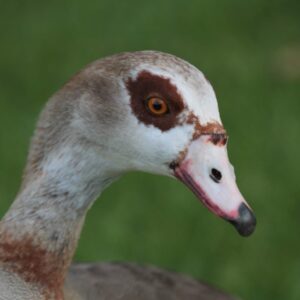
Dr Lindy Thompson (lindyt@ewt.org.za) and John Davies (EWT Birds of Prey Programme Field Officers), Rebecca Lambert and Nikita Jackson (Moholoholo Wildlife Rehabilitation Centre), and Carrie Hickman (APRN Ground Hornbill Project). In December 2020, while conducting fieldwork along the Olifants River, we found a poorly-looking Egyptian Goose showing signs that indicated it might have been poisoned. While the goose appeared to be in an otherwise good condition , with no visible injuries (broken bones or bleeding) or signs of trauma, it stumbled, fell, and rolled down the riverbank when it tried to get away from us as we approached. It was unable to fly. The African Wildlife Poisoning Database contains records of 724 Egyptian Geese that have been poisoned in Africa between 1998 and 2020. The substances used are usually organophosphates and carbamates (pesticides), and we think that most cases emanate from human-wildlife conflict due to crop damage by the geese. In this case, we suspect the goose may have been grazing in lucerne that was recently sprayed with insecticide.] We collected the unfortunate goose and drove it to Moholoholo Wildlife Rehabilitation Centre, leaving it in the capable hands of their experienced clinic team. On its arrival, the Egyptian Goose was treated with Atropine (used to treat organophosphate and carbamate poisoning) and activated charcoal (which binds to many toxins and prevents their absorption), and then it was given Ringers solution (to replace fluids and electrolytes) every two hours. After that, the goose received tubed pet food (a recovery food that is easy to digest), and then later, it was fed with pigeon pellets, crushed mealies, mealworms, flying ants, and grasshoppers. On 4 February 2021, after all this treatment and time to heal, the rehab team was happy with the bird’s condition, and we released it close to where we found it on the Olifants River. It flew off as though nothing had happened, without a backward glance – just how we like it to be every time we return wildlife to the wild. Click here to see a video of this bird being released: https://www.instagram.com/p/CLB80t5AvGy/ After publicising this rescue on Instagram, people asked us why we bothered rescuing a bird many people view as a pest species because its numbers are increasing. Firstly, when we found the bird and realised that it had been poisoned and was suffering we decided to rescue and rehabilitate it as the possible death of this bird would have bene due to human action and not natural causes. Secondly, if we had left the poisoned goose in the bush and it had died, it may have been fed on by scavengers such as vultures and jackals, which in turn may have experienced secondary poisoning. Thirdly, the EWT’s John Davies’ work with the annual Balule Waterbird Survey showed that Egyptian Goose numbers have increased along the Olifants River and a few other river systems in the Lowveld, mainly due to the deterioration of water quality due to human actions and large-scale losses of riparian forest, which has created open banks suitable for this species. Egyptian Geese exploit suitable conditions, and when these environmental conditions change, we expect their numbers to decline again. In 2020, in Balule Game Reserve, there were 377 Egyptian Geese along 49.8 km of river, including 47 chicks, while 84 Egyptian Geese were counted near the Phalaborwa barrage, and 71 at Three Bridges, almost half were found at the two most transformed (polluted) sections of the Olifants River. For most of the river, the average number of Egyptian Geese was just over four adults per kilometre, likely still slightly higher than normal, but not excessive. This is similar to parts of the Kruger National Park large-scale loss of riparian habitat have taken place.
  On the property where the goose was found, none of the 19 vulture nests we are monitoring was lost due to disturbance from Egyptian Geese. In fact, over the last six years of the EWT’s vulture nest-monitoring in the Lowveld, we have found only one case where an Egyptian Goose tried to breed in a nest still used by a recently-fledged Hooded Vulture. After numerous interactions between the geese and the vultures, the Goose’s breeding attempt failed, and there was no negative impact on the vultures. See here for more details
Thank you to Andre Botha for sharing records from the African Wildlife Poisoning Database, https://www.africanwildlifepoisoning.org/.
Please submit records of any poisoned wildlife to this database, and please contact Dr Gareth Tate at GarethT@ewt.org.za for details of Wildlife Poisoning Response Training in the Lowveld.
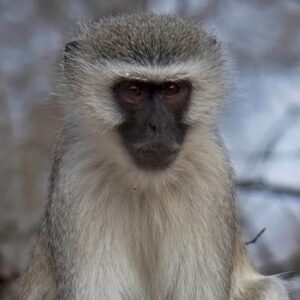
BRIDGING THE GAP FOR VERVET MONKEYS
Courtney Maiden, EWT’s Wildlife and Transport Programme student, 64083152@mylifeunisaac.onmicrosoft.com
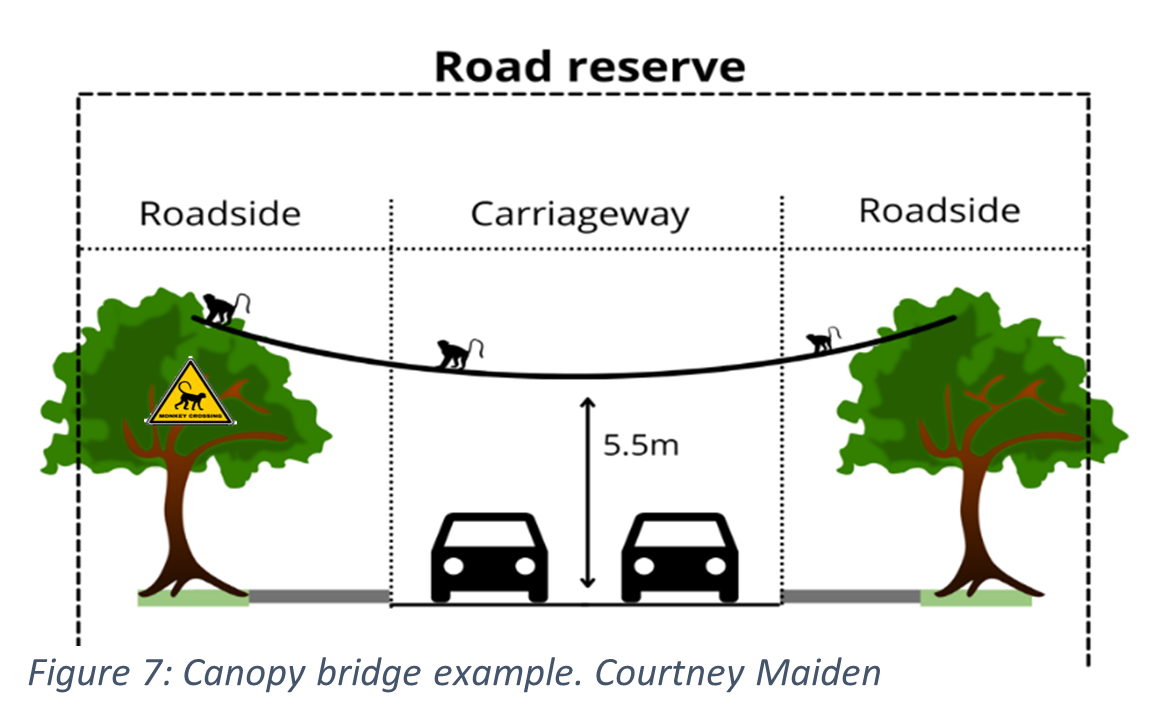
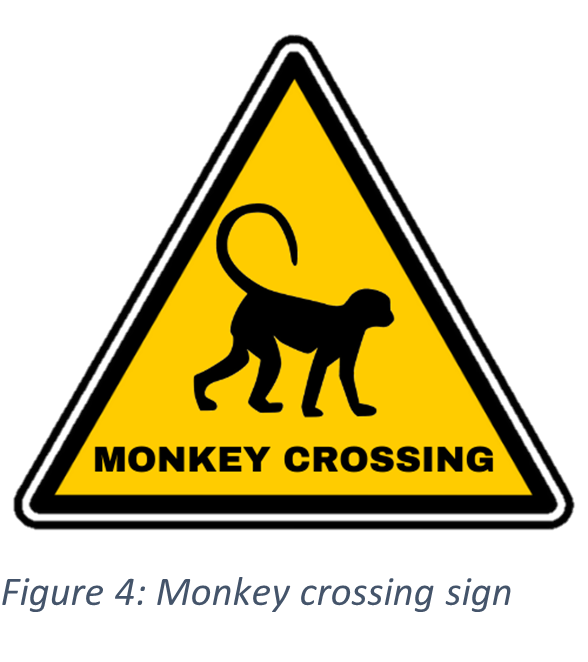
 Gaps caused in the forest canopy cover from linear infrastructure, such as roads, force arboreal species to come down to the ground and face threats such as wildlife-vehicle collisions. Wildlife crossing structures, such as canopy bridges, have been installed in many countries to reduce the impact of roads and enhance habitat connectivity for tree-dwelling species. The Vervet Monkey (Chlorocebus pygerythrus) is one of the arboreal species subjected to daily vehicle collisions throughout South Africa.
In an attempt to reduce mortalities, EWT student Courtney Maiden is designing and testing Vervet Monkey-specific canopy bridges in Durban, KwaZulu-Natal, with an end goal of installing wildlife-friendly bridges in roadkill hotspots across the country. By interrogating proposed designs and methodologies to establish a preferred Vervet Monkey crossing structure design, effective roadkill mitigation processes and species management plans can be established by integrating a simple yet potentially effective design to minimise wildlife-vehicle collisions, encourage habitat connectivity, and ensure the viability of Vervet Monkey populations. This work is being done in collaboration with the University of South Africa and the University of Wisconsin.
GOING BOSSIES
Bonnie Schumann, EWT’s Drylands Conservation Programme, Senior Field Officer, bonnies@ewt.org.za
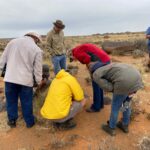
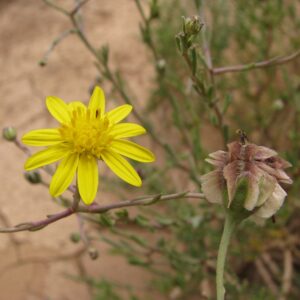
The EWT Drylands Conservation Programme, in partnership with the Grootfontein Agricultural Institute, held Karoo bossie (vegetation) identification days around Loxton this week. Altogether 32 people, mostly farmers, attended the sessions. Karoo veld generally appears rather grey and uninteresting to many passers-by, and getting to know the different species, mostly dwarf shrubs, can be very challenging at the best of times as they tend to look rather similar at first glance. For the novice, in order not to get demotivated on the first day, it is best to go in Spring and Autumn. At these times, if there has been rain, the bossies (little bushes) may be flowering and seeding, making it a lot easier to identify them. Once you spend time in the veld, you realise that there is actually a great deal of plant diversity, including over 3,000 species in the Nama Karoo. Not bad for a desert!
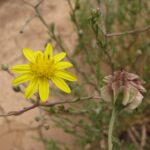
If you dare get up close and personal with the larger, thorny, rather formidable-looking bushes, you realise that they shelter a range of other fascinating species, which is why they are often called “mother bushes”. Despite the rather barren appearance of Karoo veld, when the veld is managed sustainably, the rangeland will provide fodder for wildlife and livestock year-round, as there is always something growing in every season. Grasses, which are less common as one travels west across the Karoo, are nonetheless an important component of the Karoo veld. Years of good early summer rainfall will result in a good grass component. On the other hand, the shrubs tend to prefer the cooler, wetter periods, providing valuable fodder during Autumn and Winter.
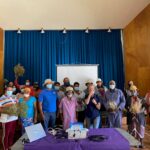
The plant identification sessions give farmers the opportunity to share their knowledge of the species growing in their area and encourage and facilitate more effective management of the veld, ensuring that the important palatable species are grazed with care, species diversity is promoted, and effective rest periods are implemented. These sessions formed part of the Karoo Forever Project, which focuses on promoting sustainable land management in the Karoo. The project is funded by the Global Environment Facility and managed by the United Nations Development Programme, in partnership with the Department of Environment, Forestry, and Fisheries, and the Department of Agriculture, Land Reform, and Rural Development.
SCIENCE SNIPPETS:
POWERLINE MARKERS PREVENT COLLISIONS IN BLUE CRANES BUT NOT LUDWIG’S BUSTARDS
Shaw JM, TA Reid, BK Gibbons, M Pretorius, AR Jenkins, R Visagie, MD Michael and PG Ryan. 2021. A large-scale experiment demonstrates that line marking reduces power line collision mortality for large terrestrial birds, but not bustards, in the Karoo, South Africa. Ornithological Applications. 10.1093/ornithapp/duaa067
Power line markers, such as flappers, are widely used to reduce or prevent bird collisions with power lines. However, few studies have robustly tested how effective they are in doing this. Power line collisions are an escalating problem for several threatened bird species endemic to southern Africa, as our powerline network continues to expand to meet the growing demand for electricity. Therefore, it is critical to know whether or not line marking works to adequately manage this problem and reduce the number of birds that are killed.
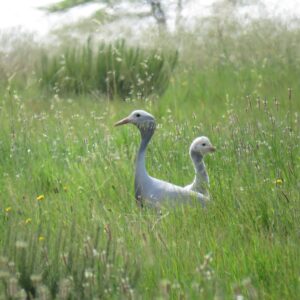
A recent paper published by Jessica Shaw from the FitzPatrick Institute of African Ornithology at the University of Cape Town, using EWT/ESKOM data, and coauthored by three EWT staff members, describes the results of a large scale eight-year experiment that tested the efficacy of the markers. The experiment was set up on 72 of 117 km of monitored transmission power lines in the eastern Karoo, South Africa, to assess whether line markers reduce bird collision mortality. The two bird species of particular interest were Blue Cranes (Anthropoides paradiseus) and Ludwig’s Bustards (Neotis ludwigii). Two different marking devices commonly used in South Africa were tested: bird flappers and static bird flight diverters.
The authors found that: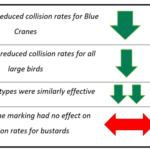
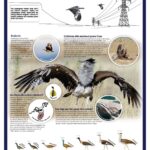
The monitoring conducted by the research team at this site also confirmed high levels of mortality of a range of species of conservation concern on unmarked lines. The authors, therefore, recommend that marking be widely installed on new power lines. However, other, more effective options need to be urgently explored to reduce collision mortality of bustards. Five different bustard species were in the top 10 list of most frequently found carcasses. High collision rates of Ludwig’s Bustards add to wider concerns about population-level effects for this range-restricted and Endangered species.
IN CASE YOU MISSED IT
CONSERVATION WEEK
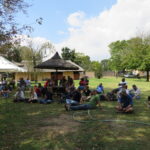
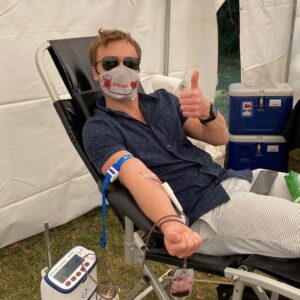
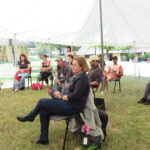
Last week, the EWT held its annual Conservation and Development Week. This event gives EWT staff from all over the country the opportunity to connect, discuss projects, share lessons learnt, revise our conservation strategies, and give back to our community. It was wonderful to catch up with colleagues after lockdown, get our creative juices flowing, and inspire each other to take our conservation work to new heights. The South African National Blood Service also joined us for a day, enabling 21 staff members to donate much-needed blood to their reserves.
CAPE TOWN GOLF DAY

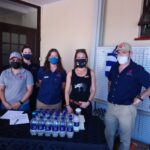
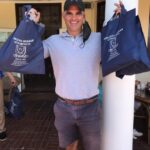
We hosted our very first golf day fundraising event in the mother city on 16 April at the Royal Cape Golf Club. Cape Town was at its most beautiful with perfect weather and no wind to speak of, and all of our players commented on what a great day out it was on an amazing course.
Fundraising is difficult at the best of times and during COVID-19, it has been even more challenging. That is why events such as this one are so important, helping to keep The EWT going and raising much needed funds for our conservation activities.
To host a successful event, you need lots of support, and the EWT had that in abundance at this event. A massive thank you to Jurgens Bekker Attorneys for sponsoring so many of our prizes and our celebrity fourball, and aha Hotels and Lodges for generously sponsoring some fantastic weekends away for our auction.
The Table Mountain Fund, Twizza, Syntell, and Bose Professional all sponsored holes on the day and played a round of golf themselves.
Jurgens Bekker, aha Hotels and Lodges, Q20, Painted Wolf Wines, Miir, Lancewood, Rhino Beetle Gin, Spanjaard, Blue Bottles Liquors, Sherry’s antiques, The Meter Man, Meerlust wines, Rob Little, and Adidas all sponsored some fantastic prizes that helped to make the day a success.
Thank you to all of our fourballs: Table Mountain Fund, Blur Bottle Liquors Paarl, Limecoal, Jurgens Bekker attorneys, Twizza, Allister Rogan, Rian du Plessis, The Meter Man, Alexander Forbes, ALP Investments, Independent Claims, Mission Engineering, Paper Boss, Syntell, Duncan McGuire, Craig Milner, John Lamont, Karen Kearns, Tania Ihlenfeldt, IQ Business, and aha Hotels and Lodges.
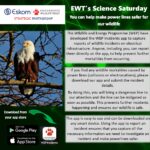
SOME OF OUR FASCINATING SCIENCE SATURDAY POSTS

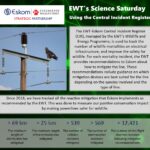
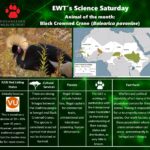
A WORD FROM THE CEO
Yolan Friedmann, EWT CEO
yolanf@ewt.org.za We have many challenges in our country, and one that plagues us all too often is poor decision-making on behalf of the authorities who have the mandate to safeguard our environment for current and future generations. We fully appreciate the fine balancing act that our decision-makers face, with millions of unemployed people needing jobs at all costs. But we cannot lose sight of the long-term devastation that can arise out of many developments that are, in fact, only opportunities for very limited, short-term gain for a select few. In cases like these, it behoves organisations like the EWT and our partners to fight for a greater good that considers not only the needs of future generations but those of the current as well. A case in point is the ongoing fight to protect the Mabola Protected Environment in Mpumalanga from inappropriate mining activity, which will destroy its critical biodiversity, its important contribution to water security, and its unique variety of threatened species.
The EWT is a member of a coalition of eight civil society organisations, which has been working since 2015 to prevent the development of the proposed Yzermyn coal mine near Wakkerstroom, Mpumalanga proceeding. Our reasons for wanting to stop this mine are based on our grave concern for the negative impact of this proposed coal mine, which would fall within a Strategic Water Source Area – one of only 22 areas from which more than 50% of South Africa’s freshwater originates. Protecting strategic water source areas is crucial for South Africa’s water security, provide water for people and economic activity, food security, and meaningful, long-term job creation.
There are currently five court challenges to various permits granted for the proposed mine, which are pending before the High Court, with more in the wings as decisions are taken which, in our view, are not in the interest of sustainable living and environmental protection to the benefit of all.
Whilst we await the courts’ decisions on the pending matters, the coalition went to court in March to seek an urgent interdict to halt any form of development. The matter went before the Pretoria High Court, which issued a ruling on 23 March that interdicts the coal mining company from commencing mining and related activities in a Strategic Water Source Area. The interdict was issued to allow the legal challenges of its various permits to be decided first before harm is done to this fragile system.
The EWT is not a litigious organisation by nature but takes seriously our commitment to ensuring a healthy planet and an equitable world that values and sustains the diversity of all life, so if we need to resort to the courts to help us secure critical water sources and fragile ecosystems, we will. The Mabola Protected Environment is one of these critical areas that cannot be lost to future generations for the unique and critically important life-giving services it provides. The other coalition members feel the same, and hence we joined forces to defend the Mabola Protected Environment along with the Mining and Environmental Justice Communities Network of South Africa, groundWork, Earthlife Africa Johannesburg, BirdLife South Africa, the Federation for a Sustainable Environment, the Association for Water and Rural Development (AWARD), and the Bench Marks Foundation, and we are all represented by the Centre for Environmental Rights in this critical and landmark case.
The EWT is pleased with the outcome of this court action, which builds confidence around the balancing role that our courts still play by upholding the rule of law in a country where competing interests can drown out the voices of many. We will continue to update you on this matter as the various court proceedings come to a head later this year.