Cross-border collaboration supports the rewilding of orphaned cheetahs
By Olivia Sievert, Project coordinator, Cheetah Conservation Project
In conservation, success often depends on collaboration, careful planning, and the ability to respond quickly to unexpected events. Over the past year, the EWT, together with partners including The Bateleurs and the Ukuzwana Foundation, has been involved in a cross-border effort to give two orphaned cheetah cubs a second chance. What began as two unrelated incidents in Malawi and South Africa became a coordinated project to return both animals to the wild.
In July 2025, a female Cheetah that had been introduced to strengthen the population in Liwonde National Park was killed by Lions, leaving behind two female cubs estimated to be around six-months-old. At this age, cubs are still dependent on their mother, and survival without intervention is unlikely. Because the female represented important genetic contributions to both the park and the broader managed Cheetah metapopulation, park management, with support from the EWT, initiated a hands-off rehabilitation and rewilding plan. When the cubs were found and subsequently rescued, however, they were severely malnourished, and only one survived.
At roughly the same time in South Africa, a separate incident resulted in another orphan. A female Cheetah sustained a severe hunting injury on a reserve in Limpopo and had to be humanely euthanised, leaving behind a female cub of approximately seven-months-old, later named Mara.
In the wild, Cheetah cubs typically remain with their mother for more than a year, after which siblings stay together for several months while learning to hunt independently. These sibling associations can play an important role in early survival. For this reason, a plan was developed to attempt to form a social bond between the two orphaned females. If successful, the intention was to rewild them together and ultimately return them to Malawi to boost the population there.
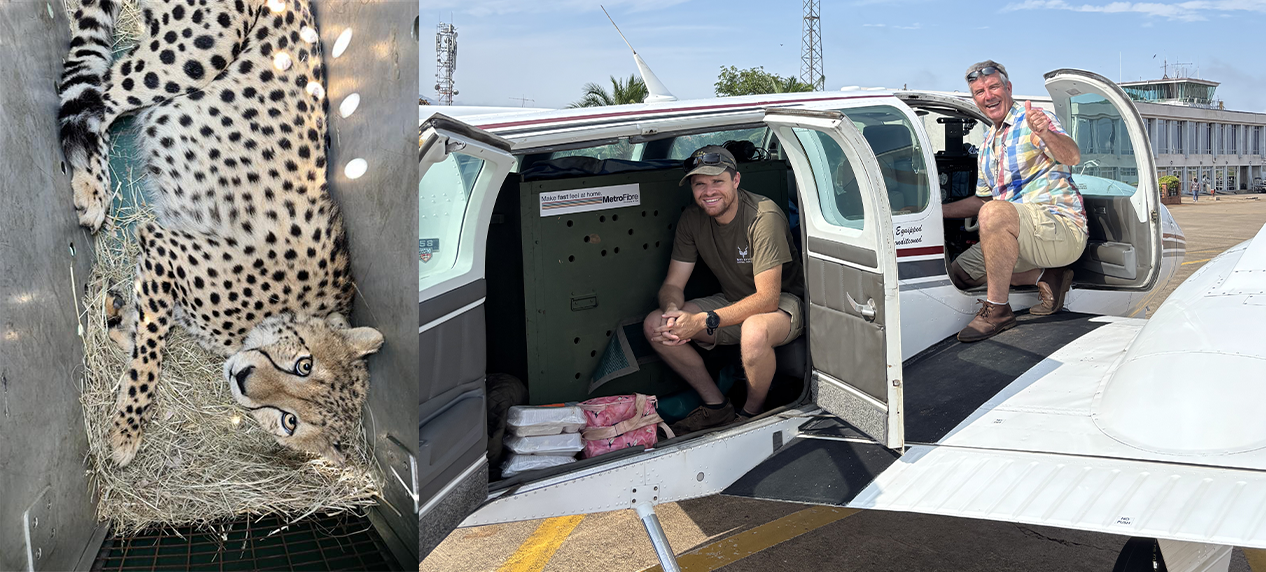
International translocation of Cheetahs is not an easy feat; it requires multiple permits, veterinary clearances, and coordination between the authorities of both countries. Over several months, the EWT worked with both government and non-government partners to facilitate the movement. Once ready, The Bateleurs provided essential aviation support, enabling our team to travel to Malawi, collect the orphaned cub, and transport her safely to South Africa for bonding and rewilding.
Given their age, both females were taken to a specialised veterinary facility near Nelspruit, where they were gradually introduced. Introductions between unfamiliar Cheetahs must be managed carefully, but in this case, the two females quickly accepted each other, allowing the project to proceed to the next phase.
Following veterinary care, the pair were moved to a reserve managed by the Ukuzwana Foundation in Mpumalanga for rewilding. The reserve supports suitable prey species while maintaining relatively low densities of large predators, with Leopard and Brown Hyena present but no Lions. This provides an excellent environment for the young Cheetahs to develop their hunting skills with reduced risk compared to more predator-dense systems.
Rewilding requires close monitoring to ensure the animals are hunting successfully and maintaining condition while remaining fully independent. Therefore, both females have been fitted with satellite-tracking collars, allowing the team to monitor their movements, assess hunting attempts, and confirm kills. The collars will remain on the Cheetahs when they are relocated back to Malawi so that post-release monitoring can continue.
If progress continues as expected, the rewilding phase will run through mid-year, after which the aim is to move the pair back to Liwonde National Park before the onset of the hot season. Their return will contribute to the genetic and demographic stability of the park’s Cheetah population and will provide further insight into the use of hands-off rewilding for orphaned individuals.
This project highlights the importance of cooperation between conservation organisations, protected area authorities, and technical partners. The rapid response in Malawi, aviation support from The Bateleurs, and the rewilding environment provided by the Ukuzwana Foundation have all been essential to the process.