
Lions: a year of success, collaboration and testing new ideas
By Marnus Roodbol, project manager: Carnivore Conservation Unit
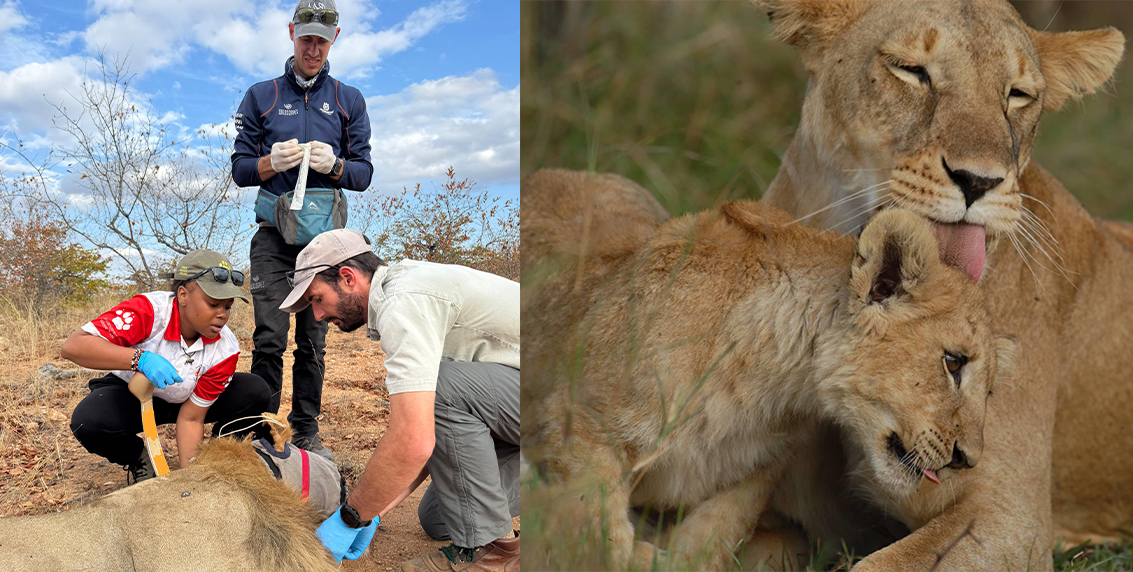
Three hundred and sixty five days may sound like a long time, but when you’re driven by purpose, the year passes quickly.
Throughout 2025, our lion conservation work expanded significantly across South Africa and Mozambique as the Endangered Wildlife Trust (EWT) also embarked on an exciting new initiative in the Kgalagadi Transfrontier Park between South Africa and Botswana. Read: Pride & Progress: Inside the Kgalagadi’s Desert Lion Survey
Kruger National Park
During 2024, SANParks, the EWT, the Greater Kruger Environmental Protection Foundation (GKEPF), and the Lion Recovery Fund (LRF) joined forces to discuss the future of lions in the northern Kruger National Park. Since beginning our work in this region in 2020, our population surveys have revealed a concerning decline in lion numbers, highlighting the urgent need for targeted conservation action.
To better understand population dynamics, several lions have been fitted with GPS collars allowing our team to track movement patterns, identify stable prides, and monitor areas frequented by nomadic males. The data we are gathering will guide long-term conservation planning aimed at restoring lion populations to their historic strength within the park.
Limpopo National Park
Limpopo National Park in Mozambique has been severely affected by the civil wars spanning almost two decades. Recovery has been slow, and today, the park remains vulnerable to poaching, particularly the targeting of lions for their body parts.
The park functions as a “sink area”, meaning that it does not yet sustain resident prides but instead receives dispersing lions from the adjacent Kruger National Park. Females often cross the border with their cubs when prides are taken over by new males, while younger males move through during their nomadic phase.
Our current efforts in Limpopo focus on two key activities:
- Camera trap surveys in a pre-selected grid to assess biodiversity.
- Supporting lion rangers with essential field equipment to enhance their ability to patrol, track, and monitor lions on foot.
Data collection continues, with analysis scheduled to begin in January 2026.
Testing the Waters: Livestock Conflict Mitigation
An exciting project embarked on has been our collaboration to rest innovative solutions for human-lion conflict with the global company CLS. This has included the development of a proof-of-concept project where cattle are fitted with GPS ear tags to monitor their movements and detect when they enter known lion territories.
Although still in its early stages, the project has already recorded several instances of livestock predation in adjacent municipal parks. With continued support, we aim to scale up this initiative in 2026, offering practical tools to help communities coexist safely with wildlife.
Together, these projects represent EWT’s commitment to securing a future where lions — and the people who share their landscapes — can thrive side by side.