Snippets from staff
Challenged by Dunes, Gates and Antbear Holes in the Kalahari: August 2020
Danielle du Toit, field officer, Birds of Prey unit
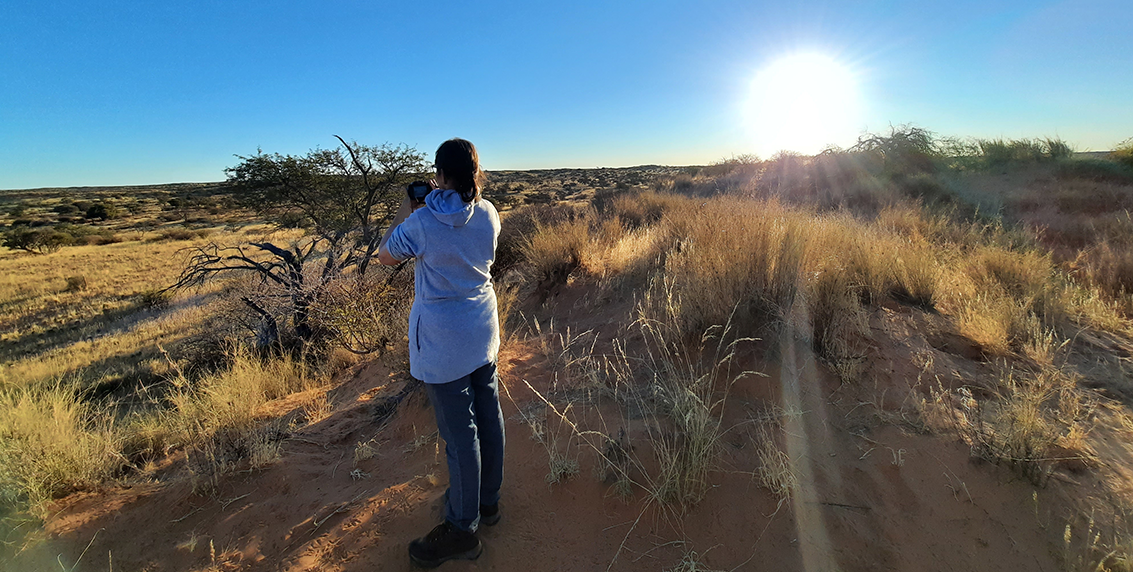
“This is not going so well,” Ronelle laughed. We were in the since-retired EWT Mazda with over 400 000km on the odometer, held together by cable ties and no 4×4. This isn’t a problem unless you are halfway up a steep dune surrounded by thorny vegetation with no idea what’s over the crest. I looked over at Ronelle, my grip on the ‘Oh Hell!’ handle above the window tightening. My first experience of fieldwork, and my mentor was laughing maniacally as my mind imagined becoming a permanent feature of this dune. The back wheels spun, whipping us to the side. Through my window, the thorn bushes approached far faster than any plant has the right to move. No sooner had I made peace with my impending doom than Ronelle took control once more, and we crested the dune. She was self-professed and categorically proved to be “her mother’s wildest child”.
The next day, we found a Dorper lamb on the roadside being sized up by a murder of crows. With no sign of its mother, it would be dead within the hour. Catching the wobbly-legged creature was anything but graceful—like chasing a ping-pong ball that bounces away every time you try to grab it. Ronelle said there was a farm gate up the road where we could turn in to go to the homestead. Upon arrival, the two–two-metre-high double gate was locked, and the house was over the hill, a fair distance away. I offered to climb over and take it there, and Ronelle would hold the lamb until I was over. No stranger to clambering over gates, I hooked my toe into the wire netting and pulled myself up.
What proceeded, however, was the most humiliating performance I have ever given. The two gates, similar to double doors, were held together by a loosely looped chain with a lock on it. What this led to was an act of physical comedy I couldn’t script if I tried. Every move I made sent both gates flapping wildly. It was like riding a mechanical bull after a few beers. The harder I tried to climb, the more the gate fought back. My legs shook, which only seemed to fuel the demon-possessed thing even more. I landed on the other side with weak knees, exhausted. Ronelle slipped the lamb through the gap.
Feeling like Little Bo-Peep after a few rounds with Mike Tyson, I started up the hill. I don’t doubt that the lamb looked at me, concerned with who was going to end up saving who. When I arrived at the house, I was panting, thirsty, sweaty and smelling like livestock. Following the noise coming from the shed, I found a group of workers. When they spotted me, terror flickered in their eyes. To be fair, I looked like something out of a fever dream: a sweaty white woman clutching a lamb, hair like I’d run through a bush backwards, and black lamb excrement smeared up my arm. Between pants and questionable Afrikaans, I explained how I’d ended up there. I held out the lamb, but the group stepped back in unison. Repulsed by the smell? Or, baffled by my mangled grammar, assumed witchcraft? One man elbowed a younger guy forward. He crept up, snatched the lamb from my arms, and hurried back to safety. I thanked them; they nodded, still looking bewildered, and left. Aware that Ronelle had been waiting, I began to run. By the time I reached the devil gate again, my lungs hated me, and the only thing that got me through the satirical repeat performance of climbing over the gate was pride.
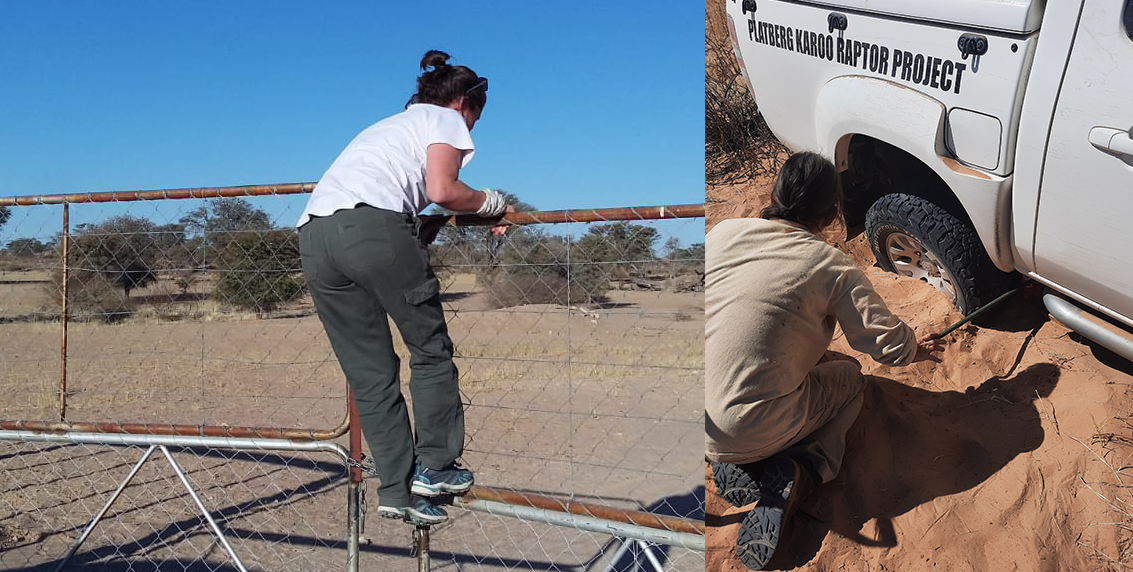
Later that week, we set out to monitor White-backed Vulture nests. Ronelle went off the beaten track, navigating her way through bushes and avoiding antbear holes. On our way back, she reversed carefully to avoid the thorny branches behind us, but only remembered the antbear holes when we found ourselves chassis deep in one. Attempting the normal way of getting unstuck: She reversed slightly, quickly changed into first gear, swung the steering, and gunned the gas but that only served to deepen the hole we were in. From the canopy, she pulled out a plank, a spade, textured plastic slats and a 4-ton jack.
More than an hour later, having tried everything short of lifting the vehicle out with our bare hands, we were no closer to getting out than when we started. We thought we had solved the issue when we saw that the undercarriage was resting on a sizable bush, assuming that was what was preventing movement. Leatherman in hand, I wiggled under the vehicle and cut away at the branches. When that failed, I attacked it with the spade. By the time I crawled out, I had sand in my sinuses, thorns in my hands, and the vague sense I’d lost my dignity under there. Ronelle kept laying brush for traction, and we tried again with no luck. I suggested calling the farmer for help. Ronelle—strong-willed and allergic to asking for assistance—cracked on.
I gave up on trying to impress her, leaned against the car, and picked thorns out of my hands. It took another hour before she relented. She made the call, and our cavalry arrived in the form of three farm workers and a Datsun bakkie that had survived the 1980s by sheer spite. They had us out in minutes, moving with the ease of people who’d done this many times before. Our earlier efforts looked embarrassingly futile.
Through the dune bashing, tangoing with farm gates and attempting the dig to China, the Kalahari blessed us with the opportunity to experience it most truly and live to tell the tale. When I remember the Kalahari, I remember seemingly impossible challenges that we overcame with laughter and blind determination and it is a lesson that I have taken with me five years down the line.