
EWT-led Vulture Safe Zone certified in a national park
By Eleanor Momberg – Communications manager, Endangered Wildlife Trust
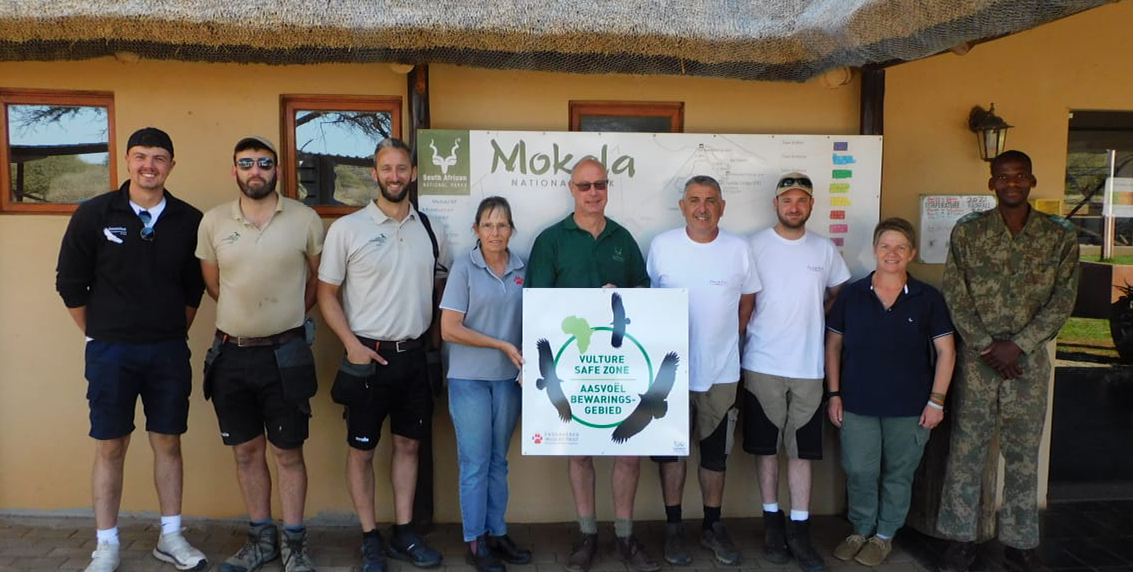
An Endangered Wildlife Trust-led Vulture Safe Zone has been certified in the Mokala National Park – a first for South Africa.
The national park, in the Northern Cape, is a stronghold for breeding White-backed Vultures (Gyps africanus). It is the first SANParks national park to be certified a Vulture Safe Zone
“The certification is a further step in a working relationship between the Endangered Wildlife Trust (EWT) and SANParks to conserve threatened species and restore and preserve the habitats they require to survive,” says the CEO of the EWT, Yolan Friedmann.
The EWT has been working in Mokala National Park since 2008, monitoring vultures and other raptors. In the last three years, the EWT’s Birds of Prey team and park management have been mitigating threats to vultures and related species on the 27,500ha property with the aim to certify it as a Vulture Safe Zone (VSZ).
What is a Vulture Safe Zone?
Vulture Safe Zones are an outflow of what is commonly known as the Asian Vulture Crisis, spanning the 1980s and 1990s, which saw declines of over 99% in the population of vultures in this landscape. Subsequent research found that the mass die-off had been caused by the veterinary NSAID (non-steroidal anti-inflammatory drug), Diclofenac. The disappearance of Vultures in India led to the ecological tipping of scales, causing the death of tens of thousands of people due to the spread of pathogens because of the decline in vultures, known as the environment’s clean-up crew.
The urgent need for action to stop the rapid decline of vulture species in Eurasia and Africa led to the development of the Multi-Species Action Plan to Conserve African-Eurasian Vultures (commonly referred to as the Vulture MsAP). Vulture Safe Zones are recognised in the Vulture MsAP as a means to encourage the responsible management of the environment by actively reducing threats to vultures in identified areas. In South Africa, the EWT has led the implementation of the Safe Zones, spanning the Karoo, the Kalahari and the Eastern Cape.
Among the criteria for a VSZ is that the area must be poison free and carcasses may not be laced with NSAIDs, power lines are mitigated to prevent electrocutions and collisions by wildlife, breeding or roosting populations of vulture species are protected from disturbance; and that breeding and/or roosting populations are monitored annually.
The Mokala Vulture Safe Zone
Mokala is the first of many identified national parks to be certified as a Vulture Safe Zone. In partnership with Eskom, the project has ensured that all power lines are safe and, through a kind donation by the SANParks Honorary Rangers, the team was able to cover the dams with nets to prevent drownings.
Because the reserve is a stronghold for White-backed Vultures, a team led by the EWT has ringed and tagged over 1,100 vulture chicks in the park since it began working there. In October 2025 alone, 90 chicks were ringed and tagged, and 155 active nests were counted in the larger breeding area, which includes neighbouring farms.
“With the Vulture Safe Zone certification in place, Mokala National Park now has ample support to continue critical conservation efforts to protect their resident vulture populations, as well as other threatened birds of prey, including Martial Eagle and Tawny Eagle,” said Friedmann.
** The EWT would like to thank our donors, partners and collaborators for their ongoing and much appreciated support for this important conservation initiative: Charl van der Merwe Charitable Trust, Puy du Fou, Gauntlet Conservation Trust and Hawk Conservation Trust, as well as the SANParks Honorary Rangers