
South Africa’s Managed Cheetah Metapopulation: A Collaborative Conservation Model
By Kelsey Brown, senior data scientist, Carnivore Conservation Unit
Once widespread across much of Africa and southwestern Asia, the Cheetah (Acinonyx jubatus) has experienced dramatic range contraction over the past century. Today, the species occupies only a fraction of its historical distribution, with most remaining populations confined to eastern and southern Africa.
Globally, Cheetah numbers are estimated at approximately 6,500 mature individuals, and the population continues to decline. The species is listed as Vulnerable on the IUCN Red List due to its small population size and ongoing habitat and prey pressures. Over the past 15 years, global numbers are estimated to have declined by about 37%, driven by habitat loss, human-wildlife conflict, illegal wildlife trade, and declining prey populations.
Equally concerning is the species’ fragmentation. Of the 33 remaining Cheetah populations worldwide, only two contain more than 1,000 mature individuals. Such isolation increases the risk of inbreeding and reduces the species’ resilience to local declines.
Southern Africa remains one of the Cheetah’s most important strongholds. The southern African subspecies (Acinonyx jubatus jubatus) occurs across Namibia, Botswana, Zimbabwe, Zambia, Mozambique, and South Africa. However, even here, populations face increasing pressure from habitat fragmentation and expanding human land use.
The status of cheetahs in South Africa
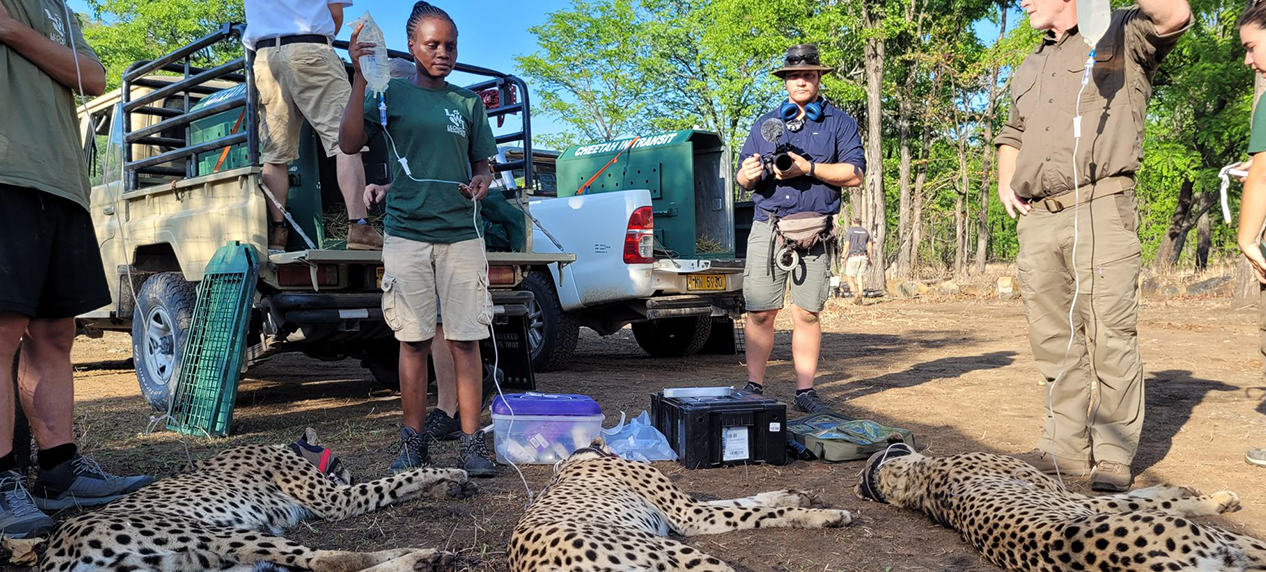
In South Africa, Cheetahs occur in four management contexts: the free-roaming population, the unmanaged free-ranging population in large protected areas such as Kruger National Park and the Kgalagadi Transfrontier Park, the managed metapopulation on fenced reserves, and the captive population.
The free-roaming population occurs primarily in northern South Africa and historically occupied around 28,900 km², supporting an estimated 196 mature individuals. A large-scale Free-Roaming Cheetah Census, led by Ashia Cheetah Conservation and the Cheetah Outreach Trust, is currently reassessing the status of this population.
Within protected areas, Kruger National Park (19,623 km²) supports approximately 116 mature Cheetahs, while the South African section of the Kgalagadi Transfrontier Park (9,591 km²) hosts around 80 resident cheetahs.
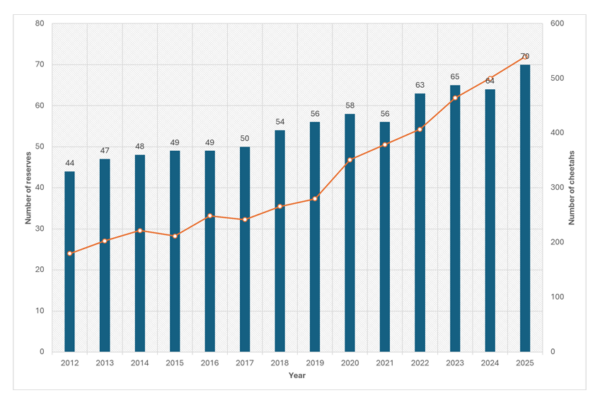
Alongside these populations is the managed Cheetah metapopulation, a conservation initiative that has become a cornerstone of Cheetah conservation in South Africa. As of December 2025, Cheetahs have been reintroduced to 70 fenced reserves covering 14,204 km², supporting approximately 298 breeding individuals aged 24 months and older.
South Africa also hosts the world’s largest captive Cheetah population, with roughly 600 animals across 68 facilities.
What is a metapopulation?
A metapopulation is a “population of populations”. These are geographically separated groups that remain connected through movement among habitat patches.
In natural landscapes, this connectivity occurs through dispersal. However, in South Africa’s network of fenced reserves, movement is often restricted. Without intervention, many Cheetah populations in small reserves would become isolated, increasing the risk of inbreeding and local extinction.
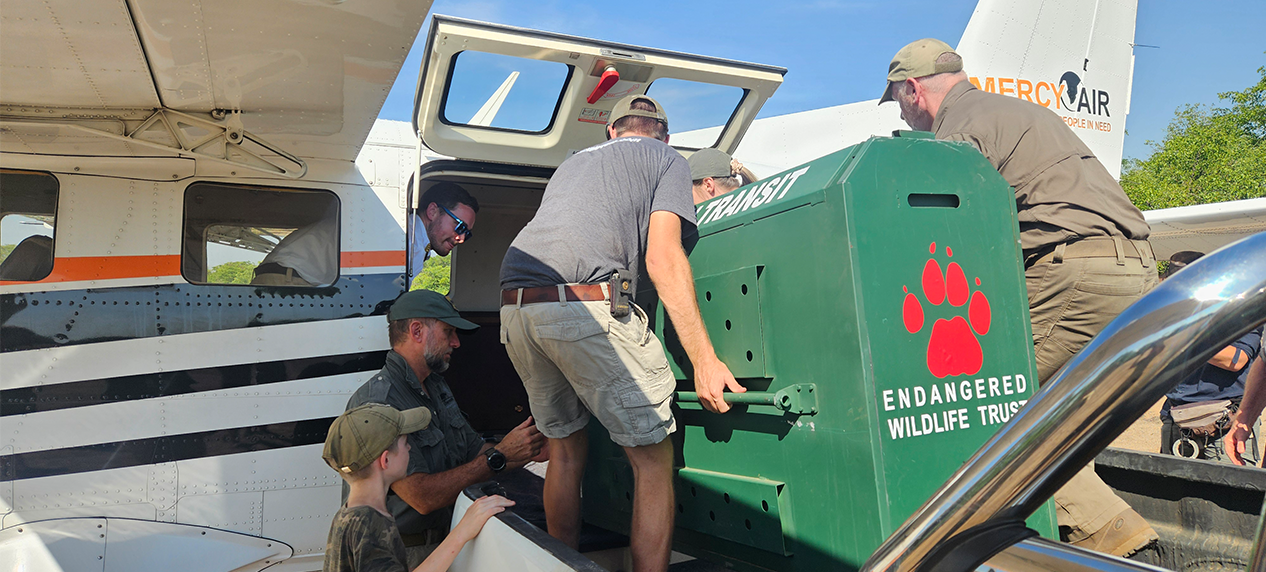
To address this challenge, the EWT and its partners manage Cheetahs across fenced reserves as a single connected system. Carefully planned translocations between reserves simulate natural dispersal, maintaining genetic diversity and stabilising small populations.
The concept of managing Cheetahs as a metapopulation was first proposed in 2009, with a formal management framework established by the EWT in 2011. Today, the initiative depends on close collaboration between conservation organisations, reserve managers, provincial authorities, and the national government.
A growing conservation success
Since the metapopulation project was formalised, the managed Cheetah population has grown steadily, demonstrating the value of coordinated, long-term management. Between 2012 and 2025, the population increased at an average annual rate of approximately 8.8%, despite the challenges associated with managing small, fenced populations.
By the end of 2025, the metapopulation comprised roughly 540 Cheetahs across all age classes, including adults, dispersers, and cubs. In 2025 alone, around 90 individuals survived to the disperser and early adult age classes (18-30 months), the cohort most likely to contribute to future population growth.
Maintaining this growth requires continuous oversight. The EWT’s Cheetah Conservation Project works closely with reserve management teams to monitor births and deaths, assess genetic representation, and coordinate translocations to ensure that no single reserve becomes isolated. Each movement is carefully planned to mimic natural dispersal while minimising stress on the animals and disruption to existing populations.
Since 2012, more than 700 translocations have been coordinated as part of the metapopulation project. Alongside this work, we have built a long-term dataset documenting the life histories of more than 2,000 individual Cheetahs across the managed system. These records allow us to track survival, reproduction, and movement patterns, and to identify emerging risks before they affect the population as a whole.
These data also play an important role beyond day-to-day management. They form the scientific basis for the Non-Detrimental Findings required under CITES, which assesses whether regulated international trade can occur without negatively affecting the species in the wild. In South Africa, our population data help demonstrate that carefully managed exports for conservation purposes do not reduce national population viability and can support efforts to restore the species in its historic range.
The same dataset feeds into Population Viability Analyses, which allow us to model how the metapopulation may change under different scenarios. By incorporating information on births, deaths, age structure, and translocations, these models help guide management decisions and evaluate potential risks before actions are taken.
Looking beyond South Africa
Although South Africa’s managed metapopulation represents only 4-5% of the global Cheetah population, it is playing an increasingly important role in the species’ conservation.
Through coordinated management and strong partnerships, the EWT and its partners have established a growing, genetically managed population across a network of reserves. This population now serves as an important source for reintroductions and restoration efforts, both within South Africa and elsewhere in the cheetah’s historical range.
In a landscape where large, connected ecosystems are becoming increasingly rare, the managed metapopulation demonstrates that fragmented protected areas can still contribute meaningfully to species conservation when they are managed cooperatively.
With continued commitment, collaboration, and science-based decision-making, this model provides a practical framework for maintaining viable Cheetah populations and supporting the species’ long-term future.