Caught on Camera: Insights into the Secret Life of Kloof Frogs

Caught on Camera: Insights into the Secret Life of Kloof Frogs

Science Snippet

Caught on Camera: Insights into the Secret Life of Kloof Frogs

By Erin Adams and Lizanne Roxburgh, Conservation Science and Planning Unit at the endangered wildlife trust

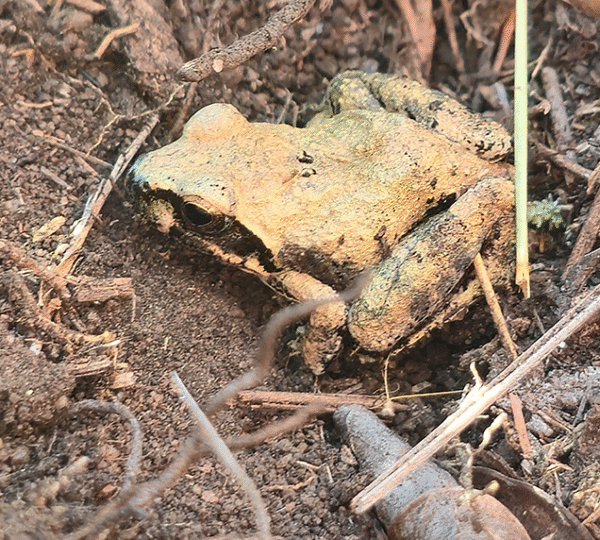
Kloof frog. Photo Credit Cherise Acker-Cooper

Camera traps are an essential tool for wildlife research, allowing scientists to monitor animals over long periods without disturbing them. They provide insights into behaviour, population trends, and habitat use.

While widely employed for studying larger animals, their potential for amphibian research has been overlooked, despite the alarming decline of these species—41% of the world’s amphibians and 23% of South Africa’s frog species face threats, such as habitat loss and climate change. Understanding their behaviour can guide conservation strategies to protect vulnerable populations.

To address this gap, EWT scientists* tested camera traps on the Endangered Kloof Frog (Natalobatrachus bonebergi), a species known for returning to the same breeding sites year after year. Their unique expanded toe tips allow them to climb slippery surfaces, enabling them to lay eggs on rocks, branches, and leaves above slow-moving streams. This placement ensures that once the tadpoles hatch, they can drop directly into the water below—a crucial survival strategy. Scientists aimed to document frog behaviour during both breeding and non-breeding seasons and analyse how environmental conditions influence their activities.

To gather data, researchers positioned camera traps along a stream where Kloof Frogs consistently breed. The cameras captured images between 18:00 and 06:00, when the frogs were active. Normally, camera traps are triggered to take a photo by the movement of animals, but Kloof Frogs are too small, so the cameras automatically took photos every minute. The images were analysed to categorise behaviours, measure the duration of the behaviour, and record the time of day that these activities occurred. Additionally, environmental data such as temperature, lunar phase, rainfall, and moon brightness were recorded, helping scientists understand how local conditions affect the frogs’ daily and seasonal habits.

The findings revealed that Kloof Frogs prefer cooler temperatures, with their breeding sites being significantly colder, up to 13°C lower in the morning and 10°C cooler in the afternoon, than surrounding areas. This is important as deforestation of their riparian habitat would lead to significantly higher temperatures along rivers, which would affect their behaviour and survival.

Deforestation is a threat to many other species and to ecosystem functioning, and disrupts water supplies. The breeding season lasts from September to April, but scientists noted a decline in egg-laying when the moon was at its brightest, possibly due to increased visibility to predators. This is another important finding, as any artificial light, which could mimic the moon, would reduce breeding behaviour and success in these frogs. Artificial urban light has also been shown to be a threat to many other species, including migratory birds and sea turtles.

Additionally, researchers observed female frogs returning to their egg clumps regularly to hydrate them using water stored in their bladder—a fascinating maternal behaviour. The study also captured the first recorded instance of crab predation on Kloof Frog eggs, highlighting an overlooked threat to their reproductive success.

This research demonstrates that camera traps can be an effective tool for studying amphibians, expanding conservationists’ ability to monitor species without human interference. By deepening the understanding of Kloof Frog behaviour, the findings will help predict how climate change and habitat degradation may impact the species. Ultimately, this information will aid in developing targeted conservation strategies to protect both the Kloof Frog and other threatened amphibian species.

A Swing for Conservation: Recap of Our 4th Annual Stellenbosch Golf Day

A Swing for Conservation: Recap of Our 4th Annual Stellenbosch Golf Day


A Swing for Conservation:
Recap of Our 4th Annual Stellenbosch Golf Day

By Tammy Baker – Business Development Officer, Endangered Wildlife Trust

We hosted our 4th annual Stellenbosch golf day proudly sponsored by Alexforbes on the 11th of April 2025.

100 golfers enjoyed a fantastic day out on the greens at the Stellenbosch Golf Club. The weather was magic, the scenery, unbeatable, and the company, rejuvenating. We have forged some wonderfully rewarding relationships within the Stellenbosch community, and we are grateful to be in a position to host this event year after year. The day would not be possible without the incredibly generous support of Alexforbes, alongside over 70 sponsors who support the day.

The EWT hosts four golf days per year throughout the country as a way to raise funds for our conservation work, and as a way for individuals and companies to be part of and support the EWT and what we stand for. We are committed to conserving landscapes across Africa as well as the species and people who rely on them. These events offer an opportunity to network with like-minded individuals and to become involved in and support an organisation dedicated to conserving threatened species and habitats for the benefit of future generations.

A special thanks to our headline sponsors, Alexforbes, as well as go2africa, aha hotels and lodges, Dream Resorts and Hotels and the Peninsula Hotel and every single sponsor that contributed to making this day such an enormous success.

Next on our calendar, you can find us at the Copperleaf Golf Club on the 23rd of May for our Ford Wildlife Foundation and Hatfield Motor Group-sponsored day.

On the 17th of July, we head to KZN Ballito and the Simbithi Golf Club for another Ford Wildlife Foundation-supported event.

We end the golf calendar year off at Dainfern Golf Club on the 23rd of October with our Alexforbes-sponsored day.

To get involved in any way (prizes, sponsors, golfers, volunteers) please get in touch with Tammy Baker on tammyb@ewt.org. We would love to have you on board supporting these important events.


Cheetah range expanded into new Mpumalanga reserve

Cheetah range expanded into new Mpumalanga reserve

Cheetah range expanded into new Mpumalanga reserve

By Olivia Sievert – Coordinator of the Cheetah Range Expansion Project, Endangered Wildlife Trust

Left: Collaring. Right: Cheetah during transport


In March, members of the Carnivore Conservation team’s Cheetah Range Expansion Project embarked on a significant cheetah relocation from the Eastern Cape to Mpumalanga—but that’s just part of the story.

In collaboration with the Mpumalanga Tourism and Parks Agency (MTPA), we’ve been working for some time to expand the cheetah range across the province through the reintroduction of the species into suitable areas.

In 2023, the Ukuzwana reserve in Mpumalanga was identified as a key restoration site for this project—the first of many steps in this larger initiative.

Ukuzwana Witbad Foundation is a newly established initiative with conservation at its core. Its mission is to protect and preserve the entire ecosystem—from trees and insects to fish, antelope, and carnivores.

After over a year of tireless efforts by all involved, particularly the MTPA scientists and the Ukuzwana team, in December 2024, we were finally ready to select suitable cheetahs for reintroduction.

Around this time, Lalibela Game Reserve in the Eastern Cape had two male Cheetahs disperse. Born and raised in Lalibela, they were accustomed to open plains and had grown up hunting blesbok. However, they also posed a high risk of inbreeding, making it crucial for us to find them a new home and assist in their dispersal from their natal reserve via translocation. Ukuzwana, with its expansive grasslands and a population of over 1,500 blesbok, was clearly the perfect place for them.

When the time was right, I began the long journey to Lalibela to capture and relocate these males to Ukuzwana.

Fifteen hours, a few brief stops, and a couple of wrong turns later, the cheetahs arrived safely in Mpumalanga and were offloaded at their new home.


Cheetah leaving the boma


As with most translocations, they were first released into a boma. This allowed them to settle into their new surroundings, getting used to the sights and smells of their new home after the long journey.

But soon their restlessness set in—they were already attempting to hunt any bird that ventured into the boma. It was clear that the time for release had come! Four weeks after their arrival in Ukuzwana, the boma gates were opened, and within 30 minutes, the brothers eagerly set off to explore their new territory.

Since then, we’ve been keeping a close eye on them and are thrilled to report that both cheetahs have settled in wonderfully, successfully hunting within their first 12 hours of release!

Ukuzwana is now the second reserve in Mpumalanga, outside of the Greater Kruger area, to offer a safe haven for wild Cheetahs. This marks a significant milestone in the species’ restoration within the province.

“As a young organisation, we are honoured to be partnering with the Endangered Wildlife Trust through the Cheetah Range Expansion Project. Becoming only the second reserve in Mpumalanga to host cheetahs is a proud moment for us, and one that marks the beginning of our journey in supporting this critical conservation effort. We’re excited to walk this path together and contribute to a future where wildlife thrives,” the owners said shortly after the arrival of the cheetah.

The EWT are excited to continue its collaboration with MTPA and Ukuzwana on cheetah conservation and look forward to introducing a female soon to establish a breeding population. Together, we’re making crucial strides to ensure the Cheetah’s future in Mpumalanga and beyond.


Drone monitoring

The Green List: A Framework for Measuring Species Recovery and Conservation Impact

The Green List: A Framework for Measuring Species Recovery and Conservation Impact


The Green List: A Framework for Measuring Species Recovery and Conservation Impact

By Dr Samantha Nicholson – senior carnivore scientist, Endangered Wildlife Trust.

Conservation efforts are essential for conserving species, and it is important to focus on how species can recover and thrive over time with such efforts. The IUCN Green Status of Species is a new tool that works alongside the Red List to track species’ recovery and measure the impact of conservation actions. In this article, we’ll explore how the Green Status is helping shape a more optimistic approach to conservation, starting with the lion, which was recently assessed for the first time.

The IUCN Red List of Threatened Species is globally recognised as the standard for assessing the extinction risk of species. However, an optimistic approach to species conservation is also essential, providing a roadmap for recovery and measuring the impact that conservation efforts have had on that species’ status. To complement the Red List, the IUCN Green Status of Species was developed to assess species recovery and the impact of conservation efforts.

The Green Status works alongside the Red List by evaluating how species populations are recovering and tracking the effectiveness of conservation actions. These assessments are crucial, offering a clear measure of recovery and the success of conservation initiatives. While the Red List highlights species that are threatened, the Green Status provides an additional perspective by measuring how much a species has and can recover. This helps identify successful conservation strategies and areas where further efforts are needed. By monitoring a species’ recovery, Green Status assessments allow conservationists to celebrate successes, maintain support for conservation projects, and adjust strategies for better outcomes. They also emphasise the importance of long-term conservation planning to ensure that species not only avoid extinction but also thrive and reach sustainable population levels. Furthermore, the Green Status contributes to a more comprehensive understanding of biodiversity conservation by emphasising both the prevention of decline and the restoration of species to healthy populations.

In 2024, the lion’s (Panthera leo) Green Status was assessed for the first time. The assessment revealed that the species requires intensified conservation efforts. The lion’s recovery score was 30%, classifying it as “largely depleted.” We broke the indigenous range of the species into ten spatial units – a spatial unity being a distinct geographic area or boundary (Figure 1). The species is most likely absent in two of its ten spatial units, likely viable in one, and present in the remaining seven. This reflects a significant decline from historical levels. While lions may still exist in some areas, their numbers are far lower than before, and they face substantial survival threats.


Figure 1. Map of the indigenous range of the Lion delineated into ten spatial units. Current range is based on the latest Red List Assessment (Nicholson et al. 2024): Extant range = Green; Possibly Extant Range = Light Yellow Green. Spatial units are as follows: Light Blue = Indian; Dark Green = Southwest Asia; Dark Blue = North African; Yellow-Green = West African; Pink = Central African; Bright Green = East African; Purple = Tanzanian Northern Mozambique; Red = Southern Central Africa; Blue = Southern Africa; Olive Brown = South African.


A key component of the Green List is determining a species’ “Conservation Legacy,” which compares its current Green Score to what it would be if no past conservation efforts had taken place. The lion, despite its depleted state, has a High Conservation Legacy, indicating that without past conservation actions—such as protected areas and legal protections—its population would have declined even further. The species’ conservation dependence is classified as “Medium,” meaning that its long-term survival and recovery rely moderately on continued conservation efforts. While lions may not face immediate extinction without these actions, they would experience significant population declines and escalating threats across their range. Without ongoing conservation measures like protected areas, legal protections, and active management, the lion is expected to be extirpated from three spatial units within the next decade. This highlights the urgent need for sustained conservation efforts to prevent further declines and ensure the species’ survival.

The Green Status evaluation shows that human activities are obstructing the lion’s ecological functionality across its range, with significant declines in many areas and extinction in North Africa and Southwest Asia. However, the assessment also emphasises that conservation efforts have helped prevent the species’ extinction in regions such as West and Southern Central Africa, South Africa, and India. To preserve the remaining populations, intensified conservation actions are critical, especially as human settlements continue to expand across the lion’s habitat.

The Green Status assessment of the lion highlights the critical need for continued and strengthened conservation efforts to safeguard this species. While the lion’s population has dramatically declined and has vanished from parts of its former range, conservation measures such as protected areas and legal safeguards have played a key role in preventing its extinction in certain regions. Despite these successes, the species’ medium conservation dependence suggests that sustained and enhanced actions are crucial for its long-term survival.

As human development increasingly impacts lion habitats, it is essential to not only protect existing conservation areas but also to actively manage and expand them. Additionally, increasing funding and support for Conservation organisations working in the field is vital to ensure that these efforts are effectively implemented and scaled. Conservation organisations provide expertise, conduct vital research, and mobilize local communities, all of which are crucial for species recovery. Without these resources, vital conservation work may struggle to achieve lasting results. The Green Status approach is a powerful tool for measuring progress and identifying areas where further action is needed. Ultimately, the lion’s future underscores the importance of long-term commitment, adequate funding, and global collaboration in protecting biodiversity for future generations.


Nicholson, S., Aebischer, T., Asfaw, T., Bauer, H., Becker, M., Bertola, L., Breitenmoser, U., Carlton, E., Fraticelli, C., Henschel, P., Hunter, L., Laguardia, A., Loveridge, A., Ndiaye, M., Roy, S., Sogbohossou, E., Scott, C., Strampelli, P. & Venkataraman, M. 2024. Panthera leo (Green Status assessment). The IUCN Red List of Threatened Species 2024: e.T15951A1595120251. Accessed on 31 March 2025.


A new sand frog discovered in Mozambique

A new sand frog discovered in Mozambique


New Species Discovery: Sand Frog Adds to Mozambique’s Biodiversity

Eleanor Momberg (Communications manager, Endangered Wildlife Trust)

An Endangered Wildlife Trust ecologist recently joined two other South African researchers to confirm the discovery of a new sand frog species in the genus Tomopterna in Mozambique’s Banhine National Park.

A small collection of frogs from inland of Beira, Mozambique, in December 1991 included two specimens of Tomopterna that differed morphologically and genetically from all previously known species. In subsequent years a series of Tomopterna specimens was collected from Banhine National Park. Genetic results indicated that the Banhine specimens were genetically closely related to those collected near Beira, and that these sequences differed substantially from all previously sequenced Tomopterna species.

In findings published in ZOOTAXA, EWT ecologist Darren Pietersen, North West University’s Alan Channing and the SA Medical Research Council’s Abeda Dawood describe this new frog species, which they name Tomopterna banhinensis after the type locality, as a species that can be distinguished from all other described species of sand frogs by several characters.

These include that the males grow to a maximum size of 43 mm, that all individuals have two pairs of divided tubercles under the first finger, more than three phalanges free of webbing on the fourth toe, a continuous glandular ridge below the tympanum, a distinct tympanic membrane, the nostrils being situated closer to the snout tip than to the eye, the absence of an outer metatarsal tubercle, the presence of small dorsal warts, the absence of (or only weak) vomerine teeth, and barring on the limbs.

This description adds a further amphibian to the list of Mozambican frogs, which has increased significantly in recent years.

According to the published research, there are presently 18 recognised species within the genus Tomopterna.

The research shows that the species of sand frogs are very similar in overall morphology, no doubt the reason why so many cryptic species were unrecognised, or synonymised with the Cryptic Sand Frog (T. cryptotis) – which was believed to be a single widespread taxon.

Sand frogs are widely distributed in sub-Saharan Africa, excluding the rainforests of central Africa. They are usually found on sandy soils, although the Eastern Beaded Sand Frog (T. pulchra) and Natal Sand Frog (Tomopterna natalensis) are prone to inhabit more rocky habitats.

While this species is presently only known from Banhine National Park and the area around Beira in Mozambique, it is likely to be more widespread than present records suggest, occurring widely across the Mozambique plain, possibly including extreme south-eastern Zimbabwe (specifically Gonarezhou National Park), to which the sandveld and drainage systems of Banhine National Park are linked.
The research paper states that the discovery of many cryptic sand frog species using DNA sequencing suggests that there are more frog species waiting to be described. Sand frog species often occur sympatrically, but the high diversity of Tomopterna, up to five species, on the coastal plain of Mozambique is remarkable.


Research published by:

ALAN CHANNING1, DARREN W. PIETERSEN2,3 & ABEDA DAWOOD4
1Unit for Environmental Sciences and Management, North-West University, Potchefstroom 2520, South Africa.
2Department of Zoology and Entomology, University of Pretoria, Private Bag X20, Hatfield 0028, South Africa.
3Endangered Wildlife Trust, Plot 27 & 28 Austin Road, Glen Austin AH, Midrand 1685, South Africa
4Division of Research Capacity Development, South African Medical Research Council, Private Bag X385, Pretoria 0001, South Africa.


Sparking to save small vertebrates

Sparking to save small vertebrates


Sparking to save small vertebrates

By Darren Pietersen, EWT Medike Reserve Manager & Ecologist.

Fences are ubiquitous structures, especially in South Africa, but increasingly across Africa. They are used to keep wildlife in (or out, depending on the farmer) of a property. They demarcate land parcels, help to keep livestock and wildlife off of roads, prevent the spread of diseases, and are used for security.

There are also many types of fences – non-electrified fences, game fences, cattle fences, Bonnox fences and, of course, electrified fences.

Electrified fences are mainly used around protected areas to keep wildlife in, thereby minimising human-wildlife conflict. They are also found around game farms to contain animals and keep intruders out. If constructed correctly, fences work really well for their intended purpose. But, there is also a dark side to electrified fences – they are silent killers.

While working for the Endangered Wildlife Trust during his studies Wits University in the mid-2000’s, Andrew Beck examined the impact of electrified fences on wildlife across South Africa. Andrew estimated that in the region of a whopping 30,000 reptiles, predominantly tortoises, are killed on electrified fences in South Africa annually. An earlier study, and several subsequent studies, have similarly highlighted the high toll taken on tortoises by electrified fences, although not quantifying the overall threat.

And it is not just tortoises that are bearing the brunt. It has been long known that pangolins are also affected by electrified fences, but it was not until 2016 that colleagues and I quantified this threat.

Based on available evidence, we estimated that in the region of 1,000 Temminck’s Pangolins are killed by electrified game fences in South Africa annually. And that’s just part of the story, given that there are an increasing number of livestock farmers fitting electrified strands to their fences in attempts to exclude Black-backed Jackal and Caracal from their farms. If we include the mortalities on these livestock fences as well, then around 2,000 Temminck’s Pangolins are killed by electrified fences in South Africa alone every year. That is 20–40 times more Temminck’s Pangolins killed on electrified fences than by trade in South Africa annually.

This is a serious conservation concern, because electrified fences have already resulted in the local population decreases and extinctions of tortoises (and perhaps pangolins) in some regions.

Yet the solution can be bizarrely simple – and cheap. Extensive fieldwork has indicated that by raising the lowest electrified strand to 300 mm above the ground (rather than the 250 mm or lower demanded by most provincial legislation), mortalities of all species can be reduced by up to 95%. Some large, well-established Big-5 reserves such as the Associated Private Nature Reserves raised their lowest electrified strands more than 10 years ago. And not a single pangolin or tortoise mortality has been recorded along these raised sections since. Just as importantly, they recorded no increase in predators or other animals leaving the reserve.

Most provinces have legislation governing the construction of electrified fences, and discussions need to be had with the relevant authorities to get this legislation amended where necessary. A further contributing factor is that the insurance industry apparently also has their own specifications for electrified fences, and if a fence does not meet their standards then a claim for any losses incurred will be denied.

Because one solution will rarely work in all situations, we have also undertaken extensive field trials with partners including Stafix, JVA, Pangolin.Africa, WESSA and The Kalahari Wildlife Project to design smart energisers that can prevent or reduce electrified fence mortalities. We produced two prototypes – a larger unit aimed at the wildlife industry and a smaller unit aimed at livestock farmers. In short, these energisers monitor the current on the electrified wires and have the ability to automatically switch off the current to specified wires for a pre-determined period of time, affording any trapped animal time to extricate itself from the fence. Although the initial results were positive and some farms reported no fence mortalities while running these units, other farmers commented that the system was too complicated, with the result that it was not maintained or used properly. However, the EWT believes that this system does have merit, and hopefully in time a workable, cost-effective version can be designed.

Changing the fence configuration could have inadvertent negative consequences, however. This could include large carnivores (Cheetah and African Wild Dog in particular) leaving reserves, resulting in human-wildlife conflict. There is no point in solving one problem just to create another one, and finding an effective solution that works for all species will require input from the wildlife and livestock industries, species specialists, conservationists, fence manufacturers and fence installers.

Overall, though, the evidence of the threat posed by fences remains and effective solutions are known. Because of this we are working to engage with all relevant role players to try and arrive at a workable solution to protect not only our megafauna and carnivores, but also our smaller species.