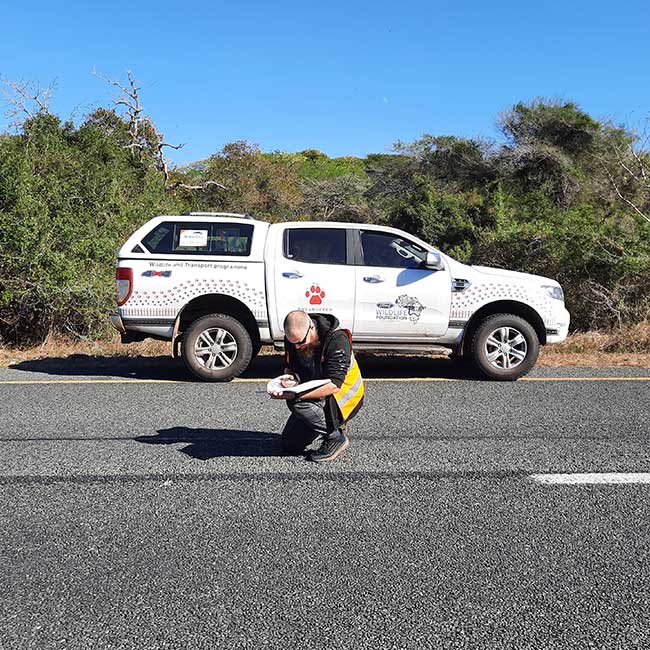
On the road to a career in conservation
Cameron Cormac, PhD Candidate with the EWT’s Wildlife and Transport Programme, ctcormac@gmail.com
I am Cameron Cormac, a PhD candidate in my second year of study at the University of KwaZulu-Natal – on my way to a career in conservation. I work with the EWT’s Wildlife and Transport Programme and Ezemvelo KZN Wildlife, researching the effects of linear infrastructure on vertebrates in Hluhluwe-Imfolozi Park and northern Zululand.
A typical day for me depends on which of the two study sites I am stationed at when I’m not back in Pietermaritzburg doing data analysis, lab work, or writing up my thesis chapters. When in Hluhluwe-Imfolozi Park, I focus on the R618, which bisects the park. My day begins an hour and a half before sunrise in the research camp near Hilltop resort, typically in pitch darkness surrounded by nothing but the sound of nocturnal insects and a light breeze blowing through the trees. A banana and a low-sugar or sugar-free energy drink help me wake up and give me some quick sustenance before I head out for an hour’s drive at 40 km/h through empty park roads. I pass through the gates of Nqumneni ranger camp before taking air and road surface temperature readings at one of three control points.
My morning survey starts after taking the temperatures at the control point on the Hlabisa side of the survey area. I spend two hours driving at 40 km/h looking for carcasses of animals killed along the 18 km survey area. A typical session sees me both trying to find carcasses for my data collection and not wanting to find too many dead animals. I usually find between three and seven carcasses. However, there are times when I don’t find any carcasses and others when there are more than 20. But every day, we are greeted by the fantastic sunrises of Zululand’s Lebombo mountains and often encounter elephants strolling down the road.
Morning sessions end with another hour’s drive back to base camp or a two-hour drive to Hluhluwe town while passing through South Africa’s oldest protected area. We’ll get several sightings of some of South Africa’s iconic animals if we’re lucky.
The rest of my days are spent doing data entry, reading linear infrastructure articles, handling project admin, preparing for nocturnal sessions, and preparing food. Meals usually consist of a light breakfast, yoghurt bowls or eggs and avocado on toast, some form of sandwich at midday and a hearty meal for dinner.

Juvenile Southern African python (Python natalensis) found crossing dirt road near Nqumeni ranger camp
My days end with a nocturnal session, typically after dinner, depending on the time of sunset, which is a rinse and repeat of the morning survey. The only difference is that nocturnal sessions provide exquisite visuals of the setting sun. Nocturnal surveys also usually give us a few very welcome, very much alive herpetofauna (amphibians and reptiles) trying to cross the road. I am a herpetologist, so this gives me great joy. These records fall into another of my data chapters aimed at identifying reptile species likely to cross my survey roads successfully. My favourite kind of bedtime story!
I sincerely thank my sponsor, the Ford Wildlife Foundation, who supplies the vehicle I use to conduct my surveys. Without their generous donation, this project would not be possible.
A brighter and more sustainable future motivating Cedarville farmers to collaborate
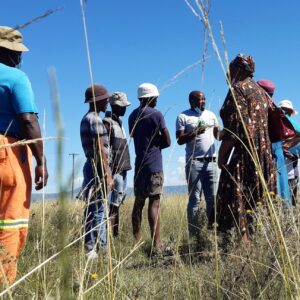
Bonnie Schumann, EWT’s Drylands Conservation Programme, bonnies@ewt.org.za South Africa’s Grassland Biome is highly productive and rich in biodiversity. However, the Grasslands are under tremendous pressure from agriculture and unsustainable mining developments. Poor planning, mismanagement, and inadequate enforcement have led to over-utilisation, degradation, and habitat loss. Altogether, 30% of the biome has already been irreversibly transformed. However, where the rangeland is still productive and extensively farmed, there are promising opportunities to reverse degradation and improve biodiversity resilience and agricultural production in the landscape. These opportunities can benefit the endemic and threatened species present and protect the livelihoods that depend on the landscape’s natural resources and ecosystem services. Farming with livestock and crops in the grasslands plays a critical role in supporting livelihoods for communities. Knowledge sharing is a powerful approach to finding solutions to challenges, particularly in diverse landscapes involving various stakeholders. With this in mind, the Endangered Wildlife Trust (EWT) engaged farmers in the biodiversity-rich grasslands of the Cedarville area in the Eastern Cape. We talked to the farmers to understand their challenges and whether they were interested in attending structured training to develop solutions to an array of sustainable land management issues together.
The Cedarville farmers face challenges primarily related to poor infrastructure on the commonages that does not support optimal grazing practices. Rangeland is grazed continuously, which does not allow the vegetation an opportunity to rest and build up reserves. Palatable species are under tremendous pressure and often disappear from the landscape, resulting in the loss of ground cover and production and an increase in undesirable plant species. Coupled with this, communities that utilise the rangeland have not had the opportunity to collaborate and coordinate their activities, limiting their abilities to manage the rangeland effectively. In addition, they cannot effectively access the highly competitive agricultural sector. Participating farmers were keen to address these issues and explore opportunities to collaborate to improve their farming practices and protect their natural resources. In February 2022, the EWT hosted an Integrated Farm Planning and Management (IFP) training course in Cedarville, attended by almost 40 farmers – double the expected turnout.
The IFP course content focuses broadly on sustainable land management principles. The original course created by the EWT was focused on the Nama Karoo Biome and is available as a free online course at https://karooforever.org.za/en/. The original course was adapted to include the Grasslands Biome content. The Cedarville course was the first IFP to be held in the grasslands, and the fourth IFP course we have presented. The EWT collaborated with Agricultural Extension officers from the Underberg Farmers Association and the Department of Agriculture and Rural Development (DRDAR), who copresented the course with staff from the EWT’s African Crane Conservation (ACCP) and the Drylands Conservation (DCP) programmes.
The Cedarville area is important for Crowned Crane conservation as the birds breed in its wetlands. Conserving Africa’s threatened crane species has benefits far beyond the cranes and their admirers. Africa’s four threatened crane species are ambassadors for conserving water catchments, including wetlands and grassland ecosystems. They are iconic and charismatic and appeal to the public, allowing us to develop relationships within communities and with other stakeholders through crane conservation activities. These grasslands supply additional non-agricultural services, such as water supply and flow regulation, carbon storage, erosion control, climate mitigation, pollination, and cultural ecosystem services. For more information on the work in the Cedarville area, contact:
Samson Phakathi, Senior Community Project Officer, Endangered Wildlife Trust’s African Crane Conservation Programme, samsonp@ewt.org.za
For resources on sustainable land management, visit:
https://karooforever.org.za/en/
The development of the original IFP Nama Karoo course was supported with funding from the UNDP GEF5 SLM Karoo Landscape Project.
The course in the Grasslands Biome in the Eastern Cape was made possible with funds from the National Lotteries Commission. The NLC relies on funds from the proceeds of the National Lottery. The Lotteries Act and regulations guide the way in which NLC funding may be allocated. The NLC wants the grants to make a difference in the lives of all South Africans, especially those more vulnerable, and to improve the sustainability of the beneficiary organisations. Available funds are distributed to registered and qualifying non-profit organisations in the fields of charities; arts, culture, and national heritage; and sport and recreation. By placing its emphasis on areas of greatest need and potential, the NLC contributes to South Africa’s development.
LATEST STORIES
Our best-kept secret
Emily Taylor, EWT Communications and Marketing Manager, emilyt@ewt.org.za
This month’s tale from the field is a special one. It isn’t often that Support Services staff based at Head Office get to write stories about field trips, or at least ones that would be interesting! But in February, the Endangered Wildlife Trust (EWT) Communications and Marketing team was given the opportunity to get out from behind our desks and venture into the spectacular Soutpansberg mountains. And what a trip it was.
The VhaVenda call it “Tha vhani ya muno” – the Mountain of salt. Rising like an island from the surrounding bushveld flatlands, the forgotten Soutpansberg is South Africa’s best kept secret and one of the country’s most unique and unexplored natural areas. The name ‘Soutpansberg’ is derived from the large natural salt pan to the northwest of the range.

The Soutpansberg Mountains. Photo credit: Suzette Britz
|
The Medike Mountain Reserve boasts 58 butterfly species, 15 scorpion, 19 amphibian, 61 reptile, 59 mammal, 229 bird, and 237 tree species. The Vulnerable Leopard, the Near Threatened Brown Hyaena and Natal Red Duiker, and the Endangered Mountain Reedbuck are among these.
|
The Soutpansberg in Limpopo is South Africa’s northernmost mountain range and forms part of the UNESCO Vhembe Biosphere Reserve. The mountainous landscape comprises an impressive variety of habitats: forest, thick thornveld, savannah, and grassland – and is home to several iconic, rare, and Endangered species, including a plethora of endemic species of both fauna and flora (which occur nowhere else on Earth)! It is also a critical groundwater source. The EWT identified the urgent need to conserve the area, and in 2015, on behalf of the Roberts family in Australia, the EWT purchased the 1,398 ha Medike Mountain Reserve in the Soutpansberg. We subsequently received funding from the Rainforest Trust to purchase a neighbouring property, almost doubling the reserve’s size.
When the EWT began working on the mountain, we embarked on several ambitious projects to restore the integrity of the mountain by clearing large patches of alien and invasive plants that had encroached on native vegetation and affected the function of the water sources on the mountain. Check out our Forgotten Mountain video to see the benefits these projects have had for the landowners and local communities. The EWT also began to engage with neighbouring landowners about interlinking their properties and creating an opportunity for the community to unite and optimise the mountain’s value as an ecotourism destination. Many landowners welcomed the opportunity for collaboration, and 17 have already decided to join the EWT in legally declaring their properties as one large protected area spanning 22,000 ha of the Western Soutpansberg, called the Western Soutpansberg Nature Reserve (WSNR). The collective vision for the WSNR is to create and protect a connected landscape under formal conservation, covering priority species, habitats, hydrologically important areas, and cultural heritage, for the benefit of biodiversity, ecosystems, and people in perpetuity.
The Old Salt Trail is one of the first projects initiated to share the mountain and its unique and diverse landscapes and cultural heritage with others, generate income for local people, and secure a sustainable future for the WSNR and Luvhondo Nature Reserves. The long-term vision is for this project to catalyse a successful ecotourism initiative, bringing visitors to the mountain in an ecologically sensitive way. Hikers will be able to experience the exceptional beauty and biodiversity on offer while gaining knowledge from local trail guides and supporting local socio-economic development within a protected environment.

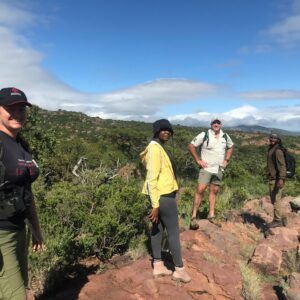
The EWT’s Communications and Marketing Team. From left to right, Kedibone Chauchau, Suzette Britz, and Emily Taylor
This particular field trip enabled the Communications and Marketing team to visit the EWT’s Medike Mountain Reserve and neighbouring properties to experience first-hand the unique mountain landscape and meet with the local landowners and communities to better understand how to market the area, and the Old Salt Trail in particular, as a unique ecotourism destination.
The Soutpansberg, and Medike in particular, is known for its astonishing diversity of landscapes and habitats , and as the geology changes, so too do the colours of the soil, the topography, the shape, size, and density of the vegetation, and the animals that occupy each habitat. And a few hundred metres later, they all change again. One minute we marvelled at the less dense thorn-veld with its brown soils, patches of golden grass, and fine-leafed thorn trees; the next, at the dense green bushveld packed with broad-leafed Bushwillows, Gardenias, Silver Cluster Leafs, and the remarkable Rock Figs that wrap themselves around and push through the mammoth rocks.
I was a field officer once upon a time, and, perhaps out of self-preservation, I often forget the utter bliss that being in the bush brings. I almost forgot that I was there for work and found so much joy just driving along, chatting to the landowners and the EWT’s Soutpansberg Rangers, and seeing first-hand what they have all achieved in the last few years. More than that, though, it was touching and inspiring to witness the connection that those living and working there have with “the mountain”, as they affectionately call it. I completely and instantly understood why they have this deep and eternal love for this land – it is undeniably one of the most enchanting places on Earth. But don’t take my word for it – you need to see it to fully comprehend its magic – contact Catherine Vise for more information on how to find the forgotten mountain.
Don’t miss out!
This spectacular range of Mountains will host the second running of the Soutpansberg Mountain Marathon. With 42 km, 21 km,10 km, and 5km courses on offer, all start and finish and Schoemansdal (30 mins from Louis Trichardt) at the base of the mountain range. The longer three courses climb up the mountain and can be considered proper challenges. To register, click here.
LATEST STORIES
Dr. Mike the Cape Vulture
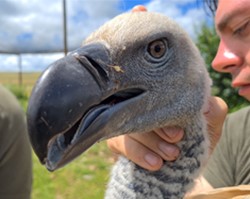
On 3 October 2021, the Lowveld BOPP team was alerted that a Cape Vulture had been found grounded on Licata Nature Reserve, northwest of Hoedspruit. The bird was initially found at sunset by the reserve wardens’ son, Stuart Reid, and although it was unclear why it could not fly, it was speculated that the bird sustained a wing injury at some point.
We arranged to collect the bird immediately after approval from LEDET, and it was taken through to Moholoholo Wildlife Rehabilitation Centre, where it was stabilised and monitored overnight by Nikkita Jackson and Rebecca Lambert. The staff there have always put an exceptional amount of effort into the rehabilitation of birds of prey and have been important allies in the past with dealing with poisoned and injured birds. The following morning, we took the bird to ProVet for x-rays, where it was immediately established that the bird had suffered a bad break to its right metacarpal. Following some emergency arrangements with LEDET, MTPA and the State Veterinary Department, we moved the bird to White River Animal Hospital, where Dr Bennie Pienaar, Dr Karien Prinsloo, and Dr Mike York did an incredible job at pinning the wing. Considering the severity of the break, it was hard to be completely confident that the bird would make a full recovery, but fortunately, the procedure was a success, and the bird could start the next part of its journey.
From here, it was then taken to Dullstroom Birds of Prey Centre, where Magdali Theron and Frith Douglas spent the next few months working their magic to get the bird back to fitness and ready to release. This is not always an easy process, and particularly at the beginning, the birds require a great deal of attention to prevent re-injury of the wing before it has fully healed. After a successful stint in the clinic, it was time to remove the bandages and the pins before placing him in one of the outside enclosures with three other Cape Vultures, two of which are non-releasable, and the third is still being rehabilitated. Fortunately, the entire process had gone incredibly well, and over the following six weeks, the bird slowly began to build up some muscle mass again until he was ready for release.
The BOPP team met up in Dullstroom on 28 January 2022 to give the bird a final check and attach a tracking device and identification ring before finally releasing it. This process could not have gone any better, and the bird immediately shot off and glided through the valley and into the distance, a great success after so much effort from several people. Although it’s still early days for this Dr Mike, he has already flown a significant distance, heading straight back to the colony at Manoutsa, popping into Mozambique, and spending some time near Shingwedzi in the Kruger National ParkThe case of Dr Mike highlights the value of collaboration between protected area management, veterinary clinics, rehabilitation centres, and conservation organisations. In combination with state-of-the-art GPS tracking, this network ensures the effective rescue, recovery, and safe release of injured birds back into the wild, where they can once again sail through the African skies. With the current declines vultures are experiencing across Africa, every individual counts. Thanks to all who played a role in the rescue and rehabilitation of this magnificent bird.
LATEST STORIES
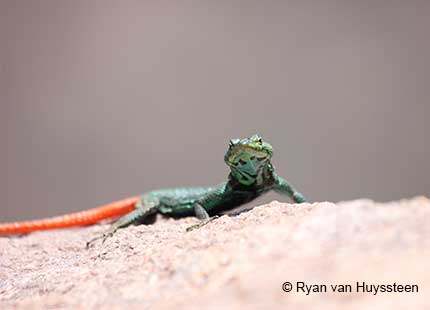
Reptile Awareness Day Shines Spotlight on Western Cape’s Scaled Biodiversity
This Reptile Awareness Day, we celebrate the remarkable diversity found at Lettas Kraal Private Nature Reserve in the Anysberg region. The Western Cape boasts 155 reptile species, with 22 found nowhere else on Earth. Situated in the transitional zone between mountain fynbos and Klein Karoo veld, Lettas Kraal’s 7,000 hectares provide critical habitat for 54 reptile species – 31 of which were recorded during a 2020 survey by EWT’s Drylands Conservation Programme.
Notable Species at Lettas Kraal
The reserve protects both common and threatened reptiles including:
- Endangered Karoo Dwarf Tortoise (Chersobius boulengeri) – IUCN Red Listed
- Karoo Sand Snake (Psammophis notostictus)
- Western Sandveld Lizard (Nucras tessellata)
- Bibron’s Thick-Toed Gecko (Chondrodactylus bibronii)
- Karoo Dwarf Chameleon (Bradypodion gutturale)
Reptile Awareness Day Initiatives
Our educational event for Anysberg landowners and farmworkers covered:
Identification of local reptile families
- Venomous snake awareness and bite first aid
- Myth-busting about snake behaviour
- Dangerous arachnid recognition (spiders/scorpions)
- Hands-on encounters with common species
Why This Matters
As former EWT Field Officer Jean-Pierre Le Roux notes, Lettas Kraal’s size makes it invaluable for reptile conservation. The reserve:
- Protects vulnerable endemic species
- Provides corridors between habitats
- Offers research opportunities
- Educates local communities
This Reptile Awareness Day, we encourage everyone to appreciate these often-misunderstood creatures that play vital roles in our ecosystems.
Learn more:
Lettas Kraal Nature Reserve
EWT Drylands Programme
Water for Life: Transforming Health and Conservation in Kutama
The Water for Life initiative, a partnership between the Endangered Wildlife Trust and Coca-Cola Foundation’s RAIN programme, is tackling critical water, health and sanitation challenges in Kutama near the Soutpansberg mountains. This holistic project addresses two fundamental needs: clean water access and menstrual health education.
The Twin Crises We’re Addressing
- Water and Sanitation
- Diarrhoeal diseases caused 1.6 million deaths globally in 2017 (Our World in Data)
- Many communities lack clean water for basic handwashing
- Our school programmes teach germ transmission and proper hygiene
- Menstrual Health
- 400 secondary school girls receiving reusable sanitary pads
- Focus groups providing vital health education
- Combating stigma while reducing waste (Ecological impact research)
Water for Life: Environmental Benefits
The initiative extends beyond immediate human needs:
- Alien plant clearing improves watershed function
- Reduced sanitary waste protects ecosystems
- Healthier communities support conservation efforts
See EWT’s Work in Action
Discover more about our Soutpansberg conservation work in our Forgotten Mountain video.
For project details, contact Dr Jenny Botha: jennyb@ewt.org.za


