LEAVING A LEGACY
The EWT relies on bequests both large and small to ensure that we continue fulfilling our vision of a healthy planet and an equitable world that values and sustains the diversity of all life. None of us can avoid the need to have an up-to-date will, ensuring that our last wishes are carried out and our legacy is continued in the way that we would choose. Including a bequest to an organisation like the EWT that you have supported in your lifetime, or that you would have liked to support, is a way to bring meaning and purpose to a life well-lived, and know that you have left the legacy of a better planet for future generations. We assure you that your legacy will make a lasting impact to the benefit of all who inhabit our beautiful country.
Your bequest will help us to…
- Empower communities to live and work in harmony with nature
- Increase safe space for Cheetahs and Wild Dogs in South Africa and beyond
- Conserve grasslands and wetlands to secure our critical water sources
- Ensure our iconic raptors remain in the skies
- Raise awareness and create connections between young people and their natural environment through our schools programmes, developing the guardians of the future
… and so much more!
Should you choose to remember the EWT in your will, you are not only helping the EWT to secure the futures of dozens of Endangered species for years to come, but you could also be providing tax benefits to your loved ones. Section 4(h) of the Estate Duty Act determines that bequests made to public benefit organisations such as the EWT should first be deducted from the nett value of your estate before estate duty is determined. This means that remembering the EWT in your will could exempt your estate from estate duty.
We are proud to be working with Capital Legacy to make leaving a legacy even easier. With a wealth of knowledge and expertise, Capital Legacy provides you with client-centric and excellence-driven service when it comes to drafting your Will, taking care of the administration of Trusts and administering your Estate in the event of your death. Capital Legacy are also the innovators of the Legacy Protection Plan™, an insurance product that completely protects your beneficiaries from the legal fees and expenses that arise when you pass away. Capital Legacy is also committed to protecting forever, together, and for every Legacy Protection Plan™ referral they receive from the EWT, they’ll be making a donation to the organisation. Find out more at https://ewt.org/get-involved/get-involved-leave-a-legacy/ or contact TammyB@ewt.org.za
TRAINING TACKLES WILDLIFE POISONING
André Botha, Manager, EWT Vultures for Africa Programme
AndreB@ewt.org.za The EWT’s Vultures for Africa Programme (VFA) has been involved in a number of Wildlife Poisoning Response Workshops at various locations in southern and east Africa during the period December 2019-February 2020. More than 100 trainees from a range of conservation organisations in Botswana, Zambia, Uganda and Tanzania participated in five workshops lead by the VFA Programme Manager André Botha. During this training, learners are provided with a comprehensive background on the drivers, motives and methods people use to poison wildlife, then we focus on enabling them to confidently assess situations on the ground to positively determine whether a poisoning incident is taking place, how to appropriately and rapidly respond to it by means of effective scene management, investigation and decontamination. We lastly work with them to draft Wildlife Poisoning Response Plans for the areas that they operate in and provide support in terms of sourcing equipment to safely conduct the management and investigation of scenes. Feedback from training recipients was very positive and we have received invitations to return for further training in Uganda and Tanzania later in the year. Another exciting development for the programme is an invitation from Cambodia to conduct similar training during two workshops in that country during March 2020. Further training interventions are also planned for the Greater Limpopo Transfrontier Conservation Area, supported by the British government’s Illegal Wildlife Trade Challenge Fund, and the Khutse Game Reserve in Botswana, in March and April respectively. The EWT has also received a firm commitment from the Junta Andalusia in Spain to assist with the development of training capacity to train poison detection dogs at various sites in Africa in the coming months. There currently are no such dogs deployed anywhere in Africa, and this ability will significantly strengthen the preventative and responsive ability of conservationists on the ground to reduce the prevalence and impact of wildlife poisoning on vultures and other species.
The work of VFA is supported by U.S. Fish and Wildlife Service
SAVING CRANES TO SAVE WETLANDS
Jimmy Muheebwa, Uganda Project Coordinator, and Janine Rennie, Southern Drakensberg Field Officer, EWT/ICF African Crane Conservation Programme
JimmyM@ewt.org.za and JanineR@ewt.org.za
Celebrated annually on 2 February, World Wetlands Day aims to raise global awareness about the vital role of wetlands for people and the planet. Wetlands are declining three times faster than forests the world over, so there is a need to sound the drums of warning against their unsustainable abuse.
The global theme for World Wetlands Day 2020 was Wetlands and Biodiversity, while in Uganda, a national theme of Life thrives in wetlands; protect them was selected, offering an opportunity to highlight both the unique biodiversity found in these ecosystems, and the need to reduce human dependence on wetland-based resources which could negatively impact this biodiversity. In Uganda, the African Crane Conservation Programme (ACCP) is using the Grey Crowned Crane as a flagship species to raise awareness for wetlands. The team was thrilled to participate in a World Wetlands Day event in Bushenyi on 7 February 2020, highlighting the crane and wetlands conservation work being implemented by the Endangered Wildlife Trust/International Crane Foundation/Nature Uganda partnership. Members of the community were also present to showcase how they conserve wetlands and the biodiversity found in these habitats, and to learn from their counterparts involved in similar work elsewhere in the country.
The team braved the hot sun, displaying their messages of enhancing the protection of the Grey Crowned Crane on a 1.5 km march from Nyaruzinga wetland to the exhibition grounds, where they then set up an exhibit showcasing the economic value of wetlands. The role of Conservation Agreements in ensuring community buy-in for this work was also highlighted. Of course, Uganda was not the only place the ACCP celebrated World Wetlands Day. The ACCP across Africa celebrated by participating in indabas, presentations, radio talk shows, clean up campaigns, restoration work, crane monitoring, community outreach and education and sharing the crane message. Activities included:
South Africa
- Participated in the Edendale Mall Mini Wetland Indaba held in KwaZulu-Natal (KZN), a busy mall situated adjacent to a wetland, which is set in an urban area with high density of people adjacent. This indaba focused on learning from one another, sharing successes and failures and networking.
- Hosted a stand at the 6th Provincial World Wetland Day in Matatiele, Eastern Cape. This event had over 500 participants from local schools, community members, municipality through to government officials and the MEC.
- Launched a community giving back campaign in the Mqatsheni area in Underberg, KZN. The aim of the campaign is for local community members to assist the local high school in any way they possibly can either through extra lessons, training, support, or being a mentor.
- Started an Eco Brick project in the Mqatsheni area to showcase the various uses of the bricks, with the aim of building a house in the area and showing what residents can do with their waste instead of just dumping it into the streams and wetlands.
- Gave a talk at Kwachibikhulu Primary School, which included a wetland clean up in Chrisiesmeer Protected Environment.
Senegal
- Celebrated World Wetlands Day in Koussabel with 20 primary school teachers, showing them around the project area, the resident cranes, and highlighting the importance of the ACCP project in the area.
- Conducted Black Crowned Crane nest surveys in Koussabel islands and Baila river and wetlands with the ACCP trained Eco Rangers to record all the nest sites in the area.
Zambia
- Officially launched the 2018 Kafue Flats Aerial Survey Report which draws attention to the Kafue Flats Restoration Programme in Zambia.
- Acted as part of the organising committee for the World Wetlands Day celebration festival, which was held in the Lochinvar National Park in Zambia. Our team hosted the Minister of Lands and Natural Resources, Hon. Jean Kapata MP, who officiated at the official celebration with the team moderating the discussions and highlighted the Kafue Flats Restoration Programme as contributing to the Wetlands Policy.
Kenya
- Took part in interviews on a local Kenyan radio station, speaking about the importance of wetlands, why we need to celebrate them, and the work that the ACCP is doing in Kenya to protect our wetlands and the birds who are dependent on them.
COMING UP TOPS
Top Trumps has teamed up with the EWT to produce a bespoke pack of Top Trumps to help bring awareness to some of our most endangered wildlife.
Top Trumps packs have been in existence since the late 1970s and were reintroduced to South Africa in 2015. The EWT pack was launched in December 2019 and was the number one selling pack at major toy retailers that month, beating the likes of titles such as Frozen 2, Toy Story, and the Lion King. For every sale, the EWT is paid a royalty.
To order yours, or find your nearest retailer, visit www.epicgames.co.za. If you would like to stock these cards, please contact David Sommer.
FARMERS FOR VULTURES
Dr Gareth Tate, Manager, EWT Birds of Prey Programme
GarethT@ewt.org.za
Many of us view the Karoo as one of the last conservation frontiers of South Africa. Vast, wild landscapes that boast rugged mountain ranges, dry riverbeds and wide-open spaces that have stood relatively undisturbed and untransformed for centuries. It is also home to an extraordinary array of large birds of prey, including Verreaux’s Eagles, Martial Eagles as well as White-backed and Cape Vultures. In many areas however, vultures have disappeared from large tracts of the Karoo landscape. Although a variety of threats occur across the Karoo, vultures’ most pertinent threat is indirect poisoning, whereby they become the unintended victims of poisons left out to exterminate predators that may feed on livestock. It is here, within South Africa’s arid heart, that the EWT’s Birds of Prey Programme has been incubating and hatching a conservation initiative to make the Great Karoo a safer place for these birds, and other wildlife, to live and thrive. At the project’s core, are the Karoo farmers themselves. A new wave of farmers that are driven to correct the mistakes of their forefathers. The farmers have teamed up with the EWT, as well as SANParks, the Mountain Zebra Camdeboo Protected Environment (MZCPE) and the SANParks Honorary Rangers, to create a Vulture Safe Zone (VSZ) in the Great Karoo. The Karoo VSZ spans across approximately 23,000 square kilometres in and around three major protected areas: namely the Karoo, Camdeboo and Mountain Zebra National Parks as well as the MZCPE. Over ninety percent of this area is privately owned. We have a unique opportunity to work with landowners to achieve the project’s long-term goal, which is to encourage Cape Vultures back to their historical ranges throughout the Great Karoo, and ultimately recover this population through the establishment of a VSZ that connects key protected areas. Importantly, Cape Vultures function as flagships for the conservation of many other species, and by removing their key threats, we also benefit other wildlife within our Vulture Safe Zone. During the first phase, the project team will conduct an assessment of current threats in cooperation with over 400 farmers, game breeders and private reserves in the area. Working actively with committed landowners, the threats will be addressed in the second phase. The Karoo VSZ Initiative can be regarded as one of the largest conservation initiatives with farmers partnering with conservation organisations like the EWT, SANParks, SANParks Honorary Rangers, and the MZCPE.
This work is made possible by Rupert Nature Foundation, Rand Merchant Bank, Puy du Fou, Charl van der Merwe Trust, and Cleveland Metroparks Zoo.
AN ARTFUL APPROACH TO CONSERVATION
Grant Beverley, Lowveld Regional Coordinator, EWT Carnivore Conservation Programme
grantb@ewt.org.za
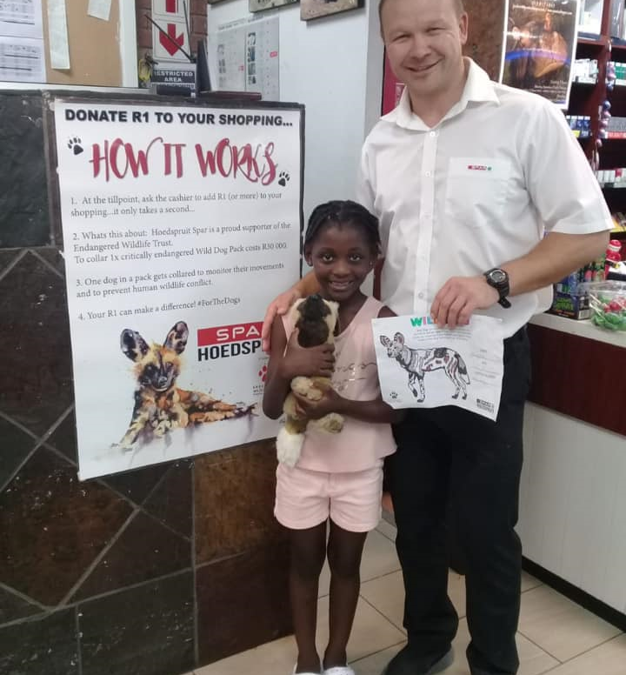
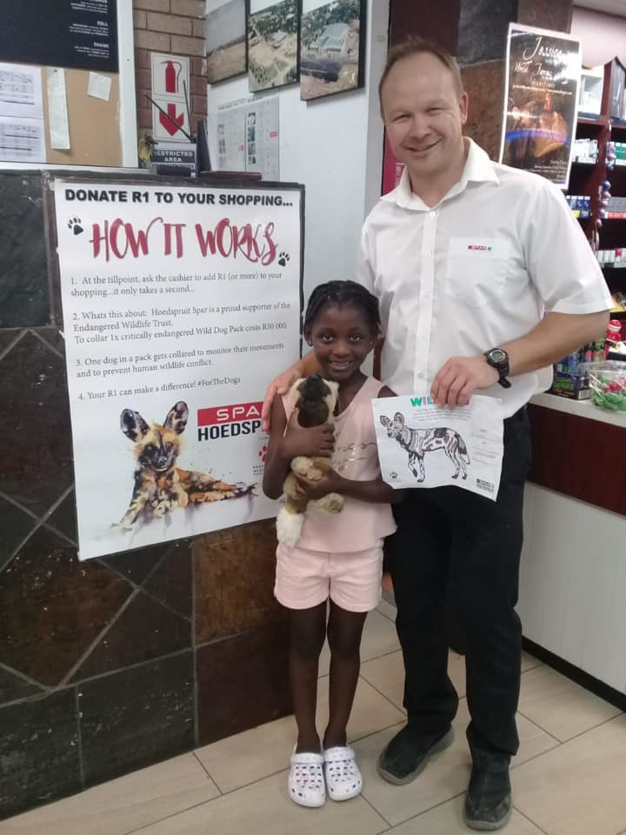
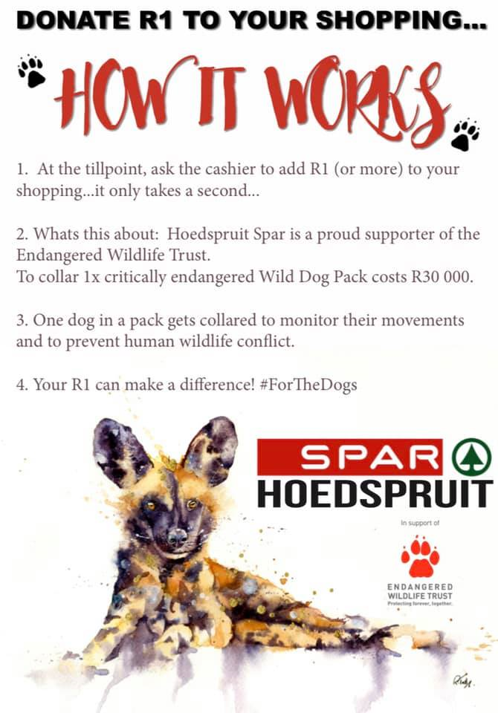
Rowan Ferreira and Hoedspruit SPAR have partnered with the Endangered Wildlife Trust to raise funds and increase awareness around the conservation of endangered species. Wild Dogs are currently the second most endangered canid in Africa, after the Ethiopian Wolf, and the most endangered carnivore in South Africa. Their behaviour is rather unique among canid species. They form incredibly strong social bonds with one another and are highly intelligent animals. Operating as a single unit, Wild Dog packs are some of the most successful predators in the world, but they need our help. Hoedspruit SPAR has encouraged customers to add R1,00 to their shopping to raise much needed funds towards the collaring of Wild Dogs in the Greater Hoedspruit area.
Hoedspruit SPAR has also launched a colouring competition for kids, where they stand the chance to win a fluffy toy and a SPAR voucher. Kulani Nyakane from the EWT recently visited Mgidi Primary School to launch the project. One hundred and ten learners from Mgidi made their voices heard through animal art, and winners were judged on the best solution to fight poaching as well as their creativity. Congratulations boys and girls!
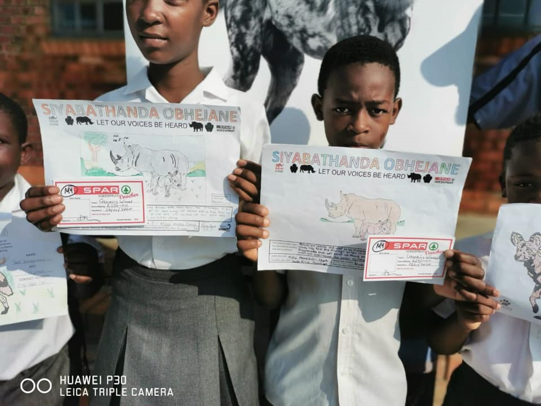
“Rhinos are special and need to be protected in order to ensure that future generations may have the privilege to see rhinos in the wild. I think there should be programmes that teach us about the importance of rhinos because the more we understand the better equipped we are to protect them.” Mnisi Mvuselelo, age 12 (grade 6)
More schools are signing up to take part, and if you would like your school to participate, please get in touch.
