SNAPSHOTS FROM THE ROAD
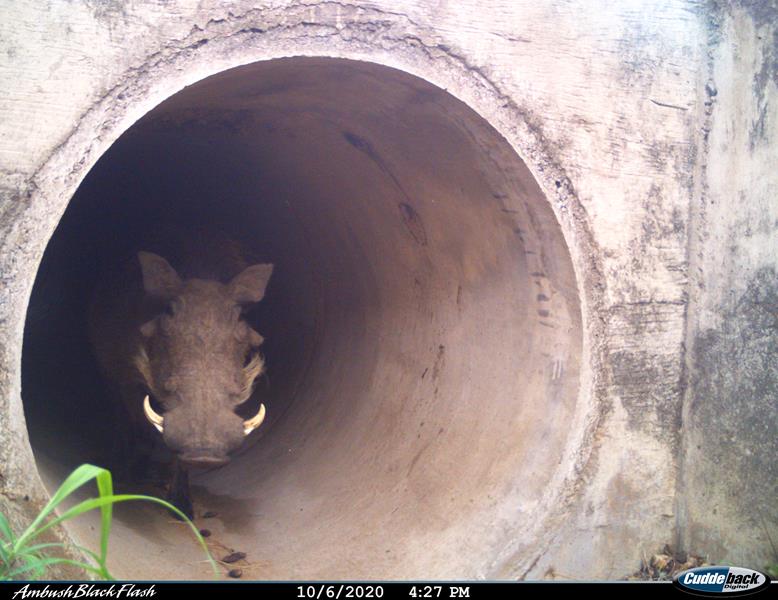
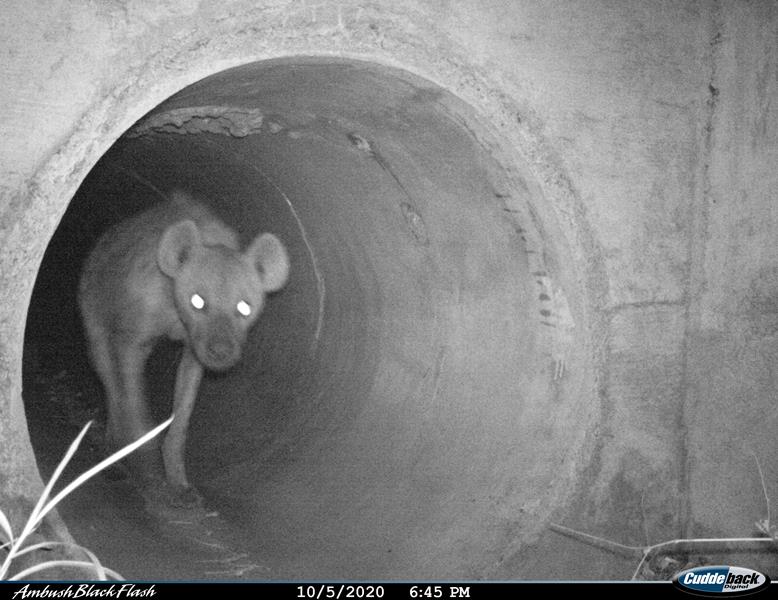
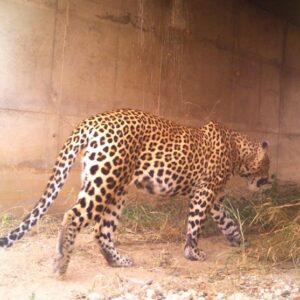
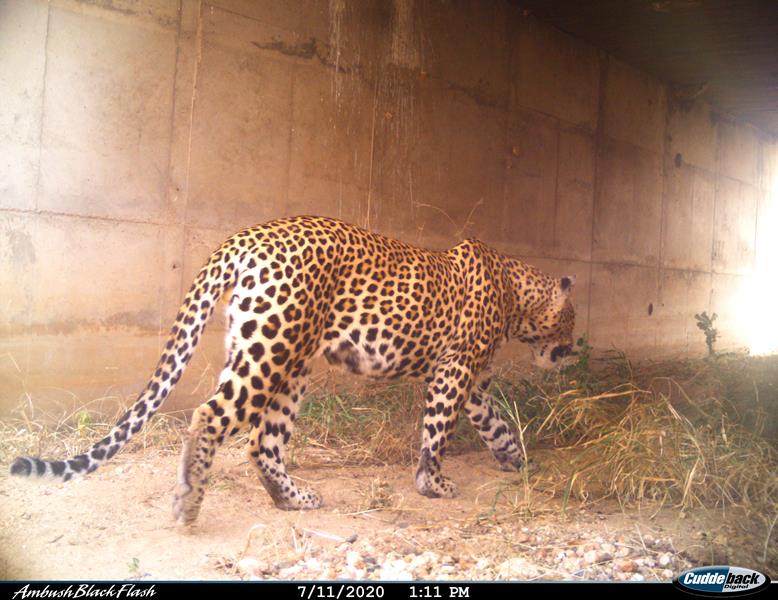
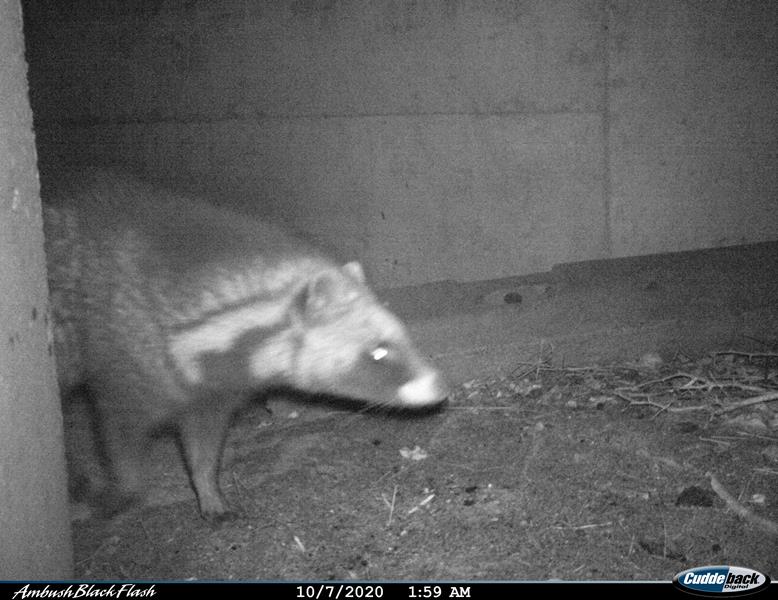
Siboniso Thela is researching rail mortalities and animal avoidance/behaviour adjacent to the railway in Balule. Here are some of the images that he has found of wildlife crossing the railway line safely using the culverts under the line. This project is supervised by Dr Lourens Swanepoel (UNIVEN) and co-supervised by Dr Mansiha Bhardwaj (Swedish University of Agricultural Sciences, Sweden), Dr Gabi Teren, Paul Allin (Transfrontier Africa-Balule), and Wendy Collinson from the EWT’s Wildlife and Transport Programme.
I WOULDN’T TRADE YOU FOR THE WORLD
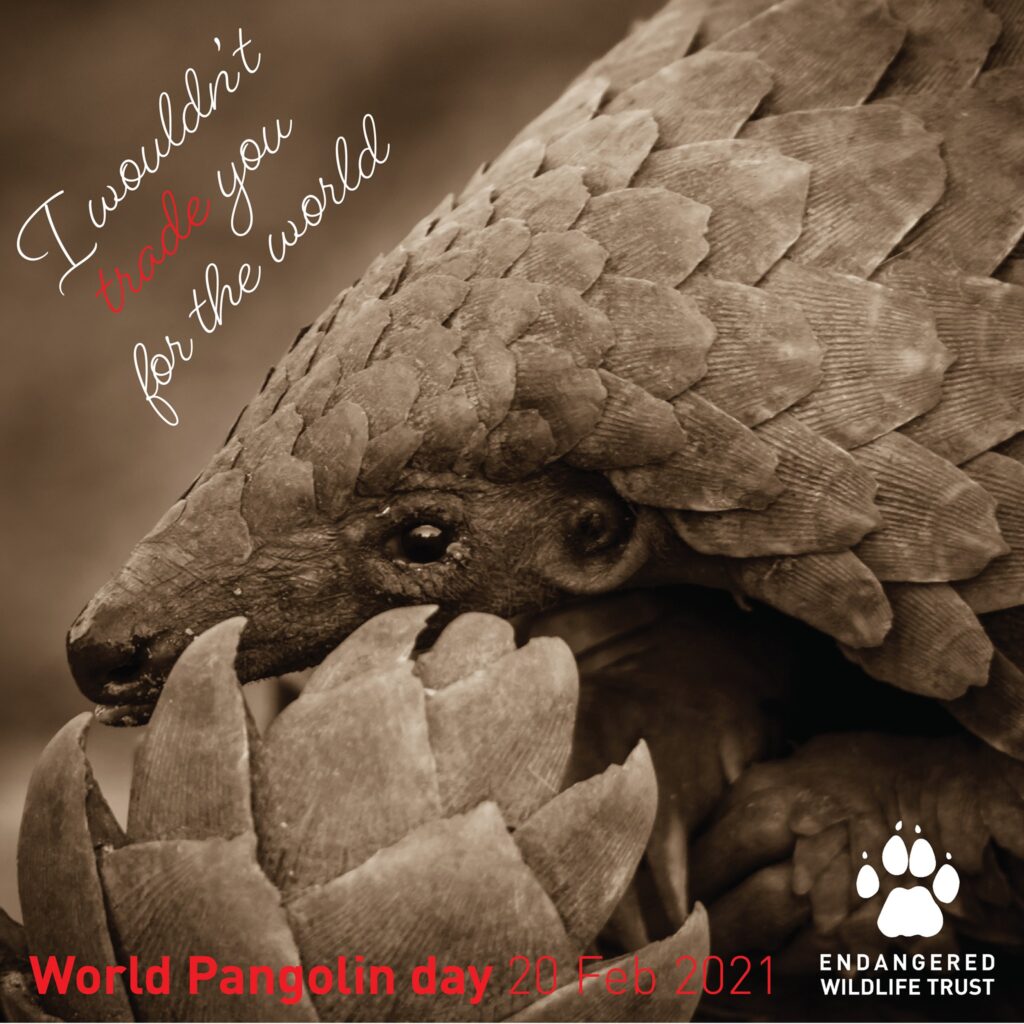
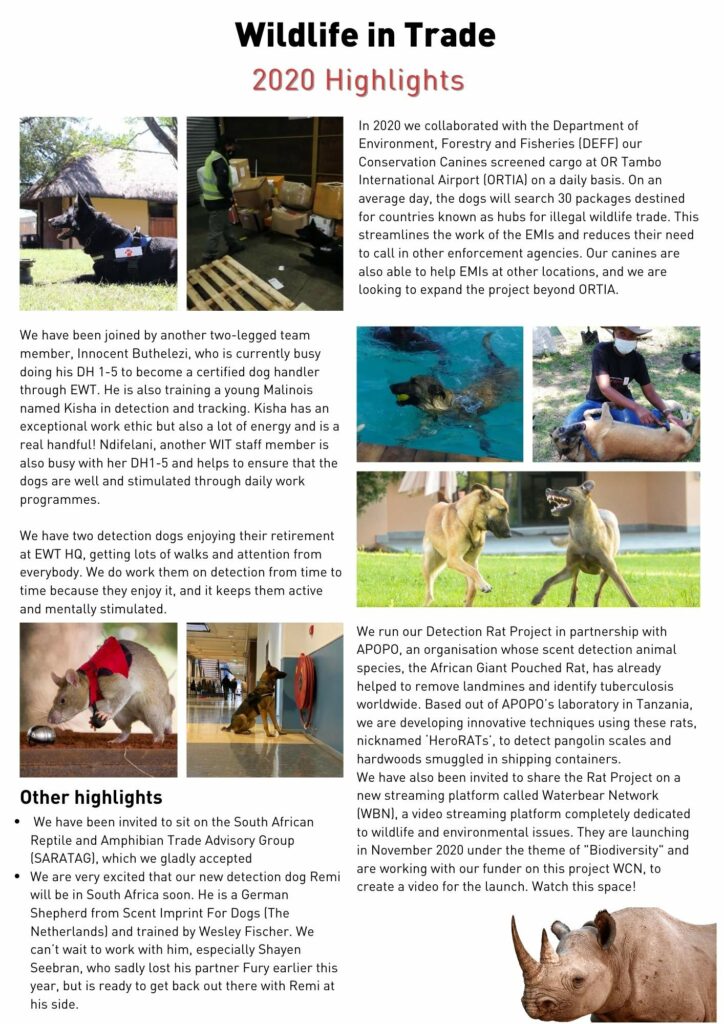
Dr Andrew Taylor, EWT’s Wildlife in Trade Programme Manager, andrewt@ewt.org.za and Ashleigh Dore, Wildlife and Law Project Manager, ashleighd@ewt.org.za On 20 February, the EWT celebrated World Pangolin Day. There are eight species of pangolins worldwide, and all are threatened with extinction and listed in the IUCN Red List of Threatened Species. The biggest threat to pangolins is illegal trade – they are the most traded mammal globally, highly prized for their scales, which are used in traditional medicine practices across Africa and Asia. Pangolins are also a source of food, as bushmeat in Africa and as a delicacy in parts of Asia. Although pangolins are shy and hard to find, they are easy to catch once discovered, making them particularly vulnerable to poachers. Add to this the fact that pangolins are uncommon, do not often survive in captivity, and have a slow reproductive rate, and we have a recipe for extinction.
The pangolin species that occurs in South Africa, Temminck’s Ground Pangolin, is currently listed as Vulnerable. We do not know the extent to which Temminck’s Ground Pangolin is trafficked out of South Africa, but there does appear to be an increasing trend in illegal catching and attempting to sell pangolins within the country because of the high prices they fetch. Pangolins and products derived from them are often trafficked around the world in air cargo or shipping containers, and these modes of transport provide an opportunity to intercept pangolin contraband. In collaboration with other conservation partners, the EWT is trying to reduce this illegal trade by placing detection dogs (aka Conservation Canines), trained to detect pangolins and their scales, in strategic sites that traffickers are likely to pass through. But they are not the only ones hot on the trail!
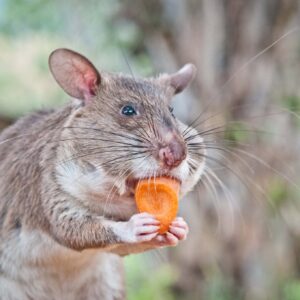
African Giant Pouched Rats have been used to detect landmines and even sniff out tuberculosis. Now APOPO, in partnership with the EWT, is training rats to detect pangolins. This Pangolin Day, we are incredibly excited to showcase this work through a feature film done by Waterbear. Subscribe now to watch how these African Giant Pouched Rats are doing their bit to protect forever, together.This work could not be possible without funding from the US Fish and Wildlife Service’s Combating Wildlife Trafficking Strategy and Partnerships Branch, the UK Government through the Illegal Wildlife Trade Challenge Fund, and the Wildlife Conservation Network Pangolin Crisis Fund.
This work could not be possible without funding from the US Fish and Wildlife Service’s Combating Wildlife Trafficking Strategy and Partnerships Branch, the UK Government through the Illegal Wildlife Trade Challenge Fund, and the Wildlife Conservation Network Pangolin Crisis Fund.
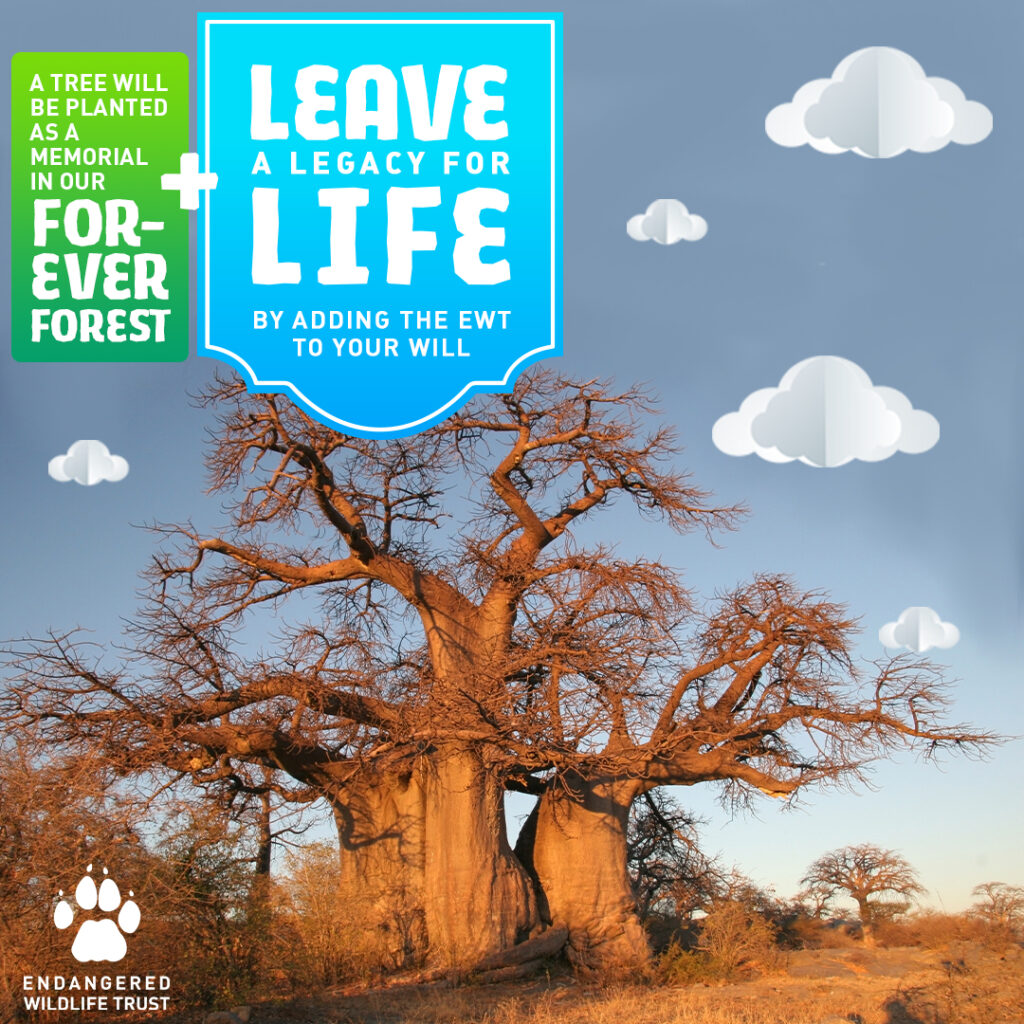
A LEGACY FOR LIFE
We were sincerely grateful to receive a moving tribute from a long-time supporter of the EWT, Greg Bond.
“I have been in communication with EWT for at least the past 20 years. This includes email education, updates on projects, donation requests, interesting presentations and their beautiful Vision editions. I have been contributing to their donation requests as they are all for a good cause as well as buying time for the future.
The continual habitat loss, stress on species and extinctions really sadden me. It is uplifting to read about the positive work and successes that EWT does and have achieved. It has been a pleasure to have helped some projects in the form of small contributions.
In this light, I have decided to leave a considerable portion of my estate to EWT, which is mentioned in my latest will.
I sincerely hope that more of your supporters do the same to help preserve and protect the environment for future generations.
Best regards, Greg.
If you too yearn for a better future for your children, leave a Legacy for Life by remembering the EWT in your will, and help us secure the health of our planet and its wildlife beyond your lifetime.
All bequests made to the EWT create legacies for life that are immeasurable and remembered through the survival of our endangered species and spaces.
CONSERVING CRANES AND COMMUNITIES
Dr. Lara Jordan, EWT African Crane Conservation Programme Field Officer, laraj@ewt.org.za
“The wind does not break a tree that bends”.
– Sukuma Proverb
We have all adapted to the new normal of social distancing and wearing face masks. As we all think about the year 2020, it might look like a dark portrait, but the picture is made beautiful by different streaks of bright colours. These bright streaks represent the generous gestures that brought hope to the lives of community members across Uganda, Kenya, and South Africa.
We are all dealing with the collective loss of the world we knew. Grieving the loss of jobs, livelihoods, physical connection with friends, loss of our daily routines etc. This has given people the world over opportunities to show our care for each other, and a little help has indeed gone a long way, not only through humanitarian efforts but also in building trust and hope across communities that we work with.
When COVID-19 struck in Africa, there were speculations that the warm, tropical weather of Africa would shield the developing countries from the virus, but to-date, the cases reported are still rising. Yet even after warnings that the African continent’s healthcare systems would not be able to bear the weight of the virus, Africa has resisted and continues to weather the storm of the pandemic. This has in no small part been a result of heroes who chose to go out of their way to help where they could.
Many families in East Africa, in the communities with which we engage, live in rural areas, and the work they are able to find is often only on a casual basis and pays enough money to feed their families for the day. When the pandemic struck, most of these families did not have a “work from home” policy, as their livelihoods depended on getting out and hustling to get their daily bread. Today, we choose to celebrate heroes that might be unnoticed but have played important roles in the lives of communities during this pandemic.
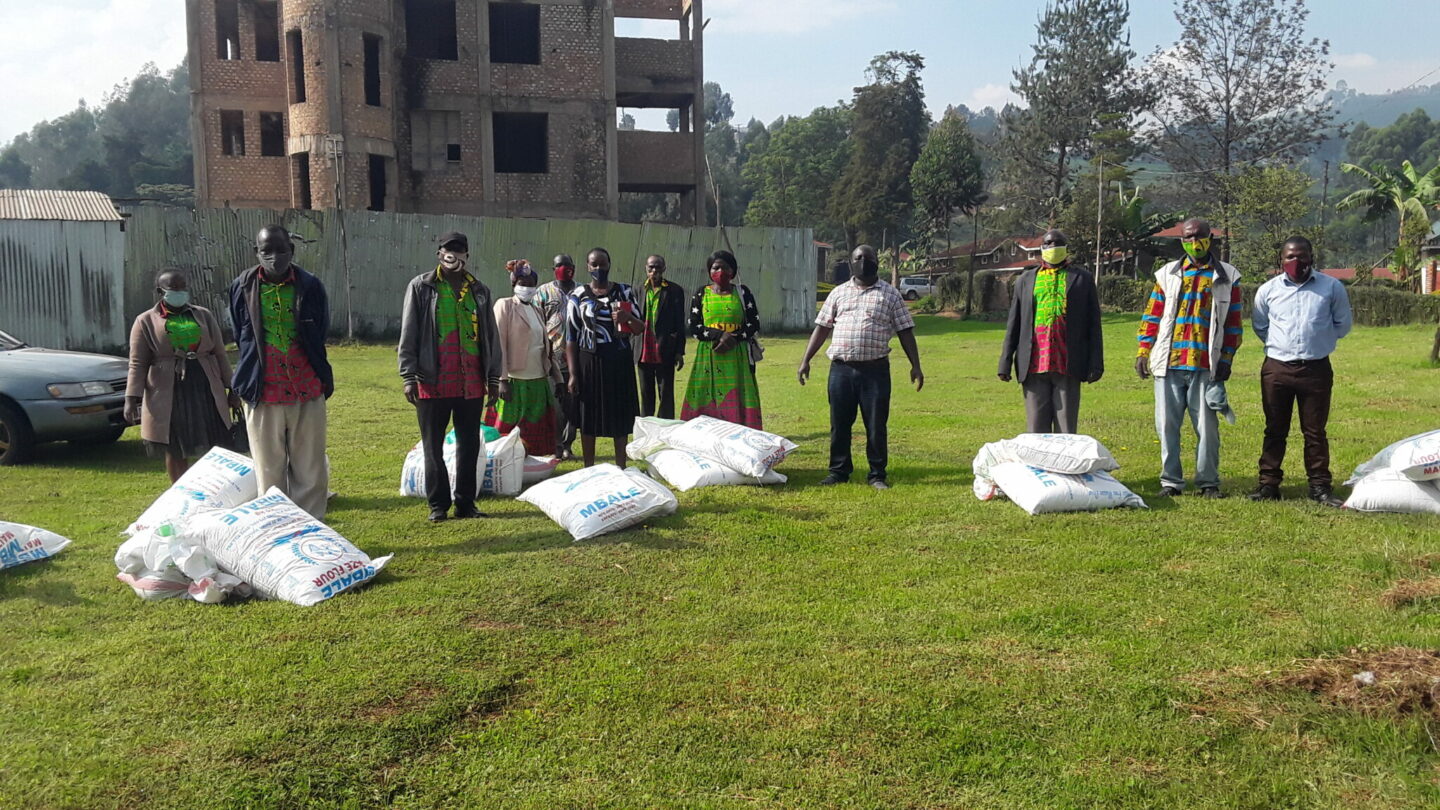
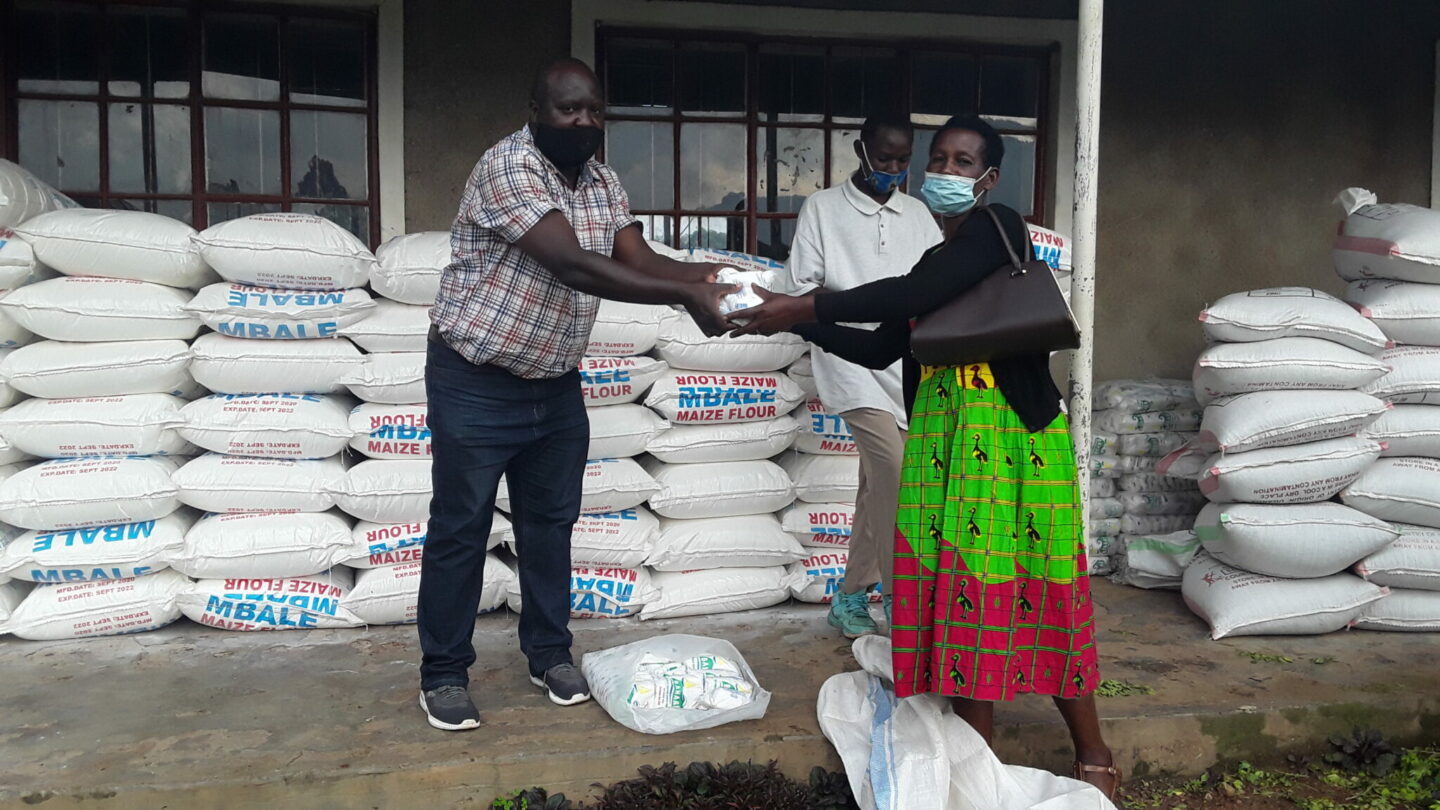
The Leiden Conservation Foundation provided generous support to families across East Africa, and as a result, many were cushioned over this difficult period.
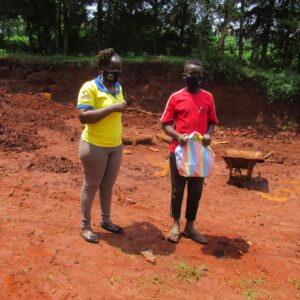
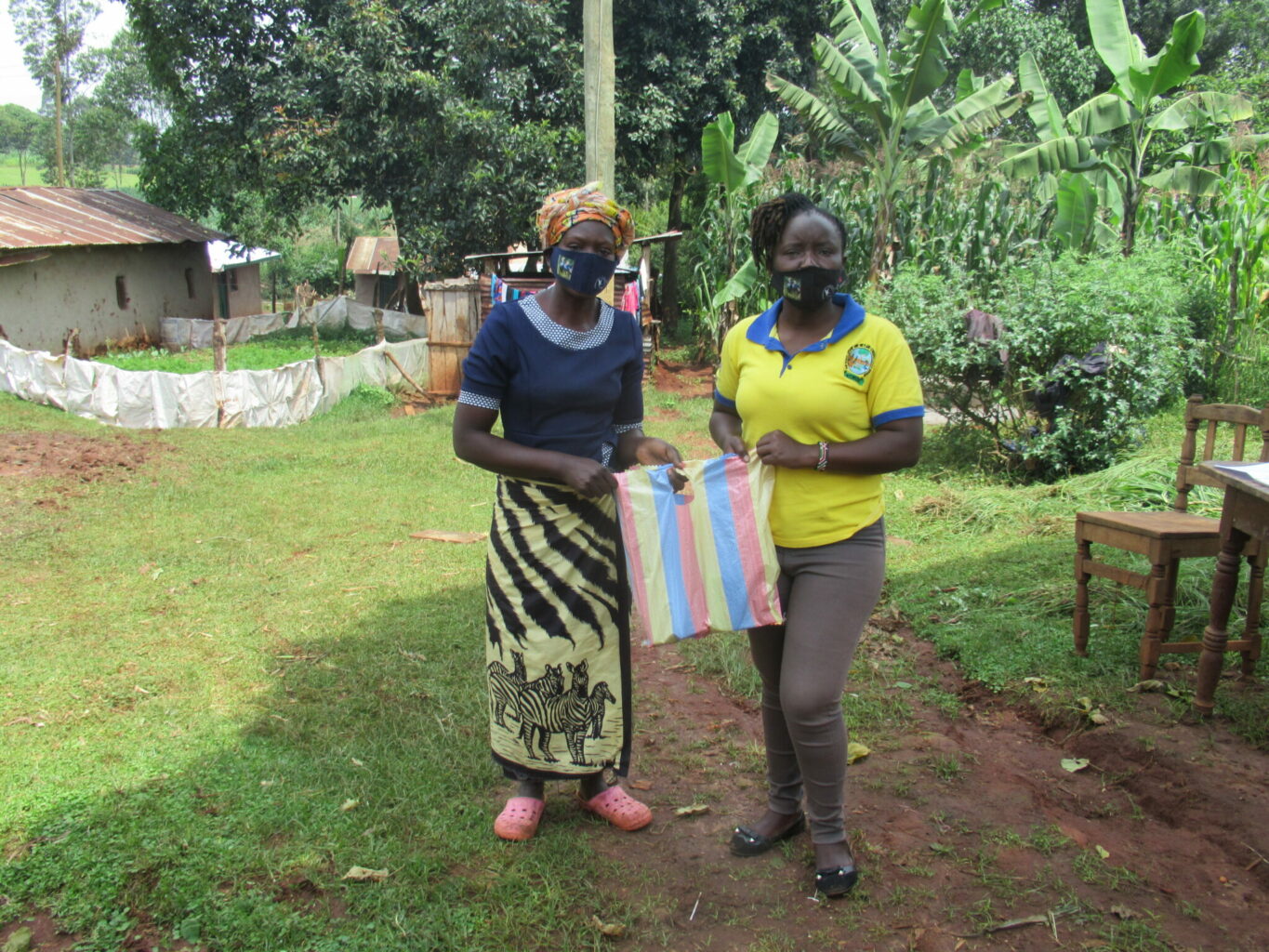
In Kenya, 238 households with an average size of 7 people were beneficiaries of masks, bar soap and handwashes (1,666 individuals). In Uganda, 34 Crane Custodians benefitted from food relief packages, including 100 kg of maize flour, 30 kg of beans, and 10 kg of salt per person. In Rwanda, face masks, soap for handwashing, cooking salt and hoes for cultivating, were distributed to 284 households, 100 fodder farmers, and 184 beekeepers (beneficiaries of conservation agreements).
In South Africa, HCI Foundation and The Lewis Foundation enabled the delivery of food parcel across four rural communities of the Eastern Escarpment, this generous donation helped beat hunger for the marginalised in the communities. An additional 299 food parcels were delivered across three communities that were so rural that it took four days to deliver the parcels, and more recently, a further 73 food parcels, weighing over 40 kg, were delivered to two rural communities. The average household size within the communities was six members, adding up to a total of 1,398 individuals that received food.

Supporting communities in this way has been vital during this period, not only for the benefits to communities but also the benefits to wildlife. Community engagement and reporting has increased during this period, despite the difficulties of lockdown, and through this support, it has become apparent that communities have embraced crane conservation, which we hope will help to steadily increase crane numbers within these vital areas. And that is how we change the world – “One random act of kindness at a time” (Nelson Mandela)
WORKING WITH WILDLIFE: SOME SNAPSHOTS OF 2020
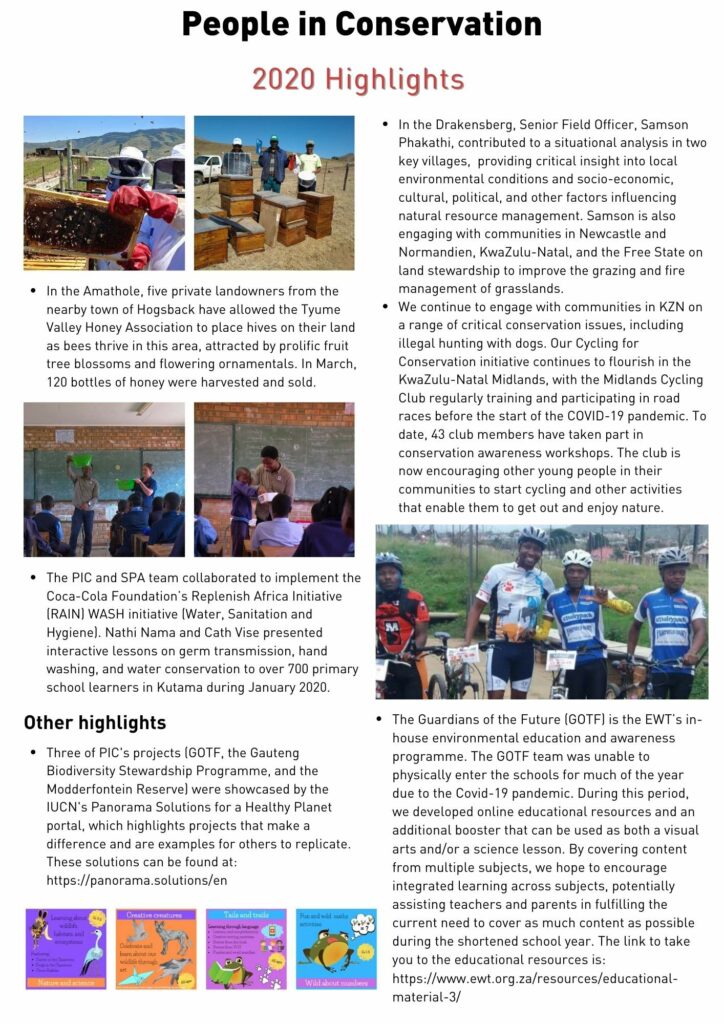
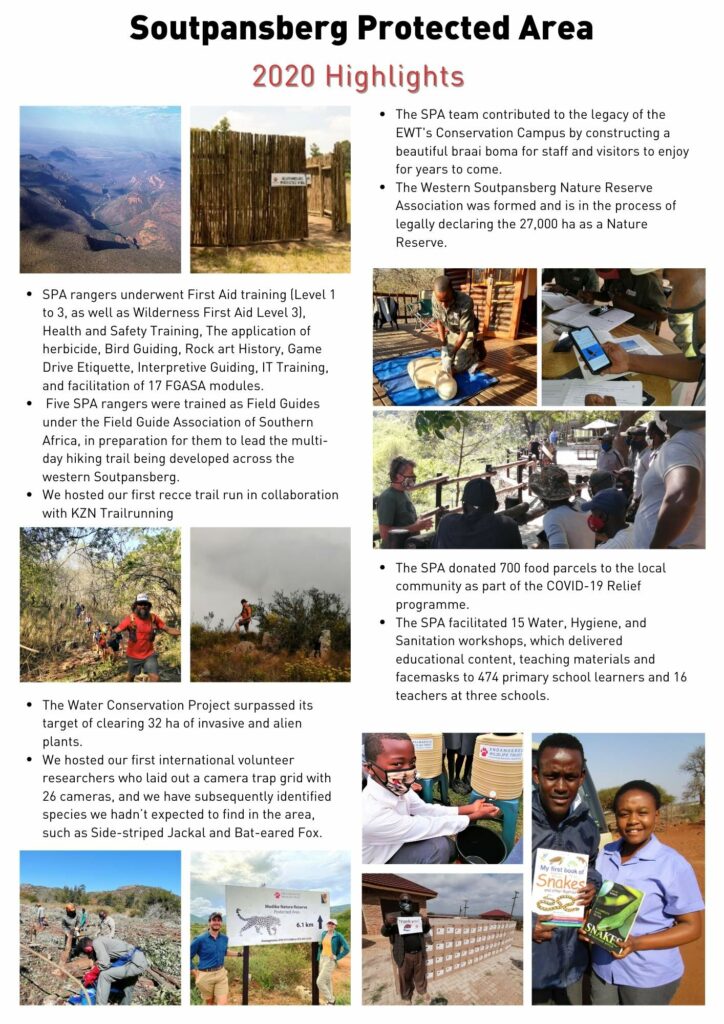
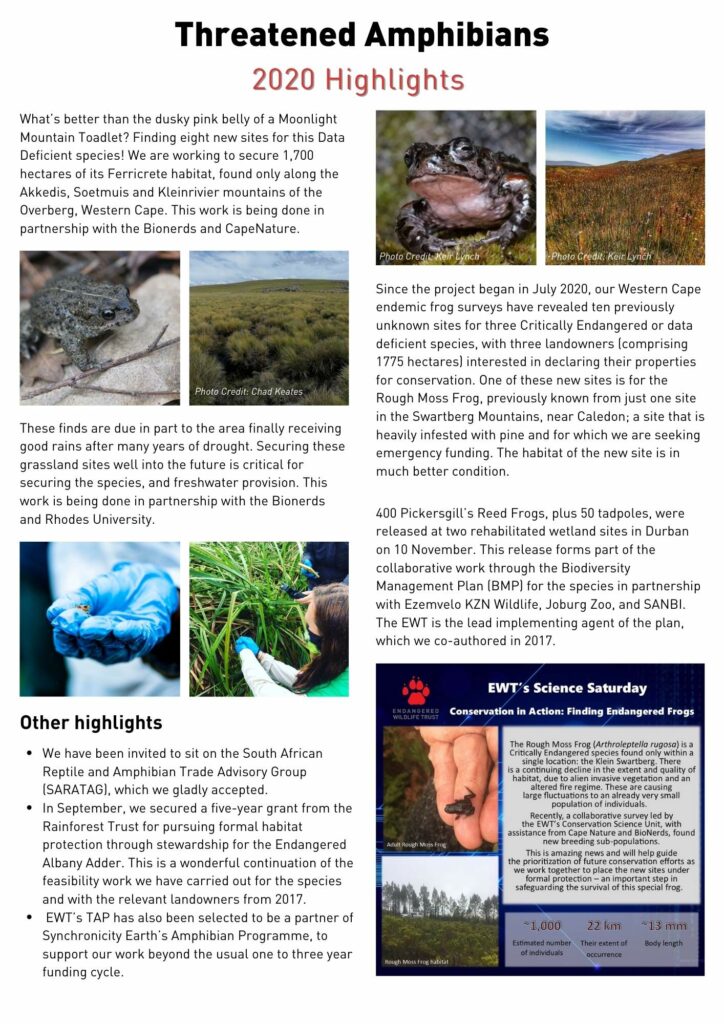
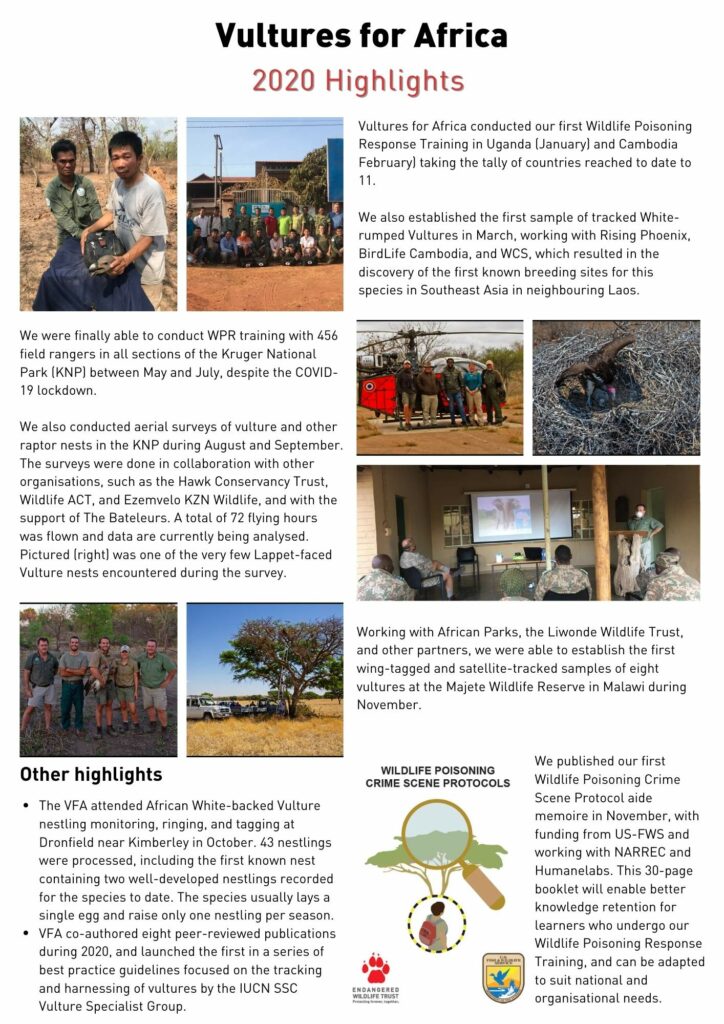
Emily Taylor, Communications Officer, emilyt@ewt.org.za The year 2020 has undoubtedly been one for the history books. While much of what made this year extraordinary was directly or indirectly a result of COVID-19, it is important to remember the full picture: the limitations, disappointments, delays, and much, much loss, but also the achievements, innovative solutions, connections, and significant technological strides that have been made across the world. These innovations have enabled the continued functioning of many businesses by making working from home possible or developing online platforms or delivery services to survive the lockdown restrictions.
A year in the life of the EWT is never dull, and instead of slowing down during lockdown, we picked up the pace and made sure that despite the challenges, we found inventive ways to meet our conservation objectives, and we achieved great things for wildlife, landscapes, and people. Here are some snapshots from a few of our programmes’ highlights of working with wildlife in 2020
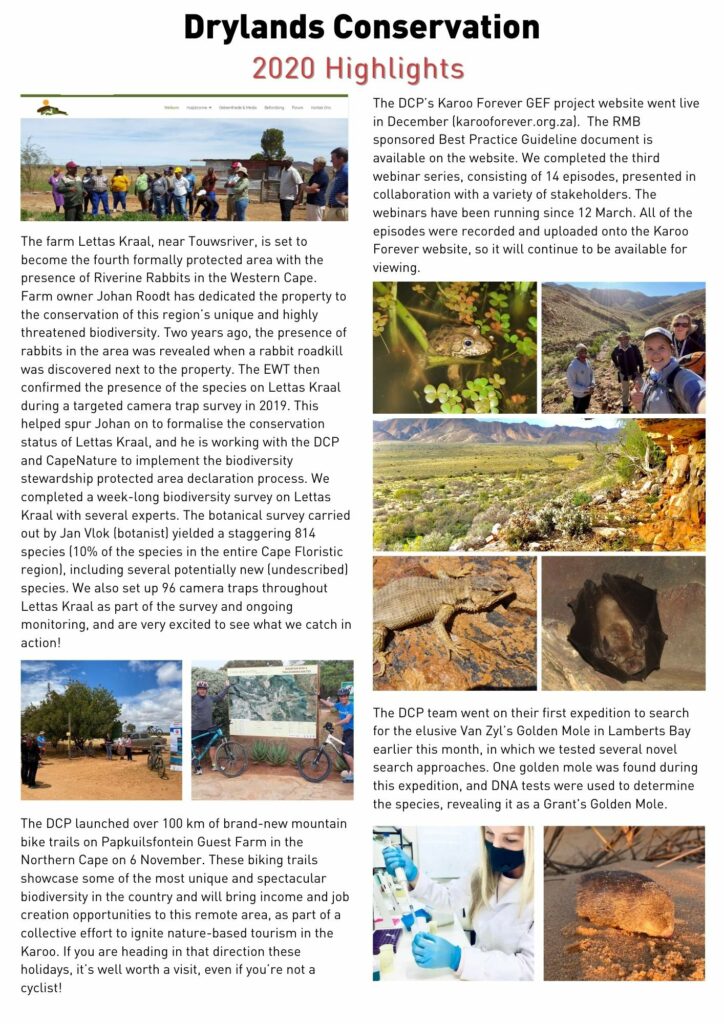

𝐂ONSERVATION THAT COUNTS: THE EWT’S INTEGRATED REPORT FOR 2020
The Endangered Wildlife Trust is proud to share with you our 2019/20 Integrated Report, which provides an overview of the EWT’s conservation impact throughout the region in our previous financial year.
Thank you to all of you who have weathered the storm of 2020 by our side, we could not have achieved all of this without you, and we look forward to all we will accomplish together in 2021.
To read more click here