CONSERVATION CHAMPION
vc_column_text css=”.vc_custom_1633342873766{padding-top: 5px !important;padding-right: 5px !important;padding-bottom: 5px !important;padding-left: 5px !important;background-color: #ffffff !important;}”]A very big thank you to Nika Viljoen, who raised R5,600 for the EWT at her school, Potchefstroom Gymnasium, by encouraging learners to wear flip-flops for the day in exchange for a donation. This is what she had to say:
“I have always been someone who cares and who wants to make some kind of difference and this side of me started to really itch when I was 12/13. I would always try and come up with some kind of idea to do something, to help someone or make an impact, and that’s when the thought occurred to me to do a fundraiser. I came across the EWT, and everything they do immediately pulled me in. Nature and the incredible creatures God gifted us has always held a special place in my heart, and the fact that we are killing them, destroying their homes and taking away their families devastated me, and I knew I had to do something, anything to try and help, and raising funds for EWT was the perfect opportunity.”
I feel like we raised some good funds and I am eternally and incredibly grateful for the opportunity I got, but I am definitely not going to stop there. I will keep on trying to make a difference, step by step.”
“We need your help! The global covid crisis has shown us more than ever how important it is to work together to support the future of our planet – the people, the environment and the animals within it.
We will be running together and on our own over the next few months, and we will add our distances together to make up the 535 km journey from our school to Big Ben in London. We hope you will cheer us on by donating to this very worthy charity – www.ewt.org.za”
GUEST ARTICLE: MY JOURNEY IN ROAD ECOLOGY
A rewarding part of my career has been training and capacity-building and seeing people and organisations become local, regional, and world-leaders in their work. A highlight for me has been watching the growth of Wendy Collinson and the Endangered Wildlife Trust to become local and international leaders in transportation ecology.
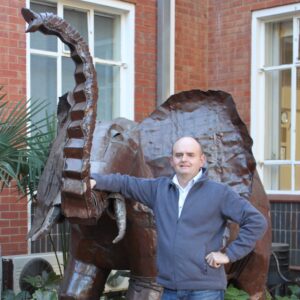
My name is Dr Rodney van der Ree, and I first met Wendy Collinson in around 2010. Our first collaboration was to co-organise a symposium at the International Wildlife Management Congress in Durban in 2012, followed by a workshop at the EWT office in Johannesburg a couple of days later. The concept of ‘road ecology’ was explored for the first time in Africa at these two events, and participants clearly understood its importance. Wendy and the team at EWT continued to develop the program and established partnerships with local road agencies (namely Bakwena, N3TC and TRAC N4), SANParks and universities to begin collecting data and training students.
In 2015 I returned to South Africa to support another series of workshops on road ecology in Africa run by EWT at a conference in Howick (The Symposium of Contemporary Conservation Practice) and Johannesburg (The Green Mile). It was incredible to see the growth in the field since the initial visit in 2012 and participation by a larger and more diverse group of people. This was also an exciting trip for me because I brought about 30 copies of my recently published ‘Handbook of Road Ecology’ (www.handbookofroadecology.org), which included four chapters from Africa, including a Chapter by Wendy and colleagues at the EWT. The handbook has 62 chapters written by more than 100 leading transportation ecologists from around the world, and I have half-price copies available as part of the 2nd ACLIE congress (see ACLIE article) that was just held. If you are interested, please send me an email rvdr@unimelb.edu.au and I can give you a quote for postage.
I started my career as a post-doctoral researcher at The University of Melbourne Australia and very quickly became focused on quantifying and mitigating the impacts of roads and traffic on wildlife. With numerous students and collaborators (including Dr Manisha Bhardwaj, who wrote an article in this newsletter last month), this field of research and practice’s critical importance is growing rapidly. I have since moved into ecological consulting to work more closely with those who are planning, designing, building and managing the roads, railways and other linear infrastructure that is being built across Africa at a pace never seen before. In an effort to improve access to important information, I established the open-access resource hub www.TransportEcology.info earlier this year, with Wendy and Lucy Waruingi (from the African Conservation Centre) on the editorial board. The site includes blog-style summaries of relevant peer-reviewed scientific articles, as well as space for case studies and best-practise notes. You are invited to submit your articles for publication and encouraged to subscribe to receive notifications when new articles are published.
Transportation ecology in Africa has come a long way since Wendy, and I ran those initial meetings almost a decade ago. With Wendy spearheading the establishment of ACLIE and the successful online ACLIE congress in August 2021, there is now a much larger group of people involved and dozens of research and management projects across many parts of Africa. Importantly, there is a growing realisation in government of the need for applied research, comprehensive environmental impact assessments, and innovation to ensure the roads, railways, and other linear infrastructure we build today do not undermine our ecosystems’ ecological integrity and sustainability for decades to come.
LATEST STORIES
FIRE FOR FROGS: USING PLANNED BURNS TO SAVE THE HABITAT OF THE CRITICALLY ENDANGERED ROUGH MOSS FROG
Alouise Lynch, Bionerds, alouise.lynch@bionerds.co.za
Jeanne Tarrant, EWT Threatened Amphibian Programme Manager, jeannet@ewt.org.za
Kier Lynch, Bionerds, Keir.lynch@bionerds.co.za
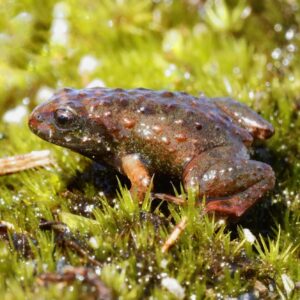
The Klein Swartberg Mountain towers above the town of Caledon in the Western Cape of South Africa amidst a field of agricultural development. This lone mountain is home to the only known populations of the Critically Endangered (IUCN Red List 2016) Rough Moss Frog, a minuscule amphibian species that requires moist mountain seeps to breed. These habitats are severely at risk from encroaching alien pine infestations threatening to dry out these crucial habitats.
The Endangered Wildlife Trust’s (EWT) Threatened Amphibian Programme (TAP) included the Rough Moss Frog as a species of conservation priority given its endemicity, high level of threat, and known population decline (IUCN Red List 2016).
During initial surveys conducted by EWT in May 2020, we observed a marching forest of alien vegetation engulfing the then only known population of Rough Moss Frogs. It became evident that rapid intervention, in the form of an ecological burn, was needed to save and secure this population. Unfortunately, the Covid-19 epidemic halted all efforts to implement any interventions in 2020. The Rapid Action Grant from the IUCN Save Our Species and the European Union awarded to this project in May 2021 will be used to create a firebreak around the Rough Moss Frog populations in the coming months. Thereafter, in early 2022, a controlled ecological fire will be used to manage the aliens. The subsequent clearing of pines will create job opportunities for local alien vegetation clearing teams from the Caledon community.
In July 2021, we held stakeholder engagement meetings and conducted a site visit with the EWT, Enviro Wildfire, the Fynbos Trust, the Klein Swartberg Conservancy, Overberg Agri, and Bionerds to establish the placement of the firebreaks on the Klein Swartberg Mountain. We made an exciting discovery of a new population of Rough Moss Frogs during the site visit, further emphasising the importance of this rapid intervention!
This project is funded by the IUCN Save Our Species and the European Union. The IUCN Save our Species aims to improve the long-term survival prospects of threatened species. It also focuses on supporting the species’ habitats and working with the communities sharing this habitat. It achieves success by funding and coordinating conservation projects across the globe. The Member States of the European Union have decided to combine their know-how, resources, and destinies. Together, they have built a zone of stability, democracy, and sustainable development whilst maintaining cultural diversity, tolerance, and individual freedoms. The European Union is committed to sharing its achievements and values with countries and peoples beyond its borders.
LATEST STORIES
AFRICAN CONFERENCE FOR LINEAR INFRASTRUCTURE AND ECOLOGY
Wendy Collinson, EWT Wildlife and Transport Programme Manager, wendyc@ewt.org.za
Lourens Leeuwner, EWT Wildlife and Energy Programme Manager, lourensl@ewt.org.za
Sarah Chiles – Landscape Infrastructure Advisor – Kenya, Ewaso Lions and Grevy’s Zebra Trust, chiles.sarah@gmail.com
Harriet-Davies Mostert, EWT Head of Conservation, harrietd@ewt.org.za
The second African Conference for Linear Infrastructure and Ecology (ACLIE), co-hosted by the Endangered Wildlife Trust (EWT), Grevy’s Zebra Trust (GZT), and Ewaso Lions (EL), took place between 12 and 17 August 2021. The first ACLIE conference was held in 2019 in the iconic Kruger National Park, South Africa, with 115 participants from 21 countries. ACLIE 2021 attracted almost 200 participants from 25 countries, 11 of which were African. We also had participants with diverse backgrounds from the engineering, ecology, policy, and finance sectors.
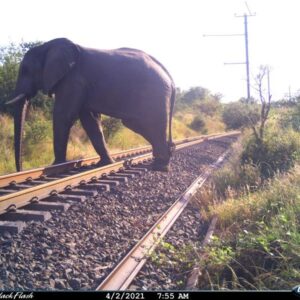
Linear infrastructure is essential for connecting society: our roads, railways, pipelines, and power lines link our cities, developments, resources, energy and water supplies. Therefore, it is perhaps ironic that linear infrastructure does exactly the opposite for natural systems – by crisscrossing landscapes, linear infrastructure serves to fragment ecosystems, isolate populations, and reduce natural flows. Roads, railways, fences, and power lines constrain animal movement, pose direct threats to species from collisions and indirect threats from increased human access to previously untapped resources, and new pathways for invasion by alien flora and fauna, with significant ecological consequences.
In many ways, Africa represents the final frontier for infrastructure development. The continent’s population has doubled in the last three decades and currently stands at 1.3 billion. Most experts agree that if it continues at its current rate, Africa’s population will double again by 2050. This means that about two-thirds of the world’s population growth is expected to take place on our continent, and by 2050 Africa will be home to more than a quarter of the world’s people. As populations and economies grow, they require greater investments in infrastructure. Over the next few decades, we will need significant investments in railways, roads, energy, and other infrastructure to meet the growing demands of emerging African economies.
ACLIE 2021 intends to foster and build on cross-sectoral African engagement and encourage the exchange of solutions around “Connecting for Resilience”. Considering the most pressing issues of our time – climate change, biodiversity loss, COVID-19, and the spectre of future pandemics – efforts to maintain ecological and human resilience are critical. The ability of ecosystems to maintain their functions and services is fundamental to sustainable development and human health.
This year’s conference was centred around four major sub-themes, one for each day. The first theme was centred around adapting to climate change, the second on innovating for mitigation and improvement, the third on planning for snowballing and cumulative impacts, and the fourth and final theme centred on applying economic tools and finance for reducing environmental impacts. After nearly a year and a half of the global pandemic, we’re all extremely familiar with online engagement, and this format has certainly enabled the participation of people from afar and allowed for constructive interaction among participants.
Each day, this conference kickstarted with an indaba, with a line-up of esteemed experts who shared their insights around the specific theme for the day. These were followed by the 20×20 sessions, where a series of presenters presented 20 images from a project they are involved in for 20 seconds. These included mitigation measures used in Cape Town to assist the Endangered Western Leopard Toad to cross the road, the use of a remotely piloted aircraft system (i.e. a drone) for marking power lines, and using bioacoustics methods to understand the linear movement of Endangered marine mammals. There were so many fantastic presentations about African issues that it is hard to select just a few to provide examples.
A new type of presentation for ACLIE was the Lion’s Den session, which provided a space where solutions were pitched to a panel of leaders, with opportunities for questions and input from the audience. Pitches included an intelligent green and grey infrastructure design system (iGGIDS), which obtained buy-in from the ‘Lions’, and the redesign of a roadkill reporting app.
Each of the first three days ended off with specialist training sessions delivered by leaders in their fields. This kind of training contributes strongly to the capacity building element of ACLIE and featured training on ‘Economic tools for informing linear infrastructure decision making’, energy system reliability through wildlife interaction mitigation’, and ‘design, construction and maintenance of wildlife crossing structures’.
Leonard Sielecki, Wildlife Program Manager from the British Columbia Ministry of Transportation and Infrastructure, said, “I am very impressed by the large South African and African representation. You have attracted a very impressive, very comprehensive range of wildlife protection-related people from the African Continent.”
Further to this, Kishaylin Chetty, Senior Environmental Advisor for Eskom, said, “The ACLIE conference is an exceptional event, that coordinates industry, civil society, government, and specialists to come together to discuss theory and feasibility surrounding linear infrastructure and its practice through Africa. The conference is a founding pillar towards responsible development in Africa.”
“ACLIE has been an extremely important convergence of knowledge, expertise, and practice from the linear infrastructure and ecology and conservation worlds. We have seen everything from demonstrations of laying overpasses to the importance of road verges and powerline diverters. Critically, we have also received commitments from major financiers of how they intend, and are, streamlining their policies to ensure that, as Africa builds new infrastructure, our landscapes will remain connected, and we will remain the drivers of the process. There are few things more hopeful”. Resson Kantai Duff, Deputy Director of Ewaso Lions
“Despite the challenges of holding a conference remotely, ACLIE 2020 was superbly organised and moderated. Participants were lively and active, and I got to meet and learn from a lot of globally experienced ecologists and industry professionals. I especially enjoyed listening to cutting edge innovations in modelling and data collection as well as successful Private-Public Partnerships that have informed infrastructure development. Can’t wait for the next conference!” David Kimiti, Deputy Director Research and Impact, Grevy’s Zebra Trust
We want to extend our thanks to AfricaMassive for logistical support of the event, Dr Rodney van der Ree and Dr Fraser Shilling for the donation of the prizes, and all the speakers and attendees, without whom this conference would not have been possible.
Finally, we’d like to announce that the next ACLIE will be held in Kenya in 2023.
LATEST STORIES
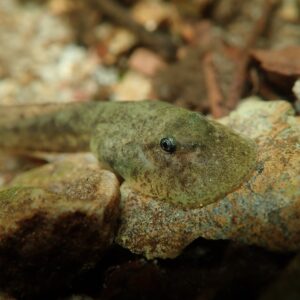
IGNORANCE IS BLISS: THE UNNOTICED IMPACTS OF ENJOYING NATURAL SPACES AND THE ROLE WE ALL NEED TO PLAY IN CONSERVING THEM.
Joshua Weeber, Threatened Amphibian Programme, joshuaw@ewt.org.za Despite our relatively recent urbanised society, most human beings still feel an innate need to immerse themselves in nature. To marvel at the magnitude of mountains, to feel the still, earthy air of a dense forest, to listen to the gentle trickle of a mountain stream – these are experiences that add value to our lives and provide us with space to think and feel. Unfortunately, this growing realisation of our need to interact with nature is mirrored by the disappearance of natural spaces themselves, destroyed mostly by human-related development. What is left are isolated natural spaces under increasing pressure from a growing human population, all searching for the peace that only nature can provide. While the increasing use of wild spaces shows an appreciation for their importance and beauty, nature lovers need to acknowledge the cumulative impacts of our presence in these spaces and ensure we play an active role in preserving them for future generations to enjoy.
One of these spaces is the iconic and popular Table Mountain, a beacon of hope that provides a place to escape the bustling metropolis of the Mother City from which it emerges. Anyone living at the foothills of this mountain will tell you how lucky they are to have access to such a beautiful natural space, close enough for a morning run or an afternoon walk through the forest with the dogs. Looking at the sheer rock walls, endless fynbos slopes, and deep forested gorges, one might wonder how a human could possibly damage this vast mountain system. Walking with a small group of people and their pets barely leaves footprints on the rocky sandstone trail and crossing a clear mountain stream only takes a moment. This reasoning would hold true if there were not close to four million people living in Cape Town who potentially access the mountain frequently. As is often the case, we choose to view our actions in isolation, and in doing so, do not acknowledge the cumulative impact we have on the world around us.
On Table Mountain, paths are used by millions of people every year, and the collective impact of individuals has begun to take a toll. In 2019, a collaborative project was initiated by the Endangered Wildlife Trust to investigate the health of Table Mountain’s perennial streams, with special emphasis on the unique and already Critically Endangered ghost frogs that rely on these streams for survival. While the seemingly larger threats of climate change, water abstraction, and invasive alien plants have also been shown to be important, the impact of path erosion emerged as a key threat to stream health. Simply put, the number of footsteps on paths within the National Park continues to increase, causing paths to widen and deteriorate. In turn, this leads to a larger surface area of exposed and unconsolidated sand transported down paths during winter rains. Problems arise when a path intersects a stream because the eroded sand is swept along the path into the stream itself. These small, rocky streams cannot deal with the abnormal sediment load and clog up, changing the stream structure, which has knock-on effects for stream species and water health. The Critically Endangered Table Mountain Ghost Frog lives in the rocky streams of Table Mountain and is totally dependent on them, occurring nowhere else in the world. Tadpoles of this secretive species spend at least twelve months living in small stream pools before beginning their incredible transformation into adult frogs. They also have very specific requirements as tadpoles and use their specialised sucker mouths to hide and feed under rocks. As paths become eroded, large quantities of sand wash into these sensitive streams, causing the rocky habitat to disappear, lost under a layer of sand and silt. A similar problem can be seen at river crossings where hundreds of feet (and paws) pound over loose rocks each month, compacting the rocky bottom and closing the small yet crucial gaps these tadpoles need to survive and thrive.
The consequences of these impacts are already being felt all over the mountain, and ghost frogs have completely disappeared from one of the nine streams in which they occur, a stream that happens to be a popular hiking and dog-walking location. These sensitive amphibians are the first animals to be affected by habitat alteration, but they will by no means be the last. Their disappearance acts as a warning of what is to come and what these beautiful natural spaces may turn into if we continue to use them without being mindful of our impact.
What is the solution to this growing problem? Is it to prohibit anyone from accessing wild spaces, to ban trail running, picnics and dog walking? Definitely not! These spaces play a crucial role in our lives and contribute to our well-being. We simply need to ensure that we return the favour. We must remind ourselves that our individual, seemingly insignificant actions of stepping on a seedling or dislodging a rock become very significant when repeated hundreds of times by other people. Just as the source of the problem is an accumulation of small, seemingly insignificant steps, so too is the solution. Simple things like being mindful of where you walk, sticking to paths and boardwalks, avoiding already eroded areas, not littering and picking up litter you see, keeping pets out of streams and cleaning up after them, and not collecting or destroying plants can help to mitigate the negative effects of our presence in natural spaces. Organisations responsible for managing these spaces also need to place nature conservation at the centre of their focus, but we must not forget how difficult it is to manage an area with no gates and thousands of visitors, particularly if those visitors refuse to adhere to simple requests like staying off closed paths and sticking to boardwalks.
Ultimately, it is up to the people who use and appreciate these wild spaces to acknowledge that their individual actions do make a difference, both in destroying and preserving nature.
This collaborative project is funded by the Table Mountain Fund, Mohammed bin-Zayed, Whitley Fund for Nature, and Synchronicity Earth, in partnership with the South African National Biodiversity Institute, South African National Parks, the University of Cape Town, and the Freshwater Research Centre
LATEST STORIES
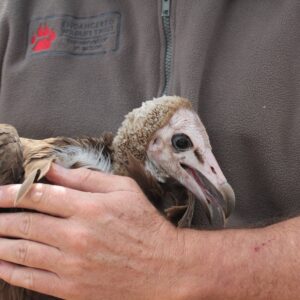
SCIENCE SNIPPETS:
VULTURE CONSERVATION BENEFITS MORE THAN JUST VULTURES
Vultures are an important component of an effective scavenger guild and have evolved a number of adaptations that allow them to locate and dispose of carcasses quickly and efficiently. (Guilds are groups of species that exploit the same resources.) A recent paper, co-authored by EWT staff*, discusses the ecosystem services provided by vultures and the consequences of the continuing decline of African vultures.
African vultures have evolved several specialisations to deal with their diet and any harmful pathogens that may be present in the carcasses they feed on. They thus play an important role in cleaning up carcasses that could cause disease in other animals, which could then be passed on to humans. The decline of African Vultures threatens the stability of the African scavenger guild, which may result in increased carcass decomposition times and, thus, the more rapid development and spread of harmful bacteria. Their absence may also result in changes in the composition of the vertebrate scavenger guild, with an increase in mammalian scavengers, which may increase the risk of viral disease transmission to humans, livestock, and other wildlife.
The economic value of vultures in terms of the sanitation or clean-up services that they provide has been evaluated for some species or countries outside of Africa (e.g., US$700 million per year for Turkey Vultures). Although they can only be deduced for Africa, they must also be substantial. For example, in East and West Africa, vultures consume up to 100 000 kg of organic waste annually, which aids local communities as they would otherwise have to pay for these services. Although the contribution of vultures to the economics of human health and veterinary care has not yet been quantified in Africa either, efforts to conserve vultures should not be deterred. Rabies is an important example of where the loss of vultures has led to substantial human health costs. 95% of global rabies cases occur in Africa and southeast Asia. In India, human health costs due to the loss of vultures were estimated at US$1.5 billion per year (Ogada et al. 2012) due to the increase in feral dogs and rabies. The authors concluded that:
Vultures play a key role in the maintenance of ecosystem health. However, the implications of the decline of African vultures are not yet fully understood and require urgent investigation. Nevertheless, there is enough anecdotal and circumstantial evidence to warrant their urgent protection. It is estimated that the ecological and human health benefits provided by vultures far outweighs the cost of their conservation. The restoration of vulture populations and the ecosystem services they provide will benefit the welfare of all humans, but particularly those who are most vulnerable to economic instability and the spill over of disease at the human-wildlife-livestock interface.
*van den Heever L, LJ. Thompson, WW. Bowerman, H Smit-Robinson, LJ Shaffer, RM Harrell and MA Ottinger. 2021. Reviewing the Role of Vultures at the Human-Wildlife–Livestock Disease Interface: An African Perspective. Journal of Raptor Research. https://doi.org/10.3356/JRR-20-22
LATEST STORIES
