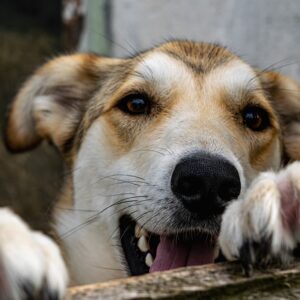
Loxton pet sterilisation drive 2022
Esther Matthew, EWT Drylands Conservation Programme, estherm@ewt.org.za and Bonnie Schumann, EWT Drylands Conservation Programme, bonnies@ewt.org.za
In South Africa, communities in rural areas seldom have access to veterinary care for domestic animals. As a result, many unwanted litters are produced by unsterilised animals, and many animals die of diseases that vaccinations could have prevented. Loxton in the Northern Cape is one of the communities that struggles with these issues.
The Loxton community and their pets were however, fortunate when a team arrived in February 2022 to carry out a pet sterilisation drive and sterilised 150 cats and dogs in just three days. All the animals that were sterilised were also vaccinated and dewormed. In addition, the team shared information on pet care with the community.
The team consisted of a veterinarian and her assistants from EnviroVets, who were supported by the Karoo SPCA Beaufort West. The Endangered Wildlife Trust’s staff and volunteers carried out logistical support during the steri-drive and compiled a list of people with animals ahead of time. The initiative was made possible with generous funding from the Aldor Trust.
The International Fund for Animal Welfare (IFAW) EnviroVets and the Endangered Wildlife Trust carried out the first pet steri-drive in Loxton in 2017, and repeat visits are carried out every few years to reduce domestic animal population growth and the resulting plethora of unwanted and uncared for animals. The presence and spread of domestic pet diseases are also reduces when the densities of animals are kept low, and sick domestic animals can transmit diseases, including rabies, to humans and wildlife. Besides the risk of disease transmission, this is also an animal welfare issue of unnecessary suffering that can be avoided by interventions such as these. The effects of sterilisation initiatives are long-lasting and benefit domestic animals, the community, and wildlife species in the area. Please support pet sterilisation drives in your communities wherever possible
LATEST STORIES
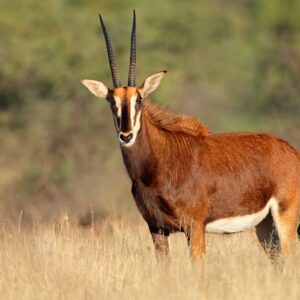
Science Snippets: Wildlife Ranches – South Africa’s Conservation Powerhouses
Private Ranches: A Growing Conservation Force
Science Snippets: Wildlife Ranches highlights a remarkable conservation success story. Across South Africa, roughly 20 million hectares of private land are dedicated to wildlife ranching—areas where sustainable wildlife-based activities generate income while protecting biodiversity. A groundbreaking study co-authored by EWT scientists* surveyed 226 wildlife ranches, revealing their untapped potential for species conservation.
Rich Biodiversity on Private Lands
The research uncovered staggering biodiversity:
- 40 wild herbivore species recorded across ranches
- 15 species per ranch on average
- Key groups included antelopes, zebras, rhinos, and elephants
- Most properties hosted at least one threatened species
- Many held translocated species outside their natural ranges
Notably, these ranches often outperformed protected areas in species richness per hectare. Larger properties consistently supported more species.
Tourism vs. Hunting: A Conservation Comparison
The study revealed key differences:
- Trophy hunting ranches had high species diversity but fewer threatened animals
- Ecotourism-focused ranches protected more vulnerable species
- Hybrid models (tourism + hunting) showed the highest overall biodiversity
Millions of Herbivores Thriving
South Africa’s ranches now sustain an estimated 4.66–7.25 million wild herbivores—a rare global example of thriving indigenous mammal populations. This success has even improved Red List statuses, like the Cape Mountain Zebra, which rebounded from Vulnerable (1930s) to Least Concern today.
Challenges: Fences and Genetics
While beneficial, ranches face conservation hurdles:
- Fencing restricts natural migration, fragmenting landscapes
- Extralimital species risk hybridization (e.g., Bontebok × Blesbok)
- Over ⅔ of Bontebok populations now show hybrid traits
Conclusion: A Vital Conservation Tool
Despite challenges, Science Snippets: Wildlife Ranches confirms these lands are critical strongholds for indigenous herbivores, including threatened species. Their blend of economic viability and ecological impact offers a model for sustainable conservation worldwide.
Study Reference:
Taylor, W. A., et al. (2021). Biodiversity and Conservation, 1-25.
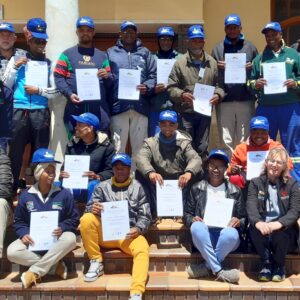
Focussing on sustainable land management in Victoria West
A group of emerging farmers from the Victoria West and Hutchinson area took part in an Integrated Farm Planning and Management training course held in Victoria West in October. The course was presented by the Endangered Wildlife Trust (EWT), in collaboration with the Department of Agriculture, Environmental Affairs, Land Reform and Rural Development and the Grootfontein Agricultural Institute. This was the third time the team has collaborated to present this course to farmers over the last two years: first in Loxton, then Prieska, and now in Victoria West.
The course aims to promote sustainable land management by building capacity amongst farmers, Agricultural Advisors and conservationists. It is vital that farmers are supported in their role as the custodians of the rich biodiversity found on South Africa’s farmlands. These areas fall outside formally protected areas but remain critical to ensuring the health and functioning of ecosystems across landscapes.mpleted the course. The coAltogether 12 farmers course focuses on a holistic approach to farm planning and the principles of sustainable land management. Considering the predicted impacts of climate variation, we must start changing how we are doing things to build environmental and community resilience to extreme climatic events, such as the current drought. Sedrick Visser, Agricultural Advisor (Northern Cape), took the lead in presenting this course. Visser is passionate about training farmers and has taken the lead in presenting the last two courses after he attended the first one held in Loxton as a participant. Sharing knowledge and having discussions around solution-based approaches will empower people to act positively and be the change that is needed. Courses like these enable farmers to improve their farming practices, protect natural resources and create sustainable futuresStaff from the EWT’s African Crane Conservation Programme joined the farmers on the course and underwent training to capacitate them to present the course to communities in KwaZulu-Natal early next year. The content of the course is currently being adapted to make it relevant to the grassland biome.
The training course is also available, for free, online at the www.karooforever.org.za website, created as a knowledge-sharing platform for sustainable land management. The content on the Karoo for Ever website was made possible by several specialists sharing knowledge in the form of webinars and written information. We thank them all for generously sharing their expertise and passion in the interest of promoting sustainable land management in the magnificent drylands of the Karoo.
The course was made possible with funding from the Global Environment Facility and managed by the United Nations Development Program in partnership with the Department of Environment, Forestry and Fisheries and Department of Agriculture, Land Reform and Rural Development and the National Lotteries.
For more information on the course contact:
Bonnie Schumann
Email: bonnies@ewt.org.za
Cell: 072 122 4232
or visit the website at karooforever.org.za
CONSERVATION CHAMPIONS OCTOBER 2021
Speed space
The EWT would like to thank Speedspace for the donation of beautiful cabins for our workspace. For over 45 years, Speedspace has specialised in providing long- or short-term affordable, practical, and efficient on-site space management solutions. These cabins have assisted the staff by providing them with safe, clean, and spacious workspaces, enabling them to continue EWT’s critical conservation work in comfort and style.
Forever Forest
Johan Pansegrouw and Stefan Delpoort visited our Conservation Campus in Midrand last week to plant five indigenous trees that they donated. These trees are the newest addition to our Forever Forest. Thank you Johan and Stefan for your generosity.You can be a conservation champion too! Have you linked your MySchool card to the EWT yet?LATEST STORIES
SAVING SPOTS AND STRIPES
Claire Patterson-Abrolat claire@ewt.org.za and Wendy Collinson-Jonker wendyc@ewt.org.za, Endangered Wildlife Trust infrastructure is a common feature wherever humans have settled. South Africa is rated as the 25th largest country in the world and ranked 18th in relation to the total road length (65,600 km paved, 689,000 km unpaved) and 74th in the total number of cars per 1,000 people. Roads are critical in providing access to primary health care, education, markets, and employment, ultimately improving livelihoods.
However, South Africa is the third most biologically diverse country in the world, and it is increasingly clear that roads and road users affect the functioning of ecosystems in which they occur. Direct collisions with wildlife have the most obvious impact, but the indirect disruption of ecological processes is equally important. Habitat loss, degradation, and population fragmentation, and disruption of the processes that maintain regional populations are just some of the ways roads can affect biodiversity.
Development is taking place rapidly, with new roads and housing developments mushrooming and trans-continental rail and road developments being expedited. In the past, such developments were planned without much thought to their impact on biodiversity, but the EWT has been working hard to improve road-user safety – that of both the occupants of vehicles and the wildlife living adjacent to or crossing our roads. We’ve been collecting data in a variety of ways, including the use of citizen scientists (data submissions from the general public), planned surveys and, importantly, using the road patrollers that drive our highways daily to deal with any hazard they come across, including the removal of dead animals from the road.
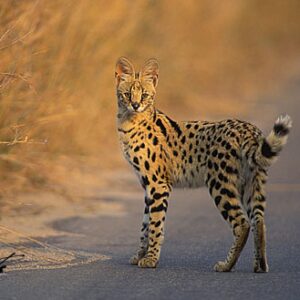
The EWT analyses roadkill data regularly, and one of the species that has caught our attention is the Serval. This mostly solitary, nocturnal species was considered extinct, or near-extinct, in the latter half of the 20th century, largely due to the mistaken belief that it caused damage to agricultural crops and compounded by competition from other carnivores such as jackal. Reintroductions and range expansions have led this species to recover to an estimated adult population of somewhere between 4,509 and 13,654 individuals, but the population is again considered to be declining due to a loss of its wetland habitat.
Serval (Leptailurus serval)
Servals are predominantly solitary except when mating or before young would leave their mothers at around eight months old. Like Leopards, the young females form territories adjacent to that of their mother, with males having larger territories that overlap that of several females.
The N3 Toll Concession, which manages the 412 km stretch of road from Heidelburg (Gauteng) to Cedara (KwaZulu-Natal), has been extremely supportive of our efforts to mitigate roadkill along the Toll Route and is concerned about the safety of both the road users and the wildlife living alongside the road.
In addition to our usual reports to the N3 Toll Concession, the EWT has been looking into why the Serval is one of the most common species reported (Figure 2) and why their roadkill numbers show an upward trend.We plotted the location of the roadkill along the N3 and noted that although roadkills were spread along the length of the road, there was a cluster along the northern parts of the route. This area is predominantly highveld sourveld and is either farmed for cattle or game or planted with mieliesWe also looked at the proximity of water to the road. Servals are wetland specialists, which are likely to be clustered close to water bodies. Water is spread fairly evenly across the landscape, and where perennial rivers are not available, farmers have created artificial water points for livestock and/or game. The diet of Servals consists mainly of Vlei Rats, so the abundance of water along the N3 does create the ideal habitat for them.
Our work is still in its infancy, and we plan to keep investigating the drivers of roadkill for this species by investigating the following:
- Whether Serval prefer artificial or natural water bodies;
- The abundance of prey species;
- Whether or not Serval use underpasses (tunnels and culverts) to cross the road; and
- If the Serval being killed on the road are young dispersing males or breeding adults, and the impact of this on the local and broader population.
Thank you to the N3 Toll Concession for their ongoing support of our work and Ford Wildlife Foundation for keeping us on the road.

USING CONSERVATION CANINES TO SAVE OUR SPECIES FROM THE ILLEGAL WILDLIFE TRADE
Andrew Taylor, Wildlife in Trade Programme Manager, Endangered Wildlife Trust, andrewt@ewt.org.zaIllegal Wildlife Trade (IWT) is one of the biggest threats to biodiversity worldwide, and an ongoing poaching surge places particular strain on some of South Africa’s most threatened species. With funding from IUCN Save Our Species African Wildlife Initiative and the European Union, the Endangered Wildlife Trust (EWT) aims to reduce IWT by reducing the poaching of five iconic mammals. White and Black Rhinos, listed as Near Threatened and Critically Endangered respectively on the IUCN Red List of Threatened Species, are both experiencing population declines due to illegal harvesting. Temminck’s Pangolin, listed as Vulnerable, is being mercilessly targeted by poachers for local and international markets and given its rare status and slow rates of reproduction, they are almost certainly experiencing population declines, although we do not have accurate population data. The African Savannah Elephant, now listed as Endangered, is not currently under threat from poaching in South Africa but has been hugely impacted across the continent, making South African populations more important to secure. Finally, the African Lion, listed as Vulnerable, is coming under increased threat from IWT for its claws and teeth and needs protection from poachers before it’s too late.
A combination of approaches is needed to reduce poaching, each focusing on different links in the wildlife trade chain. When implemented in combination with other measures, one effective method is the use of highly trained conservation canines. These dogs are trained to detect specific wildlife products and, when working at reserve gates and other strategic locations, provide a quick and reliable method of screening vehicles entering for concealed firearms and ammunition and vehicles leaving for wildlife contraband. These dogs thus prevent poachers from using vehicles to carry their weapons into reserves or transport animal parts out. Tracking dogs provide a mechanism to locate incursion entry and exit points along reserve boundaries, track poachers inside reserves, and, if they do not catch up with poachers, can identify routes taken, providing critical data for predicting future poacher movements.
Under this grant, the EWT will support seven reserves threatened by poaching by providing them with detection or tracking dogs, training for dog handlers, as well as ongoing support for dog-handler teams. Three reserves will receive detection dogs, two will receive tracking dogs, and two, which already have dogs, will receive support for their current dogs and handlers. All seven reserves have rhinos and some of the other threatened species mentioned above, and all have experienced revenue losses because of tourist travel bans resulting from COVID-19. This has severely limited their ability to generate sufficient income to maintain functioning conservation canine units to support their anti-poaching defence.
So far, we have three dogs and one new handler undergoing initial training which will be certified before deployment. We are grateful to IUCN Save Our Species and the European Union for the generous support in our fight to protect our threatened species against poaching.


This publication was produced with the financial support of the European Union through IUCN Save Our Species. Its contents are the sole responsibility of the Endangered Wildlife Trust and do not necessarily reflect the views of IUCN or the European Union.
LATEST STORIES
