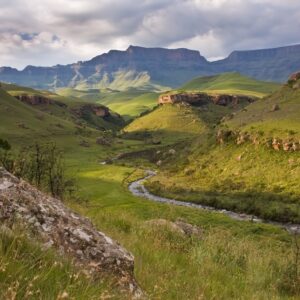
Conservation-conscious Developments: A New Era for South African Ecology
The push for conservation-conscious developments has reached a milestone with South Africa’s national Environmental Screening Tool. This digital platform, developed by the Department of Forestry, Fisheries and Environment (DFFE), helps developers identify and protect sensitive ecosystems before breaking ground – a game-changer for biodiversity protection.
How the Tool Works
The web-based system cross-references proposed sites with:
- 4,633 plant species and 425 animal species data
- Cultural and archaeological heritage sites
- Priority habitats from SANBI and BirdLife South Africa
- Real-time sensitivity mapping across all provinces
“This prevents the oversight of threatened species that often disguise themselves or appear seasonally,” explains Dr Dominic Henry of EWT, who helped develop the tool.
Conservation-conscious developments: Standardising Environmental Assessments
New protocols (gazetted October 2020) now mandate:
- Minimum data requirements for specialist studies
- Consistent impact assessment methodologies
- Clear guidelines for reporting on Species of Conservation Concern
Why This Matters Now
With South Africa:
- Ranking as the 12th largest carbon emitter
- Accelerating renewable energy projects
- Facing increased rural development pressures
The tool balances economic growth with ecological protection – ensuring conservation-conscious developments become the norm rather than the exception.
Public Participation Encouraged
Citizens can use the open-access tool to:
- Identify local species of concern
- Submit informed comments on development proposals
- Advocate for better project siting
“This is a paradigm shift,” notes SANBI’s Domitilla Raimondo. “For the first time, everyone from developers to community members can access the same biodiversity data during planning stages.”
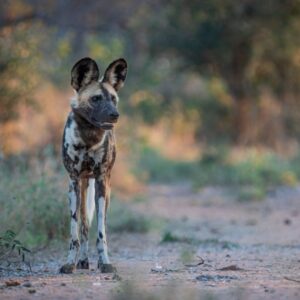
WILD DOGS REINTRODUCED TO MALAWI AFTER DECADES OF ABSENCE
On 27 July 2021, 14 African Wild Dogs were translocated successfully from South Africa and Mozambique to Liwonde National Park and Majete Wildlife Reserve in a historic project to reintroduce this Endangered species to Malawi. The translocation was undertaken through a collaboration between the Endangered Wildlife Trust [EWT] and African Parks, which manages Liwonde and Majete protected areas in partnership with Malawi’s Department of National Parks and Wildlife (DNPW). While helping to repopulate both parks, the reintroduction represents a major international effort to conserve African Wild Dogs, with only 6,600 individuals, or just 700 breeding pairs, estimated to be left on the continent.
“The Wild Dog is one of Africa’s most Endangered mammals, so we’re extremely proud to have been able to establish safe spaces in Malawi where their long-term survival can be assured”, said the Director of Malawi’s Department of National Parks and Wildlife Brighton Kumchedwa. “The conservation of our country’s natural heritage is central to our· national development strategy. Over the past two decades, our collaboration with African Parks and local communities has helped to restore multiple iconic species to our protected areas, contributing not only to meeting global biodiversity targets but to sustainable economic growth”.
The African Wild Dogs were sourced from Gorongosa National Park and Karingani Game Reserve in Mozambique, and Somkhanda Community Game Reserve and Maremani Nature Reserve in South Africa. On 27 July, all 14 animals were flown in a single aircraft from Mozambique’s Massingir Airport to Blantyre in Malawi. Eight dogs were released into bomas in Liwonde National Park and six into bomas in Majete Wildlife Reserve, where they will remain for several weeks, allowing them to adjust to the new conditions before being fully released into the wider park areas. Each pack has been fitted with a mix of satellite and radio collars to facilitate the continual monitoring of their location and habitat use and ensure their long-term protection in the parks.The dogs
The Liwonde National Park (Malawi) females were born in Somkhanda Community Game Reserve, the only community-owned reserve in the Wild Dog Range Expansion Project. Wild Dogs were introduced into the reserve in 2015, and from the reserve’s successes, Somkhanda Community Game Reserve can now contribute back to the Wild Dog range expansion work. In this case, three sisters born in 2019, offspring of the Kalahari females and Hluhluwe-iMfolozi Park males, recently showed signs of dispersal, and the collaborative decision was to capture them and bond them to male Wild Dogs and introduce the newly formed pack into Liwonde Game Reserve. Thank you to Somkhanda Game Reserve, Wildlands, Wildlife ACT – Focused Conservation, UmPhafa Private Nature Reserve (Colchester Zoo), and Ezemvelo KZN Wildlife for making this possible.
The Liwonde National Park (Malawi) males were born in Maremani Nature Reserve, a beautiful game reserve in the tropical savannah in northern Limpopo, close to the Limpopo River in the northernmost area of South Africa.
The males dispersed from their natal pack and went in search of females. In the space of ten days, the group covered 600 km, which included a stint into Bubye Valley Conservancy (Zimbabwe). Due to their vulnerability to several threats (persecution, snaring, and roadkill), a decision was made to capture the male Wild Dogs, bond with the Zululand females and introduce them into Liwonde National Park. Maremani Nature Reserve has been vital in the success of this Wild Dog population and a champion for the species in the surrounding areas.
The Majete males come from the original pack introduced into Gorongosa National Park in 2018. Gorongosa National Park is Mozambique’s flagship reserve and now boasts a thriving Wild Dog population with more than 100 Wild Dogs now roaming the landscape.
Several months ago, the Gorongosa-born males, having just turned two, dispersed from their natal pack and roamed into the buffer areas outside the park. Dr Antonio Tonecas, the head Gorongosa vet, captured the males and brought them back to safety the safety of the Gorongosa boma. Following the decision to include these males in the Majete Wildlife Reserve reintroduction, the group was relocated by air by the Mozambican veterinarian team and placed in the predator boma at Karingani Game Reserve, where they were bonded with females.
The Majete females were born on Karingani Game Reserve. The Karingani Pack was introduced in 2019 and has thrived in Karingani since. Karingani is situated in the southwest of Mozambique, bordering South Africa’s Kruger National Park. The strong conservation focus and monitoring at Karingani have seen the Wild Dog population double in the past two years.
In addition to this, Karingani has also been working in close partnership with the young organisation, Mozambique wildlife alliance – an emerging Mozambican wildlife veterinary team, mandated by the National Administration of Conservation Areas (ANAC), with high conservation impact across the country.
The Karingani pack found the Gorongosa males only days after they arrived in the Karingani boma. The Karingani team cleverly and skillfully lured the three selected females into the second compartment of the boma, capturing them without the use of anaesthesia. Since these females needed no convincing to choose the Gorongosa males, the bonding in the Karingani boma went very smoothly.
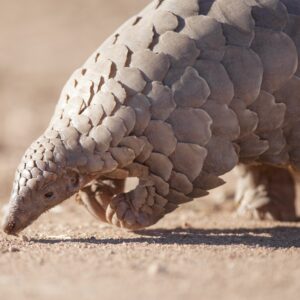
Wildlife Crime Impact Statements: Advocating for Nature in Southern Africa’s Courtrooms
The growing use of Wildlife Crime Impact Statements marks a pivotal shift in how justice systems address environmental crimes. As Southern Africa battles illegal wildlife trade – from rhino horn poaching to reptile smuggling (EMS Foundation Report) – these documents give voiceless victims (endangered species and ecosystems) representation during trials.
Why Impact Statements Matter
- Bridge the legal gap: Animals/plants lack “victim” status despite ecological value (IUCN Report)
- Highlight cascading harm: Show how crimes affect entire ecosystems
- Inform sentencing: Used successfully in Scotland (Government Report) and Hong Kong (SVIS)
EWT’s USAID-Funded Initiative
The Endangered Wildlife Trust now coordinates Wildlife Crime Impact Statements that:
- Detail species’ ecological roles
- Document population threats
- Are authored by scientists/NGOs/government experts
- Reference precedents like India’s Lakshmi Kumari case (Scroll.in)
Addressing All Victims
While rhinos dominate headlines, lesser-known species suffer equally:
- Leopard tortoises smuggled in shoeboxes
- Endangered plants illegally harvested
- Marine species caught as bycatch
As research in the Southern African Journal of Criminal Justice notes (DOI), holistic approaches are vital for effective prosecution.
The Path Forward
These statements help courts:
- Recognise wildlife’s intrinsic value
- Impose deterrent sentences (T&F Study)
- Align with global conservation goals (USAID)
“We’re ensuring magistrates hear both the legal facts and ecological consequences,” says Carina Bruwer, EWT’s Wildlife and Law Project Officer.
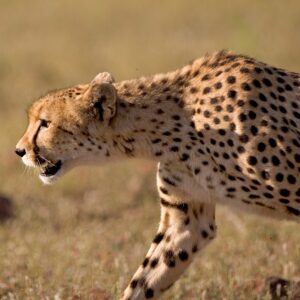
Dinokeng’s Cheetahs: Part One – From Skepticism to Success
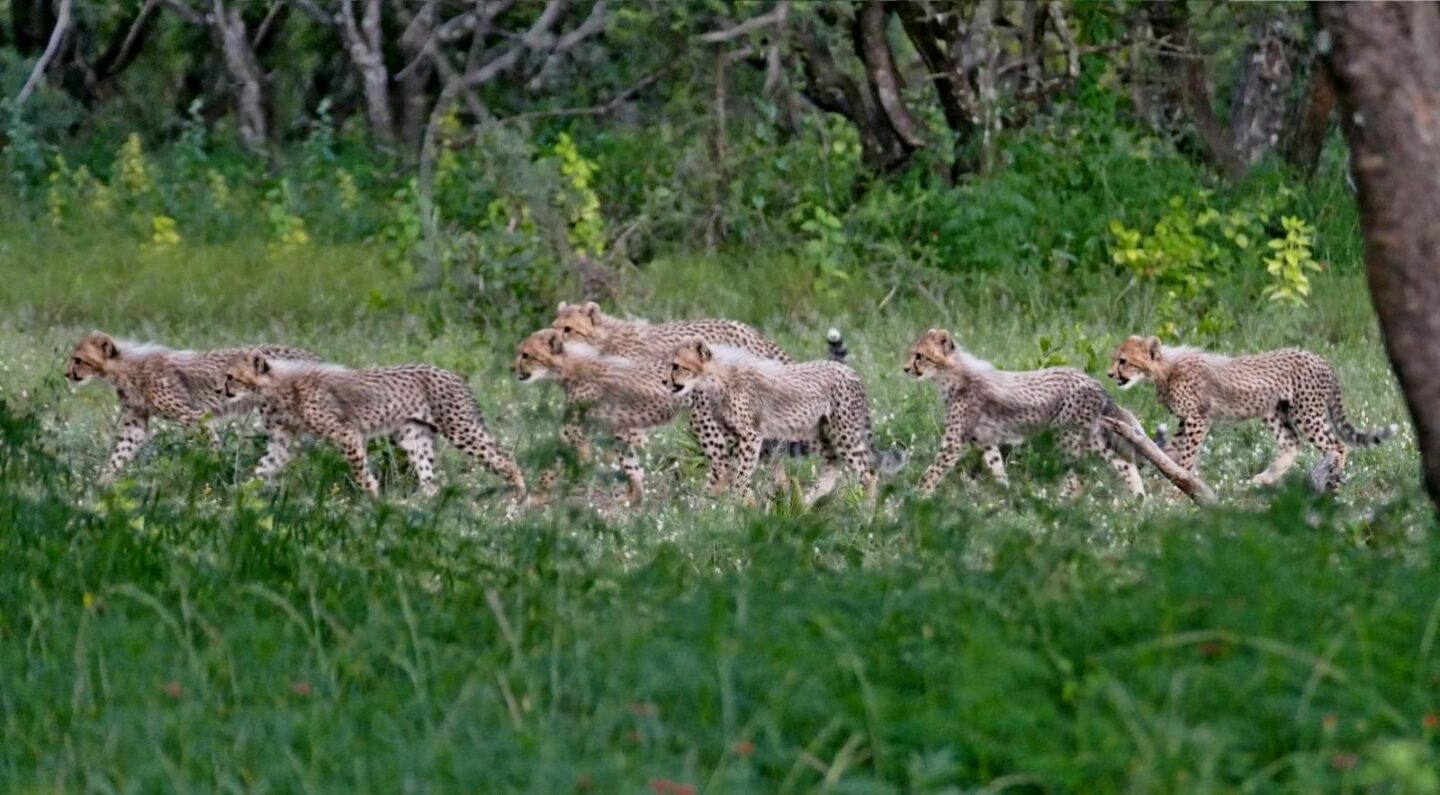
The story of Dinokeng’s Cheetahs: Part One begins with an improbable vision – reintroducing Africa’s most endangered big cat just 30 minutes from Pretoria. What started as a seemingly unrealistic dream in 2007 has blossomed into one of South Africa’s most remarkable conservation successes, with Dinokeng Game Reserve now supporting 25 wild cheetahs across its 19,000 hectares.
Against All Odds
When Vincent van der Merwe first surveyed the area in 2008, the landscape told a story of agricultural transformation:
- Rusted farm equipment littering the veld
- Endless fence lines fragmenting the land
- Skepticism from conservationists about urban wildlife potential
Yet through unprecedented collaboration between 126 landowners and government, Dinokeng became:
- Gauteng’s first Big Five reserve
- A vital cheetah metapopulation stronghold
- Proof that wildlife and urban areas can coexist
The First Cheetah Pioneers
The initial 2012 reintroduction faced challenges:
- The Darlington Male: A notorious escape artist with a 6-month, 34-goat rampage across the Eastern Cape
- The Karongwe Female: A lion-savvy survivor from the Lowveld
- Early successes (3 cubs born in 2013) followed by heartbreaking losses
Despite setbacks, these pioneers proved Dinokeng’s potential, with their genetics still contributing to metapopulations as far as Malawi today.
A Conservation Laboratory
Dinokeng’s unique urban-edge location has provided invaluable insights:
- How cheetahs adapt to mixed prey densities
- The importance of “soft reserves” like Rietvlei for founder populations
- The resilience of cheetahs in human-modified landscapes
“What seemed impossible fifteen years ago has rewritten the rules of urban-edge conservation,” reflects van der Merwe.
Stay tuned for Part Two, where we reveal how the unlikely Rietvlei female defied expectations and helped establish Dinokeng’s thriving cheetah population.
Contact the EWT Carnivore Conservation Programme: vincentv@ewt.org.za
CRANE CUSTODIANS STEP UP THEIR DRIVE TO ADDRESS CRANE POISONING IN UGANDA
Adalbert Aine-omucunguzi, Orishaba Phiona, and Gilbert Tayebwa, ICF/EWT African Crane Conservation Programme, adalberta@ewt.org.za
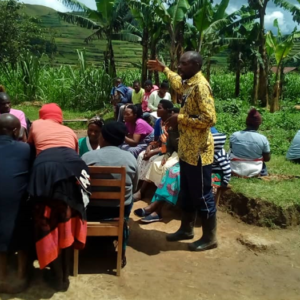
In 2012, the International Crane Foundation/Endangered Wildlife Trust Partnership (ICF/EWT) recruited and trained five community volunteers to safeguard breeding cranes in southwestern Uganda. This was in response to the escalating threats from crane poachers and wetland encroachment. These community volunteers were named Crane Custodians, and the approach was guided by the belief that securing a future for cranes depended on local people tolerating cranes on their farms, reporting poaching and other incidents, and receiving constant positive messages about cranes from their fellow community members. The Crane Custodians have since helped to raise community awareness about the importance of conserving cranes and have been instrumental in securing safe space for breeding cranes. The Uganda project has grown and now comprises 50 Crane Custodians, 17 females and 33 males
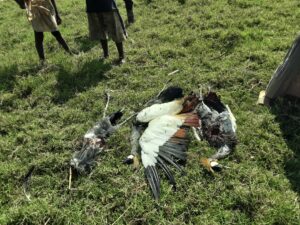
Despite this, in March and April 2021, over 60 cases of crane poisoning were reported in south-central Uganda. The poisoning is believed to have been driven by crop damaged caused by cranes. Some farmers are using agrochemicals, notably Furadan, to poison cranes that visit their crop fields. In response to escalating poisoning, our Crane Custodians have stepped up their awareness drive to educate communities so that they aware of the dangers of misusing agrochemicals, which are unfortunately readily available in local markets and can easily be purchased by anyone.
 Through various available awareness-raising activities such as community meetings, church gatherings, music composition, and moving from house to house, the custodians are sensitising community members to the consequences of poisoning cranes and the need to protect Uganda’s National Bird.The custodians have been instrumental in building the current community support and pride for cranes that we see in Uganda. The dedicated volunteers also report and monitor cranes that are breeding, contributing to increased breeding success for cranes within these communities.
The Uganda project team is heavily indebted to these unsung heroes for their dedication to crane and wetland conservation and their willingness to volunteer their time to serve nature.
EWT AND BUSINESS FOR NATURE CALL ON COMPANIES TO HELP REDUCE NATURE LOSS IN THIS DECADE.
Dr Gabi Teren, EWT’s Business and Biodiversity Network, Programme Manager gabit@ewt.org.za Healthy societies, resilient economies, and thriving businesses rely on nature. The natural resources that power businesses are under huge strain and the private sector is a major contributor to nature’s depletion. The Endangered Wildlife Trust’s National Biodiversity and Business Network (NBBN) has joined Business for Nature, a global coalition that brings together business and conservation organisations and forward-thinking companies. Together we amplify a powerful leading business voice calling for governments to adopt policies now to reverse nature loss this decade.
The Endangered Wildlife Trust (EWT) recognised the need for a body to assist businesses to integrate biodiversity into their strategies and activities and established the NBBN in 2013, in partnership with the Department of Environmental Affairs (now the Department of Environment, Forestry, and Fisheries), and leading SA companies such as De Beers, Pam Golding Properties, Nedbank Limited, Hatch, Pick n Pay, and Transnet. In 2016, the list of NBBN partners grew to include Woolworths and Eskom. The NBBN aims to reduce the impacts businesses in South Africa have on nature by developing and disseminating relevant tools and guidelines to enable a more positive relationship with nature.
Businesses depend on a healthy planet to provide a stable operating environment, customers, and workforces, and the natural resources necessary for production – food, fibre, water, minerals, building materials, and more.
Nature also provides ecosystem services worth at least US$125 trillion/year globally, from which businesses benefit at no cost through, for example, waste decomposition, flood control, pollination of crops, water purification, carbon sequestration, and climate regulation. Losing nature means losing these services and creating extra costs and vulnerability for businesses. In fact, more than half of the world’s GDP – an estimated US$44 trillion of economic value generation – is moderately or highly dependent on nature and its services.
Leading businesses are making ambitious commitments and taking decisive action for nature. Businesses have a critical role to play in reversing nature loss, protecting biodiversity, and preserving species, and business action is about more than a responsibility – there are real and material risks associated with nature’s decline.
Businesses that act now to achieve net-zero and become nature-positive across their value chains will gain a competitive advantage.
In October this year, a new global agreement on nature called the ‘Global Biodiversity Framework’ is due to be agreed at the 15th Conference of the Parties to the Convention on Biological Diversity (CBD COP15) in Kunming, China. An ambitious, clear, implementable, and enforceable international agreement at COP15 will help realise nature’s true value to livelihoods, society and our economy.
But businesses cannot address this global crisis on their own. To accelerate action, governments must set ambitious nature and climate policies that provide direction and momentum. This gives the private sector clarity to unlock new business opportunities and creates a level playing field and stable operating environment. Hundreds of companies representing trillions in combined revenue are urging governments to adopt policies now to reverse nature loss through the Nature Is Everyone‘s Business Call to Action.
Whether you are a global corporate giant, an SMME or a sole practitioner, you can sign up your company today to the Call to Action, and join over 700 businesses from around the world who are calling for ambitious and collective action for nature. Companies of any size, location or industry can add their voice.
Sign up here: bit.ly/BfNCTA
For more information on the EWT’s National Biodiversity and Business Network, contact Gabi Teren GabiT@ewt.org.za
