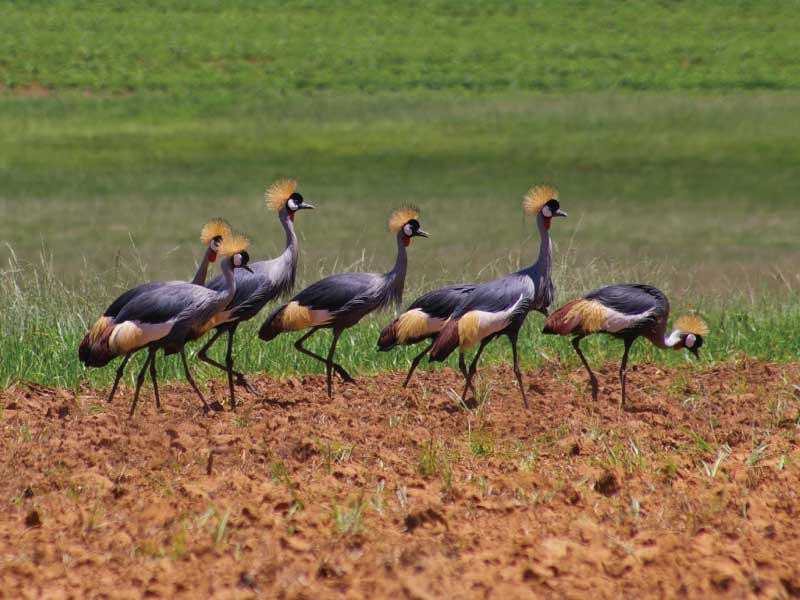
Climate change has manifested in erratic weather patterns and significantly prolonged drought seasons in Southcentral Uganda. The drought hit the Lwengo region in one of Uganda’s cattle corridors particularly hard. Farmers in Lwengo have suffered serious losses over the dry season; their crops dried up and withered over the harvest period. Maise, beans, peas, and other cash crops have also done poorly during the dry planting season. The water sources in most villages and part of the Kiyanja-Kaku wetland (a precious wetland conserved by the ICF/EWT projects) have dried up, and animals and households no longer have enough water to drink and use for domestic purposes. The dry season also affected irrigation projects, rendering irrigation impossible at the household level and reduced food security and the general well-being of the communities. The Kiyanja-Kaku wetland and its catchment also provide breeding and flocking habitat for the Endangered Grey Crowned Crane – one of Uganda’s iconic wetland species.
Unfortunately, cranes are eating more of the crops due to shortages in natural food sources, feeding on germinating seedlings and mature crops, eating all the corn, and leaving empty combs. The most affected crops in the area included maize, beans, and ground nuts. On top of the drought and deflating market prices, this has caused significant losses to the farmers, and they have resorted to poisoning cranes – 118 poisoned to date this season.
What are we doing to help communities weather the storm?
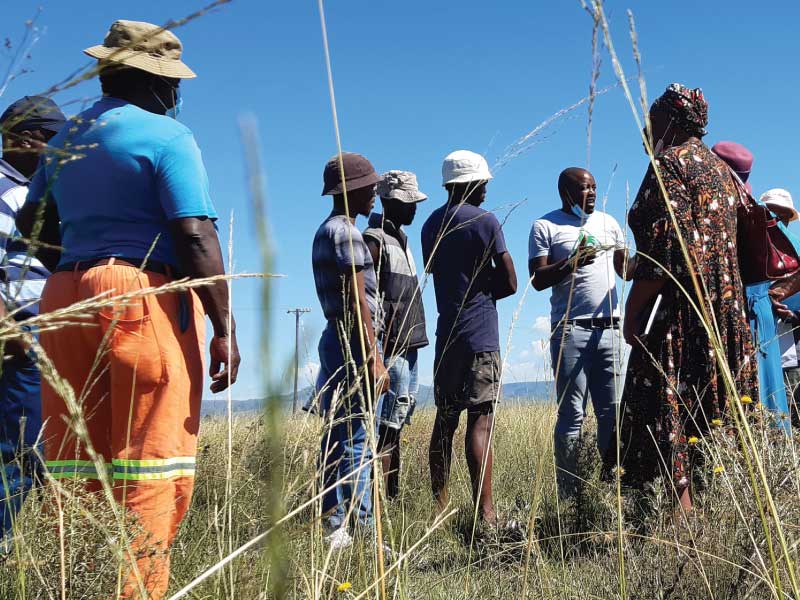
The ICF/EWT’s crane and wetlands conservation project supports some communities in establishing crane deterrent measures in various homesteads to address food insecurity caused by cranes and climate change. The measures range from the erection of human-mimicking scarecrows to the use of reflective materials, usually from non-recyclable waste products, around the crops. The measures have proven successful as there have since been no crane sightings in these areas, and crop damage has reduced to some extent.
Next steps
Since the project has established an integrated approach of deterrent measures, effectively preventing cranes from damaging crops, we need to upscale the deterrent measures and extend the approach to all affected villages. This way, we will keep crops and cranes safe. The project continues to engage farmers in establishing interventions that can also address the impacts of climate change on food security.
Integrated Farming the missing piece for communal farmers
Samson Phakathi, the EWT’s African Crane Conservation Programme Senior Community Project Officer, Samsonp@ewt.org.za
Integrated farming promotes the responsible use of natural resources and farming practices that use fewer external resources, making farming more sustainable. The concept is particularly well suited to communal land where land degradation and the resultant soil erosion and spread of encroaching plant species tend to be quite prevalent. Moreover, it is becoming evident that there is often an imbalance between livestock ratios and the availability of food and water for the animals in these landscapes. The Integrated Farm Planning (IFP) training thus came at a time when most of the community farmers desperately needed assistance to improve their management practices.
Through the National Lotteries Commission (NLC) funding, the Endangered Wildlife Trust engaged with 35 emerging farmers from the Cedarville area in the Eastern Cape. Our goal was to assist them with implementing integrated farm planning (IFP) by hosting a training day in the field that we published an article on in May 2022.
Through the National Lotteries Commission (NLC) funding, the Endangered Wildlife Trust hosted 35 emerging farmers from the Cedarville area to to discuss integrated farm planning (IFP)
The emerging farmers were carefully selected from areas within hotspots of the distribution of the three threatened crane species. These areas contain wetlands and grasslands required for the Endangered Grey Crowned Cranes, Critically Endangered Wattled Cranes, and Near Threatened Blue Cranes. Unfortunately, these habitats are highly threatened by poor rangeland management. The IFP training was designed to upskill emerging farmers to identify management-related challenges in areas where they graze their livestock. The farmers then formulate practical solutions, incorporating local knowledge and capacity to address issues. The IFP training was eye-opening to emerging farmers, who now appreciate that rangeland management is key to the sustainability of communal lands in terms of grazing, water conservation, and community livelihoods. The training emphasized the importance of species diversity in grazing lands and the need to conserve species through improved grazing management.
Emerging famers from Cedarville on an Integrated Farm Planning trip visit to learn from the Black Diamond Community in the Ukhahlamba Mountain Range
After successfully organizing and facilitating the well-attended IFP and sustainable grazing management training, the EWT arranged for a community exchange visit for the Cedarville emerging farmers to the Black Diamond Community situated in the Ukhahlamba mountain range. The Black Diamond community is quite progressive regarding practical rangeland management initiatives. The exchange visit was thus key as it allowed the Cedarville emerging farmers to interact with the Black Diamond community and draw lessons on what can be duplicated, adopted, or adapted to the Cedarville context.
The exchange visit ran from 18–19 April 2022, with over 70 people attending. The Cedarville and Black Diamond communities’ engagements and discussions were quite constructive. What stood out was the ability of the Cedarville emerging farmers to interpret the Black Diamond grazing camps using the IFP training concept, showing that the messaging resonated with the emerging farmers. More emphasis was also placed on encouraging the Cedarville emerging farmers to look at their available local capacity and resources as they improve their rangeland management. This is important, especially if self-sustaining communities with local knowledge and capacity can encourage others to address these issues. The exchange visit was also attended by key stakeholders, including a government department, another NGO, the ward councillor, and a local King.
From the project initiation phase, where robust engagements about the community’s vision for their land and how IFP can complement their activities, to the actual training session and the community exchange visit, we observed the communities taking the lead in identifying local issues, formulating intervention measures, mobilizing resources and capacity, and implementing solutions. The IFP training seemed to be the missing piece, providing the solutions for farmers to succeed, especially in highly strained communal lands in the Eastern Cape and KwaZulu-Natal. This paradigm shift to grazing management in communities can only benefit species diversity, livestock, and, more importantly, the stability of soils, vegetation, and the resultant positive spin-offs in the form of community livelihoods.
This training was made possible with funds from the National Lotteries Commission. The NLC relies on funds from the proceeds of the National Lottery. The Lotteries Act and regulations guide the way in which NLC funding may be allocated. The NLC wants the grants to make a difference in the lives of all South Africans, especially those more vulnerable, and to improve the sustainability of the beneficiary organizations. Available funds are distributed to registered and qualifying non-profit organizations in the fields of charities; arts, culture, and national heritage; and sport and recreation. By placing its emphasis on areas of greatest need and potential, the NLC contributes to South Africa’s development.
The world’s road networks are highly disturbed and fragmented areas that negatively affect many animals. Wildlife-vehicle collisions are one of the more visible effects of road, estimated to be the second-largest cause of human-related deaths in animals. One of the by-products of the Covid-19 pandemic was much lower levels of human activity related to lockdowns enforced in many countries to reduce the spread of the disease. This decrease in human activity has been named the “anthropause”, which was at its peak in April 2020. With the anthropause came a large decrease in vehicle traffic. The impact of the anthropause, particularly of decreased traffic, on species, was examined in a recent publication co-authored by EWT scientists*. With worldwide travel restrictions in full effect from April 2020, vehicle use dropped by over 50% in many countries. During this same period, scientists found a significant drop in wildlife-vehicle collisions, with as much as a 48% reduction recorded in some countries. The absence of traffic also likely brought about behavioural changes in wildlife and could have had various other ecological effects not yet documented. Some possible changes include animals being able to move more freely between fragmented landscape patches, increases in survival and population sizes, and less spreading of invasive species along roads (see figure below, from Perkins et al. 2022, which illustrates some of the possible impacts of a reduction in traffic).
Traffic noise was another aspect reviewed in this study. Researchers found that animals were less fearful with reduced traffic noise over the lockdown period. Furthermore, they noted that there were localised changes in animal distributions. For example, large animals were spotted moving through urban areas. The lowered volume of traffic noise also resulted in some birds changing their tune. For example, urban birds have been observed to alter the frequency of their song as they no longer had to compete with traffic noise. While lockdowns provided temporary relief, allowing wildlife to thrive again, human activity is recovering to pre-pandemic levels. This brief pause has allowed us to gain new insights into the impact of traffic on wildlife. The return of traffic highlights the need to have proper surveillance measures in place to help document, explain, and reduce the effects of roads on wildlife and critically evaluate the impacts of this widespread human activity on wildlife. *Perkins, S. E., Shilling, F., & Collinson, W. (2022). Anthropause opportunities: Experimental perturbation of road traffic and the potential effects on wildlife. Frontiers in Ecology and Evolution, 192.**The EWT has a road watch app for you to record any roadkill sightings, helping us to identify hotspot areas and the species most at risk. Search for Road Watch on the Google Play Store to download the app!
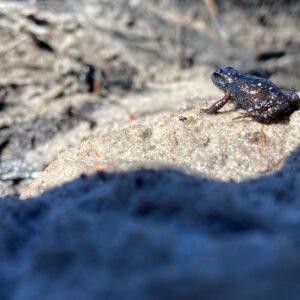
Rough Moss Frog (Arthroleptella rugosa). Photo credit: Johan du Plessis
The Rough Moss Frog (Arthroleptella rugosa) is a Critically Endangered frog species found only on a single mountain range, the Klein Swartberg, in the Overberg district of the Western Cape, South Africa. In 2020 we realized that this little frog was in big trouble. Its habitat was being degraded rapidly by alien invasive vegetation to such an extent that the survival of the only known population of this species was uncertain.
With this realization, the Endangered Wildlife Trust (EWT) approached the IUCN Save Our Species fund for support to implement a critical rapid action intervention to save this population. In 2021, the IUCN Save Our Species answered the plea for assistance with co-funding from the European Union. This support allowed us to develop a firebreak system around this original population of Rough Moss Frogs. This critical intervention supported the planning of an ecological burn in 2022 as a tool to manage an extensive pine infestation that was damaging the population’s seepage habitat. This was a novel approach to amphibian species conservation on the Klein Swartberg Mountain, not least globally.
During the surveys supported by the SOS project, an additional three populations of this species were recorded on the Klein Swartberg by project partner Bionerds PTY Ltd. This was a welcome discovery, bringing the known populations to four. Two of these newly discovered populations were in well-managed natural habitats, also good news for the species!
On 16 March 2022, the firebreaks and planning for the ecological fire were completed by our contractor, Enviro Wildfire, through the employment of an alien vegetation clearing team from the local community of Caledon. The planned ecological burn took place during the week of 28 March 2022. The ecological burn was intended to eradicate invasive pine trees and allow for the recovery of natural fynbos vegetation, not only for the conservation of the Rough Moss Frog population but also for various other Endangered plants and animals. This intervention will also benefit the local community living in the catchment zone below the Klein Swartberg by increasing the water yield from the mountain draining into the aquatic systems in the seeps and rivers and the agricultural community reliant on these water resources.
Team preparing firebreaks in the Klein Swartberg, Western Cape, South Africa. Photo credit: Johan du Plessis
The burn was successful, with very few invasive alien pine trees remaining. And those that survived will be cleared mechanically in the coming months, alongside the development of a long-term alien vegetation clearing plan covering the full extent of the mountain and supported by project partners, the Klein Swartberg Conservancy and the Fynbos Trust. In addition to the 800 ha planned for the burn, over 4,500 ha of the mountain also burnt, including the three additional Rough Moss Frog population sites discovered during the project. Post-fire monitoring by the team has happily confirmed the presence of Rough Moss Frogs at one of the burn sites. These populations will be continuously monitored over the coming breeding season (June onwards). This monitoring will include post-fire bioacoustics monitoring (recording of frog calls) to compare with pre-fire recordings to document the recovery of these populations in the coming years as habitat is restored.
Southern slope after ecological burn in the Klein Swartberg, Western Cape, South Africa. Photo credit: Johan du Plessis
The project not only achieved its objective of significantly reducing the threat of invasive vegetation to the original population but also forged partnerships, discovered previously unknown populations of a Critically Endangered species and initiated formal habitat protection processes for five properties where the species is now known to occur.
This project is supported by IUCN Save Our Species and co-funded by the European Union. The contents of this publication are the sole responsibility of the Endangered Wildlife Trust and do not necessarily reflect the views of IUCN or the European Union.
Dr Jenny Botha, EWT’s People in Conservation Manager, jennyb@ewt.org.za
“Such a blessing,” the young girl murmured as she received samples of reusable sanitary pads as part of a Water, Health, and Hygiene (WASH) project the EWT is implementing in Kutama, a vibrant area consisting of nine villages situated at the foot of the majestic Soutpansberg mountains in the Vhembe Biosphere Reserve. Despite most residents being innovative and self-driven, unemployment levels are high, and many families struggle financially, as is common throughout South Africa. Those who are fortunate enough to have a job often work far from home, leaving children in the care of grandparents or other caregivers. Despite progress in addressing global water and sanitation deficits, in 2017 approximately 1.6 million people died of diarrheal diseases. Many of these disease are spread through contaminated hands. Safe water, sanitation and hygiene underpin human, animal, and environmental health. Yet millions still lack access to clean water and basic hygiene products and information on germ transmission and risks to human and environmental health is often lacking or inaccurate.
Washing with soap is an effective and cost effective way to save lives. Moreover, by reducing exposure to a range of infectious diseases, it also reduces absenteeism through illness from work and school.With over 80% of households in Kutama deriving a monthly income of less than R3,200, purchasing basic necessities is challenging, and, as with many communities in South Africa, sanitary pads are unaffordable for many women and girls.
The Endangered Wildlife Trust (EWT) started the WASH project in 2019 as part of an integrated water conservation project in the Soutpansberg in partnership with the Coca-Cola Foundation’s Replenish Africa Initiative (RAIN). In the first year, we developed and piloted interactive lessons and teaching aids on germ transmission and hand washing, which were implemented alongside primary school educators in the classroom, reaching over 700 learners.
Primary School Germ Transmission Activity in Kutama, Limpopo
The timing of this project was fortuitous, for, in March 2020, the Covid-19 pandemic hit South Africa. Regular handwashing has always been critically important to reduce the spread of serious infections, diarrhoea, and other illnesses, especially in children. However, this simple activity and other stringent hygiene measures have become a global imperative. In 2020 we introduced additional curriculum-based learning materials to approximately 475 primary school learners to reinforce handwashing and related health messages in fun, interactive ways, and in 2021, we reached a further 800 learners and their teachers. Educators were provided with resource packs to enable them to continue implementing the germ transmission and handwashing lessons to learners on an ongoing basis.
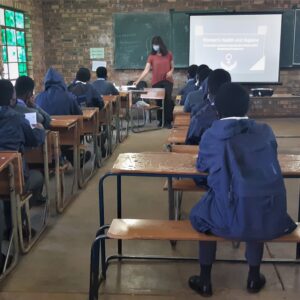
To support secondary schools in Kutama, we developed educational resources on women’s health and hygiene and held focus group discussions with 440 girls from grades 8-11 in two secondary schools in collaboration with their Life Orientation educators. We also gave each learner and some educators and school staff reusable sanitary pads to try.
Apart from assisting families financially, quality reusable sanitary pads can last for up to three years. It has been estimated that the average woman will use approximately 11,000 sanitary pads during her lifetime. Globally, municipalities and sanitation personnel are grappling to cope with the waste generated from sanitary materials, which ends up in landfills or flushed into sewerage systems, where it causes major management headaches. Substituting disposable sanitary pads or tampons with reusable pads or menstrual cups costs far less and substantially reduces the impacts of waste on water and the environment.
Our aim going forward is to gradually roll out similar WASH projects in other primary and secondary schools across all the EWT’s project sites in South Africa. Through our Education for Sustainable Development project, the Guardians of the Future, we will continue working with educators to co-develop additional curriculum-aligned interactive teaching aids and educational resources to support teaching in subjects such as Natural Science and Technology, Life Orientation, Social Sciences, and other subjects. Through these and similar interventions, we aim to support schools in developing capable, confident, and scientifically literate youth who understand the interwoven connections between people and nature and the value of collective efforts to reduce our environmental footprints and live more sustainably.
Learners walking home from school in Kutama
Thank you to the Coca-cola Foundation for sponsoring this project under its Replenish Africa Initiative (RAIN) and to the Ford Foundation for ensuring that we can get to schools and other project sites easily, no matter where they are.
Courtney Maiden, Endangered Wildlife Trust MSc Student
Over 750,000 km of roads crisscross South Africa, and the country’s natural habitats and wildlife are gravely threatened by further road development. Furthermore, with the anticipated increase of vehicles on the roads over the coming years, the likelihood of more wildlife-vehicle collisions is worrying. The Vervet Monkey (Chlorocebus pygerythrus) has adapted to thrive in human-altered landscapes. However, this also means they face many risks from humans and their activities. Vervet monkeys face daily challenges living in an urban environment due to increasing habitat loss and fragmentation. The clearing of treed areas for roads and other purposes forces monkeys to the ground, increasing their risk of being hit by vehicles. An important first step in reducing this outcome is the design of safe and cost-effective structures by which animals can safely cross the road.
Over the past two decades, wildlife crossing structures have been installed to facilitate wildlife movement over or under roads and railways to connect habitats and reduce roadkill. These structures are often custom-designed for each site and according to the needs of the targeted species. Yet, less than a handful of studies look at the effectiveness of different measures in reducing wildlife‐vehicle collisions in South Africa. Moreover, systematic assessments on designing safe and cost‐effective crossing structures for wildlife have not been carried out to date in our country, despite their importance in preventing Vervet Monkeys and other animals from becoming roadkill.
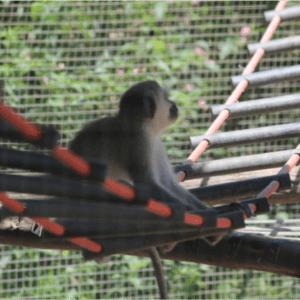
In March 2022, Courtney Maiden from the Endangered Wildlife Trust tested three different canopy bridge designs for Vervet Monkeys to identify one standardised design for the benefit of free‐ranging Vervet Monkey troops. The observational experiments took place at the Centre for the Rehabilitation of Wildlife (CROW) in Durban, where the three bridge designs were installed in two Vervet Monkey enclosures. Testing different canopy bridge designs in an ex-situ environment such as CROW allows us to establish design guidelines that can be used for free-ranging Vervet Monkeys in-situ (in their natural habitat). These ex-situ experiments are vital for understanding how Vervet Monkeys behave on different canopy bridge designs and identifying the most suitable bridge design to increase the likelihood of the bridges being used in the wild.
The bridges were made using polypropylene rope and recycled plastic. The design is adaptable to varying installation lengths, heights, and crossing environments. By observing the monkeys directly and using camera trap footage, we found that the ladder bridge was used most often and showed great potential for being the most suitable design.The positioning of any wildlife crossing structure is equally as important as its design. As the Vervet Monkey is a territorial species with daily foraging paths, installing canopy bridges along preferred movement pathways is vital for maximum benefit. Examining troop territories, crossing areas, and frequency of use can inform the best bridge location. Through the EWT-WTP student mentorship and with help from Wendy Collinson-Jonker (EWT) and Sandra Jacobson (US Forest Service Wildlife Biologist), Courtney has visited potential bridge installation sites in KwaZulu Natal and is currently studying road crossing hotspots to determine where bridges would be most likely to be used as intended.
Once suitable sites have been identified, we can begin the exciting part – testing the design identified as most suitable (the ladder bridge) on free-ranging monkeys. Watch this space for updates! All information and research updates can also be found on Instagram (@wildways_sa), Facebook (Wild Ways South Africa), and EWT platforms.