
Science Snippet
The Kudu Connection: Surprising Diet Choices of Liwonde’s Carnivores
By Erin Adams & Lizanne Roxburgh
Large carnivores are usually able to co‑exist in a landscape by eating different prey species, being active at different times of the day, and inhabiting different habitats. Among these factors, diet is often the main indicator of which carnivore species is present in a particular landscape, as many carnivores have evolved to make the most of their preferred prey. Studying what different carnivores consume therefore provides valuable insight into how best to manage them within a shared environment. In a recent publication co‑authored by EWT scientists*, the diets of lions, spotted hyaenas, and cheetahs were examined in Liwonde National Park, Malawi, to understand how these species overlap in their prey preferences.
The researchers collected scat samples from each predator species and opportunistically photographed direct feeding events whenever they were encountered. The scat samples were processed, and ten hairs from each sample were examined to determine which prey species they belonged to.
The scientists found a high degree of overlap in the prey species consumed by the three carnivores. Lions and cheetahs were each observed feeding on seven prey species, while spotted hyaenas fed on nine. Although all three species showed a preference for kudu (Tragelaphus strepsiceros) and waterbuck (Kobus ellipsiprymnus), there were notable differences: cheetahs preferred impala (Aepyceros melampus) and waterbuck and avoided warthog (Phacochoerus africanus); lions preferred eland (Taurotragus oryx) and warthog and avoided buffalo (Syncerus caffer); and spotted hyaenas preferred warthog and avoided impala.
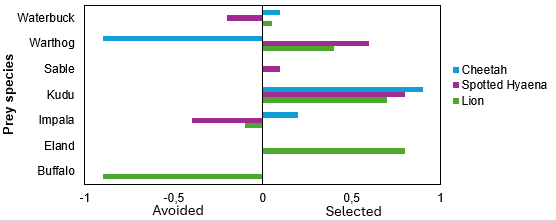
Fig. 1: Prey species avoided and selected for by lions, spotted hyaenas and cheetah in Liwonde National Park (figure adapted from the original publication).[
One of the standout findings was that all carnivores strongly preferred kudu, even though kudu were not very abundant in the landscape, indicating a clear selective preference.
Waterbuck were also frequently consumed by lions and cheetah, likely because they were highly abundant during the study period and easier to hunt due to their tendency to travel in small groups. These results highlight the importance of studying both predators and prey when assessing the health and functioning of an ecosystem. Understanding carnivore diet preferences, especially when they target less abundant species, helps conservationists make informed decisions about wildlife management, prey population monitoring, and maintaining balanced predator–prey dynamics within protected areas.
*Kayuni, B., Sievert, O., Davis, R. S., & Mzumara, T. I. (2025). Dietary Composition and Overlap Among Large Carnivores in Liwonde National Park, Malawi. African Journal of Ecology, 63(4), e70061.