
Uncurling a Future: The Release of 98 Armadillo Girdled Lizards
By Renier Basson, EWT Drylands Conservation Field Officer
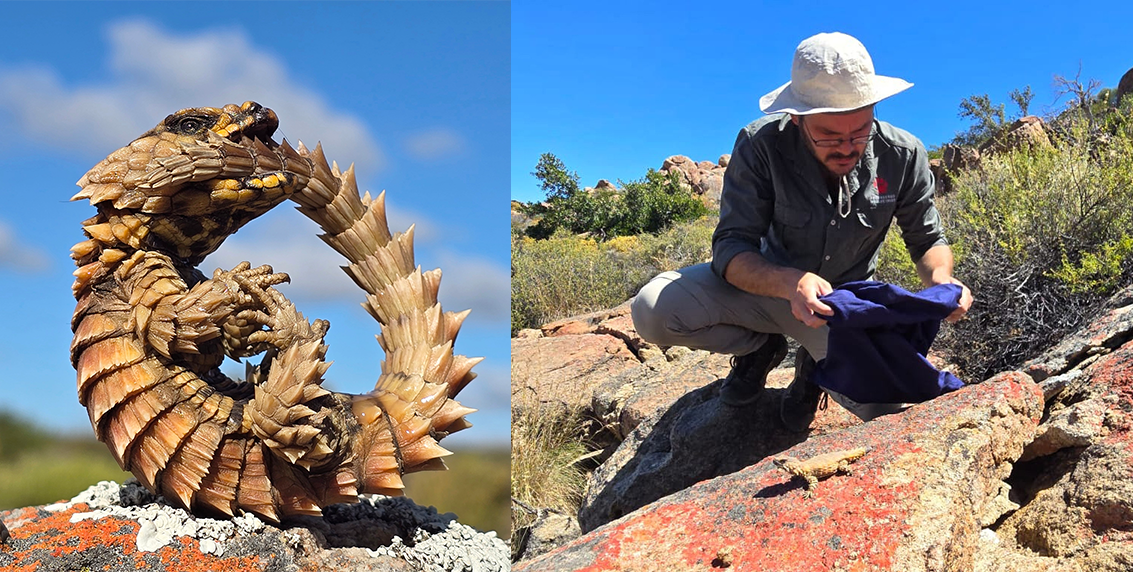
The Armadillo Girdled Lizard (Ouroborus cataphractus) is one of South Africa’s most remarkable reptiles. Endemic to the western regions of the country, these heavily armoured lizards inhabit rocky outcrops and sandstone crevices across the Succulent Karoo. Their diet consists mainly of insects, especially Southern Harvester Termites (Microhodotermes viator), with the occasional supplement of plant material.
Their most iconic behaviour is their unique defence strategy: when threatened, they clamp their tail in their mouth and curl into a tight, spiny ball. This posture shields their soft underparts and presents a ring of sharp, protective scales to predators. This striking shape resembles the ancient ouroboros symbol of a tail-biting creature, which appears in multiple mythological traditions (and heavily in Japanese visual culture). This resemblance is what inspired the genus name Ouroborus.
Unlike most reptiles, Armadillo Girdled Lizards give birth to live young, usually one or two per year, and mothers have even been recorded feeding their offspring. They are also unusually social: groups of up to 60 individuals may occupy a single crevice, forming long-term colonies that rely on the stability of their rocky habitat.
Despite their resilience, these charismatic lizards face increasing threats. Habitat fragmentation, invasive alien plants, shifting fire regimes, and climate change (particularly changes affecting termite availability) all put pressure on wild populations.
But, the most urgent threat is poaching. The Armadillo Girdled Lizard is now considered one of the most heavily trafficked reptiles in southern Africa. Growing overseas demand for the exotic pet trade has resulted in hundreds being removed from the wild every year. Recently, authorities confiscated a staggering 104 individuals in the Northern Cape.
The confiscated lizards were transported to the Kokerboom Biological Research Station near Springbok, where they received intensive care, under supervision of the African Snakebite Institute (ASI). The individuals were all monitored while regaining their strength in the hope that they could be released back into the wild. The Northern Cape Department of Agriculture, Environmental Affairs, Rural Development and Land Reform (DAERL) contacted numerous agencies and experts to assess the potential of releasing the confiscated animals back into the wild. It was agreed that a release was possible, as the approximate poaching locality was known, and the joint effort among partners such as DAERL, the EWT, the SA National Biodiversity Institute (SANBI) and ASI ensured that a suitable site with a willing landowner could be identified to receive the rehabilitated animals.
Before releasing the lizards, DAERL and EWT officials surveyed the identified private property to determine whether the habitat was suitable – ultimately selecting roughly twelve sites that met the species’ ecological requirements.
Unfortunately, due to the poor conditions in which the Armadillo Girdled Lizards were found, six individuals did not survive. Most of the remaining 98 lizards were implanted with passive integrated transponder (PIT) tags to allow for identification upon recapture, as part of the long-term monitoring. The individuals were then separated into seven mixed-age groups and released across the preselected sites. Upon release, the lizards quickly disappeared into their new crevices.
The lizards are being monitored to determine whether they have settled into their new home. The collected data will guide future decisions on relocations and the management of confiscated Armadillo Girdled Lizards in the Northern Cape. It is hoped that this information will inform decisions regarding the vast number of confiscated individuals still held in captivity in the Western Cape.
This release represents a major milestone for Armadillo Girdled Lizard conservation. However, the challenges are far from over. Demand from the illegal pet trade continues to grow, and once animals leave the country, they are almost impossible to recover. What we can do is raise awareness, avoid sharing GPS coordinates of sightings, refrain from posting identifiable habitat features online, and support enforcement agencies by reporting suspicious activities.
Every confiscated lizard represents both a loss and an opportunity. With collaboration, vigilance, and continued research, South Africa can protect this species – ensuring that the iconic, tail-biting “ouroboros” of South Africa remains safely coiled within its rocky landscape.