
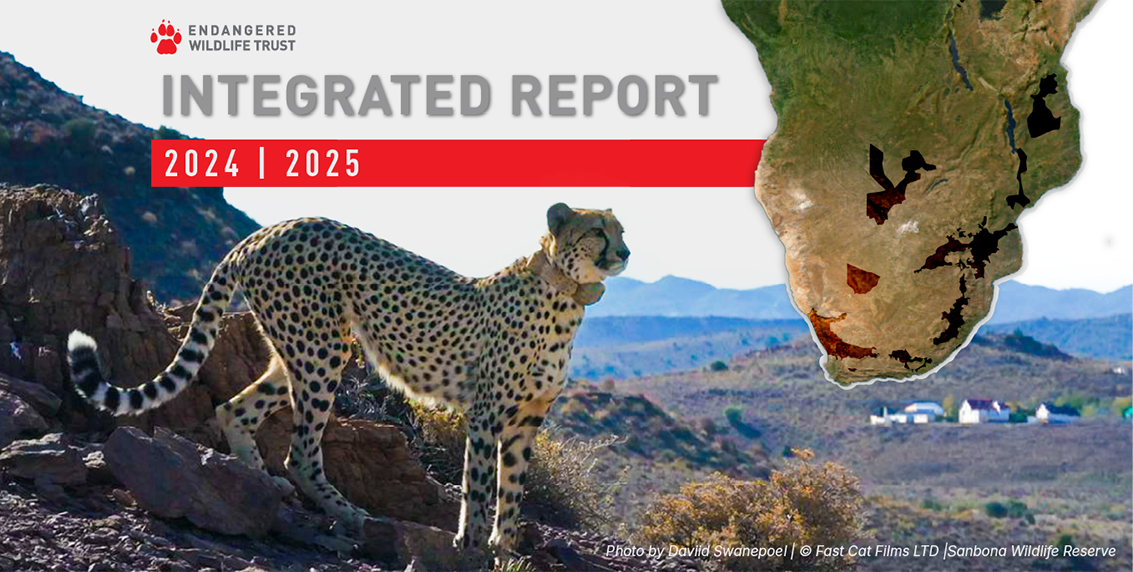
2024/25 Integrated Report: Saving species, saving lives – a year of empowerment, collaboration and expansion
“The money we are getting here has changed our lives. Our children are now going to school, says Tshifularo Madzhie of Kutama village in Limpopo as he speaks with pride about his job at the EWT’s Medike nature reserve.
Situated in the Endangered Wildlife Trust’s (EWT) Savannah Conservation Landscape, which spans large tracts of northern Limpopo and extends into Mozambique, the EWT-owned Medike nature reserve in the Soutpansberg Mountain Range is a haven for numerous threatened and highly endemic species of reptiles, insects, amphibians and plants. The EWT acquired the reserve in 2018 and has slowly been transforming it into not only a conservation wonderland, but also a distinctive tourist destination where nature-loving visitors participate in developing the story of nature-based solutions uplifting local communities.
Four members of the local communities have received training to become rangers and are now employed by the EWT. In addition, 205 community members are being supported sustainably grow and harvest Pepper Bark Trees, Haworthiopsis and other medicinal plant species.
In the past year, seven more local community members have been employed to build roads and clear alien and invasive species, further restoring the natural systems and creating access for tourism development. Two community members have been employed by Medike nature reserve to strengthen law enforcement.
Madzhie speaks with pride about his job building roads, the fact that he has obtained his driver’s license in just four months, and being able to build a fence around his family’s home, on top of all the skills he has learnt.
“I am saving my money so that I can attend a security course when this job finishes, so I can apply for a job as a security guard at one of the reserves or in town. This job has given me experience and purpose,” he says as he speaks about giving up poaching and embracing conservation, teaching his community about the environmental harm caused by littering, runaway fires and poaching. “My perception has changed because of this opportunity I have been given.”
Madzhie is one of numerous community members involved in projects managed by the Endangered Wildlife Trust, with our partners like the International Crane Foundation. This work not only restores and secures safe spaces for threatened species, but it also facilitates climate adaptation, expands protected area corridors across Africa, and reduces human-wildlife conflict. Additionally, it improves the well-being and ecological resilience of Indigenous People and Local Communities (IPLCs).
Communities are central to the EWT’s conservation success, and our 2024/5 Integrated Report showcases multiple examples of the impact of partnerships with communities to the benefit of conservation and the people who are directly dependent on their environment for their livelihoods.
Through skills training, livelihood support, and local leadership, we’ve helped people build sustainable futures that keep ecosystems healthy. With the declaration of the 11,563ha Western Soutpansberg Nature Reserve in January 2025, the EWT now works collaboratively with landowners and provincial authorities to conserve and manage an additional 31,180ha of habitat. As of the end of the 2024/25 financial year, 114,819ha of critical conservation land across all our Strategic Conservation Landscapes had undergone some form of improved land management change, rehabilitation, or restoration process, which will lead to improved ecosystem function, health, and resilience. This includes 95,000 ha declared Vulture Safe Zones, and work done on about 20,000ha to clear alien and invasive species, control erosion, restore habitats, improve law enforcement, and manage game.
A total of 20 million m3 of freshwater had been replenished through community-based initiatives to remove alien invasive species and restore catchments. In a water-scarce region, the conservation of freshwater sources is critical for climate change adaptation, benefitting both the communities and the multiple threatened species in those systems
In the year under review, more than 22,074 people were empowered through various training and development initiatives. The livelihoods of 20,356 people were directly improved through employment or income-generating activities; 1,108 people were trained to provide them with better employment opportunities; and the livelihoods of 610 people were secured by, for instance, placing livestock guarding dogs to protect their livestock.
People are integral to sustained conservation impact and, closer to home, the EWT’s own pack of extraordinary conservationists has achieved other remarkable gains for threatened species conservation.
Highlights in the EWT’s 2024/25 Integrated Report include:
- Coordinated the translocation of more than 20 Endangered African Wild Dogs and multiple Cheetah across southern Africa, creating new packs and coalitions to expand the population sizes.
- Rescued and saved 81 vultures from a mass poisoning event in the Kruger National Park in May 2025.
- Removed over 500 kg of poisons from Vulture Safe Zones.
- Supported the training of 200 Soutpansberg community members to attend an AgriSETA-accredited training programme; provided seeds and basic equipment to contribute to their household’s food security.
- In partnership with Bionerds, we recorded the first documented breeding calls and mating activity in over 40 years for the Critically Endangered Amathole Toad.
- In Durban, the Widenham Wetland was declared a Protected Environment and Treasure Beach was granted Nature Reserve Status to protect the Endangered Pickersgill’s Reed Frog and critical burrowing skink habitat.
- In the Drakensberg, spring protection projects at KwaMkhize, Mqatsheni, and Hlatikulu now supply clean water to over 1,000 people, while community-led land-use planning has designated 800 hectares of high-value grassland for conservation and grazing.
- Initiated carbon offsetting projects, covering 93,000 hectares with an additional 53,000 hectares in development. These will secure critical grassland habitat whilst providing sustainable income for the farmers.
- The EWT entered into a conservation servitude agreement with Lokenburg Farm, specifically to conserve habitat for the Speckled Dwarf Tortoise.
- The EWT’s Conservation Canine Unit hosted the first African Canines in Conservation Conference, hosting speakers and delegates from 19 countries, focusing on the use of dogs for conservation research and the science of utilising working dogs for conservation
- More than 100 renewable energy applications have been reviewed in South Africa to reduce negative impacts and enhance the positive potential of this sector to sustainably benefit the environment.
To support the rapid growth and expansion of the EWT’s groundbreaking conservation work across Africa, the EWT USA was registered as a 501(c)(3) tax-exempt public benefit organisation, kickstarting a phased approach to expanding our U.S. fundraising market.
“The EWT envisions a future where Africa’s wildlife and her people thrive together, and where our long-term strategic objectives have turned hope into intention, laying the foundation for a sustainable tomorrow. To achieve this, our 25-Year Future Fit Strategy is an ambitious, long-term framework designed to secure biodiversity, restore ecosystems, and build resilient communities across nine Strategic Conservation Landscapes in southern and East Africa,” says the EWT’s CEO, Yolan Friedmann. “Our Strategy is not just a roadmap – it is a bold commitment to future generations that is ambitious, inclusive, and enduring.”
“The year under review shows how we are successfully bringing this vision to life, and this report showcases multiple examples of how healthy ecosystems support thriving wildlife and people. We close out this financial year with energy and determination to do more.”
Friedmann adds that the 2024/5 financial year was shaped by transformation and tested the EWT’s tenacity. “Despite global and regional challenges, from geopolitical volatility to socio-economic pressures, our conservation programmes have not only endured but thrived”.
Chair of the EWT’s Board of Trustees, Muhammed Seedat, says the year marked another period of both reflection and renewal.
“The world continues to grapple with the accelerating effects of climate change, habitat loss, and economic uncertainty. Yet, despite these pressures, the EWT has not only sustained its vital conservation work, but expanded its impact across multiple fronts,” he says.
“We are entering a defining decade for biodiversity. We are at a juncture where we have just over four years in which to achieve the international targets of conserving 30% of land and sea by 2030, drastically cut greenhouse gas emissions as we work to build resilience and protect vital resources and halt biodiversity loss in the face of unforgiving climate change. The decisions we make now will determine the health of our planet for centuries to come”.
Thus, the importance of the EWT’s Future Fit Strategy. This, he says, is the EWT’s promise and commitment to a sustainable tomorrow in which no-one is left behind.