Help protect Africa's 

Science Snippets: Cape Vultures blowing in the wind

Science Snippets: Cape Vultures blowing in the wind

Science Snippets: Cape Vultures blowing in the wind

Modelling the threat of wind energy production plants for the vulnerable Cape Vulture

Erin Adams and Lizanne Roxburgh, the EWT Conservation Planning and Science Unit

Across Africa, wind energy offers opportunities to reduce national dependency on fossil fuels, increase energy security, and reduce greenhouse gas emissions. But what happens when these clean energy production sites cut through the distribution of a threatened species? In South Africa, wind energy farms overlap significantly with the flying patterns of Cape Vultures, and a recent publication* co-authored by EWT scientists quantified the risks posed by wind energy development facilities to Cape Vultures.

Wind energy is one of the fastest-growing forms of renewable energy, but it can result in the direct mortality of birds by collision with turbine blades. Large soaring species like vultures are particularly vulnerable to collisions. Cape Vultures are classified as Vulnerable on the ICUN Red List and are endemic to southern Africa. Using GPS tracking data collected from 68 Cape Vultures over twenty years, and the location of 167 core colonies and five roost sites, scientists could determine how at risk the Cape Vultures were to collisions with wind turbines. Complex modelling was done to see how the birds are likely to travel around their environment and determine the potential for collisions. Within this, they could measure how much the vultures overlapped with current wind farms and aimed to expand this to be used when planning future wind energy sites.

The scientists found that the models could accurately predict Cape Vulture movement patterns. The resulting maps produced were also able to quantify how much of a threat wind energy production plants posed to Cape Vulture colonies in South Africa. The results of this work can assist wind energy stakeholders in identifying high-risk areas and planning new developments accordingly. In future, the scientists recommend expanding this work into other regions of Africa to include other threatened vulture species, such as Rüppell’ s Vulture in East Africa.

*Cervantes, F., Murgatroyd, M., Allan, D. G., Farwig, N., Kemp, R., Krüger, S., Maude, G., Mendelsohn, J., Rösner, S., Schabo, D.G., Tate, G., Wolter, K., & Amar, A. (2023). A utilisation distribution for the global population of Cape Vultures (Gyps coprotheres) to guide wind energy development. Ecological Applications, e2809. https://doi.org/10.1002/eap.2809
 

Science Snippets: The impact of roads and powerlines on South Africa’ s primates

Science Snippets: The impact of roads and powerlines on South Africa’ s primates

Science Snippets: The impact of roads and powerlines on South Africa’ s primates

Erin Adams and Lizanne Roxburgh, the EWT Conservation Planning and Science Unit

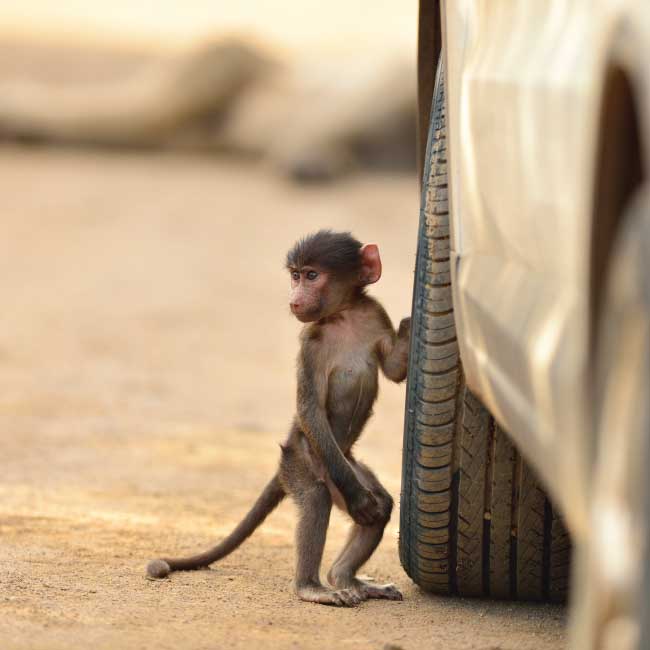
South Africa has an extensive linear infrastructure network of roads, railways and powerlines, which is essential for human connectivity. However, it is not great news for primates. Approximately 18% of the world’ s primates are directly impacted by linear infrastructure. In a recent paper* co-authored by EWT scientists, the impact of linear infrastructure on South Africa’ s primate species was studied.

Within South Africa, many primates are killed in road collisions and powerline electrocutions every year. To get an indication of the extent to which primates are affected by wildlife, data was collated from the EWT’ s database of vertebrate roadkill**, as well as from the EWT-Eskom Central Incident Register, which is a national database of wildlife incidents on electrical infrastructure, mainly electrocutions and collisions. The focal species for this study were the Vervet Monkey (Chlorocebus pygerythrus), Chacma Baboon (Papio ursinus), Thick-Tailed Bushbaby (Otolemur crassicaudatus), Southern Lesser Bushbaby (Galago moholi), and Samango Monkey (Cercopithecus albogularis).

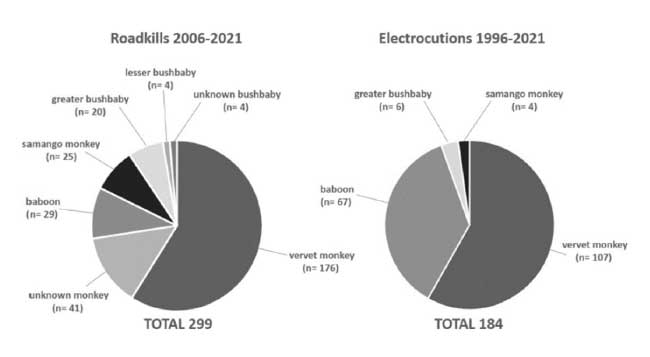
The authors found that Vervet Monkeys were most reported in both roadkill and powerline collision incidents (see the figure below). The Southern Lesser Bushbaby was least frequently reported. The data also showed that several incidents involved more than one individual. When it came to roadkill, 4% of incidents involved between two and four individuals killed in one collision, whereas in electrocution incidents, 13% of cases had between two and six individuals killed in one incident.

Graph showing the comparison of South Africa’ s primate roadkill and electrocution mortalities

Comparison of South Africa’ s primate roadkill and electrocution mortalities (from Linden et al. 2022)

The authors recommended that mitigation measures, such as canopy bridges across roads and better insulation of transformers and substations, be more widely implemented to help conserve South Africa’ s primate populations. Although South Africa leads the African continent regarding roadkill and electrocution data collection, key information, such as GPS coordinates and the age and sex of individuals, is missing. Data collection protocols can be improved to better inform mitigation measures and understand impacts on populations. Future Red List assessments should acknowledge linear infrastructure as a more significant threat to primates.

* Linden, B., Cuozzo, F. P., Sauther, M. L., & Jonker, W. C. (2022). Impact of linear infrastructure on South Africa’ s primate fauna: the need for mitigation. Folia Primatologica, 1(aop), 1-19.

** The EWT has a free road watch app available to record any roadkill sightings. This will help us identify hotspot areas as well as the species most at risk.

MRI whale unit research

MRI whale unit research

MRI Whale Unit Research: Drones Revolutionise Whale Conservation

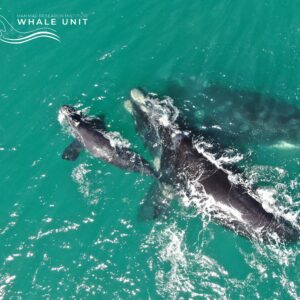
The MRI whale unit research partnership between the Endangered Wildlife Trust and University of Pretoria is transforming how we study Southern Right Whales. Using cutting-edge drone technology, researchers can now assess whale body conditions and behaviour patterns in a cost-effective, non-invasive manner – critical for understanding climate change impacts on marine ecosystems.

Drone Technology Breakthroughs

The EWT’s licensed drone operations (SACAA-approved since 2020) are enabling groundbreaking conservation work:

  • Power line safety: Attaching bird flight diverters
  • Wildlife monitoring: Thermal imaging for nocturnal animal counts
  • Marine research: Photogrammetry of whale populations

Southern Right Whale Research

The unit employs specialised drones to:

  • Capture high-resolution aerial images
  • Measure body condition indices (BCI)
  • Track individual whales over time
  • Compare populations across South Africa, Australia and Argentina

“Drone technology has revolutionised our research,” says Dr Els Vermeulen, MRI Whale Unit Research Manager. “We can now track body condition variations annually and observe behaviours invisible from boats.”

Climate Change Connections

The research highlights worrying trends:

  • Krill populations (whales’ main food) affected by ocean warming
  • Declining body conditions may indicate ecosystem stress
  • Long-term data crucial for conservation planning

How to Get Involved

Contact Lourens Leeuwner (lourensl@ewt.org.za) for drone operation enquiries