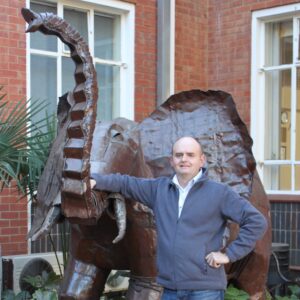
GUEST ARTICLE: MY JOURNEY IN ROAD ECOLOGY
A rewarding part of my career has been training and capacity-building and seeing people and organisations become local, regional, and world-leaders in their work. A highlight for me has been watching the growth of Wendy Collinson and the Endangered Wildlife Trust to become local and international leaders in transportation ecology.
My name is Dr Rodney van der Ree, and I first met Wendy Collinson in around 2010. Our first collaboration was to co-organise a symposium at the International Wildlife Management Congress in Durban in 2012, followed by a workshop at the EWT office in Johannesburg a couple of days later. The concept of ‘road ecology’ was explored for the first time in Africa at these two events, and participants clearly understood its importance. Wendy and the team at EWT continued to develop the program and established partnerships with local road agencies (namely Bakwena, N3TC and TRAC N4), SANParks and universities to begin collecting data and training students.
In 2015 I returned to South Africa to support another series of workshops on road ecology in Africa run by EWT at a conference in Howick (The Symposium of Contemporary Conservation Practice) and Johannesburg (The Green Mile). It was incredible to see the growth in the field since the initial visit in 2012 and participation by a larger and more diverse group of people. This was also an exciting trip for me because I brought about 30 copies of my recently published ‘Handbook of Road Ecology’ (www.handbookofroadecology.org), which included four chapters from Africa, including a Chapter by Wendy and colleagues at the EWT. The handbook has 62 chapters written by more than 100 leading transportation ecologists from around the world, and I have half-price copies available as part of the 2nd ACLIE congress (see ACLIE article) that was just held. If you are interested, please send me an email rvdr@unimelb.edu.au and I can give you a quote for postage.
I started my career as a post-doctoral researcher at The University of Melbourne Australia and very quickly became focused on quantifying and mitigating the impacts of roads and traffic on wildlife. With numerous students and collaborators (including Dr Manisha Bhardwaj, who wrote an article in this newsletter last month), this field of research and practice’ s critical importance is growing rapidly. I have since moved into ecological consulting to work more closely with those who are planning, designing, building and managing the roads, railways and other linear infrastructure that is being built across Africa at a pace never seen before. In an effort to improve access to important information, I established the open-access resource hub www.TransportEcology.info earlier this year, with Wendy and Lucy Waruingi (from the African Conservation Centre) on the editorial board. The site includes blog-style summaries of relevant peer-reviewed scientific articles, as well as space for case studies and best-practise notes. You are invited to submit your articles for publication and encouraged to subscribe to receive notifications when new articles are published.
Transportation ecology in Africa has come a long way since Wendy, and I ran those initial meetings almost a decade ago. With Wendy spearheading the establishment of ACLIE and the successful online ACLIE congress in August 2021, there is now a much larger group of people involved and dozens of research and management projects across many parts of Africa. Importantly, there is a growing realisation in government of the need for applied research, comprehensive environmental impact assessments, and innovation to ensure the roads, railways, and other linear infrastructure we build today do not undermine our ecosystems’ ecological integrity and sustainability for decades to come.
LATEST STORIES
GUEST ARTICLE: EVERY ANIMAL MATTERS
Fraser Shilling, Director Road Ecology Centre, University of California, Davis fmshilling@ucdavis.edu
 In the 90s, I used to drive long distances to see my girlfriend in Southern California. I would see dead wildlife on my drive, and for many species, it was the first time I had seen them in the wild. Years later, as a landscape ecologist at UC Davis, I started to connect the real wildlife losses along roads with the habitat fragmentation I studied in geographic information systems on computers. In many ways, this transformed my research trajectory and brought my science closer to my concern for the Earth. Many scientists shy away from saying they are environmentalists or want to fight to protect the Earth, but that’ s silly and is like being a ship’ s engineer and not caring if it sinks.
My name is Fraser Shilling, and I am the director of the Road Ecology Centre at the University of California, Davis. My centre is affiliated with the Institute of Transportation Studies (ITS), both the firsts of their kind. ITS is well-known for investigating non-motorised travel, alternative fuels, and other revolutions in transportation needed to prevent climate change and improve human quality of life. My centre is best known for studying conflicts between transportation and nature, many of which can be measured as impacts on wildlife. We aren’ t shy about our position that nature and wildlife matter, and we use our studies across scales from whole continents to individual animals to make this case.
This concern for wildlife and especially those needlessly killed on roads brought me into contact with the EWT and in particular, the extraordinary Wendy Collinson. We have begun an incredible project together, bringing together the “transportation ecologists” from around the world into one Congress to discuss the outstanding issues in our field. The brainchild of Wendy, the Global Congress on Linear Infrastructure and Environment (GCLIE), will have its first meeting this year, preceding the conference I organise, the International Conference on Ecology and Transportation. GCLIE will kick off with experts from around the world sharing their perspectives and include open discussions about how road, rail, canal, powerline, and fence infrastructure break habitat up into pieces, kill wildlife, and exacerbate human impacts on Nature. If you are reading this, you are welcome to join the discussion. Go to https://gclie.org for more information.
To learn more about the Road Ecology Centre, go to https://roadecology.ucdavis.edu.
LATEST STORIES

GUEST ARTICLE: INVESTIGATING IMPACTS
Manisha Bhardwaj, Postdoctoral Researcher, Swedish University of Agricultural Sciences, manisha.bhardwaj@slu.se The ecological impacts of roads and railways on wildlife can be far-reaching and detrimental. For example, transportation infrastructure contributes to habitat loss and fragmentation, where animals are impeded from travelling through their environment without avoiding transportation infrastructure or the mortality risks involved in crossing roads and railways. In addition, habitat quality adjacent to roads can be compromised as noise and light from traffic and streetlights spill into the surroundings. These impacts, individually and cumulatively, can have devastating effects on wildlife, reducing their ability to persist in landscapes. These are the types of implications I study.
My name is Manisha Bhardwaj. I am a postdoctoral researcher at the Swedish University of Agricultural Sciences, investigating the impacts of the built environment and human activity on wildlife populations. My interests include understanding how anthropogenic activities impact the ecology and behaviour of animals. I am particularly interested in the roles noise and light pollution play in wildlife populations’ persistence and how animals respond to these stresses behaviourally. In addition, I enjoy exploring human-wildlife interactions and the interconnectedness between our activities as people, the landscapes we occupy, and the landscapes needed for wildlife.
My interest in road and railway ecology has brought me fruitful and fulfilling collaborations with the EWT, particularly with the Wildlife and Transport Programme. Together with Wendy Collinson and Paul Allin from Transfrontier Africa, we are investigating the impacts of railways on wildlife in the Greater-Kruger National Park Region in the first formal South African railway ecology programme. Our project brings together NGOs, researchers, and managers to address the impacts of railways on native fauna such as Elephants, Hyaena, Wild Dogs, and Impalas. We have investigated where and when wildlife cross railways and collisions occur, how effective mitigation strategies can be to reducing the rate of collisions, and how animals react to oncoming trains. With this project, we will provide insights into this issue to reduce the overall impacts on South Africa’ s wildlife.
SCIENCE SNIPPETS:
SPLAT STATS
Dominic Henry, EWT Conservation Science Unit, Ecological Modelling Specialist, dominich@ewt.org.za
Road networks form a substantial part of current and future infrastructure development and are a major hazard for local wildlife populations. Due to high mortality rates, wildlife-vehicle collisions are a threat not only to individual animals but to broader animal communities, populations, and species. The threat of wildlife-vehicle collisions is set to increase globally as an additional 25 million kilometres of road are expected to be added to the global road network by 2050.
We need to estimate how many wildlife deaths result from vehicle collisions if we want to understand this impact on wildlife populations and develop strategies to prevent or reduce the collisions, so we need to get out there and do surveys.
However, conducting roadkill surveys is a resource-intensive exercise. Labour costs, fuel, mileage, and vehicle maintenance are just some of the costs incurred for this type of research. Depending on the study site and survey durations, these costs can escalate quickly. Research budgets are often limited, and it is important to make each rand go as far as possible. In light of financial resource limitations, the question is, is there an alternative to conducting daily surveys of roadkill while still having a robust study design?
When designing roadkill surveys, there is a trade-off between survey frequency (and all the logistical effort and costs incurred) and roadkill carcass detection. In this regard, carcass persistence (the period a carcass remains detectable before it is removed by decomposition or scavengers) is important; the longer a carcass persists, the greater the likelihood it will be detected with lower survey effort by conducting more infrequent surveys.
Part of our research, published recently in the Journal of Environmental Management, looked at this question. The study was based on Wendy Collinson-Jonker’ s roadkill dataset collected in the Greater Mapungubwe Transfrontier Conservation Area. An observer drove a standardised 120 km transect daily for a month, recording all carcasses as well as how long they remained on the road. Over 340 carcasses were recorded, comprising 73 species ranging from the smallest frogs to a Brown Hyaena. We used these data to simulate what would happen if surveys were conducted with different intervals from 2–10 days.
We found that the proportion of carcasses detected decreased sharply when survey intervals were longer than three days. However, we showed that survey costs could be reduced by up to 80% by conducting non-daily surveys. By carefully considering the objectives of the survey and characteristics of the focal species, researchers can substantially reduce the costs of their studies. We developed a web app (https://roadsplat.ewt.org.za/) that can be used by researchers to compare survey costs across a variety of survey characteristics. This web app allows researchers to assess the trade-off between carcass detection and cost easily.
Details of the journal article:
Citation: Henry, D.A.W., Collinson-Jonker, W.J., Davies-Mostert, H.T., Nicholson, S.K., Roxburgh, L. and Parker, D.M. 2021. Optimising the cost of roadkill surveys based on an analysis of carcass persistence. Journal of Environmental Management 291:112664
Link to paper: https://doi.org/10.1016/j.jenvman.2021.112664
Link to app: https://roadsplat.ewt.org.za/
ALL ABOARD THE CONSERVATION EXPRESS
Wendy Collinson, Manager, EWT Wildlife and Transport Programme
wendyc@ewt.org.za
Prior to COVID-19, animals had, over time, adapted their ways in response to our increased transportation networks, namely railways and roads. Many avoided these corridors due to the impact on their survival – that is, a mortality caused by colliding with a train or a vehicle. With fewer people travelling and limited transportation of goods on our rail networks, it has not taken long for wildlife to notice and take advantage of this, reverting to their normal and preferred ways. They are now foraging and hunting through moving back and forth at will between various parts of their habitats, including crossing railways and roads that are now quieter. We have also seen increased animal presence in many of our towns and cities as animal confidence increases due to low human presence.
From a research perspective, this begs the question, what happens as more people return to their usual travel habits? We are presented with a unique, once-in-a-lifetime opportunity and insight into studying animal behaviour from before, during, and after the current restrictions placed on travel. The variation in transport volumes due to different phases of allowed activity for multiple species across the world will be incredibly interesting to monitor. With this in mind, the EWT’ s Wildlife and Transport Programme (WTP) is launching two new projects, both supported by GreenMatter, with two Master’ s students jumping on board to expand on the work already being undertaken by the programme. Research will be conducted on the Balule Nature Reserve to determine wildlife-rail mortality rates as well as animal behaviour adjacent to the railway. Wendy Collinson, the WTP’ s programme manager states that, “whilst we had initially already decided on the focus of these two research projects, we had not anticipated the global pandemic and current travel restrictions. Consequently, these projects have since evolved to incorporate the current situation and will be pioneering in understanding animal behaviour. The research will provide possible answers to the potential difference that can be made to reduce railkill, simply through reducing train volumes on routes, particularly in a protected area or nature reserve”.
In Africa, the expansion of railway networks is associated with the projected rapid urbanisation and the development of mines that will produce large volumes of bulk goods. Railways are essential transportation corridors that facilitate the movement of goods and people, but railways and trains can also negatively affect wildlife through collision mortalities, habitat loss, barrier effects, and disturbances such as noise and light. The occurrence of mortalities due to train collision can contribute to the population decline of wildlife and pose a serious threat to biodiversity conservation. This has been observed in Scandinavia with Reindeer, as well as Black Bear in North America. The occurrences of wildlife mortalities as a result of collision with trains have serious implications in protected areas, such as the Balule Nature Reserve, where the railway traverses the landscape, potentially impacting conservation and wildlife management on the reserve, not to mention the potential costs to Transnet through repairs to the line and train.
Siboniso Thela and Nthabiseng Mampa are two GreenMatter Fellows who will be working in collaboration with the EWT to understand how the Phalaborwa–Hoedspruit railway line in Balule Nature Reserve affects animals. Siboniso has begun his initial fieldwork, under strict conditions, with the correct personal protective equipment and will be examining the differences between seasons and mortalities of mammals on the railway. He has been setting up camera traps adjacent to the railway line to monitor animal movements, as well as what type of animals make use of the railway line. Nthabiseng will determine whether railways act as a barrier against the movement of animals across the landscape, with the unique opportunity of monitoring this during the various stages of the lockdown periods. South Africa has the 10th longest rail network in the world, one of the most advanced in Africa. These lines are used for both passenger transport and freight and cross a variety of landscapes from urban developments to agricultural farmland and wildlife conservation areas, often bringing trains into conflict with wildlife. Almost no attention has been paid to the threat this poses to the country’ s biodiversity and the people using the rail network. Therefore, the information gleaned from projects such as this are of extreme importance to conservation and economic development in the country.
Users of our transportation networks need to be mindful that wildlife has become used to our absence. They may not be expecting trains and vehicles and we therefore need to be extra cautious of wildlife activity in these areas, giving them time to adapt back to knowing we are there. Ultimately, as our transportation corridors eventually reopen, we should embrace practices that reflect human-wildlife coexistence, rather than human-wildlife conflict and take the opportunity of this lockdown to reflect and see how we can be more organised in the future to find a balance.
This project is supported by GreenMatter and is a collaborative project amongst the EWT and the Universities of Venda, Witwatersrand, the Swedish University of Agricultural Sciences, Wildlife and Ecological Investments and Transfrontier Africa-Balule. This huge team of experts is devoted to this project and hopes to gain a real understanding of the how animals behave around railways, and what preventative measures can be put in place to curb wildlife mortalities.