Battle of the Bullets: The Lead-free awareness drive by South Africans for South Africans.
Danielle du Toit, Vulture Safe Zone Officer, Birds of Prey Programme.
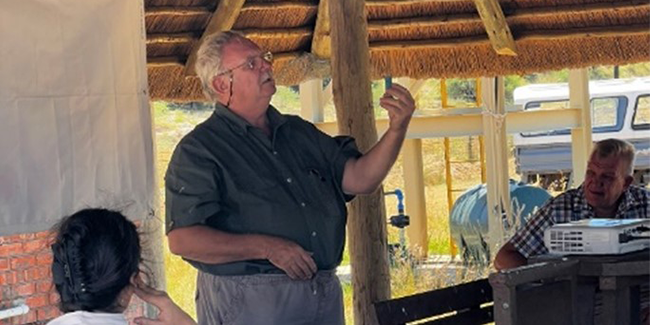
Ronelle Visagie speaking to delegates about vulture conservation
The EWT Vulture Safe Zone project objectives include reducing and ultimately eliminating the threats to vultures within project areas. Among many other dangers is lead poisoning; a serious threat to vulture populations and other species across the globe.
Poisoning in its many forms is the leading cause of population decline in vulture species. Although both intentional and unintentional poisonings have resulted in huge knocks to vulture numbers in single incidents, lead poisoning can be considered a quiet killer. It is a silent destroyer of which few people appreciate the serious impact it has on, for example, scavenging species like vultures.
Lead poisoning is caused when lead is ingested and allowed to enter the blood stream reaching vital organs and the animal’ s bones. It can cause an array of ailments including, but not limited to, decreased coordination, decreased fertility, bone fragility, organ disease and failure and eggshell fragility.
Vultures are usually slowly poisoned by lead when carcasses of animals shot with lead ammunition are fed on by these scavenging birds, either in the veld, at carcass dump sites or vulture restaurants. The skulls of animals harvested through head shots and which have been thrown into these dump sites are of particular concern as lead fragments are highly concentrated in those parts.
Vultures are also susceptible because their entire digestive system is highly acidic (unlike humans, which have alkaline mouths and saliva). This causes the lead to break down easily into smaller particles which are quickly taken up into the bloodstream. Studies have shown that the lead causing this poisoning is indeed from lead ammunition.
(For more on this, read: van den Heever, L., Elburg, M.A., Iaccheri, L. et al. Identifying the origin of lead poisoning in white-backed vulture (Gyps africanus) chicks at an important South African breeding colony: a stable lead isotope approach. Environ Sci Pollut Res 30, 15059–15069 (2023). https://doi.org/10.1007/s11356-022-23209-z )
The EWT’ s Vulture Safe Zone project came up with Battle of the Bullets initiative to address what we call ‘the threat behind the threat’ . It was established to not be prescriptive in its nature, but has rather taken the form of a round table where all role players within the ammunition and conservation circles are brought together to determine how all can benefit, or be benefitted by, opening a conversation around the latest science in conservation and lead-free bullet ballistics.
In February 2023, the EWT and partners, BirdLife South Africa and SA Hunters, with major input from our ballistics specialist, Kobus du Plessis, hosted the 3rd Battle of the Bullets at the Rooifontein Shooting Range in Kimberley. This location was chosen because lead poisoning of the resident vulture populations was shown to be some of the highest in the country.
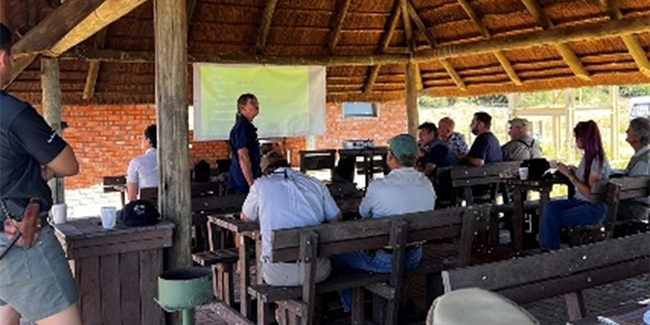
Attendees at Battle of the Bullets in Kimberley
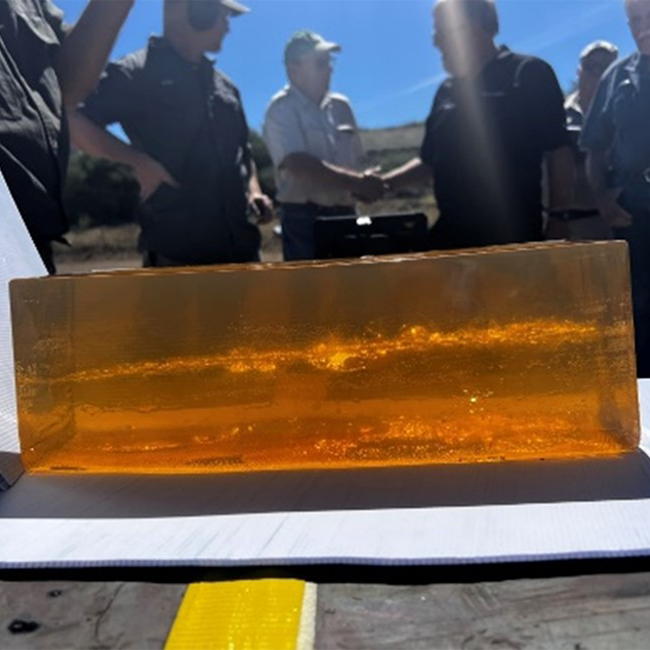
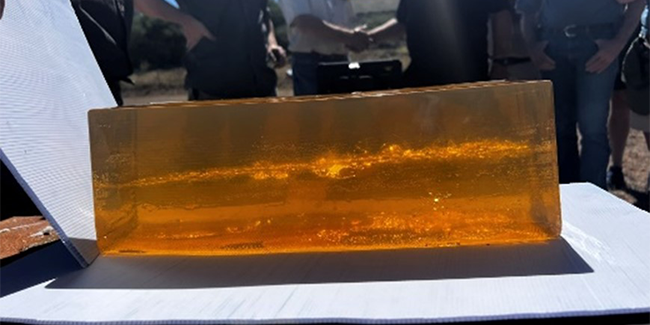
Gelatin targets are used to visibly show the bullet energy transferrence and trajectory
Ronelle Visagie presenting speaking to delegates about vulture conservation
The day started with presentations from the EWT’ s Ronelle Visagie who spoke about her work in vulture conservation in the Northern Cape, followed by Linda van den Heever of Birdlife SA who presented her study on lead poisoning in vulture species. Schalk van der Merwe, formerly of the Endangered Species Unit, discussed what to do if one came across a potential poisoning.
Linda van den Heever’ s presentation was hugely important as it not only simplified the jargon used in science for the average person, but also revealed just how bad the lead poisoning situation is. This then begged the question, if lead is so bad, what are the alternatives?
For many years, lead free ammunition and bullets have been assumed to be unreliable, costly, and inaccessible. Many have complained that the bullet does not perform according to what the user needs. However, we are now seeing a steep increase in the quality of lead-free ammunition. South African manufacturers are testing, retesting and constantly improving their products for the South African hunter and shooter — for South African conditions.
Kriek Bullets and Impala Bullets demonstrated different ammunitions on different targets to show just how well they performed under various circumstances – from distance, to accuracy, to impact. They tested lead ammunition versus lead free ammunition in each demonstration. It was easy to see that the bullets were performing well in every scenario presented and showed that users can have peace of mind when choosing to use lead free alternatives.
The Battle of the Bullets not only provides the latest information and science on lead poisoning and lead free bullets to attendees, but also highlights the link between vulture conservation and the hunter. February’ s event once again proved that by leaving assumptions at the metaphorical door, and entering into the day with an open mind, we could all learn something new while supporting conservation efforts and local manufacturers.
Special thanks to Ekapa Mining, Esther van der Westhuizen, Ruan Maré and their team for hosting the day at Rooifontein Shooting Range and for your support of our event.
Cobus du Plessis discussing the various types of ammunition
Rotondwa Sithagu, the EWT’s Soutpansberg Protected Area Ranger
There are few opportunities for rangers in the remote Soutpansberg Mountains to travel overseas and learn from highly acclaimed international conservationists, but I was recently fortunate enough to get this chance.
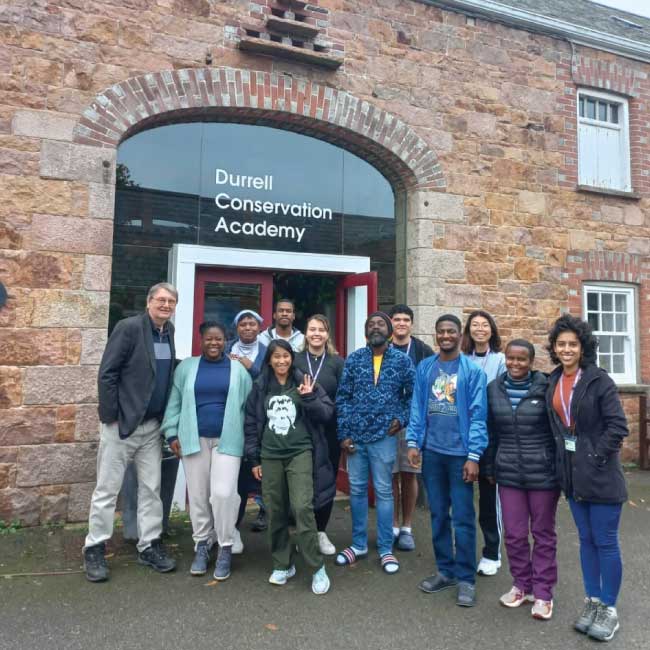
Each year, students from around the world are chosen and sponsored to attend the Durrell Conservation Academy’ s DESMAN (Durrell Endangered Species Management) course in Jersey, the largest Channel Island between England and France. The academy is one of the world’ s centres of excellence in conservation capacity development, and I was honoured and grateful for this once-in-a-lifetime experience.
I was the first to arrive and checked into a hotel called Dolphins – right under a medieval castle called Mont Orgueil Castle, which has been standing for over 800 years near the port at Gorey village. I had a chance to visit and see the inside of the castle as there was free entrance over the weekend. I was then moved to Durell Hostel for the remainder of the scholarship period. The first week was mainly introductions to the facilities and getting to know the staff and the team.
When school commenced, we had a week of learning facilitation and communication skills led by Dan Craven, a volunteer manager for Durrell. The course was designed to equip us with skills to facilitate meetings and workshops, develop and coordinate teams, deal with internal and external conflict, and improve our teamwork skills. At the beginning of October, we were taught how to effectively plan and manage conservation projects by applying the Conservation Standards, conducting a participatory situation analysis, identifying conservation strategies, and developing a strategy-oriented project plan. In November, we learned about population monitoring techniques such as distance sampling, camera trapping, and radio-tracking, which are especially valuable for our projects researching the species and ecology of the Soutpansberg mountains. We also learned how to integrate conservation and rural development, conservation education, and communication techniques, and this struck close to home for me because there is still a major need to teach young community members about the animals found on the mountain and the importance of the mountain in terms of what its ecosystems provide.
I also had a chance to present a project proposal to Durrell staff about our work in the Soutpansberg and what I would like to implement involving assessing the effects of snaring on Leopard ecology in the Soutpansberg and how to address this issue holistically, which involved engaging with local communities. The proposal was well received despite most of the audience not being from South Africa or my part of the country.
The highlight of my trip was the opportunity to live with and be taught by Carl G. Jones, one of the leading experts in zoo conservation. He was mentored by a renowned conservationist and author, Gerald Durrell, after whom the academy is named. I learned much from him, including principles of species recovery, understanding population limiting factors, and ecosystem restoration. It was a life-changing experience for me and one I intend to put into practice to build the capacity of my colleagues and community to protect our magical mountain.
Thank you to the Jersey Government and the Durrell Academy for awarding Rotandwa this once-in-a-lifetime opportunity.
So far, we have deployed two tracking dogs in reserves and will soon be deploying a further four, including both tracking and detection dogs. We have also supported the full training of two new handlers and partial training for a third handler through our relationship with Genesis K9 Group. Furthermore, we provide ongoing support to these deployed dogs and the handlers who have recently completed their training to reinforce what they have learned.
This project is supported by IUCN Save Our Species and co-funded by the European Union. The contents of this publication are the sole responsibility of the Endangered Wildlife Trust and do not necessarily reflect the views of IUCN or the European Union.
LATEST STORIES
Thanks to this grant, the EWT supports seven reserves that have many ecologically and economically important species threatened by poaching. We are taking a three-pronged approach that includes deploying freshly trained young Conservation Canines (trained in detection or tracking), training dog handlers who will be responsible for working with and looking after these dogs and supporting these dog-handler teams in these reserves to ensure they have what they need to work effectively.
Black Rhino (Diceros bicornis) in the Eastern Cape, South Africa. The Black Rhino is threatened by the illegal trade in rhino horn products. Photo credit: the african eye
The reserves we are assisting suffered income losses during the COVID-19 pandemic due to tourist travel bans, and we aim to support them through these hard economic times. Many reserves at risk of poaching use a variety of approaches to combat it, with anti-poaching field rangers commonly the first line of defence. Certified dog-handler teams can provide invaluable support to these teams on the ground in several ways. Our dogs either track poacher incursion routes within a reserve or provide a quick and reliable method for screening vehicles for concealed firearms or wildlife contraband.
So far, we have deployed two tracking dogs in reserves and will soon be deploying a further four, including both tracking and detection dogs. We have also supported the full training of two new handlers and partial training for a third handler through our relationship with Genesis K9 Group. Furthermore, we provide ongoing support to these deployed dogs and the handlers who have recently completed their training to reinforce what they have learned.
Conservation Canine Nala, a three-year old Belgian Malinois recently deployed in the Eastern Cape. Nala is a tracking dog and works with anti-poaching teams to protect threatened species.
This project is supported by IUCN Save Our Species and co-funded by the European Union. The contents of this publication are the sole responsibility of the Endangered Wildlife Trust and do not necessarily reflect the views of IUCN or the European Union.
LATEST STORIES
Conservation Canines to Save our Species from illegal wildlife trade
Dr Andrew Taylor, EWT’s Wildlife in Trade Programme Manager, andrewt@ewt.org.za
South Africa is blessed with exceptional wildlife and landscapes that attract tourists and boost our economy. Some of our country’ s biggest drawcards, such as White and Black rhinos (which are Near Threatened and Critically Endangered, respectively on the IUCN Red List of Threatened Species), the African Savannah Elephant (Endangered), and the African Lion (Vulnerable), play vital roles in our ecosystems while also bringing in valuable ecotourism income. However, these species are threatened by the global illegal wildlife trade (IWT), which is a major cause of population declines in some countries. With funding from the IUCN Save Our Species Rapid Action Grant and the European Union, the Endangered Wildlife Trust (EWT) aims to reduce IWT by preventing wildlife poaching. We use our Conservation Canines to achieve this by training and deploying them to detect wildlife products and track poachers.
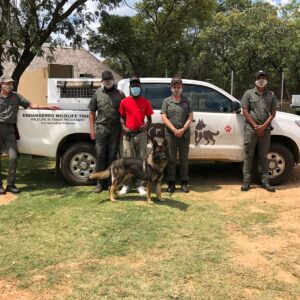
Newly qualified dog handler trained at Genesis K9 Newly qualified dog handler trained to reduce poaching as part of the project funded by the IUCN Save Our Species Rapid Action Grant and the European Union.
Thanks to this grant, the EWT supports seven reserves that have many ecologically and economically important species threatened by poaching. We are taking a three-pronged approach that includes deploying freshly trained young Conservation Canines (trained in detection or tracking), training dog handlers who will be responsible for working with and looking after these dogs and supporting these dog-handler teams in these reserves to ensure they have what they need to work effectively.
Black Rhino (Diceros bicornis) in the Eastern Cape, South Africa. The Black Rhino is threatened by the illegal trade in rhino horn products. Photo credit: the african eye
The reserves we are assisting suffered income losses during the COVID-19 pandemic due to tourist travel bans, and we aim to support them through these hard economic times. Many reserves at risk of poaching use a variety of approaches to combat it, with anti-poaching field rangers commonly the first line of defence. Certified dog-handler teams can provide invaluable support to these teams on the ground in several ways. Our dogs either track poacher incursion routes within a reserve or provide a quick and reliable method for screening vehicles for concealed firearms or wildlife contraband.
So far, we have deployed two tracking dogs in reserves and will soon be deploying a further four, including both tracking and detection dogs. We have also supported the full training of two new handlers and partial training for a third handler through our relationship with Genesis K9 Group. Furthermore, we provide ongoing support to these deployed dogs and the handlers who have recently completed their training to reinforce what they have learned.
Conservation Canine Nala, a three-year old Belgian Malinois recently deployed in the Eastern Cape. Nala is a tracking dog and works with anti-poaching teams to protect threatened species.
This project is supported by IUCN Save Our Species and co-funded by the European Union. The contents of this publication are the sole responsibility of the Endangered Wildlife Trust and do not necessarily reflect the views of IUCN or the European Union.
Provinces challenged to manage their land more sustainably
By Bonnie Schumann, EWT Drylands Conservation Programme, bonnies@ewt.org.za
The UNDP-GEF5 Sustainable Land Management (SLM) Project and the Endangered Wildlife Trust (EWT) recently brought Engineering Technicians and LandCare officials together for a unique SLM challenge. The officials, all experts in soil erosion control, represented four provincial departments of agriculture from the Western-, Eastern- and Northern Cape, and the Free State. The challenge was hosted by the Samara Private Game Reserve near Graaff Reinet, in the Mountain Zebra Camdeboo Protected Environment (MZCPE) in the Eastern Cape, from 7–10 February 2022.
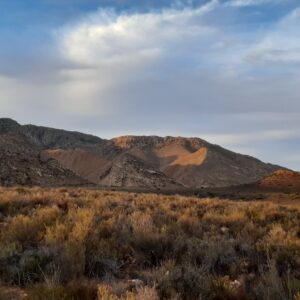
The four teams were tasked to assess three sites on Samara with varying severities of soil erosion that are typically found in the region. The teams were challenged to develop practical, cost-effective and replicable technologies and approaches to addressing the soil erosion issues. The degradation is primarily caused by historical grazing practices that were not ideal and is compounded by continuous grazing by game. What makes veld regeneration in this landscape particularly challenging is the topography in the area. The catchments are large and consist of mostly steep slopes, which result in high volume, very erosive runoff directed towards the lower slopes, where soils are vulnerable to erosion. The protracted drought experienced in the Karoo over the last approximately eight years resulted in a loss of vegetation cover, leaving soils exposed and vulnerable to both wind and water erosion.
The spirit between the provincial teams was positive, open, and cooperative, with high levels of camaraderie. Teams shared survey results, advice, and suggestions. Training of younger technicians formed an integral component of this knowledge sharing initiative. The collective institutional experience of the team was around 400 years, which is really astonishing considering there were only 14 participants. The challenge was concluded with a knowledge-sharing workshop and seminar. Participants on the last day included the Samara Management Team, neighbouring farmers, and two senior government officials from the Western- and Northern Cape responsible for Sustainable Land Management. The provincial teams presented their suggested soil conservation plans, and some lively discussions followed. In summary, all the participants agreed that this wealth of technical knowledge is critically important for SLM and soil conservation in the drylands. We need to ensure that this hard-earned experience and “institutional” knowledge needs to be shared with the next generation of soil technicians.
The next step will entail compiling these case studies and sharing the information with all the stakeholders in the MZCPE and throughout the drylands to encourage soil conservation action. Watch this space!
This initiative formed part of the United Nations Development Programme’ s GEF 5 SLM Project – Small Grants initiative. The EWT, through their Karoo Forever SLM project, is responsible for the implementation of small grants in the Karoo landscape.
A brighter and more sustainable future motivating Cedarville farmers to collaborate
Bonnie Schumann, EWT’s Drylands Conservation Programme, bonnies@ewt.org.za South Africa’ s Grassland Biome is highly productive and rich in biodiversity. However, the Grasslands are under tremendous pressure from agriculture and unsustainable mining developments. Poor planning, mismanagement, and inadequate enforcement have led to over-utilisation, degradation, and habitat loss. Altogether, 30% of the biome has already been irreversibly transformed. However, where the rangeland is still productive and extensively farmed, there are promising opportunities to reverse degradation and improve biodiversity resilience and agricultural production in the landscape. These opportunities can benefit the endemic and threatened species present and protect the livelihoods that depend on the landscape’ s natural resources and ecosystem services. Farming with livestock and crops in the grasslands plays a critical role in supporting livelihoods for communities. Knowledge sharing is a powerful approach to finding solutions to challenges, particularly in diverse landscapes involving various stakeholders. With this in mind, the Endangered Wildlife Trust (EWT) engaged farmers in the biodiversity-rich grasslands of the Cedarville area in the Eastern Cape. We talked to the farmers to understand their challenges and whether they were interested in attending structured training to develop solutions to an array of sustainable land management issues together.
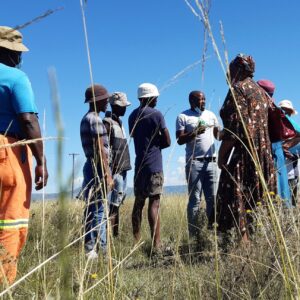
The Cedarville farmers face challenges primarily related to poor infrastructure on the commonages that does not support optimal grazing practices. Rangeland is grazed continuously, which does not allow the vegetation an opportunity to rest and build up reserves. Palatable species are under tremendous pressure and often disappear from the landscape, resulting in the loss of ground cover and production and an increase in undesirable plant species. Coupled with this, communities that utilise the rangeland have not had the opportunity to collaborate and coordinate their activities, limiting their abilities to manage the rangeland effectively. In addition, they cannot effectively access the highly competitive agricultural sector. Participating farmers were keen to address these issues and explore opportunities to collaborate to improve their farming practices and protect their natural resources. In February 2022, the EWT hosted an Integrated Farm Planning and Management (IFP) training course in Cedarville, attended by almost 40 farmers – double the expected turnout.
The IFP course content focuses broadly on sustainable land management principles. The original course created by the EWT was focused on the Nama Karoo Biome and is available as a free online course at https://karooforever.org.za/en/. The original course was adapted to include the Grasslands Biome content. The Cedarville course was the first IFP to be held in the grasslands, and the fourth IFP course we have presented. The EWT collaborated with Agricultural Extension officers from the Underberg Farmers Association and the Department of Agriculture and Rural Development (DRDAR), who copresented the course with staff from the EWT’ s African Crane Conservation (ACCP) and the Drylands Conservation (DCP) programmes.
The Cedarville area is important for Crowned Crane conservation as the birds breed in its wetlands. Conserving Africa’ s threatened crane species has benefits far beyond the cranes and their admirers. Africa’ s four threatened crane species are ambassadors for conserving water catchments, including wetlands and grassland ecosystems. They are iconic and charismatic and appeal to the public, allowing us to develop relationships within communities and with other stakeholders through crane conservation activities. These grasslands supply additional non-agricultural services, such as water supply and flow regulation, carbon storage, erosion control, climate mitigation, pollination, and cultural ecosystem services. For more information on the work in the Cedarville area, contact:
Samson Phakathi, Senior Community Project Officer, Endangered Wildlife Trust’ s African Crane Conservation Programme, samsonp@ewt.org.za
For resources on sustainable land management, visit:
The development of the original IFP Nama Karoo course was supported with funding from the UNDP GEF5 SLM Karoo Landscape Project.
The course in the Grasslands Biome in the Eastern Cape was made possible with funds from the National Lotteries Commission. The NLC relies on funds from the proceeds of the National Lottery. The Lotteries Act and regulations guide the way in which NLC funding may be allocated. The NLC wants the grants to make a difference in the lives of all South Africans, especially those more vulnerable, and to improve the sustainability of the beneficiary organisations. Available funds are distributed to registered and qualifying non-profit organisations in the fields of charities; arts, culture, and national heritage; and sport and recreation. By placing its emphasis on areas of greatest need and potential, the NLC contributes to South Africa’ s development.