Saving species through habitat conservation: Sungazers
Saving species through habitat conservation: Sungazer Lizards
Bradley Gibbons, Senior Field Officer, ICF/EWT African Crane Conservation Programme
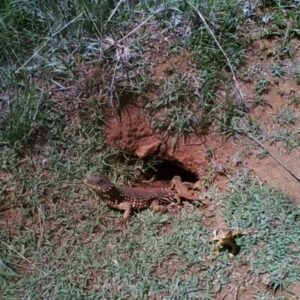
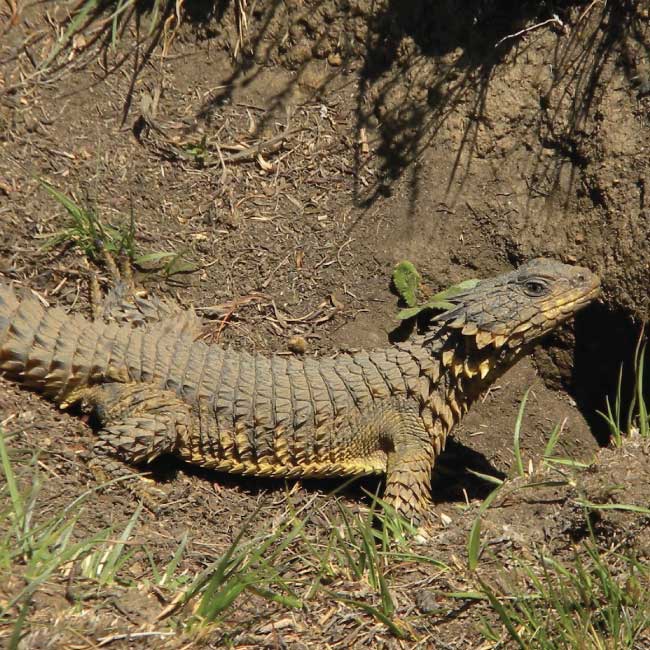
South Africa’ s Free State Province is thought to be home to 95% of the population of Sungazer Lizards (Smaug giganteus), with the remaining population found in Mpumalanga. Sungazers are endemic to South Africa, meaning they occur nowhere else in the world. They were named “Sungazers” because of their habit of standing in the sun in a unique posture with their front legs upright, underside not touching the ground, and faces angled toward the sky. They are given the name “Ouvolk” in Afrikaans, which means “old folk” in English. The theory is that they were given this name due to their dinosaur-like appearance.
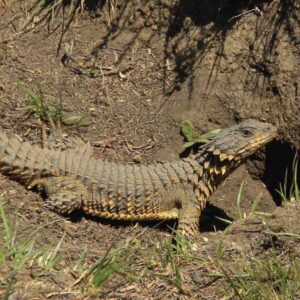
Sungazer Lizard outside burrow
Sungazers are threatened because their virgin grassland habitat is being rapidly transformed for agricultural expansion, mining activities, overgrazing, and the collection of individuals for the pet trade or local traditional use. They are found in a specific type of grassland, making them habitat specialists, and they do not translocate easily, with many individuals not surviving the process. Therefore, protecting the habitat that Sungazers depend on is paramount.
Currently, very few sites are protected to conserve Sungazers because approximately 99% of these lizards occur on privately-owned farms and properties. Sungazers are not rock-dependent and construct burrows underground – roughly 45 cm below the ground surface, extending up to 2 metres. The association with the short grass makes it easier for Sungazers to be on the lookout for predators. When danger approaches, their only defence is to run into their burrows. For this reason, they spend a lot of time in their burrows, but if you’ re lucky, you can catch these fascinating dragon-like lizards when they emerge to find food and show their reverence for the sun!
The Endangered Wildlife Trust is working to protect the habitat of the Sungazer Lizard and other threatened species through Biodiversity Stewardship and by reducing threats such as illegal wildlife trade. Visit www.ewt.org.za to find out more about Sungazers and what you can do to help.
Case study: The Eeram Protected Environment
The Endangered Wildlife Trust (EWT) is currently busy with a project to proclaim the Eeram Protected Environment, and a gazette notice was published at the end of October 2022. This area is located between Warden and Harrismith in the Free State and is 7,398 hectares in size. It will be the first area proclaimed to conserve the Endangered Botha’ s Lark. Not only will this offer protection for this bird, but also for Sungazers and Blue Cranes.
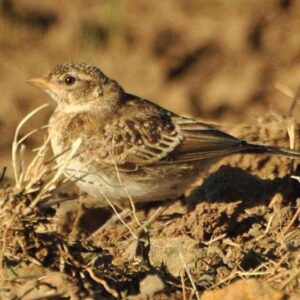
Botha’ s Lark. Photo credit: David Weaver
A protected environment is a form of habitat conservation on privately-owned properties and is an agreement made by a landowner to conserve the biodiversity in the area. The area is proclaimed through the National Environmental Management: Protected Areas Act – No 31 of 2004 (NEMPAA), allowing the farmer to continue farming in a manner that does not compromise the biodiversity and ecology in the declared area.
Grasslands are one of South Africa’ s most endangered biomes, with only 2.5% formally conserved and 60% permanently damaged. These grasslands are critical for the long-term provision of ecosystem services, and all grasslands play this role, even a small farm close to a city. The grassland biome is also in a water production zone and critical to water supply to cities in Gauteng and the Free State. This protected environment will be valuable for conserving threatened species in this important area, including the Sungazer Lizard.
This work is made possible by Eskom Holdings SOC Ltd, Ezemvelo KZN Wildlife, the Ford Wildlife Foundation, the HCI Foundation, Heather Henson, International Crane Foundation Conservation Impact Fund, the African Wildlife Initiative Rapid Action Grant co-funded by IUCN Save our Species (SOS) and the European Union, National Lotteries Commission, Millstream Farm, N3 Toll Concession, Paul L King, Rand Merchant Bank, and the Whitley Fund for Nature.