A fond farewell and best wishes to three of our pack members
Chris Joubert
Cath Vise, Soutpansberg Protected Area Manager
Chris Joubert, our Medike Nature Reserve & Eco-Tourism Manager, will sadly be leaving Medike and the EWT at the end of March 2023, and I’ d like to take this opportunity to express my sincere appreciation to him for all his efforts in the Soutpansberg.
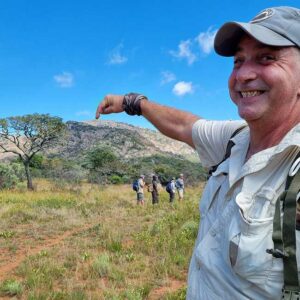
Chris – thank you so much for all your hard work over the past two years. For the endless hours fixing old infrastructure and questionable plumbing, wrangling multiple contractors to get upgrades done, and keeping Medike and our rangers safe and sound. Thank you, especially for all your efforts in opening up Thomas Wilson Pass – the many long hours in the heat of the bush, enduring all the Mopani Bee bites, early mornings, late evenings, and a lot of excavator issues and breakdowns. The road is spectacular and something you can be extremely proud of. Thank you for taking so much care while manoeuvring an excavator through such a sensitive environment. It is very rough terrain and not easy for building a road, and I am so impressed that you and Frank (the excavator driver) managed to get through some of the areas you did and that we can now drive from Medike West to East, on the most spectacular 4×4 mountain pass. I am sure all who drive it will love and be grateful for it!
Thank you for being the friendly, welcoming face of Medike, for guiding and contributing to the development of our now Green Flag accredited Old Salt Trail, for managing marathon support stations and ensuring trails were good to go, for looking after visiting students, and especially for the role you play in our mountain conservation community.
I’ d like to wish you all the best and good luck in your new opportunities. Enjoy the dry, northern side of our mountain and remember that you are always welcome at Medike and will always be part of our extended EWT Soutpansberg family.
Suzette Britz
Emily Taylor, EWT Communications Manager
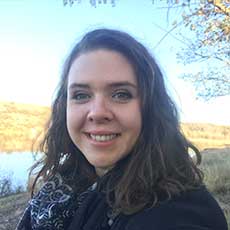
Suzette joined the EWT in October 2021 during a whirlwind time for the Communications and Marketing Department with lots of projects that needed design assistance and us a short way into our biggest project of the year – the annual Integrated Report. She hit the ground running – calm, collected, and extremely capable – she took it in her stride and, despite the pressure, produced incredible work time and again. In 2022, Suzette was tasked with a mammoth project – revamping our digital platforms and website. For those of you who saw our previous site, I’ m sure you will agree that the new site is streets ahead, both to look at and to use. Few people realise the work that goes on behind the scenes in a project like that, and despite performing all her day-to-day graphic work, she delivered a flawless product in record time.
As a fairly new manager, it was a great relief to have her working beside me – taking on any task I threw at her capably and calmly. I never had to worry that she wouldn’ t deliver or impress. We have received nothing but praise for our digital and print materials produced during Suzette’ s time with the EWT, and she leaves a truly remarkable legacy with designs that will be used and loved for years to come.
Thank you, Suzette, for your hard work and commitment, your calm in sometimes turbulent waters, and your support and friendship. The EWT is honoured and grateful for all you have achieved in your time with us, and we wish you all the best for your bright future. You will always be part of the EWT family.
Sean Kelly
Dr Andrew Taylor and Shadi Henrico, EWT Wildlife in Trade Programme
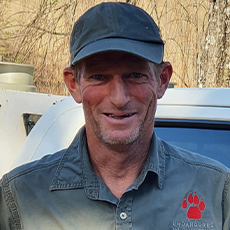
Sean Joined our EWT canine unit in September 2021 to work with us on our IUCN SOS project to deploy conservation dogs to reserves with important populations of threatened species. Sean brought many years of dog handling experience with him and strengthened our team considerably. He is very energetic and is constantly on the go, and even when not working with the dogs, he makes sure everything involving the infrastructure needed for the dogs is functioning. As one would hope for in a good dog handler, Sean always put the dogs first and even took on the responsibility of housing two of our working dogs at home when we were short of kennel space. We are very thankful to Sean for his hard work and commitment to our dog projects and wish him all the very best in his future endeavours.

Careers in Conservation – Bringing conservation to life through storytelling
Kedibone Chauchau, the EWT’ s Communications and Marketing Department
My name is Kedibone Jacqueline Chauchau. I am the last of five kids, born and bred in the West of Johannesburg. My mom owned an Early Childhood Development Centre that she operated from our garage at home. My dad started as an educator in rural Limpopo, about 5 km from the Kruger National Park’ s Punda Maria gate and later became a truck driver at Spoornet (now known as Transet). They are both retired now and living in Malamulele, Saselamani.
I grew up in a bilingual household with a Pedi mom and a Tsonga dad. We have conversations in both languages, sometimes using them in a single sentence. Outside my household was a community speaking Tswana, Sotho, Zulu, Xhosa, and Venda, and I absorbed all of them, developing a passion for languages and now fluent in seven.
However, while I can speak in many tongues, I was a very quiet child in school, adopted by a group of extroverts, and surrounded by loud, outgoing friends who love the spotlight – I still am.
I first realised that I was terrible with numbers in high school, so when I finished my matric, I explored career paths aligned with my strengths and passion for writing and creativity. It took a while. I studied graphic design for a year at Damelin, then transferred to the Vaal University of Technology the following year. Though it was a good fit, it didn’ t feel quite right. So, I took a gap year and applied for the BA (Media Studies) Degree at the University of Limpopo.
I started my career at an ad agency three months after completing my qualification. Having majored in several things, I had the opportunity to explore and enhance my skills without limitations before becoming a conservationist, which I hadn’ t dreamed was even possible with my qualifications. But a while later, I stumbled upon a job advert for a communications position with the Endangered Wildlife Trust (EWT). I applied because I want my work (and life) to make a difference by effectively communicating the important conservation work of the EWT. None of the work conservationists do matters if it remains within their circles. I want to use my curiosity and the will to make sense of everything to tell complex conservation stories and show what people are doing to conserve our planet.
Conservation storytelling is most powerful when combining words and powerful visuals of our remarkable wildlife and ecosystems. I hope to build on my communication knowledge and experience by mastering the art of visual storytelling for conservation. Studies have shown that our brains retain and transmit much more information — and process it more quickly — when delivered visually. The human brain processes visuals 60,000 times faster than text. Visuals are important because people remember only 20% of what they read and 10% of what they hear. However, people remember about 80% of what they see and do. It’ s one thing to tell people why Wild Dogs are also known as Painted Wolves and another to show them the vivid coat of a Wild Dog.
Another reason visual storytelling is important is that it breaks down complex ideas. Seeing something instead of reading about it enables the audience to connect to or relate to that thing or person on a deeper level and become invested in it. Visual storytelling conveys emotions and realities more effectively and inspires people to support and participate in conservation initiatives.
Too often, we work to benefit ourselves and show little interest in working to ensure the future of the planet and others. I urge the youth to explore a fulfilling career avenue that will secure our collective future.
MY JOURNEY IN CONSERVATION AND THE ROAD AHEAD
Innocent Buthelezi, Field Officer, EWT Wildlife and Transport Programme
innocentb@ewt.org.za
I was born on 27 January 1990 at Jericho Clinic. Jericho is a rural village in the North West Province of South Africa. I grew up in Johannesburg, where my mother worked as a domestic worker. During the school holidays, I would alternate between visiting my maternal family in North West and my paternal family in KwaZulu-Natal, where my parents now live in Madadeni, near Newcastle.
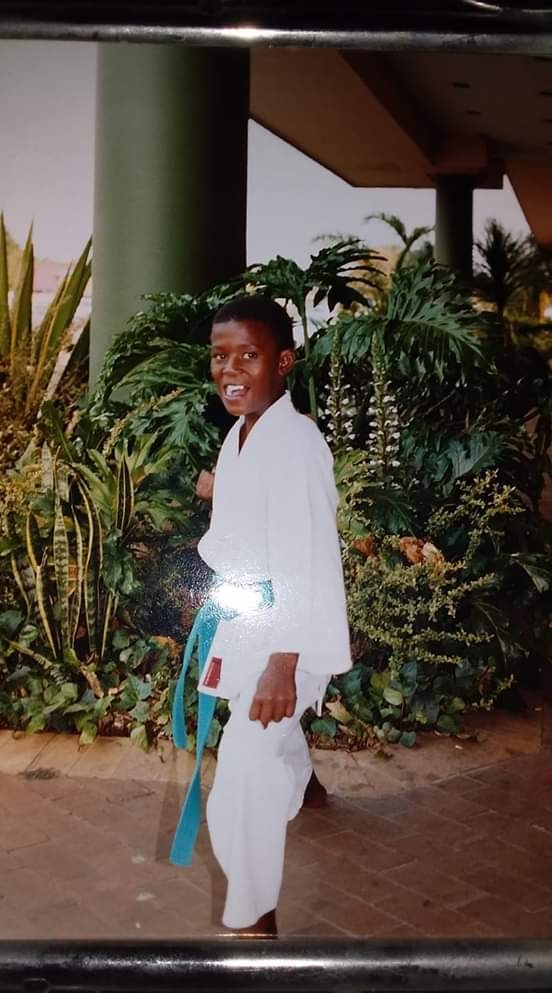
While my parents were growing up, neither of them had the opportunity to finish their schooling, but they were determined to build a better future for me and provide me with the opportunities that they never had. Living in Johannesburg, I was fortunate to receive a higher standard of education than many other children residing in the more rural areas of the North West or KwaZulu-Natal. At the age of seven, I discovered a love for karate, and progressed to Red Belt by the age of 13. I stopped my karate lessons when I went to high school, but continued with other sports such as soccer, rugby, and athletics. My love of rugby encouraged me to build up my strength and stamina, and I started lifting weights that I made from cement compressed into empty paint cans.
During my teenage years, while not doing sports, I developed an interest in watching National Geographic and Animal Planet on DSTV, where my passion for nature really took hold, and eventually led me to pursue a career in nature conservation. I matriculated in 2008, and I started my studies at Tshwane University of Technology (TUT) in 2009. I graduated from TUT with a National Diploma in 2012, which I would never have achieved without the generosity of my mother’ s employer, who financially supported my studies. No one else in my family had completed schooling, let alone tertiary studies. After graduating I volunteered with SANBI and worked at Rand Water as an assistant until 2017, when I embarked on my current career with the Endangered Wildlife Trust’ s Wildlife and Transport Programme (WTP).
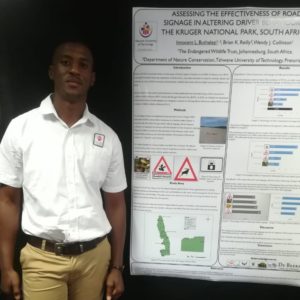
Upon joining the EWT in 2017, I felt the urge to pursue a Bachelor’ s in Technology (BTech), and with support from the EWT and a generous study bursary from Trans African Concessions (TRACN4) to conduct my BTech through a research project entitled ‘Assessing the effectiveness of road signage in altering driver behaviour in the Kruger National Park (KNP), South Africa,’ based on reports on social media (specifically Facebook) that indicated levels of public concern for the number of animals being killed on the roads (i.e. roadkill) inside the KNP.
I have always been a dreamer; it is what has always kept me going throughout my conservation career, and my ultimate goal is to achieve a PhD. Despite the disruption of the academic year by the COVID-19 pandemic, I aim to complete my BTech this year and I hope to graduate in 2021.
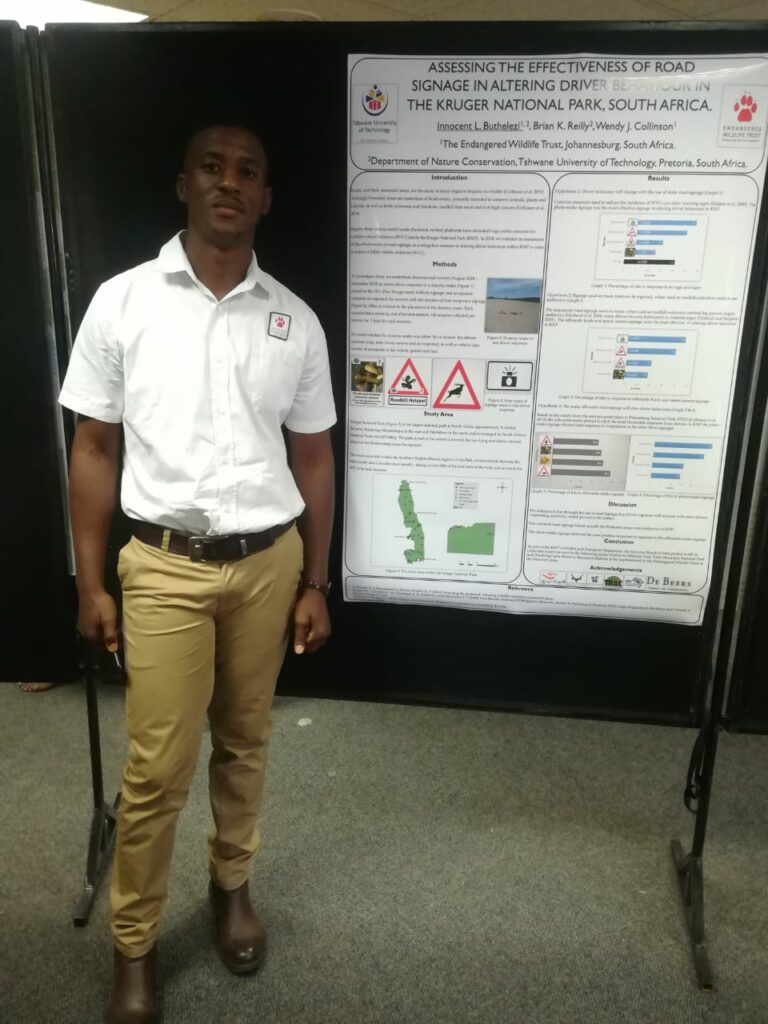
I will not deny that working full-time and studying has not been without its challenges, particularly while fulfilling the role of a husband and father. Fortunately, a lot of my studies have related directly to the work I do with TRACN4, and without the bursary it would have been extremely difficult to support my family and further my studies. I am eternally grateful for the faith they have placed in me and bringing me ever closer to my destination as a wildlife conservationist.
THE SHINING STARS OF THE EWT
Belinda Glenn, EWT Marketing and Communications Manager
BelindaG@ewt.org.za
The EWT annual award ceremony is an opportunity to recognise those team members who have excelled in various ways each year. The 2019 edition took place on 27 November, and we are extremely proud of the following well-deserving winners:
- CEO Award: Constant Hoogstad (Senior Manager: Industry Partnerships)
- Programme of the Year: Soutpansberg Protected Area
- Programme Manager of the Year: Lourens Leeuwner (Wildlife and Energy Programme)
- Conservation Achiever: Amos Letsoalo (Wildlife and Energy Programme)
- Conservation Supporter: Claire Relton (Conservation Science Unit/African Crane Conservation Programme), Cynthia Chigangaidze (African Crane Conservation Programme), and Thembi Mlimi (Support Services)
- Outstanding Media Coverage: Drylands Conservation Programme
- Pawprint Brand Ambassador: Cole du Plessis (Carnivore Conservation Programme) and his dog, Lihle
- Newcomer of the Year: Khanya Peacock (Communications)
- Honey Badger Award (Fiercest Field Officer): Oscar Mohale (Wildlife and Energy Programme)
- Maloti Award (Best Conflict Resolution): Ashleigh Dore (Wildlife in Trade Programme)
- Special Recognition: Richard Berridge (Support Services)
- Long Service – 20 Years: Harriet Davies-Mostert (Head of Conservation)
- Long Service – 10 Years: Emma Chisare (Human Resources) and Grant Beverley (Carnivore Conservation Programme)
Congratulations!
A huge thank you to Trappers and Faithful to Nature who donated prizes for our worthy winners.
