Help protect Africa's 

New Tool developed for South Africa’s natural habitat

New Tool developed for South Africa’s natural habitat


New Tool developed to address accelerating competition for South Africa’s natural habitat


View of the grasslands landscape

Competition for South Africa’s natural habitat is accelerating due to parallel and largely invisible crises.

This is because three legitimate national priorities – biodiversity conservation, renewable energy and food security – are trying to compete for the same land.

To help navigate that competition, the EWT has developed the Landscape Planning Tool, an interactive, data-driven web application built with funding from the JRS Biodiversity Foundation. The tool allows planners, government and developers to see, at a national or provincial scale, where conservation priorities, renewable energy potential and agricultural land can be allocated with the least conflict, rather than each sector planning in isolation.

Three claims on the same ground

South Africa’s commitment to the Kunming-Montreal Global Biodiversity Framework requires 30% of the country’s land and ocean under effective conservation management by 2030; currently we sit at approximately 15%.

At the same time, the government’s Integrated Resource Plan 2025 calls for approximately 34 GW of new wind and 25 GW of new solar PV capacity by 2039 – with an additional 14,000 km of new transmission infrastructure. Layered on top is the National Development Plan’s target of close to a million new agricultural jobs by 2030, underpinned by a planned 500,000 ha expansion of irrigated land, and reinforced by the Preservation and Development of Agricultural Land Act (Act 39 of 2024), which protects 24 million ha of high-value agricultural land as a scarce national resource.

These three imperatives are not competing in the abstract. Renewable energy infrastructure is increasingly sited in areas that overlap Critical Biodiversity Areas and Ecological Support Areas, while agricultural expansion is concentrated in regions where biodiversity sensitivity is often highest. Conservation targets must be met on land that is simultaneously wanted for both.

Left unmanaged, this collision risks poor outcomes on all three fronts: degraded habitat and species extinction, delayed energy infrastructure, and lost agricultural potential.


Our Landscape Planning Tool addresses this overlap by applying systematic conservation planning methods and advanced mathematical optimisation modelling, to answer the question of where conservation, renewable energy and agriculture should each go.

It draws on over 50 spatial data layers per land use zone, spanning biodiversity importance, land cover, wind and solar resources, grid and transmission infrastructure, and socioeconomic factors, to allocate planning units across the country at both a national level and for all nine provinces.

Rather than producing a single fixed answer, the tool also lets users define their own areas of interest, set their own targets for how much land should go to each use and see the resulting trade-offs immediately, on an interactive map, with the full methodology openly documented rather than hidden inside a black box.

Dr Oliver Cowan, project lead says not many people could argue in good faith that increasing the conservation estate, rolling out green energy, and safeguarding our national food security are not all an important part of South Africa’s present and future. However, they are all navigating for space within a finite amount of land.

“South Africa cannot afford to address these as though they exist on different maps. They exist on the same map, and the Landscape Planning Tool gives us, for the first time, a shared and transparent way to plan them together,” he says.

The Tool is accessible here: https://rsa-landscapeplanning.ewt.org/

Archives

Saluting rangers protecting wildlife and conserving nature

Saluting rangers protecting wildlife and conserving nature

Saluting rangers protecting wildlife and conserving nature

By Eleanor Momberg


EWT rangers patrolling protected landscapes to safeguard South Africa's threatened wildlife.

As nature’ s guardians, most rangers are not only the first line of defence against wildlife crime, but also protectors of a fragile and changing environment.

Working at the forefront of conservation of species and habitats, these passionate individuals often give up valuable personal time to ensure wildlife is protected from criminals, be they poachers or illegal harvesters of threatened plant species.  They also spend critical hours removing invasive alien species, burning firebreaks to safeguard infrastructure, assisting with management burns to achieve specific ecological goals, and guiding guests to ensure an absolutely unforgettable visit to nature, among a multitude of other tasks.

On 31 July, the Endangered Wildlife Trust (EWT) joined rangers across the globe to mark World Ranger Day; a day on which rangers worldwide remember honour colleagues who have lost their lives in the line of duty.  This year’ s theme A Legacy of Protection, Courage, and Service recognised that rangers are working in a world defined by climate extremes and biodiversity loss, increasing human-wildlife conflict, organised wildlife crime, and shifting social and political landscapes.  Amid these challenges, rangers continue to safeguard the future of our natural world. On the 20th anniversary of World Ranger Day, the EWT honoured its newly-appointed Threat Protection Rangers and Restoration Rangers, alongside the team of rangers at the Medike Nature Reserve.

While one team of rangers is focused on addressing, and preventing, wildlife crime, their colleagues are focused on improving the habitats in which people, plants and animals, live and prosper.
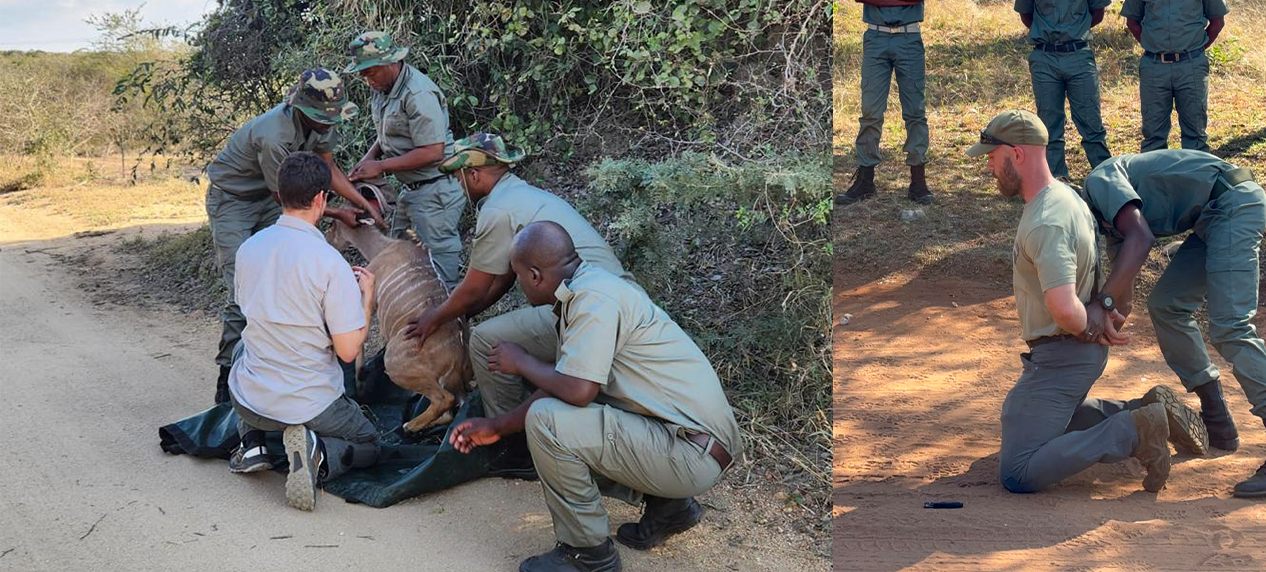
EWT rangers patrolling protected landscapes to safeguard South Africa's threatened wildlife.

Threat Reduction Rangers

Illegal wildlife-related activities are placing mounting pressure on already vulnerable wildlife populations while simultaneously posing significant security risks to people living and working within affected landscapes.

To mitigate wildlife crime within the Greater Kruger area of Limpopo, the Endangered Wildlife Trust has appointed five Threat Reduction Rangers to reduce illegal wildlife activities.  This includes snaring in the Greater Kruger area in northern Limpopo – a buffer zone to the west of the Kruger National Park, and Great Limpopo Transfrontier Conservation Area.

The team, comprising a head ranger and four rangers, undertake regular patrols, remove snares, record illegal activity, monitor high-risk areas using camera traps and share information with landowners and conservation partners so that threats can be timeously detection and addressed immediately.

Thus Unit helps protect both wildlife and people. By removing snares and reducing illegal activities, endangered animals are saved, healthier ecosystems are supported, and wildlife crime is prevented from spreading into protected areas. At the same time, it improves safety for landowners and local communities through better monitoring, coordination, and a stronger presence on the ground.

In the Greater Kruger area, snaring for bushmeat represents one of the most pervasive and persistent threats. This indiscriminate and illegal hunting method has intensified in recent years, reaching unsustainable levels across southern Africa.

To address this, the EWT’ s Threat Reduction Unit now delivers a coordinated, intelligence-driven response across property boundaries in an effort to halt the escalation of snaring, safeguard threatened wildlife populations, ensure human safety and reinforce the integrity of the Greater Kruger conservation system.

The project being undertaken in potentially high-risk areas prioritises community and privately-owned land where enforcement capacity is limited, and thus vulnerable to illegal wildlife activities.  The present focus is encourage these  landowners and communities to participate in the initiative.

To achieve our conservation goals, we have partnered with the Kevin Richardson Foundation. Soldiers for Wildlife and Van Niekerk Wildlife have provided ranger traising, with additional support being received from the Scales Conservation Fund, Phalaborwa Natural Heritage Foundation and Kendra Carano.
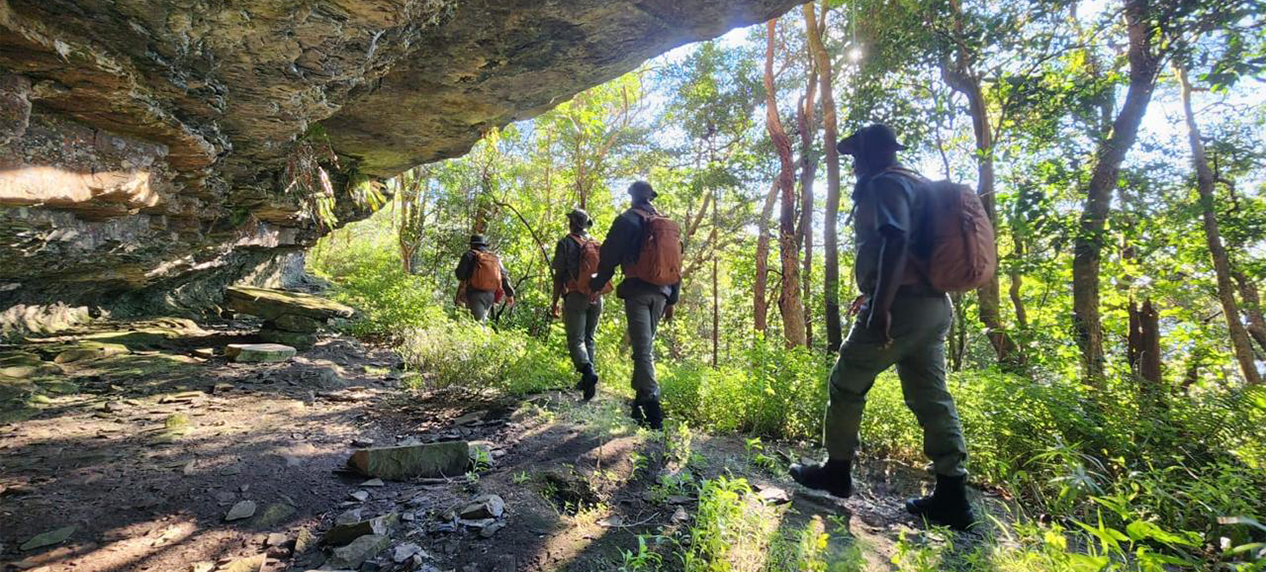
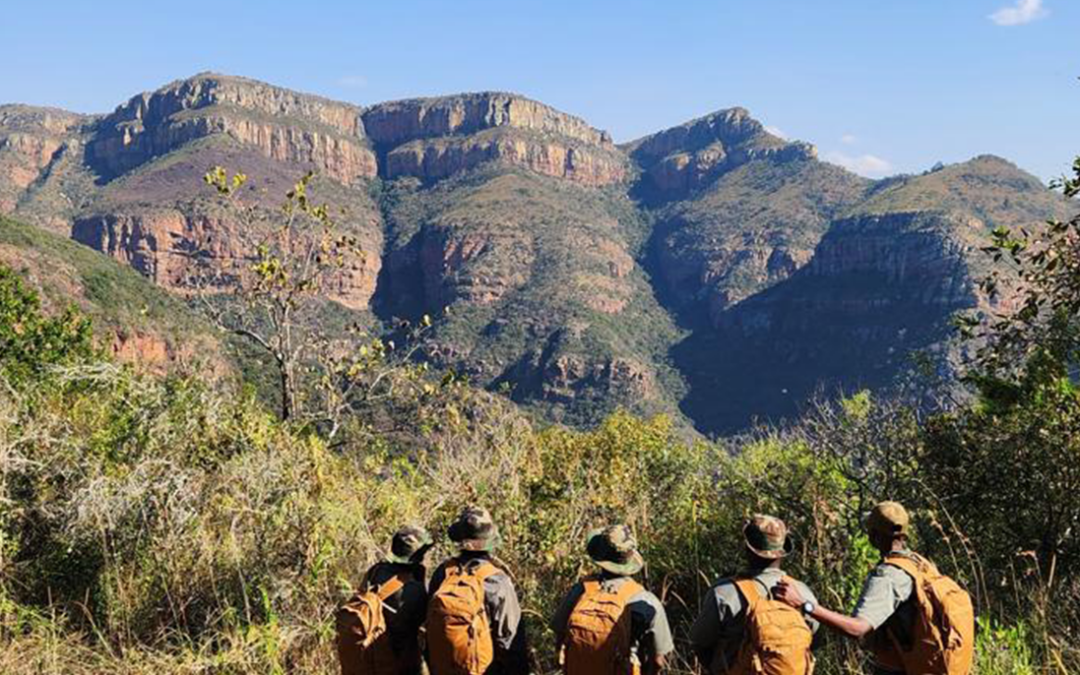
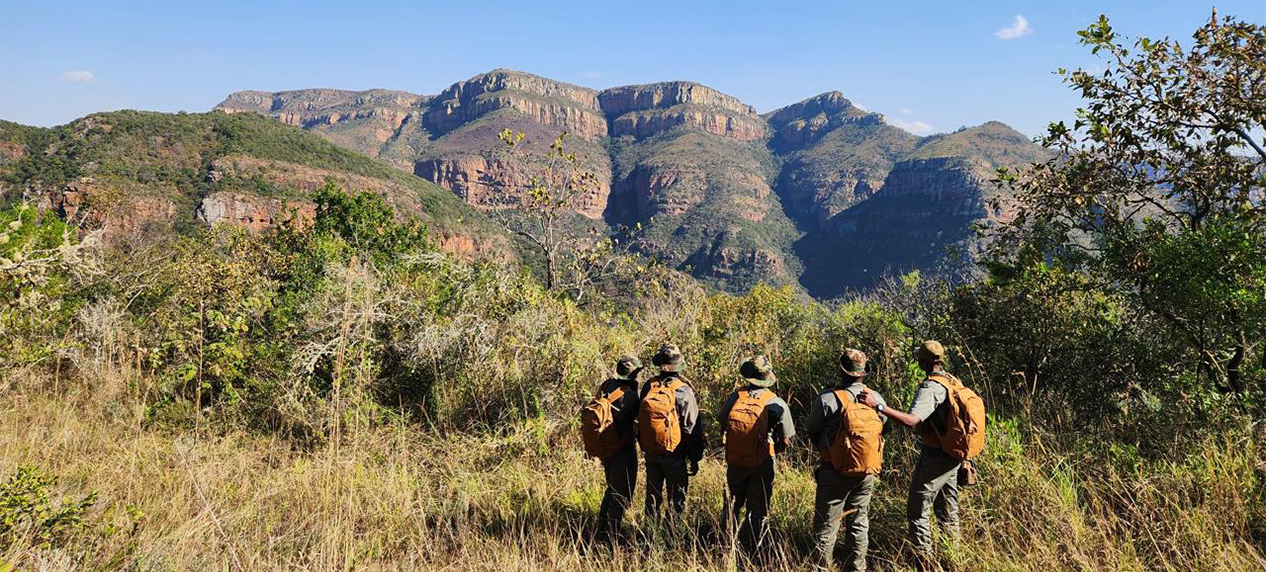
Restoration Rangers working to restore natural habitats and protect biodiversity.

Restoration Rangers

In the heart of the Soutpansberg is a team of Restoration Rangers protecting the landscape and restoring it back to health, one tree at a time.

The EWT’ s Restoration Rangers are working to reverse decades of environmental degradation caused by invasive alien plants. Their daily work often includes hiking on steep, inaccessible, remote mountain slopes carrying all their equipment and safety gear up to 8 kg per person.  The specialised team focuses on removing invasive trees and plants that threaten one of South Africa’s most biologically diverse landscapes.

The Soutpansberg is recognised as one of the country’s unexplored biodiversity hotspots, supporting an extraordinary diversity of plants and animals, many of which occur nowhere else on Earth. However, invasive alien plants, particularly water-thirsty eucalyptus trees that take up to 260 litres per day, reduce streamflow, outcompete indigenous vegetation, increase wildfire intensity, and degrade vital habitats.

The Restoration Rangers are helping to change this trajectory. Through strategic invasive plant control, follow-up clearing, wetland restoration, road and trail maintenance, and ongoing monitoring, they are restoring ecological processes that allow indigenous ecosystems to recover naturally. Their work contributes to healthier catchments, improved water security, greater resilience to climate change, and stronger habitat connectivity for wildlife.

This team consists of young people from neighbouring communities who receive practical ecological restoration training while gaining valuable work experience and developing skills that contribute to South Africa’s growing restoration economy.

Over the past year alone, the team has removed thousands of invasive plants across priority conservation areas, restored ecologically sensitive wetlands, maintained critical access routes for landowners and conservation partners, and supported collaborative restoration efforts across the Western Soutpansberg Nature Reserve. Every invasive tree removed represents more water remaining in the landscape, improved habitat for indigenous species, and another step towards restoring ecosystem health.

As the impacts of climate change intensify, ecological restoration has become one of the most effective nature-based solutions available. Investing in restoration rangers means investing in water security, biodiversity conservation, disaster resilience and sustainable rural livelihoods.
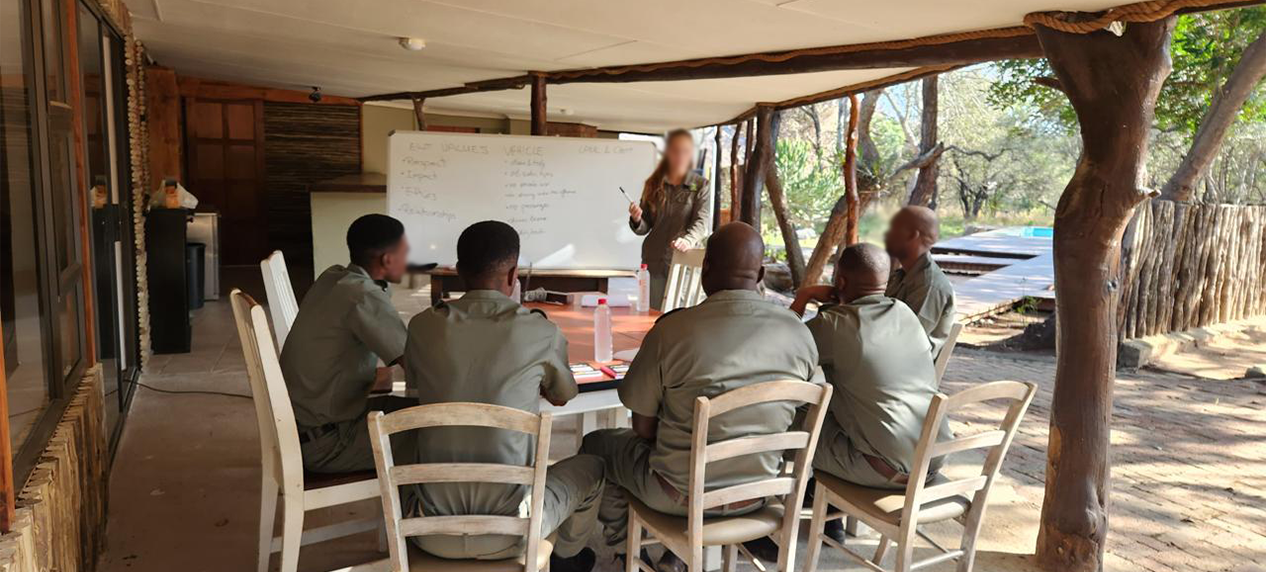
Endangered Wildlife Trust rangers working together to conserve wildlife and restore ecosystems.

Medike Rangers

 At the EWT’ s Medike Reserve in the Soutpansberg,  three rangers and four conservation interns are engaged in work that rangers from de=snaring and anti-poaching patrols, to monitoring, invasive alien species removal, road and accommodation development and maintenance, guest hospitality and guiding.

While many rangers are recognised for protecting wildlife on the frontlines against poaching, this group of conservation champions is quietly restoring ecosystems that sustain both biodiversity and people.

Rangers are the custodians of our natural heritage. Whether protecting endangered wildlife or restoring degraded ecosystems, their work is essential to safeguarding South Africa’s biodiversity and supporting the communities that depend on healthy landscapes.

This World Ranger Day, the EWT celebrates not only the bravery of rangers protecting wildlife but also the determination of those restoring ecosystems from the ground up. Their work reminds us that conservation is about more than protecting what remains – it is about restoring what has been lost and ensuring healthy landscapes for future generations.

The EWT extends its sincere gratitude to its funding partners, landowners, community members and conservation collaborators whose continued support makes this work possible.


Who are the EWT’ s Restoration Rangers?

The Restoration Rangers have as their focus habitat restoration  in the heart of the Soutpansberg Mountains in Limpopo, there they are working to reverse decades of environmental degradation caused by invasive alien plants. Their daily work often includes hiking on steep, inaccessible, remote mountain slopes carrying all their equipment and safety gear up to 8 kg per person.  The specialised team focuses on removing invasive trees and plants that threaten one of South Africa’s most biologically diverse landscapes. Their work contributes to healthier catchments, improved water security, greater resilience to climate change, and stronger habitat connectivity for wildlife.

Richard Ndou is from Elim Varry Village in Limpopo.  Speaking to Conservation Matters,  Richard said he had chosen a job in restoration to help eliminate invasive alien species from the area around his village.  His involvement in the EWT’ s habitat restoration initiative in the Soutpansberg has not only benefited his family financially, but also raised awareness within his community about the threats of invasive alien species.

“l chose a restoration job, because all around the Soutpersberg area villages are struggling with water because of alien plants such as massive tall trees like Blue Gums. They are highly intrusive and are disturbing the water table, because it can absorb around 260 litters per day.”

Besides saving water, Richard is also committed to saving wildlife from the “high amount of poaching all over the world”.

Since being employed by the EWT, he has learnt to identify invasive alien plants and how to control these, how to protect wildlife.

“Plants are important for feeding and trees are important for medicine. The importance of restoration saves life because we are also sharing information in the community so that they know more about restoration,”  he said.


Willington Mavhandu from Kutama Village joined the Restoration Rangers because of the struggle faced by villages across the Soutpansberg to access water resources limited by alien invasive species.

“These trees are highly water intensive and they are disrupting local water tables…so that is why I chose to be a ranger to save animals and water,” he said.  “I learned that animals and plants are very important and have a right to live”.

Willington believes that because of his work and learning, he is able to share information with his community of “the importance of restoration to save life”.

“I believe there is more future for Restoration Rangers as there is a lot of work to be done all around the world. Everyone is impressed with the work we are doing. My family and I are benefitting a lot with support, knowledge and training from EWT and we are willing to work harder and harder,”  said Willington.


Michael Sithagathaga is from Khavhambe village.  He joined the Soutpansberg Restoration Rangers  to learn new skills in conservation and to use his energy to fight things like erosion, bushfires and invasive plants.

“I want to protect our heritage,” he said.

“Since I joining the ranger team, I learnt lot about conservation, how to identify invasive plants, control bushfires, do anti-poaching patrol and also work as team spirit, take care of equipment.  My is important because we are protecting the Soutpansberg mountains. This area gives us clean water, fresh air and home for wildlife,”  he said.

Michael believes there is a future for Restoration Rangers in South Africa, and around the world.  “Yes there is a future. South Africa is dealing with drought, floods and erosion, so restoration of land and rivers is one of the main ways we can fix for next generation”.

His employment by the EWT team, he said, has a number of benefits for him, and his family.

“As a restoration ranger, it has helped my family a lot. I’m able to provide food, pay transport for school and also supply my family with skills and knowledge about how to take care of nature and water,”  said Michael.


Sengani Ramalamula also hails from Khavhambe Village and joined the Restoration Rangers because wants to conserve wildlife.

During his time in the ranger unit, he has learnt to “solve problems continuously”.

Sengani believes his new role as a Restoration Ranger is important because it helps rebuild native habitat and “helps support households through community development and land rehabilitation”.

“There is a powerful, essential future for Restoration Rangers because nature always needs repair.  Through this project I am able to understand conservation, wildlife and support my family financially,”  said Sengani.


The EWT’ s Field Rangers at Medike reserve

The Medike Reserve in the Soutpansberg boasts three full-time field rangers and four conservation interns.   The team has a variety of responsibilities as field rangers, such as law enforcement & monitoring which includes patrols, snare removal, and anti-poaching,  hiking trail support on the Old Salt Trail, veld fire control, invasive alien plant removal and infrastructure maintenance that includes plumbing, building and road revamps.   This team also does environment awareness in the local community and among tourists, ensure the accommodation is ready for visitors, interpretive guiding and dealing with guests.

The full-time team are:

Oscar Musevhula is one of the longest serving staff members at Medike. He has been working in the Medike East area for 14 years, and is an active member of the anti-poaching team. Oscar is handy man, he helps the reserve with plumbing and building.

Khathutshelo Mukhumeni has been trained as a law enforcement field ranger. He is also handy man. He has been active in conservation guardianship and law enforcement. He recently developed an interest in field guiding and is supporting our hikes. Khathutshelo is also capacitating conservation interns on anti-poaching, snare removal and the basic skills of field guiding .

Micheal Modimana  has been involve in alien plant removals and snare removal. He is the main Kubota TLB driver during roads maintenance. He is also our slackpacked driver during the old Salt Trail.

Raptors in Decline: What One Researcher’s Roadside Observations Revealed

Raptors in Decline: What One Researcher’s Roadside Observations Revealed

Raptors in Decline: What One Researcher’ s Roadside Observations Revealed

By Ronelle Visagie, Birds of Prey Unit


Left: Jackal Buzzards in Middelburg district. Right: Data tracking

Left: Jackal Buzzards in Middelburg district. Right: Data tracking

A study of long-term road surveys undertaken by Ronelle Visagie, field officer in the Birds of Prey Unit, has been referenced in a new research report revealing widespread declines in South Africa’ s raptors and other large birds.  Ronelle co-authored the report published by the University of Cape Town.

How did the survey come about?  Here is Ronelle’ s story:

I was recently asked to share the story behind a study I co-authored that revealed widespread declines in raptor numbers across South Africa. The data behind the research came from an unexpected source: the many kilometres I’ ve driven while working for the Endangered Wildlife Trust (EWT).

My work involves a lot of time on the road. I regularly travel long distances to investigate power line incidents involving birds, and in 2019 I began monitoring 400 vulture nests in the Kalahari. From my home to Askam—where that fieldwork begins—is about 600 km. Much of the monitoring takes place along the Kuruman and Molopo Rivers and near Van Zylsrus. I’ ve also spent years travelling through the region for the Vulture Safe Zone project.

Because I often drove the same long routes, I started looking for something productive to do while travelling. I realised that I could record the raptors I saw along the roads. Using the CyberTracker app on my phone, I began logging every bird of prey I encountered. The system is simple and effective: it allows you to record the species, age class and behaviour of each bird, while automatically storing the GPS coordinates.

From that point on, every work trip became an opportunity to collect data. Whenever I drove anywhere, I recorded the raptors I saw along the way. I also noted roadkills, which can provide insight into wildlife populations and threats. Interestingly, I’ ve noticed that roadkills seem to have decreased over time, possibly because people increasingly collect them for food.

Over the years, the kilometres added up. Between 2009 and 2025, I drove over 500,000 km for my work with the EWT. Along the way, I built up a large dataset of roadside raptor observations.

A few years ago, I presented this dataset at the EWT’ s Birds of Prey Conference in Swadini, Limpopo. In the audience was Assistant Professor Arjun Amar from the University of Cape Town. After the talk, he approached me and asked whether one of his students, Santiago Zuluaga, could analyse the data and develop it into a scientific paper.

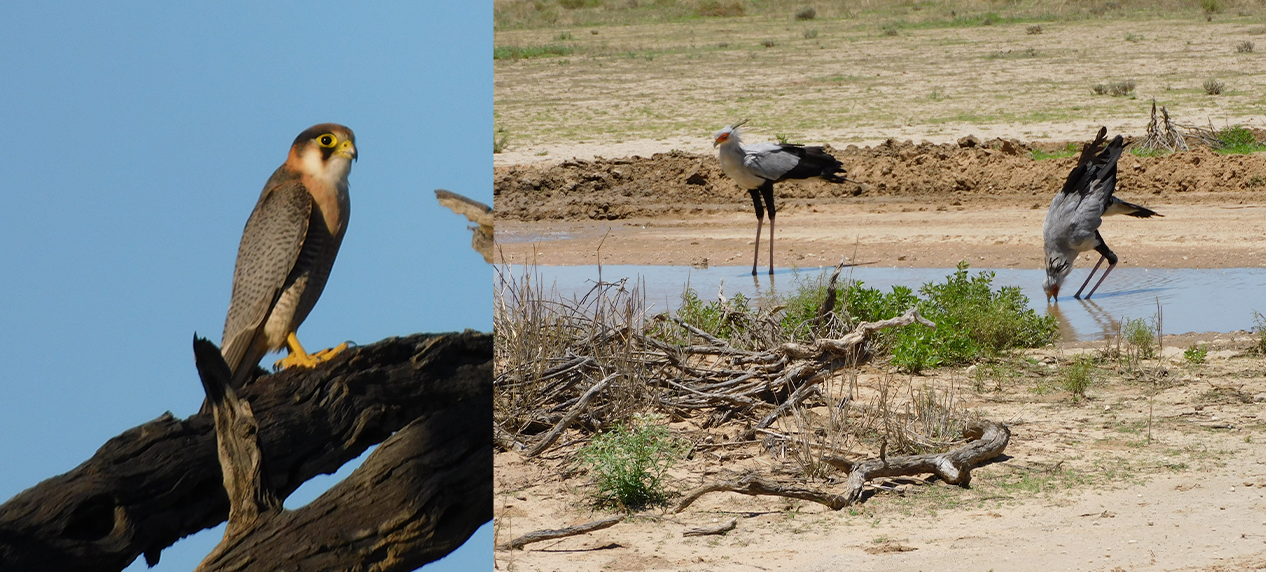
Red-necked Falcon in KNP and Secretary birds drinking water in the road

Left: Red-necked Falcon in KNP. Right: Secretary birds drinking water in the road

The results were sobering. The analysis showed that half of the raptor species I recorded had declined over the study period.

This matters because raptors play a critical role in ecosystems. They help regulate populations of animals such as rodents and dassies, preventing these species from becoming overly abundant. Vultures perform an equally essential service by removing carcasses from the landscape, helping to limit the spread of disease.

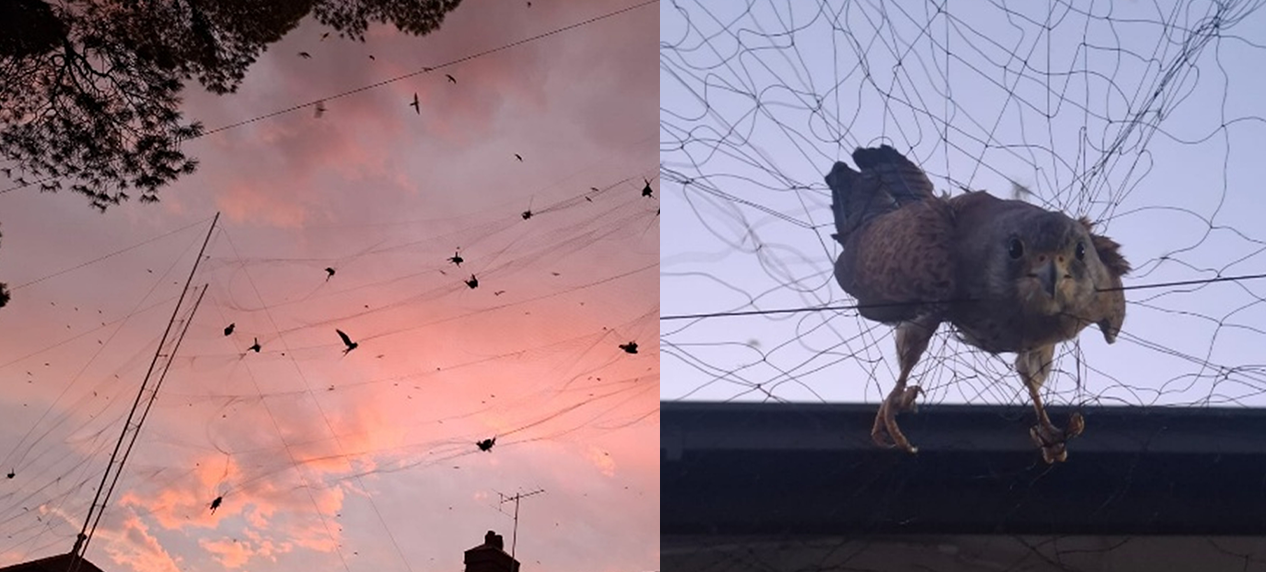
Some of the declines we observed are likely linked to human activities. In parts of the Northern Cape and Free State, certain raptors are persecuted because they occasionally catch chickens or lambs. Poisoning is also a growing threat, and unfortunately poisons are often easy to obtain. Owls appear to be particularly affected by this.

Addressing these challenges requires working with the people who share the landscape with these birds. When I travel through farming areas, I spend time talking with farmers to understand their concerns and look for ways to help reduce conflict. I also visit schools to talk to children about why raptors are important and the threats they face.

Studies like this help highlight the scale of the problem. Raptors are declining, and yet they provide vital services that keep ecosystems functioning. The more we understand these trends, the better we can work together to protect these remarkable birds.

The article can be accessed here: https://doi.org/10.1016/j.biocon.2026.111764.

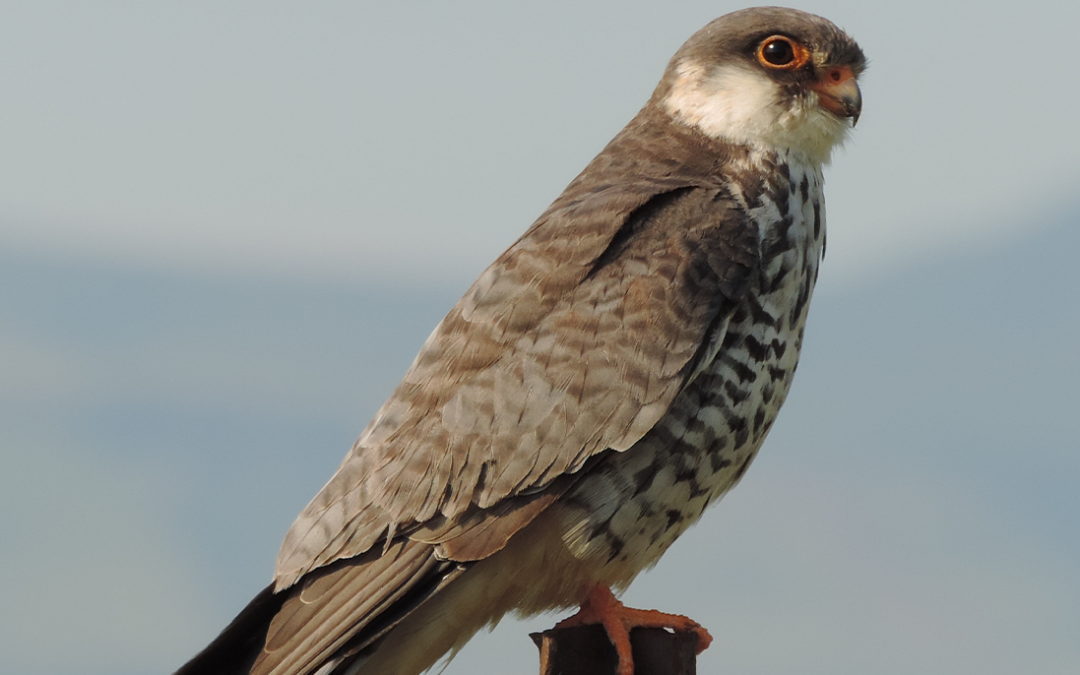
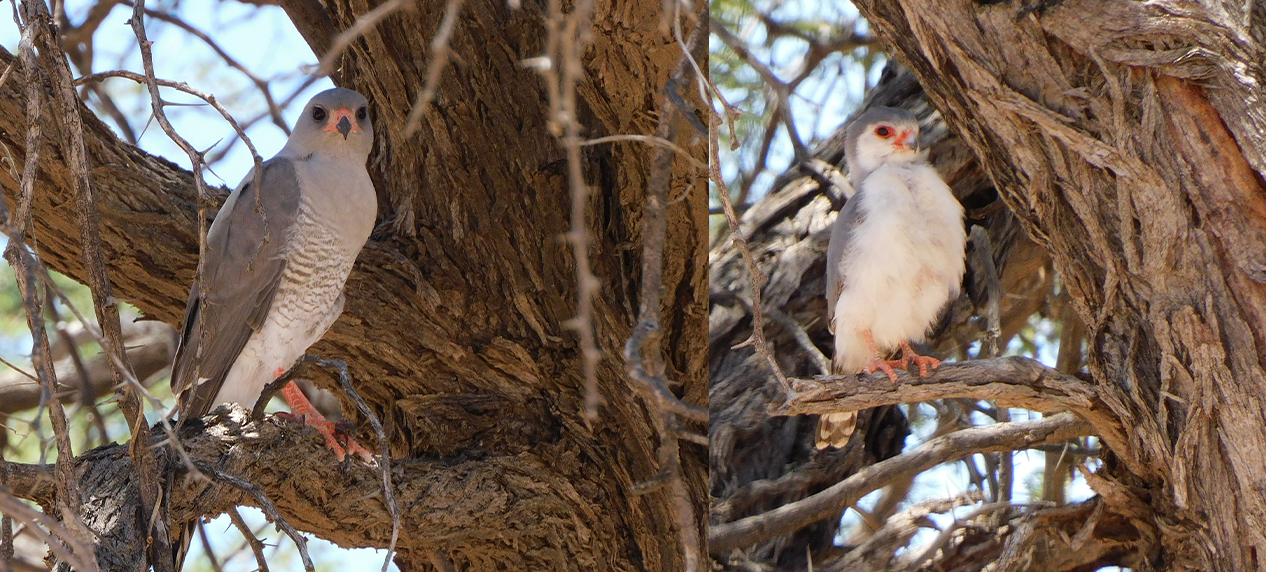
Left: Gabar Goshawk in KNP. Right: Pygmy Falcon in KNP

Left: Gabar Goshawk in KNP. Right: Pygmy Falcon in KNP

Shop. Swipe. Support Conservation – The Power of the MySchool Card

Shop. Swipe. Support Conservation – The Power of the MySchool Card

Shop. Swipe. Support Conservation – The Power of the MySchool Card


MySchool Card donation at retail store


Imagine making a difference for endangered species every time you shop—without spending an extra cent. That’ s the power of the MySchool Card, a simple yet impactful way for EWT supporters to contribute to conservation.


How does it work?

Every time you shop at participating retailers and swipe your MySchool Card, a percentage of your purchase is donated to the Endangered Wildlife Trust (EWT). The best part? These donations come from the retailer, not your pocket.


Why sign up?
  • No extra cost: Your contribution doesn’ t cost you a cent.
  • Easy to use: Just swipe your card when shopping at partner stores.
  • Supports conservation: Every transaction helps fund EWT projects that protect endangered species and habitats.
  • Convenient: Accepted at major retailers nationwide, making it perfect for everyday shopping.
  •  
Collective Impact Matters

Small actions add up to big wins for conservation. Funds raised through MySchool have already supported critical EWT projects—from safeguarding cranes and wetlands to protecting threatened carnivores. Every swipe brings us closer to a future where wildlife thrives.


Ready to make a difference?

Sign up for your MySchool Card today and choose EWT as your beneficiary. Then, simply Shop. Swipe. Support Conservation. It’ s that easy.


Challenged by Dunes, Gates and Antbear Holes in the Kalahari: August 2020

Challenged by Dunes, Gates and Antbear Holes in the Kalahari: August 2020

Snippets from staff

Challenged by Dunes, Gates and Antbear Holes in the Kalahari: August 2020

Danielle du Toit, field officer, Birds of Prey unit


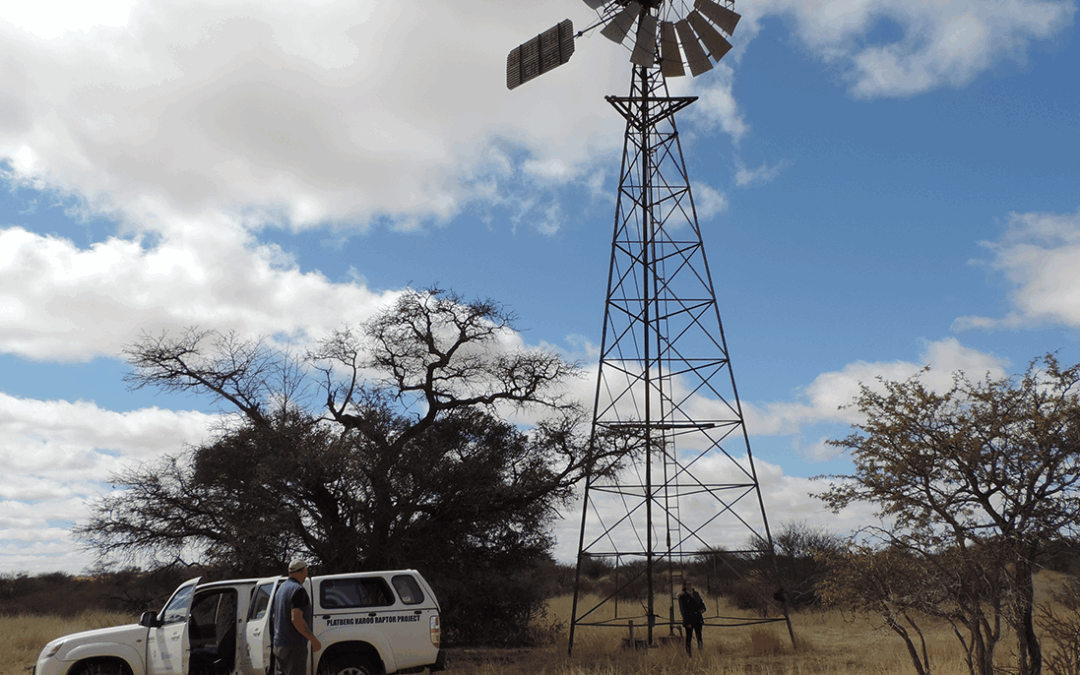
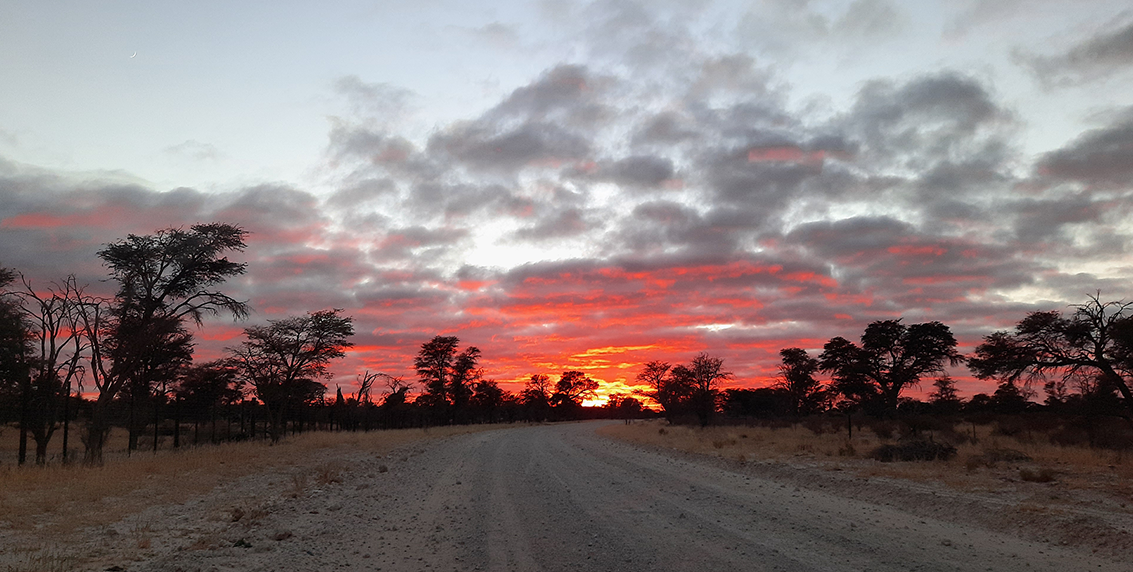
Kalahari fieldwork with EWT team


“This is not going so well,” Ronelle laughed. We were in the since-retired EWT Mazda with over 400 000km on the odometer, held together by cable ties and no 4×4. This isn’ t a problem unless you are halfway up a steep dune surrounded by thorny vegetation with no idea what’ s over the crest. I looked over at Ronelle, my grip on the ‘Oh Hell!’ handle above the window tightening. My first experience of fieldwork, and my mentor was laughing maniacally as my mind imagined becoming a permanent feature of this dune.  The back wheels spun, whipping us to the side. Through my window, the thorn bushes approached far faster than any plant has the right to move. No sooner had I made peace with my impending doom than Ronelle took control once more, and we crested the dune. She was self-professed and categorically proved to be “her mother’ s wildest child”.

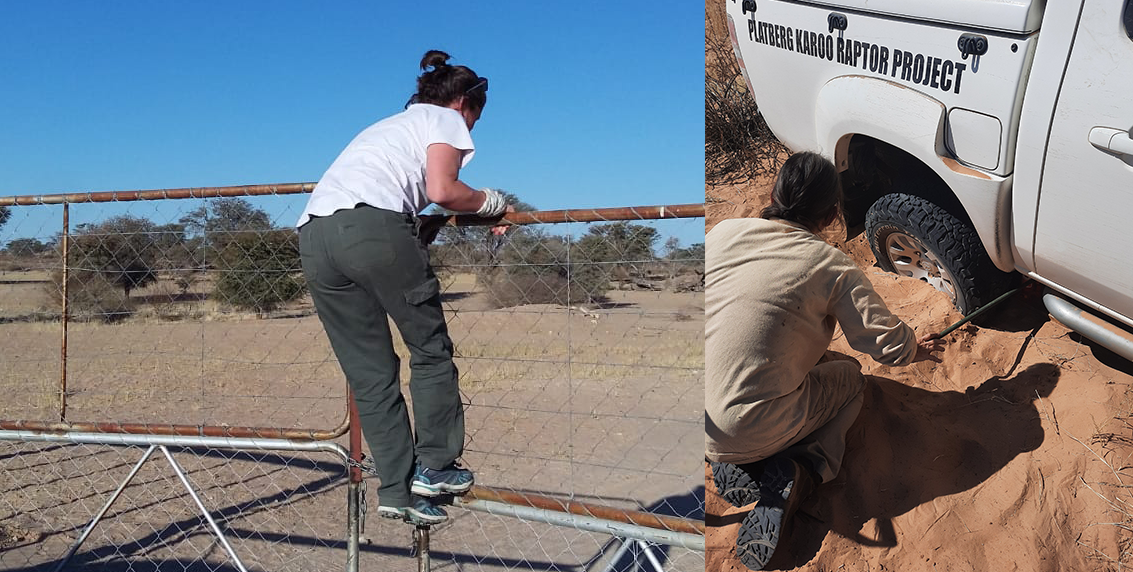
The next day, we found a Dorper lamb on the roadside being sized up by a murder of crows. With no sign of its mother, it would be dead within the hour. Catching the wobbly-legged creature was anything but graceful—like chasing a ping-pong ball that bounces away every time you try to grab it. Ronelle said there was a farm gate up the road where we could turn in to go to the homestead. Upon arrival, the two–two-metre-high double gate was locked, and the house was over the hill, a fair distance away. I offered to climb over and take it there, and Ronelle would hold the lamb until I was over. No stranger to clambering over gates, I hooked my toe into the wire netting and pulled myself up.

What proceeded, however, was the most humiliating performance I have ever given. The two gates, similar to double doors, were held together by a loosely looped chain with a lock on it. What this led to was an act of physical comedy I couldn’ t script if I tried. Every move I made sent both gates flapping wildly. It was like riding a mechanical bull after a few beers. The harder I tried to climb, the more the gate fought back. My legs shook, which only seemed to fuel the demon-possessed thing even more. I landed on the other side with weak knees, exhausted. Ronelle slipped the lamb through the gap.

Feeling like Little Bo-Peep after a few rounds with Mike Tyson, I started up the hill. I don’ t doubt that the lamb looked at me, concerned with who was going to end up saving who. When I arrived at the house, I was panting, thirsty, sweaty and smelling like livestock. Following the noise coming from the shed, I found a group of workers. When they spotted me, terror flickered in their eyes. To be fair, I looked like something out of a fever dream: a sweaty white woman clutching a lamb, hair like I’ d run through a bush backwards, and black lamb excrement smeared up my arm. Between pants and questionable Afrikaans, I explained how I’ d ended up there. I held out the lamb, but the group stepped back in unison. Repulsed by the smell? Or, baffled by my mangled grammar, assumed witchcraft? One man elbowed a younger guy forward. He crept up, snatched the lamb from my arms, and hurried back to safety. I thanked them; they nodded, still looking bewildered, and left. Aware that Ronelle had been waiting, I began to run. By the time I reached the devil gate again, my lungs hated me, and the only thing that got me through the satirical repeat performance of climbing over the gate was pride.

vehicle stuck in Kalahari antbear hole

Later that week, we set out to monitor White-backed Vulture nests. Ronelle went off the beaten track, navigating her way through bushes and avoiding antbear holes. On our way back, she reversed carefully to avoid the thorny branches behind us, but only remembered the antbear holes when we found ourselves chassis deep in one. Attempting the normal way of getting unstuck: She reversed slightly, quickly changed into first gear, swung the steering, and gunned the gas but that only served to deepen the hole we were in. From the canopy, she pulled out a plank, a spade, textured plastic slats and a 4-ton jack.

More than an hour later, having tried everything short of lifting the vehicle out with our bare hands, we were no closer to getting out than when we started. We thought we had solved the issue when we saw that the undercarriage was resting on a sizable bush, assuming that was what was preventing movement. Leatherman in hand, I wiggled under the vehicle and cut away at the branches. When that failed, I attacked it with the spade. By the time I crawled out, I had sand in my sinuses, thorns in my hands, and the vague sense I’ d lost my dignity under there. Ronelle kept laying brush for traction, and we tried again with no luck. I suggested calling the farmer for help. Ronelle—strong-willed and allergic to asking for assistance—cracked on.

I gave up on trying to impress her, leaned against the car, and picked thorns out of my hands. It took another hour before she relented. She made the call, and our cavalry arrived in the form of three farm workers and a Datsun bakkie that had survived the 1980s by sheer spite. They had us out in minutes, moving with the ease of people who’ d done this many times before. Our earlier efforts looked embarrassingly futile.

Through the dune bashing, tangoing with farm gates and attempting the dig to China, the Kalahari blessed us with the opportunity to experience it most truly and live to tell the tale. When I remember the Kalahari, I remember seemingly impossible challenges that we overcame with laughter and blind determination and it is a lesson that I have taken with me five years down the line.

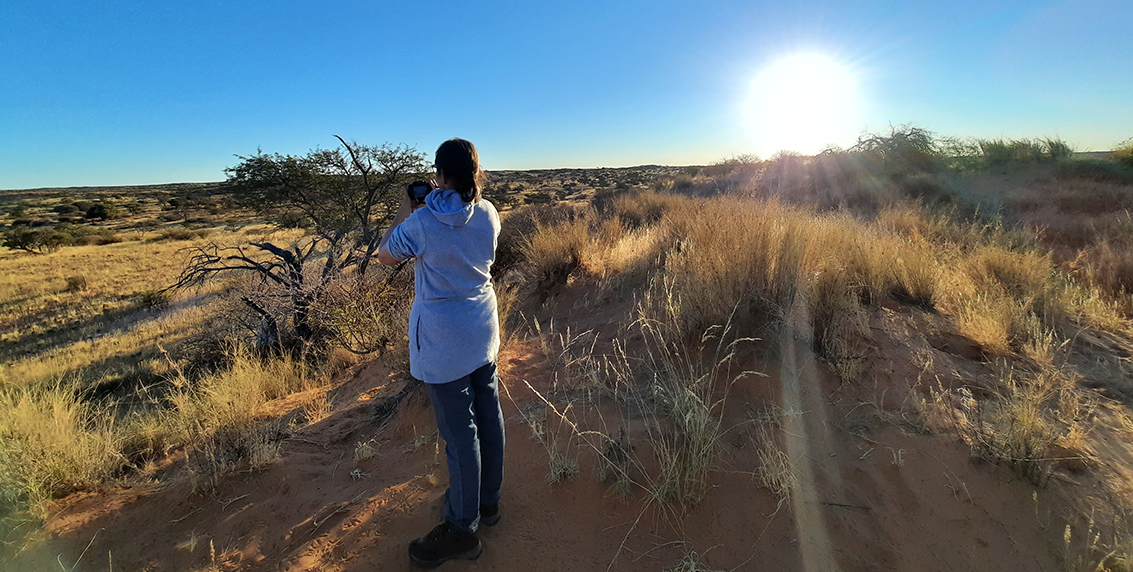
EWT field officer navigating Kalahari dunes