SAVING SPOTS AND STRIPES
Claire Patterson-Abrolat claire@ewt.org.za and Wendy Collinson-Jonker wendyc@ewt.org.za, Endangered Wildlife Trust infrastructure is a common feature wherever humans have settled. South Africa is rated as the 25th largest country in the world and ranked 18th in relation to the total road length (65,600 km paved, 689,000 km unpaved) and 74th in the total number of cars per 1,000 people. Roads are critical in providing access to primary health care, education, markets, and employment, ultimately improving livelihoods.
However, South Africa is the third most biologically diverse country in the world, and it is increasingly clear that roads and road users affect the functioning of ecosystems in which they occur. Direct collisions with wildlife have the most obvious impact, but the indirect disruption of ecological processes is equally important. Habitat loss, degradation, and population fragmentation, and disruption of the processes that maintain regional populations are just some of the ways roads can affect biodiversity.
Development is taking place rapidly, with new roads and housing developments mushrooming and trans-continental rail and road developments being expedited. In the past, such developments were planned without much thought to their impact on biodiversity, but the EWT has been working hard to improve road-user safety – that of both the occupants of vehicles and the wildlife living adjacent to or crossing our roads. We’ ve been collecting data in a variety of ways, including the use of citizen scientists (data submissions from the general public), planned surveys and, importantly, using the road patrollers that drive our highways daily to deal with any hazard they come across, including the removal of dead animals from the road.
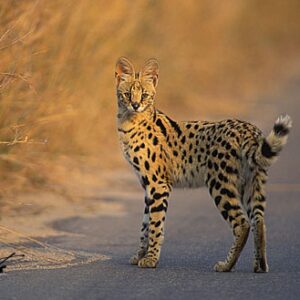
The EWT analyses roadkill data regularly, and one of the species that has caught our attention is the Serval. This mostly solitary, nocturnal species was considered extinct, or near-extinct, in the latter half of the 20th century, largely due to the mistaken belief that it caused damage to agricultural crops and compounded by competition from other carnivores such as jackal. Reintroductions and range expansions have led this species to recover to an estimated adult population of somewhere between 4,509 and 13,654 individuals, but the population is again considered to be declining due to a loss of its wetland habitat.
Serval (Leptailurus serval)
Servals are predominantly solitary except when mating or before young would leave their mothers at around eight months old. Like Leopards, the young females form territories adjacent to that of their mother, with males having larger territories that overlap that of several females.
The N3 Toll Concession, which manages the 412 km stretch of road from Heidelburg (Gauteng) to Cedara (KwaZulu-Natal), has been extremely supportive of our efforts to mitigate roadkill along the Toll Route and is concerned about the safety of both the road users and the wildlife living alongside the road.
In addition to our usual reports to the N3 Toll Concession, the EWT has been looking into why the Serval is one of the most common species reported (Figure 2) and why their roadkill numbers show an upward trend.We plotted the location of the roadkill along the N3 and noted that although roadkills were spread along the length of the road, there was a cluster along the northern parts of the route. This area is predominantly highveld sourveld and is either farmed for cattle or game or planted with mieliesWe also looked at the proximity of water to the road. Servals are wetland specialists, which are likely to be clustered close to water bodies. Water is spread fairly evenly across the landscape, and where perennial rivers are not available, farmers have created artificial water points for livestock and/or game. The diet of Servals consists mainly of Vlei Rats, so the abundance of water along the N3 does create the ideal habitat for them.
Our work is still in its infancy, and we plan to keep investigating the drivers of roadkill for this species by investigating the following:
- Whether Serval prefer artificial or natural water bodies;
- The abundance of prey species;
- Whether or not Serval use underpasses (tunnels and culverts) to cross the road; and
- If the Serval being killed on the road are young dispersing males or breeding adults, and the impact of this on the local and broader population.
Thank you to the N3 Toll Concession for their ongoing support of our work and Ford Wildlife Foundation for keeping us on the road.
THE FEMALE OF THE SPECIES IS DEADLIER THAN THE MALE
Wendy Collinson-Jonker, Programme Manager EWT Wildlife and Transport Programme, wendyc@ewt.org.za
Men have dominated our society and controlled our commerce for most of recorded history. Rudyard Kipling’ s poem, written in 1911, implies that women are more dangerous than men, referring to animal species in which the female is more aggressive than the male. A prime example of this is sexual cannibalism, a behaviour in which a female animal kills and consumes the male before, during, or after copulation, common amongst insects. Female dominated societies, such as matriarchal elephant herds and hyaena clans, are also observed in the animal kingdom. Does this make the female more dangerous? Highly unlikely, but it may make her more vulnerable.
Historically, women have commonly been referred to as the “fairer sex”, usually based on their apparent vulnerability and appealing looks, and it seems this stereotype is hard to escape. Women’ s beauty is another trait that some believe makes her more deadly, but most of the time, it just makes her more vulnerable. In other species, however, it is often the other way around, with the males much more appealing in appearance than the females. According to Charles Darwin, this was due to two characteristics related to sexual selection: those physical traits that serve as weapons, allowing males to fight for access to females, such as the impressive horns on Kudu bulls, and those ornamental traits that attract the attention of females, such as long tails and bright colours on male birds. As a general rule, birds typically have specific breeding periods (seasonal breeding) so that offspring are born or hatch at an optimal time. The same is true for amphibians and reptiles, also reliant on ambient temperature, precipitation, availability of surface water, and food supply to breed. Mammals, fall more into the category of opportunistic breeders, and are reliant upon other conditions in their environment (aside from time of year), such as prey or forage availability, and can have multiple litters in a year.
Understanding animal behaviour such as breeding habits is critical to understanding the specific threats to our wildlife. Not only does breeding behaviour place wildlife in threatening situations, but these threats, in turn, have an impact not only on the number of live individuals but also on the breeding success of species. A Giant Bullfrog, for example, emerges from hibernation after the first rains and migrates to a different area to breed. Giant Bullfrogs in Gauteng are often required to cross multiple roads to get to their potential mates, and they get killed in their thousands by vehicles, drastically reducing the number of breeding individuals. Of course, this is one of the reasons they are what we call “explosive breeders”, having adapted to emerge and migrate in their thousands, as many simply don’ t make it to the other side.
The EWT’ s Wildlife and Transport Programme (WTP) has been gathering wildlife road mortality in South Africa since 2013, not only to determine which species are most at risk but also to determine what impact this may have on their populations. One of the ways by which we do this is training route patrollers from three of the toll concessionaire companies (namely, N3 Toll Concession, Bakwena N1/N4 Toll, and TRAC N4) to gather roadkill data, which helps us understand what is happening on these highways.
To date, we have almost 20,000 data points, identifying species most at risk, but most of these do not include the gender of the animal, since it is quite challenging to determine in many species, especially if the animal is very squashed. We know from research undertaken elsewhere in the world that is important to ascertain whether it is males or females being killed on the roads. But why?
We know that male amphibians are very reliant on their vocalisations to not only protect their territory but also to attract a mate. A study in Brazil in 2017 showed that traffic noise affects amphibian calling behaviour, and if a female cannot hear the male call, then breeding is compromised. A collateral effect of this is that the females may spend longer trying to locate males, and her chances of being hit on the road are increased. A study in France showed that more male snakes were killed during their breeding period (especially in species where mate-searching males travel widely), while females in oviparous species are killed during their egg-laying migrations. In North America, male bears chose to avoid roads, while females elect to cross them, but in Australia, more male kangaroos are killed on the roads than females. No matter what the species, roads effectively create “invisible” barriers between wildlife populations, which is something we as humans have experienced during the COVID-19 pandemic, social distancing creating an invisible barrier between friends and families.
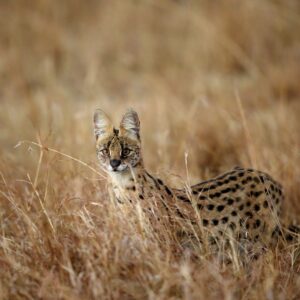
One of the mammal species most impacted on South African roads is the Serval, especially on the N3 highway, with almost 250 killed since 2014. The habitat along the N3 is very favourable for Serval, and we are working closely with N3 to implement some solutions to prevent Serval mortalities. However, information on the sex of the animals being killed is limited, and this information is key to understanding the effects of roadkill on the breeding viability of populations. For example, if more females are being killed, then this will decrease breeding success, while if it is young, dispersing males, this will have less of an impact. To expand on our knowledge and address threats to specific species. The WTP, where possible, will gather information about the sex of a roadkill specimen to understand more about species’ behaviour around roads.
Thank you to the loyal supporters of the Wildlife and Transport Programme, namely Ford Wildlife Foundation, De Beers Group of Companies, N3 Toll Concession, Bakwena N1/N4 Toll and TRAC N4.
