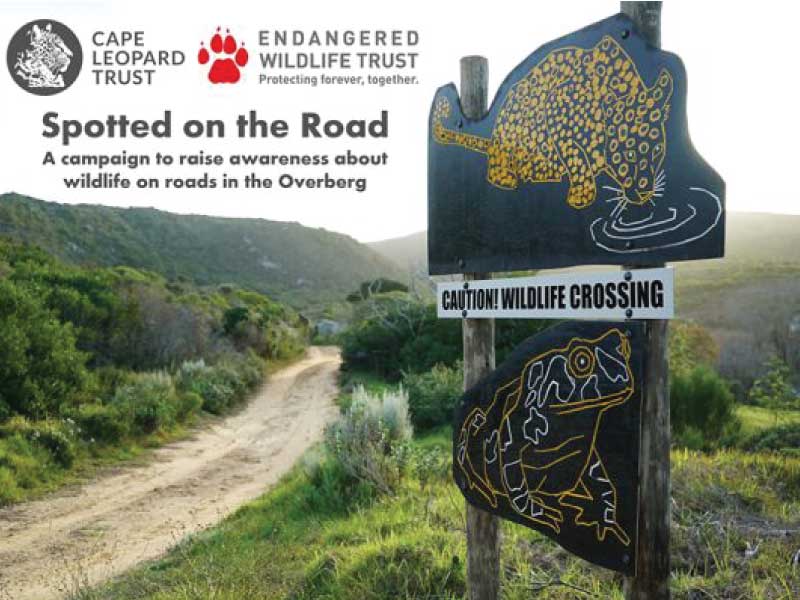
A campaign to raise awareness about wildlife on roads in the Overberg
Most people are familiar with the sad sight of dead animals on the side of the road, and many vehicle accidents in South Africa involve a collision with wildlife. Insurance claims suggest that approximately R82.5 million is paid each year in damages as a result of wildlife associated vehicle collisions. While actual collisions are the most obvious impact of roads on wildlife, other negative consequences include reduced air quality due to vehicle emissions, noise interference, and physical barriers to animal movement caused by the position of the road itself. Temporary road closures, wildlife crossings and bridges are means of improving safety for wildlife near roads, but the most common method is the use of roadside signs to warn motorists and mitigate wildlife-vehicle collisions. Signs installed in areas of high animal activity can help make drivers more aware of wildlife presence and ideally modify driving behaviour. With this in mind, the Cape Leopard Trust (CLT) and the Endangered Wildlife Trust (EWT) have launched the ‘Spotted on the Road’ campaign to raise awareness about wildlife on roads in the Overberg. The campaign is part of the collaborative Tale of Two Leopards project (see links at the end of this document to read more), which focuses on two iconic species found in the Overberg region – the leopard and the Western Leopard Toad (WLT). Leopards and WLTs find themselves in an increasingly urbanised environment and must navigate through this transformed landscape, including crossing roads. The Endangered toads move en masse during their breeding season from July – September and when juveniles disperse in October. It is during these times that they are most vulnerable on roads. Leopards in the Cape have huge home ranges that are intersected by many roads, and leopards often cross roads in mountainous and natural areas, especially at night, putting them at risk of collisions with vehicles. The Tale of Two Leopards Spotted on the Road campaign worked with Cape Town-based artist Bryan Little to create reflective road signs of WLTs and leopards in an innovative move to alert motorists to slow down for these, and other animals on the roads, especially at night. The signs have been installed at five strategic locations in the Overberg, based on where WLT mortality by vehicles has been recorded previously and areas where camera traps have confirmed leopard movement. The locations vary between public and private land and tarred and dirt roads to maximise their reach. The signs were introduced to the public at an informal evening event held at Ou Meul Bakery and Café in Stanford on Saturday,16 July 2022. The Spotted on the Road evening featured an informative presentation, the unveiling of the signs, and an outdoor frogging experience at the Willem Appelsdam in Stanford. Contrary to the usual wet and windy weather that accompanies the Cape’s winters, the evening turned out to be calm, sunny and warm – perfect conditions for a nature walk to view the new reflective signs while listening out for different toad and frog calls around the dam. The CLT and the EWT sincerely thank the various landowners and the Overstrand Municipality who granted permission to host the new signs, as well Ou Meul Stanford for hosting the event, and Mountain Falls Spring Water for sponsoring its locally bottled water. The reflective road signs now join the interpretive Tale of Two Leopards information signboards to remind residents and travellers of the Overberg region’ s amazing biodiversity. Please join us in our mission to protect it by making the roads of the Overberg safer for all wildlife!
Spotted on the Road Call to Action – How Can You Help?
- Drive slowly, especially at night
- Be on the lookout for animals on the roads
- Don’ t swerve, but avoid collisions by reducing speed
- Help a toad cross a road (in the same direction in which it is travelling)
Be a citizen scientist and submit information!
- Contribute to leopard research by submitting photos of leopard sightings, signs like spoor or droppings, and threats to leopards to the CLT Western Cape leopard database: app.capeleopard.org.za
- As we move deeper into winter, the Western Leopard Toad breeding season is in full swing. This is an amazing time in the Overberg to see and hear this Endangered toad. Please share your WLT sightings with the EWT: inaturalist.org/projects/leopard-toads-of-the-overberg
Tale of Two Leopards news links:
Introducing the Tale of Two Leopards at the Tip of Africa Camera trapping for Overberg leopards in full swing! Overberg camera survey – success & highlights! Camera trapping in the Overberg – hefty hippos, baby birds & spotted cats! The Tale of Two Leopards in the Overberg – information signs & wildlife wines Released by the Cape Leopard Trust and the Endangered Wildlife Trust
For general / media information, contact:
Jeannie Hayward, CLT Communications and Media Manager, communications@capeleopard.org.za Emily Taylor, EWT Communications and Marketing Manager, emilyt@ewt.org.za
For research information, contact
Dr Katy Williams, CLT Research & Conservation Director, rcdirector@capeleopard.org.za Dr Jeanne Tarrant, EWT Threatened Amphibian Programme Manager, jeannet@ewt.org.za
SAVING SPOTS AND STRIPES
Claire Patterson-Abrolat claire@ewt.org.za and Wendy Collinson-Jonker wendyc@ewt.org.za, Endangered Wildlife Trust infrastructure is a common feature wherever humans have settled. South Africa is rated as the 25th largest country in the world and ranked 18th in relation to the total road length (65,600 km paved, 689,000 km unpaved) and 74th in the total number of cars per 1,000 people. Roads are critical in providing access to primary health care, education, markets, and employment, ultimately improving livelihoods.
However, South Africa is the third most biologically diverse country in the world, and it is increasingly clear that roads and road users affect the functioning of ecosystems in which they occur. Direct collisions with wildlife have the most obvious impact, but the indirect disruption of ecological processes is equally important. Habitat loss, degradation, and population fragmentation, and disruption of the processes that maintain regional populations are just some of the ways roads can affect biodiversity.
Development is taking place rapidly, with new roads and housing developments mushrooming and trans-continental rail and road developments being expedited. In the past, such developments were planned without much thought to their impact on biodiversity, but the EWT has been working hard to improve road-user safety – that of both the occupants of vehicles and the wildlife living adjacent to or crossing our roads. We’ ve been collecting data in a variety of ways, including the use of citizen scientists (data submissions from the general public), planned surveys and, importantly, using the road patrollers that drive our highways daily to deal with any hazard they come across, including the removal of dead animals from the road.
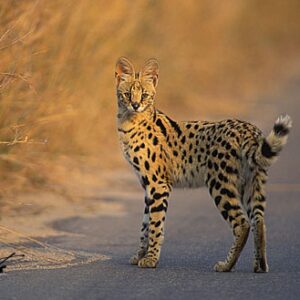
The EWT analyses roadkill data regularly, and one of the species that has caught our attention is the Serval. This mostly solitary, nocturnal species was considered extinct, or near-extinct, in the latter half of the 20th century, largely due to the mistaken belief that it caused damage to agricultural crops and compounded by competition from other carnivores such as jackal. Reintroductions and range expansions have led this species to recover to an estimated adult population of somewhere between 4,509 and 13,654 individuals, but the population is again considered to be declining due to a loss of its wetland habitat.
Serval (Leptailurus serval)
Servals are predominantly solitary except when mating or before young would leave their mothers at around eight months old. Like Leopards, the young females form territories adjacent to that of their mother, with males having larger territories that overlap that of several females.
The N3 Toll Concession, which manages the 412 km stretch of road from Heidelburg (Gauteng) to Cedara (KwaZulu-Natal), has been extremely supportive of our efforts to mitigate roadkill along the Toll Route and is concerned about the safety of both the road users and the wildlife living alongside the road.
In addition to our usual reports to the N3 Toll Concession, the EWT has been looking into why the Serval is one of the most common species reported (Figure 2) and why their roadkill numbers show an upward trend.We plotted the location of the roadkill along the N3 and noted that although roadkills were spread along the length of the road, there was a cluster along the northern parts of the route. This area is predominantly highveld sourveld and is either farmed for cattle or game or planted with mieliesWe also looked at the proximity of water to the road. Servals are wetland specialists, which are likely to be clustered close to water bodies. Water is spread fairly evenly across the landscape, and where perennial rivers are not available, farmers have created artificial water points for livestock and/or game. The diet of Servals consists mainly of Vlei Rats, so the abundance of water along the N3 does create the ideal habitat for them.
Our work is still in its infancy, and we plan to keep investigating the drivers of roadkill for this species by investigating the following:
- Whether Serval prefer artificial or natural water bodies;
- The abundance of prey species;
- Whether or not Serval use underpasses (tunnels and culverts) to cross the road; and
- If the Serval being killed on the road are young dispersing males or breeding adults, and the impact of this on the local and broader population.
Thank you to the N3 Toll Concession for their ongoing support of our work and Ford Wildlife Foundation for keeping us on the road.
SCIENCE SNIPPETS:
SPLAT STATS
Dominic Henry, EWT Conservation Science Unit, Ecological Modelling Specialist, dominich@ewt.org.za
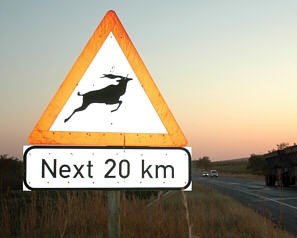
Road networks form a substantial part of current and future infrastructure development and are a major hazard for local wildlife populations. Due to high mortality rates, wildlife-vehicle collisions are a threat not only to individual animals but to broader animal communities, populations, and species. The threat of wildlife-vehicle collisions is set to increase globally as an additional 25 million kilometres of road are expected to be added to the global road network by 2050.
We need to estimate how many wildlife deaths result from vehicle collisions if we want to understand this impact on wildlife populations and develop strategies to prevent or reduce the collisions, so we need to get out there and do surveys.
However, conducting roadkill surveys is a resource-intensive exercise. Labour costs, fuel, mileage, and vehicle maintenance are just some of the costs incurred for this type of research. Depending on the study site and survey durations, these costs can escalate quickly. Research budgets are often limited, and it is important to make each rand go as far as possible. In light of financial resource limitations, the question is, is there an alternative to conducting daily surveys of roadkill while still having a robust study design?
When designing roadkill surveys, there is a trade-off between survey frequency (and all the logistical effort and costs incurred) and roadkill carcass detection. In this regard, carcass persistence (the period a carcass remains detectable before it is removed by decomposition or scavengers) is important; the longer a carcass persists, the greater the likelihood it will be detected with lower survey effort by conducting more infrequent surveys.
Part of our research, published recently in the Journal of Environmental Management, looked at this question. The study was based on Wendy Collinson-Jonker’ s roadkill dataset collected in the Greater Mapungubwe Transfrontier Conservation Area. An observer drove a standardised 120 km transect daily for a month, recording all carcasses as well as how long they remained on the road. Over 340 carcasses were recorded, comprising 73 species ranging from the smallest frogs to a Brown Hyaena. We used these data to simulate what would happen if surveys were conducted with different intervals from 2–10 days.
We found that the proportion of carcasses detected decreased sharply when survey intervals were longer than three days. However, we showed that survey costs could be reduced by up to 80% by conducting non-daily surveys. By carefully considering the objectives of the survey and characteristics of the focal species, researchers can substantially reduce the costs of their studies. We developed a web app (https://roadsplat.ewt.org.za/) that can be used by researchers to compare survey costs across a variety of survey characteristics. This web app allows researchers to assess the trade-off between carcass detection and cost easily.
Details of the journal article:
Citation: Henry, D.A.W., Collinson-Jonker, W.J., Davies-Mostert, H.T., Nicholson, S.K., Roxburgh, L. and Parker, D.M. 2021. Optimising the cost of roadkill surveys based on an analysis of carcass persistence. Journal of Environmental Management 291:112664
Link to paper: https://doi.org/10.1016/j.jenvman.2021.112664
Link to app: https://roadsplat.ewt.org.za/
