Hunting the hunter: for the love of Mantids
Hunting the hunter: for the love of Mantids
Bonnie Schuman, the EWT’ s Drylands Conservation Programme and Bianca Greyvenstein, Unit for Environmental Sciences and Management, North-West University
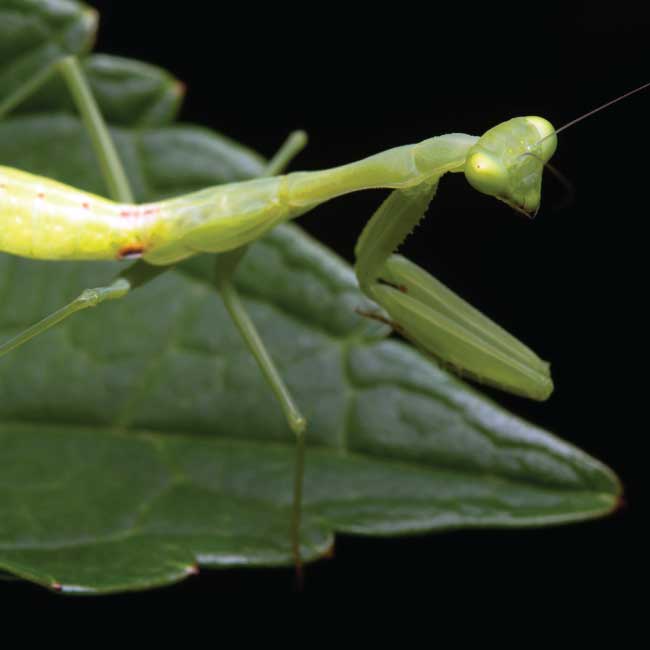
Praying mantises are weird and wonderful-looking insects that most people seem to be familiar with, with their iconic “prayer” posture and reputation for honeymoons that end badly. However, as a taxonomic group, very little is known about the Mantids regarding their ecology, behaviour, distribution or even the range of species in South Africa. Two people are working hard to change this situation and are hunting these little hunters across South Africa with a view to finding out all there is to know about these poorly understood miniature predators.
Bianca Greyvenstein, Post Doctoral Fellow, and Professor Johnnie van den Berg from the North-West University (NWU) are the leading experts in South Africa on Mantids, specialising in praying mantid (Mantodea) diversity. The Endangered Wildlife Trust (EWT) recently invited these two researchers to visit the Papkuilsfontein proposed Protected Environment on the Bokkeveld Plateau near Nieuwoudtville to document the praying mantis species on the property. The EWT, in collaboration with the landowners (the Van Wyk family) and the Department of Agriculture, Environment, Land Reform and Rural Development (DAERL), recently launched an initiative to document the incredible range of biodiversity on the property.
The Northern Cape, in particular, is extremely data deficient with regard to insect diversity, especially in the Mantodea Order, under which these charismatic mantids are grouped. For example, of the approximately 4,000 museum specimens representing 170 species that have been collected in South Africa since 1838, only 0.2% are from the Northern Cape Province. Of these 15 specimens, only one species was collected near Papkuilsfontein.
Due to the poor rainfall season experienced during the winter prior to the survey, the region was extremely dry during this visit, and the diversity of arthropods at this time of year was extremely low. However, the Bokkeveld Plateau is not known to be a biodiversity hotspot for no good reason. Despite the ongoing drought and the heatwave experienced during the survey, surprisingly high levels of mantid diversity were recorded. Sampling focussed on the Bokkeveld Sandstone Fynbos vegetation type, but the Nieuwoudtville Shale Renosterveld and the Hantam Karoo were also surveyed.
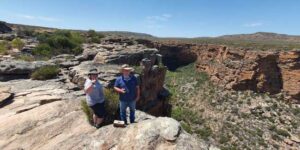
Rresearchers visit the Papkuilsfontein proposed Protected Environment near Nieuwoudtville to document the praying mantis species on the property. Photo credit: Paul Janse van Rensburg
Records reflect that eight superfamilies in the Mantodea order have been documented in South Africa so far, of which no less than six were present on Papkuilsfontein. Of the known 22 families, seven were recorded on Papkuilsfontein, which also represented ten different genera. In addition to recording the Mantids, the NWU team documented eight insect orders, 23 families and 36 species during their short visit in January 2023.
The team will return to the plateau in spring this year, and hopes are high for a good winter rainfall season. Just imagine what awaits discovery on this spectacular property following a good rainy season! The NWU team welcome sightings of Praying Mantises from across South Africa, as these can help shed light on species diversity and distribution. High-resolution photographs will go a long way in aiding the identification of any sightings.
Please share any sightings of Preying Mantises with Bianca at the Unit for Environmental Sciences and Management, North-West University, Potchefstroom, South Africa. Email: biagrey90@gmail.com

The work on Papkuilsfontein was made possible with generous support from the Table Mountain Fund
Paul Janse van Rensburg
Fun Facts about Praying Mantises
- Praying Mantises feature prominently in mythology in many cultures, most likely due to the fact that they fold their forelegs in what appears to be a “praying” position.
- Praying Mantises are wait-and-hunt predators. They wait patiently for prey to pass close by and then snatch the unsuspecting prey with their long, spiny forelegs.
- Contrary to common belief, female Mantids do not always consume their male partners after breeding. If the female is well-fed, the lucky suitor will escape with his head remaining on his shoulders.
- Turns out these little predators live on average 260 days, and some of their egg packets or ootheca can have up to 150 tiny mantids that emerge all at once! These little guys will have to shed their skin or moult between five and nine times before they become big, beautiful adult mantids.