Wildlife poisoning has become increasingly prevalent and destructive in recent years, placing pressure on conservation organisations to improve their response times in order to reduce the impact on particularly endangered species.
Because poisoning is a silent, swift, and brutally efficient killer, it not only affects specific animals but leaves a trail of collateral damage, killing thousands of unintended victims and pushing species closer to extinction. This includes large carnivores such as lions and leopards, as well as hyenas, jackals, and avian scavengers, such as vultures.
It is because of a speedy response on 6 May that the Endangered Wildlife Trust, SANParks and our partners were able to rescue 84 vultures from a poisoning incident at the Mahlangeni Section in the Kruger National Park.
Although wildlife poisoning is an ongoing crisis, the severity of this incident was well beyond what has occurred in recent years. When rescuers arrived at the scene, they discovered the grim reality: a mass poisoning event involving hundreds of vultures, the result of an elephant carcass laced with highly toxic poison laid by poachers.
In this specific incident, we noticed the previous evening through the EWT’ s pioneering wildlife poisoning surveillance and detection system that there was suspicious activity in a high-risk area of the park. The SANParks section ranger, who flies a Bat Hawk aircraft, was able to fly over the site at first light and immediately provide feedback, indicating that this was a serious incident.
A World-Class Wildlife Rescue Operation
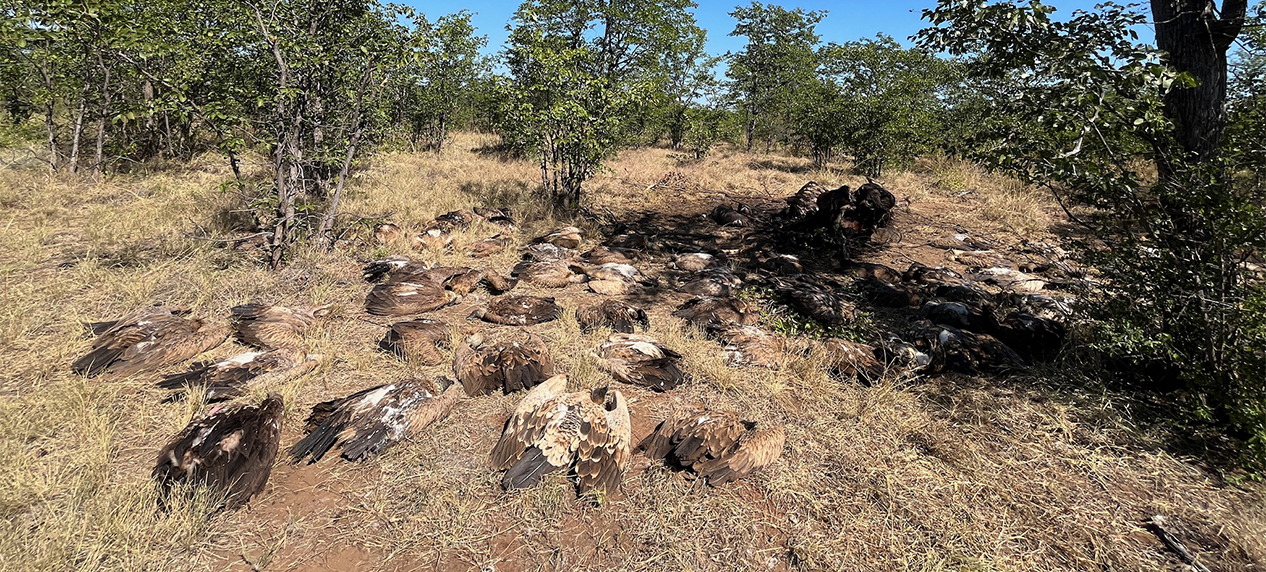
Vultures found dead and alive at the scene of a mass poisoning event
EWT field officer Kyle Walker and Birds of Prey Programme intern Dembo Jatta were ready to enter the Park by 6am and immediately made their way to the scene. In the meantime, the Programme’ s senior manager, Gareth Tate, hooked up the EWT’ s vulture ambulance, collected vets and rehabilitation staff and raced to an area as close to the scene as possible.
By then, we had already received two immobility alerts, which meant two of the tagged vultures had already died.
The support team included colleagues from the Moholoholo Wildlife Rehabilitation Centre, Briner Veterinary Services and Wildscapes Veterinary Services, SANParks rangers and aerial support and the Hope for Wildlife helicopter. This was the first time that SANParks helicopters were formally used in a wildlife poisoning rescue of this scale, marking the beginning of similar collaborative rescue operations in future.
First-hand account
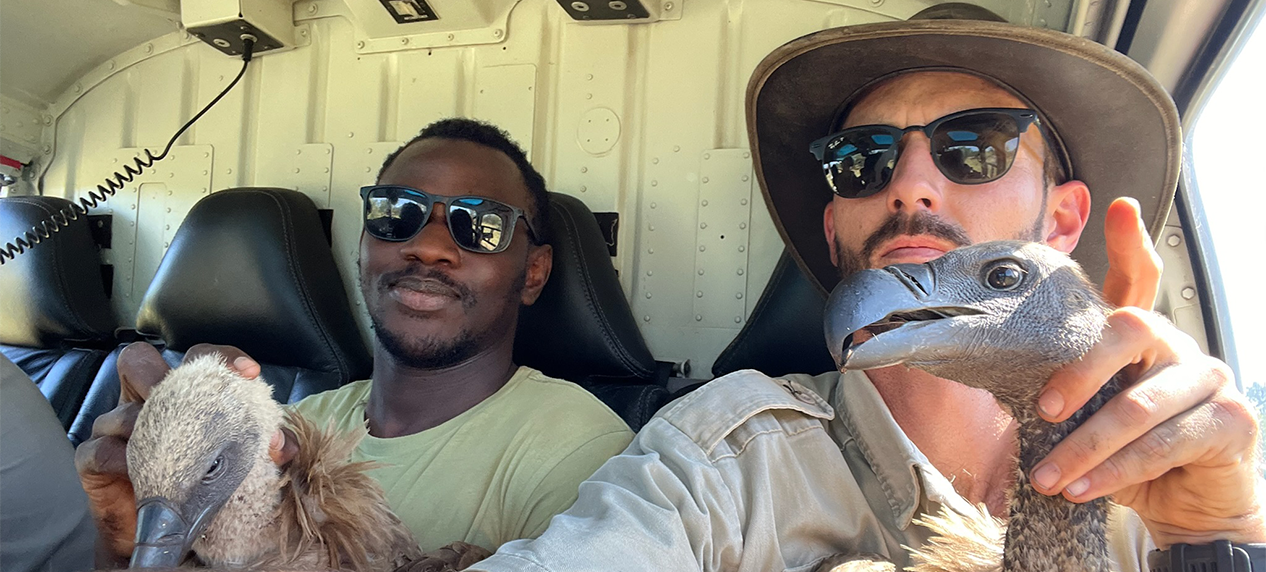
Kyle Walker and Dembo Jatta with vultures en-route to treatment facility
Although this was a very traumatic experience and crisis, the timing of everything was absolutely perfect. There was already a helicopter on the scene, and some of the birds were being treated ahead of the arrival of Gareth and the support teams.
“When we arrived, it was almost like a movie scene when this helicopter appeared on the horizon and came bolting in and banked over us. The goosebumps I had on that day – everything just came together in a way that I could never have imagined into a worldclass rescue response,” said Gareth, adding that the helicopter collected him and the team where they had parked about 3km from the scene.
“My first experience was just live birds everywhere. I did not even see the poison source and the event, and what Kyle and Dembo and some of the rangers who had never touched a bird in their life had done,” he said.
“Everything just fell into place – vets were treating the birds, getting the poison out of their systems, fluids were being administered, and then we were getting the vultures into the helicopters, which had never been done before,” said Gareth. “Everyone had a job and a role, and that saved 84 birds.”
The live vultures were immediately treated using emergency vulture first aid: atropine, activated charcoal, and fluid therapy.
The rescued vultures were flown either to the SANParks K9 unit in Phalaborwa for stabilisation, or directly to the vulture ambulance before being transported to the Moholoholo Wildlife Rehabilitation Centre in Hoedspruit. En route, one of the vultures died. Two others died subsequently.
Treatment and Rehabilitation
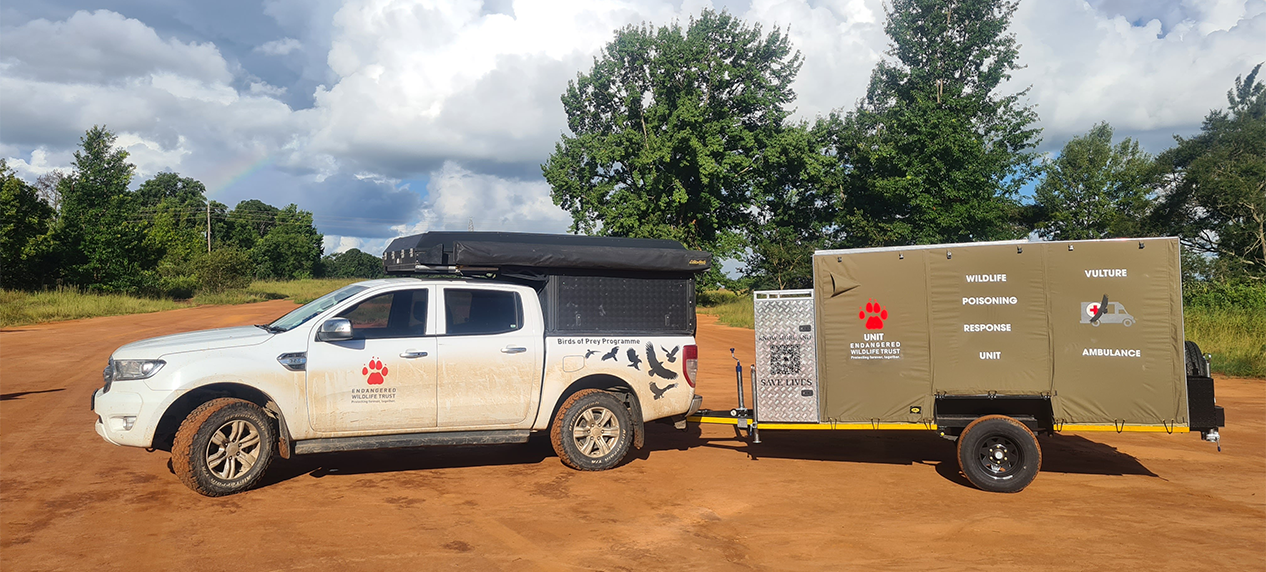
Ewt’s Vulture Ambulance
Fortunately, treating poisoned animals it is very simplistic, explained John Davies, Birds of Prey Programme manager, detailing the process followed by the EWT team five years ago to develop protocols for incidents such as this. It was through that work that field officers and rangers carry poisoning treatment kits in backpacks and are able to provide initial treatment until support arrives.
“The first 48 hours are the most critical. The birds are checked every two to three hours, which is time-consuming,” says John, adding that he and Lindy Thompson got “bitten to shreds” overnight by birds being treated in cubicles in the ICU section.
Once they were deemed healthy enough, the vultures were released into enclosures in preparation for their release back into the wild, usually within a week. The EWT Birds of Prey Programme boasts a 96% survival rate for poisoned vultures that are found alive in the last three to four years.
Reacting to poisoning scenes speedily remains the key to success. This, said John, remained the only stumbling block. And the only way to effectively respond in a practical time is through the reliance on strong collaborations, as well as technology.
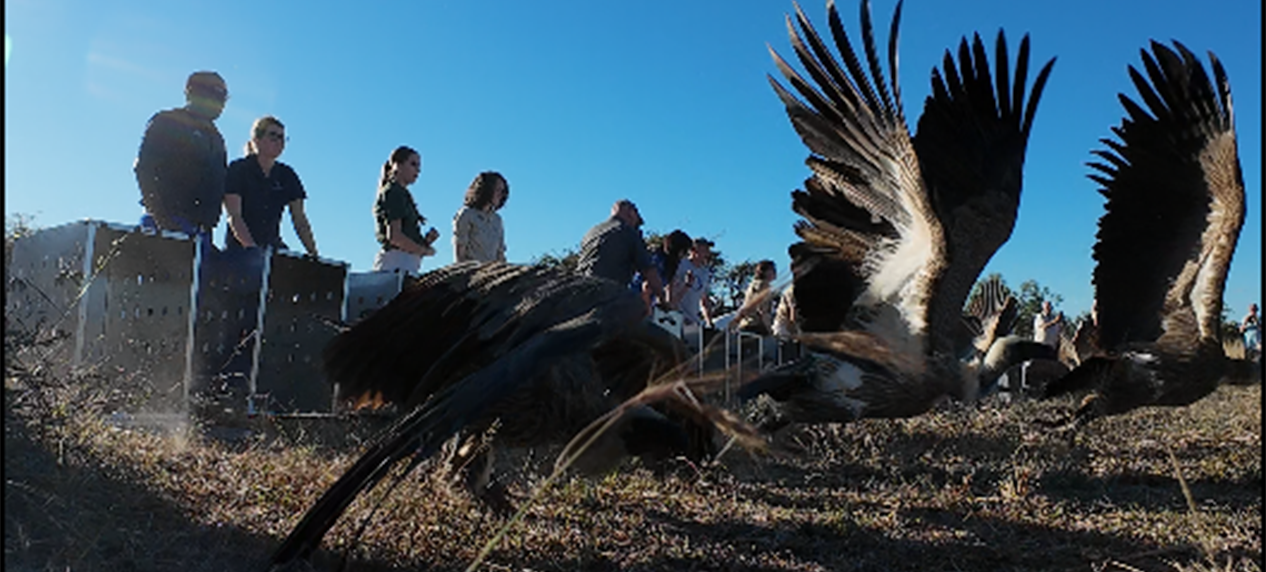
Releasing the birds back into the wild
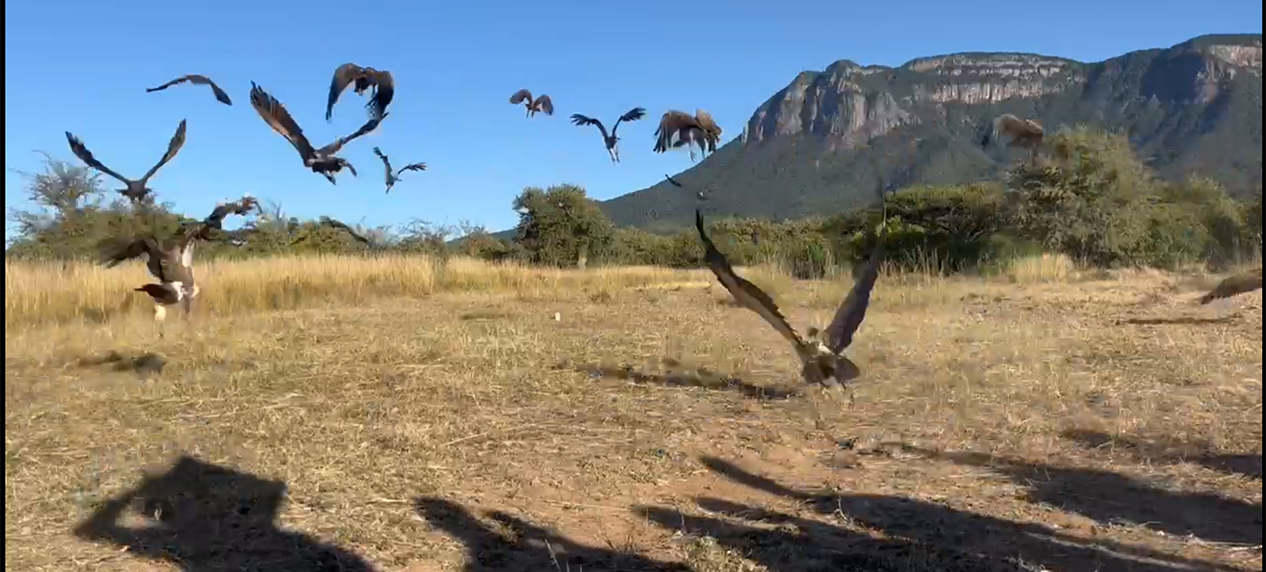
By the end of May, all the vultures had been returned to the wild.
The tracked birds are doing well, and one was back on its nest in a private reserve with its mate the next morning, and several others have returned to their nests in the Kruger National Park.
Releasing the birds back into the wild is a difficult step, but a necessary one, said Gareth and John.
“We can’ t be moving towards a world where vultures are kept in enclosures in the name of vulture conservation. These birds have gone through a lot of stress and… every bird released with a tracking unit is another layer of cover and another layer of information we can utilise to prevent this from becoming more severe. We have a full commitment to that stance,” said John.
Fortunately, we’ ve already seen an increased focus on dealing with these incidents from the government, and although conservation resources are often quite stretched, it’ s an important factor, as high-level support is critical for success.
“It is little things like that that matter to us at the end of the day. The start of the breeding season is a very risky time. Some of the vultures haven’ t laid eggs, but it is on that cusp. May is very much the beginning of their breeding season, so a poisoning event such as this is catastrophic,” said John.
A National Wildlife Tragedy
The scale of the tragedy was staggering: 123 vultures were found dead at the scene – 102 White-backed Vultures and one Lappet-faced Vulture, all listed as endangered or critically endangered species – and 20 Cape Vultures. Of these, 116 were already deceased when the team arrived.
This marked one of the largest vulture poisoning events in Southern Africa, and the most extensive coordinated response effort and rescues to date. Over 20 individuals across conservation, veterinary, and enforcement sectors played a role in the rescue and response. Without rapid detection by the EWT’ s wildlife poisoning detection and surveillance system and the unprecedented cooperation between NGOs, rangers, vets, and SANParks aerial and ranger units, many more birds would have been lost.
Gareth and John hold their praise for not only Moholoholo’ s team, but also Wildscapes Veterinary Services and Dr. Jessica Briner from Briner Veterinary Services, who has guided a lot of the EWT’ s treatment protocols and continues to provide input.
“Without that sort of support, we would not be able to do the job we do. It just gets better the bigger the pool is,” said John.
The Growing Threat of Poison Poaching
This horrific incident is part of a broader crisis unfolding across southern Africa: the escalating use of poisons in wildlife poaching. Poachers increasingly use toxins to target high-value species – not just vultures, but also lions, leopards, hyenas and jackals
Although many believe the demand for animal parts for muthi is driving the mass killing of vultures, the killing of nature’ s clean-up crew is largely attributed to the fact that they are a sentinel species, exposing poaching scenes to rangers. These killings are indiscriminate and ecologically devastating, wiping out entire scavenger communities, contaminating food chains, and risking human health. This is compounded by the bushmeat trade and the use of snares to target wildlife in large protected areas, also closely linked to poisoning events and use.
Police, who were on the scene, are investigating.
Urgent Call to Action
This is not just a conservation issue—it is a wildlife crime emergency. The EWT and its partners call for:
- Stronger regulations to control the sale and storage of toxic agrochemicals.
- Harsher penalties for wildlife poisoning offenders.
- Increased awareness about the devastating impact of using wildlife in traditional medicine.
The public must understand the reality: poison is being weaponised in our protected areas. We are losing iconic species at a terrifying pace, with the local extinction of flagship species such as vultures becoming a sad reality in the near future.
We are heartbroken—but we are not defeated. Our teams are back on the ground, and the fight continues.