Umgavusa Protected Environment
Umgavusa Protected Environment
The Heart of Community-Based Conservation
Cherise Acker, the EWT’s Threatened Amphibian Programme
Umgavusa Protected Environment lies in the area surrounding the small town of Gingindlovu. Although small, Gingindlovu has a rich cultural heritage attributed to the Battle of Ndonkakusuka, in which King Cetshwayo won the struggle over his brother Mbulazi for the Zulu throne in 1856. Gingindlovu, meaning “The place of he who swallowed the elephant”, was named by King Cetshwayo in honour of his victory. In 1879, King Cetshwayo faced another battle against the British troops. This time, however, King Cetshwayo’ s army did not claim victory and was defeated by the British, after which Ginginglovu was placed under colonial rule.
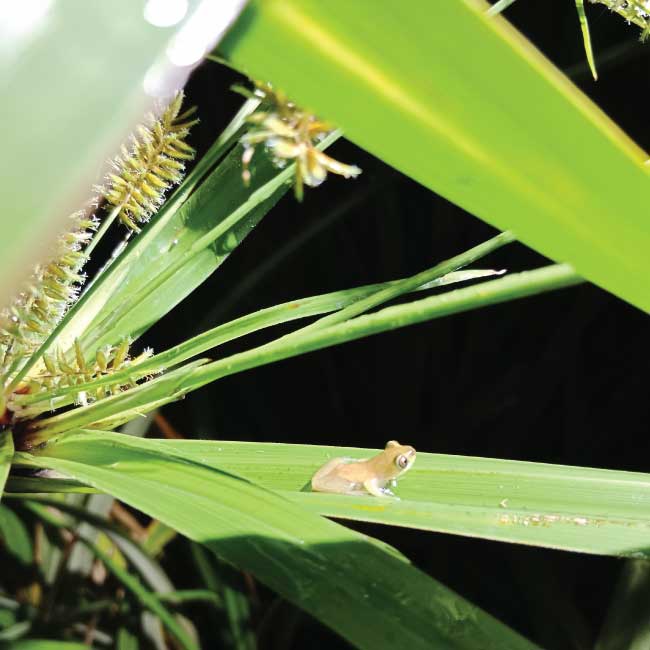
Today, the now peaceful community of Gingindlovu farms extensively in the area where generations of farming families have forged a close-knit community with a passionate appreciation for their community and environment, knowingly safeguarding future generations. One local farmer, Ian Johnson, tracked the EWT’ s Cherise Acker-Cooper to a parking lot in Nyoni, where she was working with local teams clearing invasive alien plants. Ian’ s curiosity to identify a ‘Mystery Frog’ he had recently photographed in a reedbed on his farm spurred his eager pursuit. From a picture on Ian’ s phone, the ‘Mystery Frog’ was confirmed to be the Endangered Pickersgill’ s Reed Frog, known to occur exclusively along a narrow band along the KwaZulu-Natal coastline. Ian’ s excitement of knowing that his farm was home to this KZN endemic frog led him to report the record to the local Environmental Committee. Subsequently, the chair of this committee, Mr Ashton Musgrave, invited Cherise to present at their November 2019 committee meeting so they could learn not only of Pickersgill’ s Reed Frog but the importance of amphibians and their conservation.
It was during this presentation and the resulting acknowledgement of the plight for amphibian conservation in South Africa that four local farmers (Mr Ashton Musgrave, Mr Jonathan Saville, Mr Bret Arde and Mr Jonu Louw) banded together and asked Cherise to visit their farms to determine if the Pickersgill’ s Reed Frog was present on their farms. Song meters were rotated among the farms, followed by careful listening to hours of recordings until the Pickersgill’ s Reed Frog’ s quiet but distinctive call was confirmed by the EWT’ s Threatened Amphibian Programme Manager, Dr Jeanne Tarrant.
Confirming their presence was enough for these enthusiastic farmers, who were keen to ‘do the right thing’ and protect them to ensure their continued presence. In this spirit, the farmers keenly agreed to pursue formally declaring the habitat of the Endangered Pickersgill’ s Reed Frog as a Protected Environment through the Biodiversity Stewardship Process in 2020. However, the journey of declaration, led by Cherise, was not an easy route. Despite the numerous bends along the way, including COVID-19, the social unrest in July 2021, and the April 2022 floods, KZN MEC formally declared the Umgavusa Protected Environment from the Department of Economic Development Tourism and Environmental Affairs, Honorable Mr Siboniso Armstrong Duma, on 25 May 2023. It is the first protected area we have declared to conserve the Endangered Pickersgill’ s Reed Frog and its habitat, but it won’ t be the last!
The infectious drive for amphibian conservation by these local frog conservation pioneers has awakened a love for frogs and frogging within the community, who have flocked to the Umgavusa Protected Environment to catch a glimpse of the diminutive Endangered Pickersgill’ s Reed Frog.
It is not just frogs that these farmers are enthusiastic about. They work tirelessly to rehabilitate wetlands, clear and maintain watercourses from invasive alien plants, and support student research on the abundant wildlife that inhabits the area. These initiatives are driven by their innate love for their environment, and it is through this that the heart of community-based conservation offers enormous opportunities towards securing the biodiversity and cultural heritage of South Africa for all.
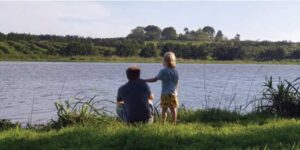
Mr Ashton Musgrave and his son enjoying their piece of the Umgavusa Protected Environment.
Thank you to our partners, Conservation Outcomes and Ezemvelo KZN Wildlife, and to Rainforest Trust and Synchronicity Earth for supporting the project.