Help protect Africa's 

EWT looking into new technologies to curb rhino poaching

EWT looking into new technologies to curb rhino poaching

EWT looking into new technologies to curb rhino poaching

By Eleanor Momberg
 

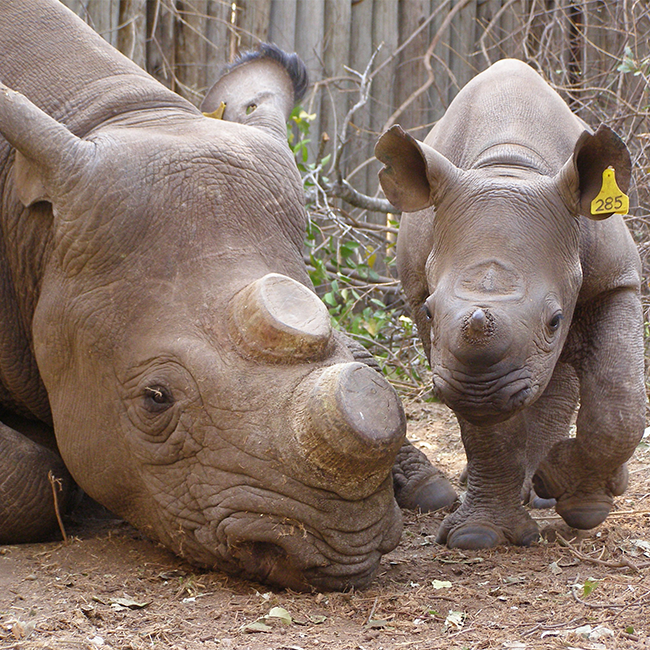
The Endangered Wildlife Trust continues to work on ways to unlock new technologies to curb the onslaught on South Africa’ s rhino population, says Louwrens Leeuwner, Senior Conservation Manager: Business and Wildlife.

Reacting to the recent poaching of rhino in Limpopo, days after the release of the 2023 rhino poaching statistics, Leeuwner renewed an appeal to the public to come forward with any information about the killing of the iconic animals, and to support the authorities in dealing with poaching incidents as this may “ultimately be the only way” to deal with the problem. 


Forestry, Fisheries and the Environment Minister Barbara Creecy announced earlier in February that 499 rhino were poached across South Africa in 2023, more that 60 percent of which were killed in KwaZulu-Natal.   This is an increase of 51 rhino poached compared to 2022.  Of the pachyderms killed, 408 were poached on state properties and 93 on privately owned land.

“The pressure again has been felt in the KwaZulu-Natal (KZN) province with Hluhluwe-iMfolozi Park facing the brunt of poaching cases losing 307 of the total national poaching loss. This is the highest poaching loss within this province. While KZN recorded 49 arrests and 13 firearms seized, multi-disciplinary teams continue to work tirelessly in an attempt to slow this relentless pressure,” said Creecy.

Kruger National Park (KNP) recorded a 37% decrease from 2022 with a total of 78 poached in 2023. No rhinos were poached in other national parks.

Creecy commended the work being done by the Hawks in several regional and transnational engagements to enhance the government’s integrated approach to combat wildlife trafficking.

She said responsible partnerships between the public and private sectors, and the financial and transporting sectors remains critical in combating international wildlife trafficking. The approach is not exclusive to South Africa but is followed within the region and transnationally. Working with the transit and end user countries in South-East Asia, especially with the People’s Republic of China, Singapore, Qatar, Malaysia and Vietnam.

Ashleigh Dore, Wildlife and Law Senior Project Manager at the EWT said wildlife crime was having huge impacts on South Africans.

“It is a personal attack on our heritage so all wildlife crimes need to be taken seriously,” she said.

Dore added that rhino poaching was a prime example of transnational organised crime, or transnational wildlife crime.  “I think people need to  understand how complex it is responding to transnational organised crime and understand the different levels and roleplayers in syndicates.   When we look at poachers we are looking at people operating at the first level. But there are other levels of wildlife crime that need consolidated efforts and we see that globally,” she said.

In the meantime, the wildlife crime monitoring group, Traffic, reports that a Singapore court has convicted South African national, Gumede Sthembiso Joel, for rhino horn smuggling and sentenced him to two years in prison.   This was the maximum terms allowed for the offence under the law at the time of his arrest in 2022 when he was nabbed smuggling 20 pieces of rhino horn from Johannesburg to Laos via Singapore.
Powerlines May Be A Cause Of Ludwig’ s Bustard Population Declines

Powerlines May Be A Cause Of Ludwig’ s Bustard Population Declines

Powerlines May Be A Cause Of Ludwig’ s Bustard Population Declines

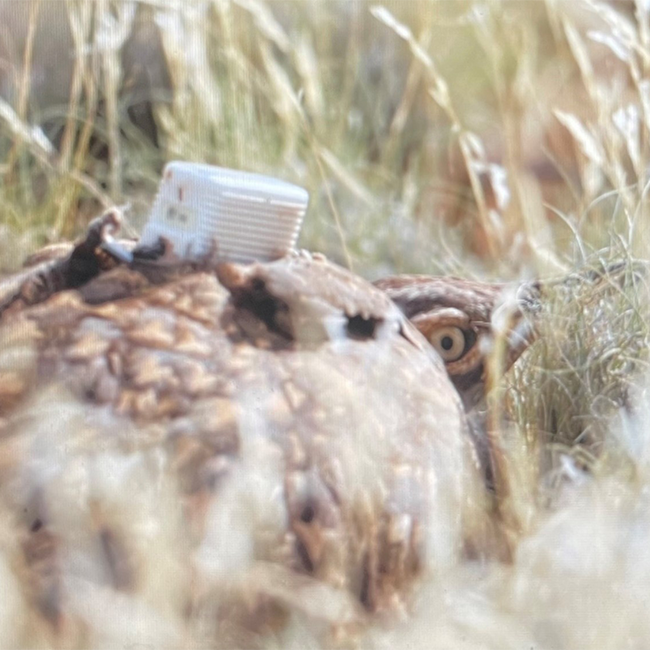
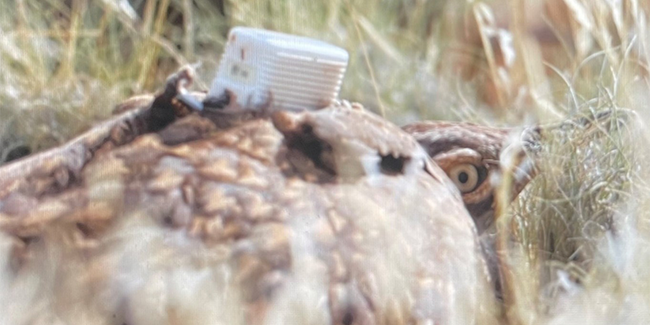
Figure 1: An incubating Ludwig’ s Bustard female, fitted with a white GPS tracking device, sits tightly on her nest.

Collisions with overhead power line cables are thought to be the main driver of apparent population declines of the Ludwig’ s Bustard (Neotis ludwigii).

Endangered Ludwig’ s Bustard populations are assumed to be decreasing, with a  more than 50% reduction expected over the next three generations.

At present, transmission line collision mortality rates of 1.12 bustards per kilometre per year are alarmingly high given the extent of these lines throughout their range. The species remains a research priority for the partnership between the Endangered Wildlife Trust and South Africa’ s power utility, Eskom.  The Partnership has found after a 10-year transmission line marking experiment that mitigation is ineffective for the Ludwig’ s Bustard and for bustards in general.

Bustards are the one group of birds for which effective mitigation measures are yet to be demonstrated in southern Africa. Conservation options are limited to the  further development and testing of new marker types and to burying overhead power line cables. A new power line marking experiment, for which four novel marker types are being tested, is showing some very positive results: no new Ludwig’ s Bustard mortalities having been recorded since the marking of experimental sections of a transmission line in the Karoo in February 2022.

A well-informed estimate of the extent to which power line collisions affect the survival of the species is needed to justify significant future investment in conservation efforts. Such an estimate requires better information about Ludwig’ s Bustard breeding biology, movement ecology and population dynamics. Some of the most basic parameters of these aspects have not yet been answered empirically, as the species is notoriously shy and difficult to study in the field. Luckily, advances in certain technologies present new tools that may enable us to fill these knowledge gaps.

To help us answer some of these questions, a Ludwig’ s Bustard GPS-tracking study, the ‘Karoo Ludwig’ s Bustard Project’ , was initiated in 2022. Extensive trapping efforts resulted in a sample of 16 adult birds being captured and fitted with GPS trackers in the past two years. Our goal has been to focus on female birds to obtain information about their breeding parameters.

Since the first birds were captured in August 2022, we have been following up on GPS signals that may indicate nesting activity. This was unsuccessful until 2 February 2023 when one of the GPS-tagged females was found incubating a single large egg. The bird was well camouflaged and we only managed to detect her at a distance of less than three metres. 

When she flushed from her nest, we were able to install a remote camera to monitor the nesting. We are now very eager to retrieve the camera to view the photographs captured in the field.

We hope to encounter more nesting attempts to collect the data required for a population viability analysis. Through this exercise we will hopefully be able to model the impact that power line collision mortalities have on the survival of the South African Ludwig’ s Bustard population —  information that will help direct the focus of our current and future research.


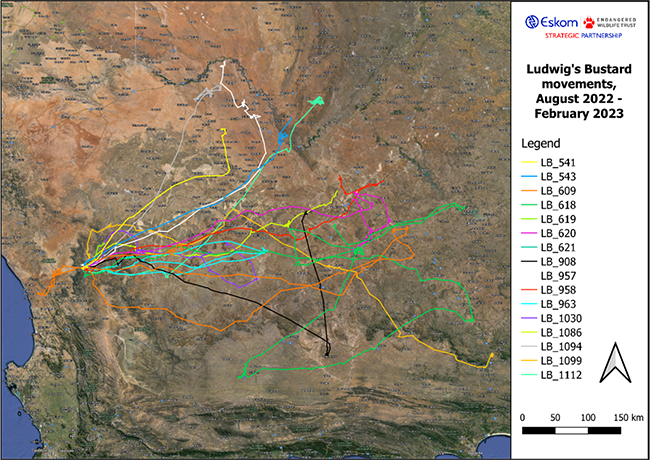
Figure 2: The movements of 16 GPS-tagged Ludwig’ s Bustards, August 2022 – February 2024.

Figure 1: An incubating Ludwig’ s Bustard female, fitted with a white GPS tracking device, sits tightly on her nest.

To help us answer some of these questions, a Ludwig’ s Bustard GPS-tracking study, the ‘Karoo Ludwig’ s Bustard Project’ , was initiated in 2022. Extensive trapping efforts resulted in a sample of 16 adult birds being captured and fitted with GPS trackers in the past two years. Our goal has been to focus on female birds to obtain information about their breeding parameters.

Since the first birds were captured in August 2022, we have been following up on GPS signals that may indicate nesting activity. This was unsuccessful until 2 February 2023 when one of the GPS-tagged females was found incubating a single large egg. The bird was well camouflaged and we only managed to detect her at a distance of less than three metres. 

When she flushed from her nest, we were able to install a remote camera to monitor the nesting. We are now very eager to retrieve the camera to view the photographs captured in the field.

We hope to encounter more nesting attempts to collect the data required for a population viability analysis. Through this exercise we will hopefully be able to model the impact that power line collision mortalities have on the survival of the South African Ludwig’ s Bustard population —  information that will help direct the focus of our current and future research.

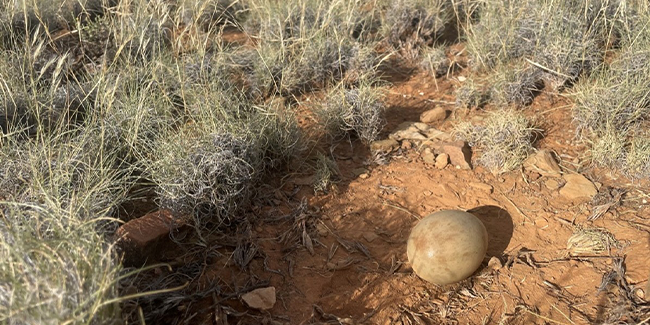
Figure 3: A single, large Ludwig’ s Bustard egg.

Science Snippets: Powerline markers prevent collisions in Blue Cranes but not Ludwig’ s Bustards

Science Snippets: Powerline markers prevent collisions in Blue Cranes but not Ludwig’ s Bustards

SCIENCE SNIPPETS:

POWERLINE MARKERS PREVENT COLLISIONS IN BLUE CRANES BUT NOT LUDWIG’ S BUSTARDS

Shaw JM, TA Reid, BK Gibbons, M Pretorius, AR Jenkins, R Visagie, MD Michael and PG Ryan. 2021. A large-scale experiment demonstrates that line marking reduces power line collision mortality for large terrestrial birds, but not bustards, in the Karoo, South Africa. Ornithological Applications. 10.1093/ornithapp/duaa067

Power line markers, such as flappers, are widely used to reduce or prevent bird collisions with power lines. However, few studies have robustly tested how effective they are in doing this. Power line collisions are an escalating problem for several threatened bird species endemic to southern Africa, as our powerline network continues to expand to meet the growing demand for electricity. Therefore, it is critical to know whether or not line marking works to adequately manage this problem and reduce the number of birds that are killed.

A recent paper published by Jessica Shaw from the FitzPatrick Institute of African Ornithology at the University of Cape Town, using EWT/ESKOM data, and coauthored by three EWT staff members, describes the results of a large scale eight-year experiment that tested the efficacy of the markers. The experiment was set up on 72 of 117 km of monitored transmission power lines in the eastern Karoo, South Africa, to assess whether line markers reduce bird collision mortality. The two bird species of particular interest were Blue Cranes (Anthropoides paradiseus) and Ludwig’ s Bustards (Neotis ludwigii). Two different marking devices commonly used in South Africa were tested: bird flappers and static bird flight diverters.


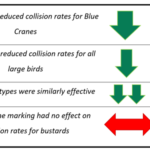
The authors found that:

The monitoring conducted by the research team at this site also confirmed high levels of mortality of a range of species of conservation concern on unmarked lines. The authors, therefore, recommend that marking be widely installed on new power lines. However, other, more effective options need to be urgently explored to reduce collision mortality of bustards. Five different bustard species were in the top 10 list of most frequently found carcasses. High collision rates of Ludwig’ s Bustards add to wider concerns about population-level effects for this range-restricted and Endangered species.