The cat’ s out of the bag – understanding South Africa’ s captive lion sector
Christina Hiller, EWT Wildlife in Trade Programme Consultant, tinah@ewt.org.za
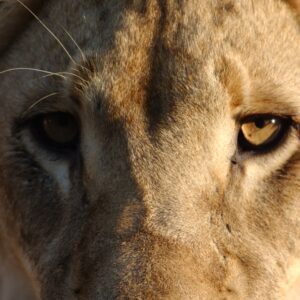
South Africa is currently the only country with an extensive captive lion sector where lions in captivity significantly outnumber wild and free-roaming animals. There is an ongoing debate around the practices of keeping lions for commercial use, and captive lion hunting, the lion part trade, and human interaction such as cub-petting have been heavily criticised. However, there was a need to establish a detailed understanding of South Africa’ s captive lion sector and evaluate its environmental and socio-economic impacts.

The Endangered Wildlife Trust initiated a study to close this information gap by developing an improved understanding of the sector and the trade of captive lion products and services. The research aimed to supply the South African government and the local CITES (Convention on International Trade in Endangered Species of Wild Fauna and Flora) authority with sound information to inform future policy decisions and measures to adequately address the sector’ s influences on environmental, economic, and social outcomes and developments.
We conducted 51 semi-structured interviews and verified and supplemented the findings through five focus-group sessions with experts from related fields and desk review activities. Interview parties consisted of 31 captive lion facilities in four provinces, i.e., the Free State, North West, Limpopo and Gauteng and 20 key players in the sector. These actors included professional hunters of captive lions, taxidermists, lion part traders, live lion traders, veterinarians, scientists, non-governmental organisations (NGOs), and provincial environmental management inspectors (EMIs). In addition, we collected quantitative data on captive lion facilities from the South African provinces where the interviews took place to further augment the research findings.The research report describes how the sector is structured and functioning amidst influencing factors such as mainstream and social media pressure, regulatory conditions, and conflicting ideas about the meaning of sustainability and sustainable use regarding an iconic species like the lion.
We found that captive lion owners’ underlying motives and deep-seated attitudes are behind the uniqueness of every captive lion facility’ s (business) model. A combination of eleven different motives underpinned the decision to establish a captive lion facility. Only four of those were income-related. It was found that facilities were seldom established primarily for financial gain, suggesting the importance of personal drivers other than income generation and profit. Furthermore, our research revealed five distinctly different sector clusters with corresponding supply chain models and typical breeding systems. Findings suggested that facilities do not specifically breed lions for their bones, so this was not considered a separate cluster. The lion bone trade rather forms part of the hunting tourism cluster.
Cluster 1: No lion revenue cluster
Cluster 2: Sanctuary cluster
Cluster 3: Guest attraction cluster
Cluster 4: Live export cluster
Cluster 5: Hunting tourism cluster (incorporating the lion part trade)
Legal trade in each cluster was organised along a distinct supply chain (except for cluster 1 without lion-related trade activities). All supply chains in the sector are separate, and research did not show an organised supply chain wherein captive lions were hunted after being used for human-lion interactions. However, a shared supply chain segment for selling lions to other South African facilities combined with a lack of traceability makes it feasible to move captive lions between clusters, especially between the guest attraction, live export, and hunting tourism clusters. It was clear that there was little transparency in the sector because of the non-existent, inefficient, or inconsistent collection, storage, and sharing of information about facilities and their trade activities.
The research data suggest that reasonable and tolerable management practices fall into five domains: financial health, legality, conservation, animal welfare, and social responsibility. Moreover, two specific areas emerged as seemingly insurmountable obstacles for managing captive lion facilities. On the one hand, the data suggest that managing a captive lion facility and animal rights are mutually exclusive. On the other hand, the interviews revealed that transformation is not happening, which is why the facilities are deemed not acceptable.
The insights of this research will support more robust decisions about the sector. We conclude that it will be critical to follow a nuanced approach to shape the sector’ s future, mindful of the five clusters. Simultaneously, immediate measures ought to be taken to prevent undesired loss or harm until a clear future scenario for the sector materialises.
The report will be released soon – keep an eye on our socials and check back here in a few days for the link.
LATEST STORIES
Science Snippets:The African Vulture Crisis- what do we know?
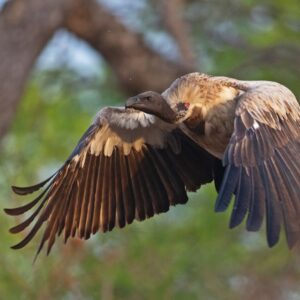
Most populations of vultures in Africa are declining rapidly, and conservationists are calling this an ‘African Vulture Crisis’ 1. There has been an increasing focus on the movements of vultures using tracking devices, but so far, there are very few continent-wide studies 2. To address this, a group of 35 researchers pooled their tracking data from 163 vultures to look at how vulture movements vary across Africa and how vultures are using protected areas in a new study published in Biological Conservation 3. The researchers found that breeding adult vultures had smaller ranges than non-breeding adults and immature vultures. Adult Rüppell’ s Vultures had range sizes larger than 75,000 km2, while Cape Vultures and White-backed Vultures had range sizes of up to 36,000 km2. But the overlap of vultures’ ranges with protected areas was low, which poses significant challenges for conserving African vultures, particularly since the main threat to vultures, the intentional poisoning of carcasses, is widespread, and one poisoning event can kill large numbers of vultures because most species of vultures are social feeders. Successful conservation of vultures relies on reducing wildlife poisoning over vast areas, both inside and outside of protected areas, by tackling the drivers of poisoning. These drivers include human-wildlife conflict, trade in vulture parts4, and elephant poaching 5. For African vultures to survive and thrive, we need better law enforcement and anti-poaching, reduced human-wildlife conflict, and prevention of the illegal trade in vulture parts. Studies using tracked vultures should help prioritise where these interventions are needed most. Full article available here: https://doi.org/10.1016/j.biocon.2022.109516
References:
1 Ogada D. et al. (2016). Another continental vulture crisis: Africa’s vultures collapsing toward extinction. Conservation Letters 9: 89-97. https://doi.org/10.1111/conl.12182
2 Thompson L.J. et al. (2020). Variation in monthly sizes of home‐ranges of Hooded Vultures Necrosyrtes monachus in western, eastern and southern Africa. Ibis 162: 1324-1338. https://doi.org/10.1111/ibi.12836
3 Kane A. et al. (2022) Understanding continent-wide variation in vulture ranging behavior to assess feasibility of Vulture Safe Zones in Africa: Challenges and possibilities. Biological Conservation 268: 109516. https://doi.org/10.1016/j.biocon.2022.109516
4 Mashele N.M. et al. (2021). Uses of vultures in traditional medicines in the Kruger to Canyons Biosphere Region, South Africa. Journal of Raptor Research 55: 328-339. https://doi.org/10.3356/JRR-20-36
5 Mateo-Tomás P. and López-Bao J.V. (2020). Poisoning poached megafauna can boost trade in African vultures. Biological Conservation 241: 108389. https://doi.org/10.1016/j.biocon.2019.108389
LATEST STORIES
RESCUE AND REHABILITATION OF A POISONED EGYPTIAN GOOSE
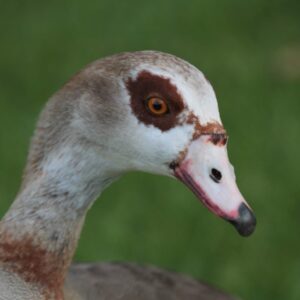
Dr Lindy Thompson (lindyt@ewt.org.za) and John Davies (EWT Birds of Prey Programme Field Officers), Rebecca Lambert and Nikita Jackson (Moholoholo Wildlife Rehabilitation Centre), and Carrie Hickman (APRN Ground Hornbill Project). In December 2020, while conducting fieldwork along the Olifants River, we found a poorly-looking Egyptian Goose showing signs that indicated it might have been poisoned. While the goose appeared to be in an otherwise good condition , with no visible injuries (broken bones or bleeding) or signs of trauma, it stumbled, fell, and rolled down the riverbank when it tried to get away from us as we approached. It was unable to fly. The African Wildlife Poisoning Database contains records of 724 Egyptian Geese that have been poisoned in Africa between 1998 and 2020. The substances used are usually organophosphates and carbamates (pesticides), and we think that most cases emanate from human-wildlife conflict due to crop damage by the geese. In this case, we suspect the goose may have been grazing in lucerne that was recently sprayed with insecticide.] We collected the unfortunate goose and drove it to Moholoholo Wildlife Rehabilitation Centre, leaving it in the capable hands of their experienced clinic team. On its arrival, the Egyptian Goose was treated with Atropine (used to treat organophosphate and carbamate poisoning) and activated charcoal (which binds to many toxins and prevents their absorption), and then it was given Ringers solution (to replace fluids and electrolytes) every two hours. After that, the goose received tubed pet food (a recovery food that is easy to digest), and then later, it was fed with pigeon pellets, crushed mealies, mealworms, flying ants, and grasshoppers. On 4 February 2021, after all this treatment and time to heal, the rehab team was happy with the bird’ s condition, and we released it close to where we found it on the Olifants River. It flew off as though nothing had happened, without a backward glance – just how we like it to be every time we return wildlife to the wild. Click here to see a video of this bird being released: https://www.instagram.com/p/CLB80t5AvGy/ After publicising this rescue on Instagram, people asked us why we bothered rescuing a bird many people view as a pest species because its numbers are increasing. Firstly, when we found the bird and realised that it had been poisoned and was suffering we decided to rescue and rehabilitate it as the possible death of this bird would have bene due to human action and not natural causes. Secondly, if we had left the poisoned goose in the bush and it had died, it may have been fed on by scavengers such as vultures and jackals, which in turn may have experienced secondary poisoning. Thirdly, the EWT’ s John Davies’ work with the annual Balule Waterbird Survey showed that Egyptian Goose numbers have increased along the Olifants River and a few other river systems in the Lowveld, mainly due to the deterioration of water quality due to human actions and large-scale losses of riparian forest, which has created open banks suitable for this species. Egyptian Geese exploit suitable conditions, and when these environmental conditions change, we expect their numbers to decline again. In 2020, in Balule Game Reserve, there were 377 Egyptian Geese along 49.8 km of river, including 47 chicks, while 84 Egyptian Geese were counted near the Phalaborwa barrage, and 71 at Three Bridges, almost half were found at the two most transformed (polluted) sections of the Olifants River. For most of the river, the average number of Egyptian Geese was just over four adults per kilometre, likely still slightly higher than normal, but not excessive. This is similar to parts of the Kruger National Park large-scale loss of riparian habitat have taken place.
 On the property where the goose was found, none of the 19 vulture nests we are monitoring was lost due to disturbance from Egyptian Geese. In fact, over the last six years of the EWT’ s vulture nest-monitoring in the Lowveld, we have found only one case where an Egyptian Goose tried to breed in a nest still used by a recently-fledged Hooded Vulture. After numerous interactions between the geese and the vultures, the Goose’ s breeding attempt failed, and there was no negative impact on the vultures. See here for more details
Thank you to Andre Botha for sharing records from the African Wildlife Poisoning Database, https://www.africanwildlifepoisoning.org/.
Please submit records of any poisoned wildlife to this database, and please contact Dr Gareth Tate at GarethT@ewt.org.za for details of Wildlife Poisoning Response Training in the Lowveld.