Our best-kept secret
Emily Taylor, EWT Communications and Marketing Manager, emilyt@ewt.org.za
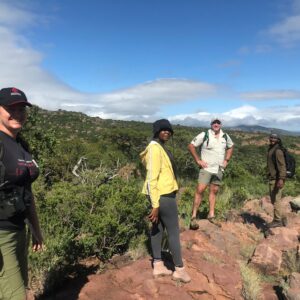
This month’ s tale from the field is a special one. It isn’ t often that Support Services staff based at Head Office get to write stories about field trips, or at least ones that would be interesting! But in February, the Endangered Wildlife Trust (EWT) Communications and Marketing team was given the opportunity to get out from behind our desks and venture into the spectacular Soutpansberg mountains. And what a trip it was.
The VhaVenda call it “Tha vhani ya muno” – the Mountain of salt. Rising like an island from the surrounding bushveld flatlands, the forgotten Soutpansberg is South Africa’ s best kept secret and one of the country’s most unique and unexplored natural areas. The name ‘Soutpansberg’ is derived from the large natural salt pan to the northwest of the range.

The Soutpansberg Mountains. Photo credit: Suzette Britz
|
The Medike Mountain Reserve boasts 58 butterfly species, 15 scorpion, 19 amphibian, 61 reptile, 59 mammal, 229 bird, and 237 tree species. The Vulnerable Leopard, the Near Threatened Brown Hyaena and Natal Red Duiker, and the Endangered Mountain Reedbuck are among these.
|
The Soutpansberg in Limpopo is South Africa’ s northernmost mountain range and forms part of the UNESCO Vhembe Biosphere Reserve. The mountainous landscape comprises an impressive variety of habitats: forest, thick thornveld, savannah, and grassland – and is home to several iconic, rare, and Endangered species, including a plethora of endemic species of both fauna and flora (which occur nowhere else on Earth)! It is also a critical groundwater source. The EWT identified the urgent need to conserve the area, and in 2015, on behalf of the Roberts family in Australia, the EWT purchased the 1,398 ha Medike Mountain Reserve in the Soutpansberg. We subsequently received funding from the Rainforest Trust to purchase a neighbouring property, almost doubling the reserve’s size.
When the EWT began working on the mountain, we embarked on several ambitious projects to restore the integrity of the mountain by clearing large patches of alien and invasive plants that had encroached on native vegetation and affected the function of the water sources on the mountain. Check out our Forgotten Mountain video to see the benefits these projects have had for the landowners and local communities. The EWT also began to engage with neighbouring landowners about interlinking their properties and creating an opportunity for the community to unite and optimise the mountain’ s value as an ecotourism destination. Many landowners welcomed the opportunity for collaboration, and 17 have already decided to join the EWT in legally declaring their properties as one large protected area spanning 22,000 ha of the Western Soutpansberg, called the Western Soutpansberg Nature Reserve (WSNR). The collective vision for the WSNR is to create and protect a connected landscape under formal conservation, covering priority species, habitats, hydrologically important areas, and cultural heritage, for the benefit of biodiversity, ecosystems, and people in perpetuity.
The Old Salt Trail is one of the first projects initiated to share the mountain and its unique and diverse landscapes and cultural heritage with others, generate income for local people, and secure a sustainable future for the WSNR and Luvhondo Nature Reserves. The long-term vision is for this project to catalyse a successful ecotourism initiative, bringing visitors to the mountain in an ecologically sensitive way. Hikers will be able to experience the exceptional beauty and biodiversity on offer while gaining knowledge from local trail guides and supporting local socio-economic development within a protected environment.

The EWT’s Communications and Marketing Team. From left to right, Kedibone Chauchau, Suzette Britz, and Emily Taylor
This particular field trip enabled the Communications and Marketing team to visit the EWT’ s Medike Mountain Reserve and neighbouring properties to experience first-hand the unique mountain landscape and meet with the local landowners and communities to better understand how to market the area, and the Old Salt Trail in particular, as a unique ecotourism destination.
The Soutpansberg, and Medike in particular, is known for its astonishing diversity of landscapes and habitats , and as the geology changes, so too do the colours of the soil, the topography, the shape, size, and density of the vegetation, and the animals that occupy each habitat. And a few hundred metres later, they all change again. One minute we marvelled at the less dense thorn-veld with its brown soils, patches of golden grass, and fine-leafed thorn trees; the next, at the dense green bushveld packed with broad-leafed Bushwillows, Gardenias, Silver Cluster Leafs, and the remarkable Rock Figs that wrap themselves around and push through the mammoth rocks.
I was a field officer once upon a time, and, perhaps out of self-preservation, I often forget the utter bliss that being in the bush brings. I almost forgot that I was there for work and found so much joy just driving along, chatting to the landowners and the EWT’ s Soutpansberg Rangers, and seeing first-hand what they have all achieved in the last few years. More than that, though, it was touching and inspiring to witness the connection that those living and working there have with “the mountain”, as they affectionately call it. I completely and instantly understood why they have this deep and eternal love for this land – it is undeniably one of the most enchanting places on Earth. But don’ t take my word for it – you need to see it to fully comprehend its magic – contact Catherine Vise for more information on how to find the forgotten mountain.
Don’t miss out!
This spectacular range of Mountains will host the second running of the Soutpansberg Mountain Marathon. With 42 km, 21 km,10 km, and 5km courses on offer, all start and finish and Schoemansdal (30 mins from Louis Trichardt) at the base of the mountain range. The longer three courses climb up the mountain and can be considered proper challenges. To register, click here.
LATEST STORIES
Protecting our rich culture and biodiversity for future generations
Jenny Botha, EWT People in Conservation Programme Manager, jennyb@ewt.org.za
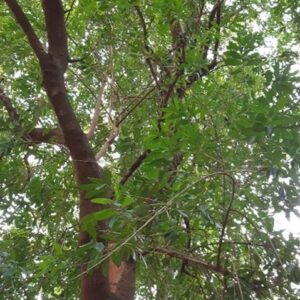
Although the leaves of the Pepper-bark Tree (Warburgia salutaris) are reportedly used in curries and to flavour other foods in Kenya, the species is more commonly known for its healing properties throughout its range in East and southern Africa. This attractive evergreen tree grows in diverse habitats, including forest, kloofs, thickets, and open woodlands. Historically, it was distributed from north-eastern KwaZulu-Natal and Swaziland to Mpumalanga, Limpopo, and Zimbabwe, extending into Mozambique and Malawi. Today though, the Pepper-bark is classified as Endangered on the IUCN’ s Red List of Threatened Species, and many of its habitats are degraded and fragmented through human activities and the impacts of alien plants.
In 2020, the Endangered Wildlife Trust (EWT), with the support of the Fondation Franklinia, initiated a strategic conservation project in Limpopo to safeguard the Pepper-bark for future generations. To achieve this, we need to protect and improve the management of existing Pepper-bark Tree habitats and ensure that people who have historically depended on this tree for medicine, and continue to do so, have legal access to it.
To secure habitat for the Pepper-bark and other plant and animal species of high conservation value, the EWT has been collaborating with the Limpopo Department of Development and Tourism (LEDET) and private landowners in Limpopo to increase formal protection of these sites. It is also important to manage these habitats effectively. Over the past two years, we cleared alien vegetation from 25 hectares of Pepper-bark habitat.
Despite the Covid-19 pandemic, we were able to meet with over 100 traditional healers, community leaders, and other community members from 25 villages or towns to discuss mutual challenges arising through the loss of the Pepper-bark through overharvesting. Traditional healers, leaders, and community members welcomed donations of Pepper-bark saplings that will enable them to harvest directly from their gardens in future. Thanks to a year of high rainfall, the trees are growing well and will provide the traditional healers with a vital source of bark, roots, and root-bark in upcoming years. The traditional healers can also use the tree’s leaves now that scientists have verified that they contain the same phytochemical constituents as the bark and roots. This has the potential to substantially reduce the impacts of harvesting from the wild, as it is far easier to harvest sustainably if the leaves can be used instead of bark or roots.
We would like to thank SAPPI, the Agricultural Resource Council, and SANParks for the donation of 2,000 trees to this project and look forward to continuing this exciting journey with the many traditional healers, communities, and other conservation partners who are participating in this initiative.
LATEST STORIES
STRATEGIC CONSERVATION OF THE PEPPER-BARK TREE IN THE SOUTPANSBERG
Jenny Botha, Programme Manager, EWT People in Conservation Programme, jennyb@ewt.org.za
Traditional medicine has evolved over thousands of years, resulting in the development of an extensive herbal pharmacopoeia. Some of our earliest records of ancient herbal remedies were inscribed on clay tablets in Mesopotamia dating back to about 2,600 BC (Gurib-Fakim, 2006). Traditional medicine is still widely used across the world today. African Traditional Medicine Day was celebrated on 31 August 2020. The World Health Organisation describes traditional medicine as: “the sum total of knowledge, skill and practices based on the theories, beliefs ad experiences indigenous to different cultures, whether explicable or not, that are used to maintain health, as well as to prevent, diagnose, improve or treat physical and mental illness”. Over the past 2-3 decades, there have been sustained efforts through the World Health Organisation and others to integrate traditional medicine into international and national health care systems. This health care modality is now officially recognised and regulated through legislation in South Africa, and a directorate of Traditional Medicine has been established by the National Dept of Health.
In South Africa, over 2,060 plant species have been recorded as being used in traditional medicine – approximately 10% of the total number of species that occur here (Williams V.L., Victor J.E. and Crouch N.R. 2013). Many species are facing increasing pressures in the wild through high levels of use as well as other human pressures, including loss of habitat through urbanization, agriculture, industrial expansion, and other activities. Amongst these species is the Pepper-bark tree, which is now classified as Endangered on the Red Data List.
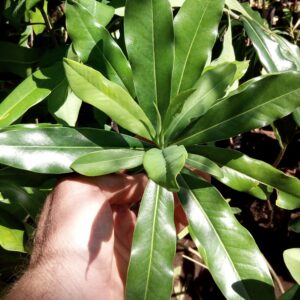
The Pepper-bark tree is an evergreen tree that typically grows to about 5-10 m in height. It occurs in temperate climates in forests and woodlands in mountains and hills in eastern and southern Africa, including parts of KwaZulu Natal, Mpumalanga and Limpopo Provinces, Mozambique, Swaziland and Malawi. Its English and Afrikaans names refer to the peppery taste of the bark and leaves. ‘Salutaris’ means ‘healthful’ , alluding to the reason it is so widely sought after not only for traditional medicine but also as an alternative remedy in tablet form on the shelves of pharmacies. The scientific name of Pepper-bark tree is Warburgia salutaris. It is known as Mulanga or Manakha in Venda; isiBaha/isiBhaha in Zulu, Peperbasboom or Peperblaarboom in Afrikaans, and Molaka in South Sotho. The Endangered Wildlife Trust recently embarked on an exciting project to conserve this significant tree in the Soutpansberg, Limpopo Province. This multi-pronged project includes the monitoring of existing populations and improving the natural habitat through the removal of alien and invasive plant species that encroach on its habitat. Over 10,000 invasive Sicklebush (Dichrostachys cinerea) trees have been removed since April/May 2020. The wood was made available to local communities for firewood.
We are also assessing the extent of trade in local markets and will be working with traditional healers to encourage the cultivation of this important species in homesteads. Scientists have confirmed that the same active phytochemicals occur in the bark and the leaves of the Pepper-bark tree. This means that the leaves can be substituted for the bark in traditional medicine. Harvesting the leaves of trees more sustainable than removing bark, particularly if the tree is cultivated in homesteads. The leaves are also starting to appear in some markets, which is encouraging from a conservation perspective.
We would like to thank the Fondation Franklinia for their support of this project, which not only contributes to the strategic conservation of the Endangered Pepper-bark tree, but also ensures that people who depend on traditional medicine will continue to access this important species in the future.
References
Gurib-Fakim A. 2006. Medicinal plants: traditions of yesterday and drugs of tomorrow. Molecular Aspects of Medicine: 27: 1-93
Williams V.L., Victor J.E. and Crouch N.R. 2013. Red Listed medicinal plants of South Africa: status, trends and assessment challenges South African Journal of Botany 86: 23-25.


