Hot on the heels of strong women working in conservation
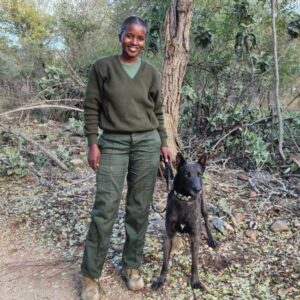
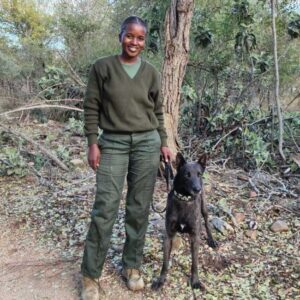
Precious Malapane, Conservation K9 handler and anti-poaching ranger
The South African government’ s theme in celebration of Women’ s Day/month 2022 is “Women’ s Socio-Economic Rights and Empowerment: Building Back Better for Women’ s Improved Resilience”. The theme focused on strategically advancing women’ s socio-economic empowerment agenda towards achieving gender equality by 2030.
Precious and EWT Conservation K9 Ruger
The resilience of South African women has been recognised throughout our country’ s history but assigned social and professional roles have often hindered women from raising their social and economic status. I am one of many women who have not let anything stand in their way. My name is Precious and I am a Conservation K9 Handler working with Ruger and Bekha, the Endangered Wildlife Trust’ s Conservation K9s and strong females themselves. I am the only woman in a team of 12 rangers. I am also the only Dog Handler in the team. You might be wondering how I ended up here. This is my tale.
I grew up in a remote village off the north-eastern border of the Kruger National Park border. I was a very quiet and rather shy child. I came out of my shell when I joined a girl’ s traditional dancing group at age ten, where I learned to be confident and comfortable in my skin. Attending practice every day and dancing in front of people helped me build my confidence.
I sadly lost my mother when I was just two years shy of matriculating. She was our only parent, and when we lost her, my three siblings and I started doing odd jobs around the village to survive. However, we did not let our situation get in the way of our education. I matriculated in 2014 and enrolled in the Southern African Wildlife College, where I trained as a field ranger. I was lucky enough to get an internship in the college’ s K9 unit. I started working with Conservation K9s under the guidance of renowned Dog Master – Johan van Straaten, from whom I learned much. I know everything I know today because of his teachings.
My love for dogs began at a very young age when my family got one as a pet. I knew then how great dogs are. I didn’ t know that they could do so much!
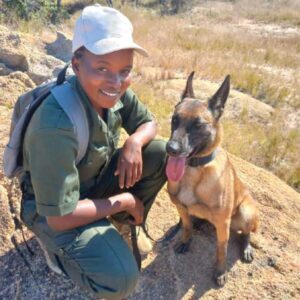
Precious with EWT Conservation K9 Bekah
I love working with dogs because they are always eager to go out and work. With them, there is no politics, social roles, or discrimination. I am just their beloved handler and trainer. I also love how they are not biased or easily swayed by external forces. Their job is to help their handler find what they are looking for, and they will not stop until they find it. And when they do, they will not leave it until the handler arrives. They have taught me to be honest and dedicated in my work.
Although I am mostly surrounded by men in my line of work, I have been fortunate to know and learn from strong women who have shaped my life and career. They have empowered me and improved my resilience both socially and economically. These are some of them:
My mother: That woman is my hero, my pillar and strength, even now in her absence. She played a huge role and did a great job as a single parent. I really love how she raised me and my siblings. I am where I am today because of her.
Theresa Sowry: The CEO of the Southern African Wildlife College. I love how involved she is on every level. You can tell she is passionate about conservation from her interaction with all students and the team at the college.
Shadi Henrico: Shadi is the Conservation Canine Project Coordinator at the Endangered Wildlife Trust. She assisted me in qualifying as a Dog Handler and trained Ruger – the dog I work with at the reserve. She also shared with me this great life I get to live now because of her willingness to help me whenever I reach out to her.
Anitjie Mkhansi: She is also a Conservation Canine handler at another private reserve. I always go to her when I face work-related challenges, and she is always keen to sit down with me and come up with solutions. Navigating work and inspiring each other as young women of the same age and in the same field makes everything easier.
Having come across all these amazing women, and in celebration of women’ s month in South Africa, I encourage other women and young girls to pursue careers in conservation and dog handling because why not?
I personally believe that, as women, we can do anything we put our minds to. We are all human, after all.
With all that being said, I hope we find ways to continue liberating women from cycles of poverty and assigned social roles and giving them the resources to improve their social and economic opportunities.
We will play out of this with my favourite song – Master KG’ s I am a superstar.
Keep your eyes on the Endangered Wildlife Trust’ s Wild Diaries for my and Ruger’ s tracking adventures.
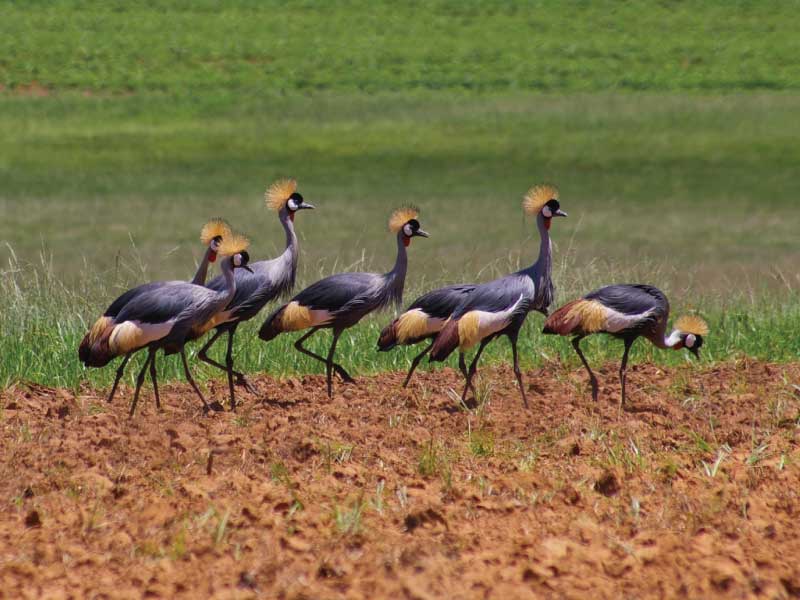
Climate change has manifested in erratic weather patterns and significantly prolonged drought seasons in Southcentral Uganda. The drought hit the Lwengo region in one of Uganda’ s cattle corridors particularly hard. Farmers in Lwengo have suffered serious losses over the dry season; their crops dried up and withered over the harvest period. Maise, beans, peas, and other cash crops have also done poorly during the dry planting season. The water sources in most villages and part of the Kiyanja-Kaku wetland (a precious wetland conserved by the ICF/EWT projects) have dried up, and animals and households no longer have enough water to drink and use for domestic purposes. The dry season also affected irrigation projects, rendering irrigation impossible at the household level and reduced food security and the general well-being of the communities. The Kiyanja-Kaku wetland and its catchment also provide breeding and flocking habitat for the Endangered Grey Crowned Crane – one of Uganda’ s iconic wetland species.
Unfortunately, cranes are eating more of the crops due to shortages in natural food sources, feeding on germinating seedlings and mature crops, eating all the corn, and leaving empty combs. The most affected crops in the area included maize, beans, and ground nuts. On top of the drought and deflating market prices, this has caused significant losses to the farmers, and they have resorted to poisoning cranes – 118 poisoned to date this season.
What are we doing to help communities weather the storm?
The ICF/EWT’ s crane and wetlands conservation project supports some communities in establishing crane deterrent measures in various homesteads to address food insecurity caused by cranes and climate change. The measures range from the erection of human-mimicking scarecrows to the use of reflective materials, usually from non-recyclable waste products, around the crops. The measures have proven successful as there have since been no crane sightings in these areas, and crop damage has reduced to some extent.
Next steps
Since the project has established an integrated approach of deterrent measures, effectively preventing cranes from damaging crops, we need to upscale the deterrent measures and extend the approach to all affected villages. This way, we will keep crops and cranes safe. The project continues to engage farmers in establishing interventions that can also address the impacts of climate change on food security.
The world’s road networks are highly disturbed and fragmented areas that negatively affect many animals. Wildlife-vehicle collisions are one of the more visible effects of road, estimated to be the second-largest cause of human-related deaths in animals. One of the by-products of the Covid-19 pandemic was much lower levels of human activity related to lockdowns enforced in many countries to reduce the spread of the disease. This decrease in human activity has been named the “anthropause”, which was at its peak in April 2020. With the anthropause came a large decrease in vehicle traffic. The impact of the anthropause, particularly of decreased traffic, on species, was examined in a recent publication co-authored by EWT scientists*. With worldwide travel restrictions in full effect from April 2020, vehicle use dropped by over 50% in many countries. During this same period, scientists found a significant drop in wildlife-vehicle collisions, with as much as a 48% reduction recorded in some countries. The absence of traffic also likely brought about behavioural changes in wildlife and could have had various other ecological effects not yet documented. Some possible changes include animals being able to move more freely between fragmented landscape patches, increases in survival and population sizes, and less spreading of invasive species along roads (see figure below, from Perkins et al. 2022, which illustrates some of the possible impacts of a reduction in traffic).
Traffic noise was another aspect reviewed in this study. Researchers found that animals were less fearful with reduced traffic noise over the lockdown period. Furthermore, they noted that there were localised changes in animal distributions. For example, large animals were spotted moving through urban areas. The lowered volume of traffic noise also resulted in some birds changing their tune. For example, urban birds have been observed to alter the frequency of their song as they no longer had to compete with traffic noise. While lockdowns provided temporary relief, allowing wildlife to thrive again, human activity is recovering to pre-pandemic levels. This brief pause has allowed us to gain new insights into the impact of traffic on wildlife. The return of traffic highlights the need to have proper surveillance measures in place to help document, explain, and reduce the effects of roads on wildlife and critically evaluate the impacts of this widespread human activity on wildlife. *Perkins, S. E., Shilling, F., & Collinson, W. (2022). Anthropause opportunities: Experimental perturbation of road traffic and the potential effects on wildlife. Frontiers in Ecology and Evolution, 192.**The EWT has a road watch app for you to record any roadkill sightings, helping us to identify hotspot areas and the species most at risk. Search for Road Watch on the Google Play Store to download the app!
Thabo Hlatshwayo, Wildlife and Transport Programme Intern, thaboh@ewt.org.za
The N3 Toll Route (N3) passes through landscapes of grasslands, freshwater ecosystems and wetlands, which attract animals, bringing them close to the road. Land used for cultivating maise and other grain crops closer to the highway also increases bird and small mammal activity in the area, resulting in increased wildlife-vehicle collisions (i.e., roadkill). The N3 Toll Route comprises road features such as road signage, guideposts, safety barriers, boundary fence, and raised road markers. These objects are installed on the road to control traffic and improve road safety. However, numerous owl species use these road structures during the evenings to perch on while hunting for prey, such as rodents and squirrels attracted to crops and food deposited by passing vehicles. Unfortunately, this increases the risk to the birds of being struck by vehicles.
Through the strategic partnership work undertaken by the EWT and the N3TC since 2014, robust data on the incidences of roadkill have been recorded. The existing EWT-N3TC database shows that owls are the most common bird killed by vehicles on specific sections of the highway. To respond to this, the EWT recommended the installation of owl perches within the hotspot areas but away from the road, creating safe perching spots from which owls and other birds of prey can hunt safely.
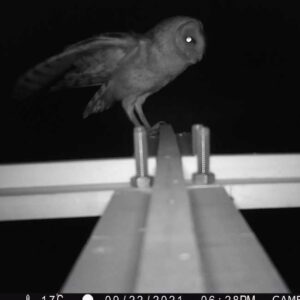
We installed camera traps on the EWT-N3TC owl perch to see if birds would use these perches. Our camera traps revealed increasing birds of prey activity on the perch. Barn Owls, Black-shouldered Kites, and some falcon species have used it as their feeding restaurant. Interestingly, other wading birds like the Black-Headed Heron and passerine bird species (Stonechats and Pied Starling) have also been observed enjoying a rest on the owl perch.
Camera traps such as this are invaluable for increasing our understanding of animals’ interactions with roads – particularly what attracts them to roads. In this case, it is clear that structures similar to these perches erected on roadsides are at least in some part used for resting and feeding purposes and that by providing alternatives, we might be able to reduce the time birds spend on or near roads. We expect to learn more from these camera traps and hope you’ ll stay tuned to catch rare glimpses into the daily lives of our raptors.