Help protect Africa's 

Decoding alphabet soup reveals a historical achievement in global conservation

Decoding alphabet soup reveals a historical achievement in global conservation

Decoding alphabet soup reveals a historical achievement in global conservation

 
Dr Gabi Teren, EWT National Biodiversity and Business Network, Programme Manager


On December 19, The UN CBD COP-15 adopted the Post-2020 GBF with the key 30×30 target for NBSAPs.

Scientists love talking in acronyms or alphabet soup. Let me unpack this for you by describing a recent momentous conservation achievement. The UN CBD – The United Nations Convention on Biological Diversity (CBD), ratified by 196 nations in 1992, encourages actions that will lead to a sustainable future, including:
“the conservation of biological diversity, the sustainable use of its components and the fair and equitable sharing of the benefits arising out of the utilisation of genetic resources”

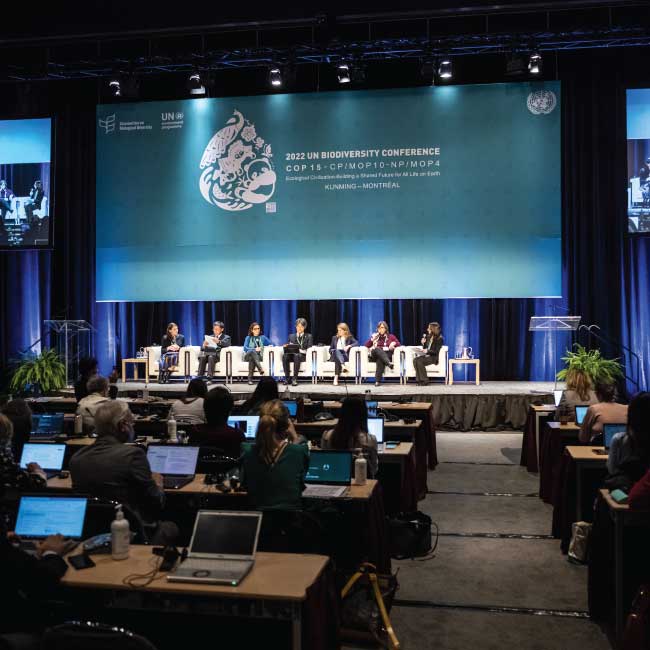
COP15 Business and Biodiversity Forum plenary session

Every few years, the 196 countries party to the convention (including South Africa, but notably not the USA) meet at a Conference of the Parties (COP). The COP27, the 27th meeting of the UN Framework Convention on Climate Change (UNFCCC) parties, was held in November in Sharm el-Shaikh. COP15 was subsequently held in Montreal, Canada. You may be thinking someone really can’t do arithmetic, but there are different conventions that focus on different aspects of environmental action. The former COP (27) was the annual UN Climate Change Conference that advances global climate talks, mobilises action, and provides opportunities to look at the impacts of climate change and potential innovation and solutions in Africa.

COP15, on the other hand, united parties to the Convention on Biological Diversity to review and sign into the Post-2020 Kunming-Montreal Global Biodiversity Framework (GBF). This was essentially equivalent to the famed Paris Agreement signed by the UNFCCC, which is THE international agreement to try and keep the rise in mean global temperature below 1.5 °C to help countries adapt to the disastrous effects of climate change.

The GBF is trying to help the world adapt to the disastrous effects of extinction and biodiversity loss.

“ An average of around 25 per cent of species in assessed animal and plant groups are threatened, suggesting that around 1 million species already face extinction, many within decades unless action is taken to reduce the intensity of drivers of biodiversity loss. Without such action, there will be a further acceleration in the global rate of species extinction, which is already at least tens to hundreds of times higher than it has averaged over the past 10 million years.

The biosphere, upon which humanity as a whole depends, is being altered to an unparalleled degree across all spatial scales. Biodiversity – the diversity within species, between species and of ecosystems – is declining faster than at any time in human history.

Nature can be conserved, restored and used sustainably while other global societal goals are simultaneously met through urgent and concerted efforts fostering transformative change.” GBF page 4.

The framework sets out four global goals and 23 targets. Target 3 is particularly important. Known as the 30×30 target, it sets out to ensure that by 2030, 30% of all land and water on Earth are effectively conserved and managed. To put that in perspective, despite being the third most biodiverse country on the planet, only 9.2% of South Africa’ s mainland is formally protected[1] (although that doesn’ t include other effective conservation areas). It is also an important target as it is quantified with a timeline. The quantification of some of the global goals got watered down in the final version to words like ‘significant’ , which are vague and don’ t promote action.

So how do countries now meet these targets? Or show progress towards meeting them? National Biodiversity Strategies and Action Plans (NBSAP) are the principal instruments of implementing the CBD at a national level and provide for integrating conservation and sustainable use into national decision-making policy. Of the 196 parties to the convention, 185 have developed NBSAPs. You can access all of them, including South Africa’ s, at https://www.cbd.int/nbsap/. So now South Africa and all the other parties must immediately begin to revise their existing NBSAPs to implement the GBF and show progress at COP16, to be held in the latter half of 2024. While this doesn’ t give us much time, the EWT is working hard to contribute to the process so that we can measurably address biodiversity loss on the ground.
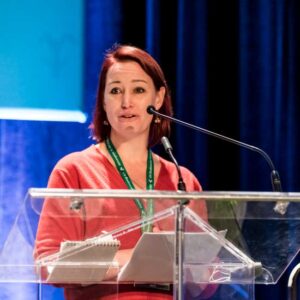
Dr Gabi Teren, the EWT’s National Biodiversity and Business Network Manager

EWT programmes like the National Biodiversity and Business Network are already working to accelerate meaningful dialogues around the business-centred targets, which aim to address the private sector’ s role in destroying nature and to equip people to make responsible and sustainable choices. We had a large presence in Montreal, where I, as the Manager of the NBBN, was the MC of the B&B… sorry, the Master of Ceremonies of the official UN Business and Biodiversity Forum. It was an incredible privilege to give the opening speech to hundreds of business leaders, policymakers, and conservationists and introduce renowned global thinkers like the economist Jeffrey Sacchs and Hank Paulson, the ex-US Secretary of the Treasury, and high-profile CEOs and ministers. I spoke about Ubuntu and how the world needs to come together more than ever in the spirit of ‘I am because we are’ . Covid taught us that in a crisis, we can mobilise entire nations overnight and disrupt entire value chains within days to go from making gin to hand sanitiser, and in the face of our planetary crisis, the biggest disaster humanity faces, we need to do more. You can view my impassioned speech and those of all the keynote speakers here (really worth a listen!).

The EWT also partnered with DFFE (Department of Forestry Fisheries and Environment) at an official side event, which we were lucky to get as hundreds of applications could not be accommodated. Supported by UNDP (UN Development Programme), BirdLife International, and the South African National Biodiversity Institute (SANBI). At this event, we spoke about the importance of collaborations between private-public-NGO bodies and how South Africa has some incredible success stories from such collaborations, such as the National EIA Screening Tool developed by SANBI, the EWT, – the world’ s first biodiversity accounting framework for businesses to measure and disclose their footprints, which was proudly developed by the EWT with funding from Eskom. The audience’s reactions showed how these collaboration demonstrations could inspire action.

In a Post-2020 world, we need to work together to live more harmoniously with nature. Watch this space as we build that action to conserve our world with your help. In follow-up articles, I will unpack some key targets and how we plan to achieve them. Follow our socials here for more.

[1] http://www.statssa.gov.za/publications/D04012/D040122020.pdf

Alarms are ringing – is the COVID-19 pandemic a wakeup call for businesses?

Alarms are ringing – is the COVID-19 pandemic a wakeup call for businesses?


ALARMS ARE RINGING – IS THE COVID-19 PANDEMIC A WAKEUP CALL FOR BUSINESSES?

Megan Murison, Project Officer, EWT National Biodiversity and Business Network, Angela Cherrington consultant, and Dr Joel Houdet, consultant
meganm@ewt.org.za
“Nature is sending us a message with the coronavirus pandemic and the ongoing climate crisis”.

The United Nations Environment Chief, Inger Anderson (2020)

Disease outbreaks, biodiversity loss and climate change

According to the World Economic Forum (2020), the frequency of disease outbreaks has been increasing steadily. There were 12,012 recorded outbreaks between 1980 and 2013, comprising 44 million individual cases all over the world. While these outbreaks are linked to increasing global travel, trade, connectivity, and high-density living, and although our understanding of how functional ecosystems protect us from diseases is still limited, there also appear to be strong linkages between disease outbreaks, climate change, and biodiversity loss.

Human activities have significantly altered three-quarters of the land and two-thirds of the ocean, changing the planet to such an extent as to birth a new era: The Anthropocene”. Changes in land use that result in habitat destruction for biodiversity (e.g. deforestation and agriculture) bring wildlife, domestic animals, and humans into closer contact, facilitating the spread of zoonotic diseases, including new strains of bacteria and viruses. Uncontrolled illegal and legal trade in live wild-caught animals breeds even more dangerous grounds for human-wildlife contact and the transmission of diseases. Many recent outbreaks have originated in markets selling a combination of live and dead, wild and domestic mammals, birds, and reptiles.

Climate change has also altered and accelerated the transmission patterns of infectious diseases such as Zika, malaria, and Dengue fever, and in some cases resulted in the displacement of large groups of people to new locations, often under poor conditions. Groups under these conditions are also more vulnerable to additional ailments such as measles, malaria, diarrheal diseases, and acute respiratory infections.

Business unusual: Time for pro-active biodiversity mainstreaming

Biodiversity is under severe threat globally, including in South Africa, and the private sector is one of the primary drivers behind the degradation of habitats and the loss of biodiversity. The Intergovernmental Science-Policy Platform on Biodiversity and Ecosystem Services (IPBES), an independent body established in 2012, made up of over 130 member states around the world, recently confirmed that around one million animal and plant species are now threatened with extinction, more than ever before in human history.

Business both relies and impacts on biodiversity. Biodiversity produces a wide variety of services on which businesses depend. Examples include the supply of raw material, crop pollination, genetic resources, water filtration, flood attenuation, erosion control, and many others. As such, business is critically dependent on ecosystem services to produce the goods and services it sells. Companies would not be able to operate without biodiversity.

In the context of COVID-19, countries and the private sector must not use the pandemic as an excuse to weaken environmental protection and enforcement, as argued by a UN independent human rights expert. The reverse should be the case. Governments and businesses must tackle the Covid-19, biodiversity, and climate crises with a holistic strategy – transforming the global economy to be just, inclusive, sustainable, and resilient.

If this is to be achieved, the mainstreaming of biodiversity should be done in all economic sectors: i.e. integrating biodiversity into business strategies and activities, notably in supply chains where land use changes, resource consumption and wildlife trade take place.  Biodiversity mainstreaming needs to benefit both humans and nature, and businesses need to be able to assess their impacts on biodiversity and manage them effectively. This builds on a growing movement toward nature-based solutions, which harness the power of biodiversity and ecosystem services to mitigate effects of the climate crisis, unsustainable food systems, water pollution, and other socio-economic and environmental challenges. The EWT’ s National Biodiversity & Business Network’ s Biodiversity Disclosure Project (BDP) aims to assist companies to assess both their opportunities and their risks related to biodiversity. The BDP offers businesses an easy method to account for their biodiversity impacts, using a standardized accounting protocol. Should you or your business be interested in better understanding your impacts on biodiversity, please contact the NBBN team here.

Risk, reputation and reporting: Does business have a biodiversity blind spot?

Risk, reputation and reporting: Does business have a biodiversity blind spot?

RISK, REPUTATION AND REPORTING: DOES BUSINESS HAVE A BIODIVERSITY BLIND SPOT?

Megan Murison, Programme Officer, EWT National Biodiversity and Business Network

MeganM@ewt.org.za

Often the link between biodiversity and business can be difficult to identify. On 18 February 2020, the EWT’ s National Biodiversity and Business Network (NBBN) hosted their annual Indaba under the theme of risk and reputation. The biodiversity economy of South Africa encompasses business and economic activities that either directly depend on biodiversity for their core business or that contribute to the conservation of biodiversity through their activities. Therefore, the aim of the Indaba was to provide a knowledge sharing platform to explore biodiversity relating to:

  • risk management and oversight
  • reputation management
  • increasing stakeholder activism
  • sustainable financing disclosure and reporting

The keynote speaker was Chief Directorate: Biodiversity Specialist Monitoring and Services, Wadzi Mandivenyi, who highlighted the desperate need for business to become aware of the risks as well as the benefits of biodiversity to their activities. Notable presentations included those by the JSE Limited’ s Shameela Soobramoney, Reputation Matter’ s Regine le Roux, and Tracey Davies of Just Share. The Indaba was well attended, with over 60 participants representing a wide variety of business sectors. The NBBN, as well as its partners, recognise the importance of biodiversity to business and aims to build the capacity of business to act as a positive force for the conservation of biodiversity in South Africa.