Fighting landslides in Rukiga
Phionah Orishaba, EWT’ s African Crane Conservation Programme/International Crane Foundation Partnership, Field Officer – Southwestern Uganda, PhionaO@ewt.org.za
April 2022
Kigezi region in southwestern Uganda has always experienced heavy rains in March-May and September–November, which are also the crop growing seasons. Human activities on the steep hillslopes in Rukiga, including bush burning, deforestation, and overgrazing, have left the soil bare and eroded. With nothing holding the soil there, runoff from the steep slopes after heavy rains has increased drastically, causing landslides that destroy people’ s property and crops below. The runoff removes soil and sediment in wetlands, affecting the local populations of Grey Crowned Cranes, such as in the Rushebeya-Kanyabaha wetland. Soil erosion control in Uganda is a critical issue that needs addressing for communities to thrive.
While an important economic activity in the Rukiga District, excessive eucalyptus planting on the hillslopes has become a great environmental challenge. Eucalyptus trees don’ t allow the growth of short grass under their canopies, and rainwater runs quickly down the hillslopes and into the lowlands, where it causes havoc for the communities. Under pressure from an ever-increasing population, the fragmented land of Rukiga has continued to be divided into smaller plots to cater to the many children in each family. Households in the Rukiga district have an average number of six children each, and parents struggle to provide for the basic needs of their families.
Soil and water conservation initiatives have been proposed to remedy the issue of runoff that causes soil erosion in Rukiga district. One such project, funded by The Darwin Initiative, is being implemented by the International Crane Foundation/Endangered Wildlife Trust Partnership, Margaret Pyke Trust, London School of Hygiene and Tropical Medicine, and Rugarama Hospital in Rukiga district. The project has established two Napier grass demonstration gardens in

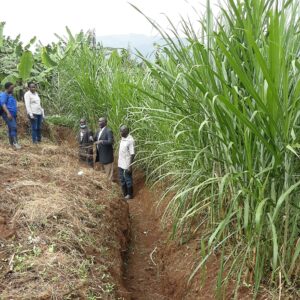
A Napier grass garden in Rukiga
Rwamucuucu and Kashambya sub-counties, in which Napier grass will be distributed to farmers to plant on the terraces of their gardens so that, when mature, the grass will stabilise these slopes. As part of the resilient livelihoods support that has been given to 248 households, each household was given 500 stem cuttings of three nodes each to be planted along their terraces, as soil and water conservation is one of the conservation actions identified in conservation agreements between the community conservation groups and project partners.
The Rwamucuucu sub-county chief Gideon Tumwesigyire has shown appreciation for the initiative. “This project has come at a time where it is needed because we normally experience heavy rains, sometimes unexpected, which has been a challenge to our community people. We therefore think that giving this Napier grass to farmers in the communities will cause a great impact by controlling soil erosion”.

Communal trenches dug on the hillslopes in Rukiga District to control the speed of water during heavy rains
The chairperson of the local council in Kashambya sub-county embraced the initiative saying that soil erosion has always been a great challenge to their people, but with this Napier grass, we hope to make a difference in the sub-county and district at large.
Community engagement has motivated the district leadership at all local council levels to join hands with ICF/EWT to make communal trenches on the hillslopes as one of the soil and conservation activities that can help to control the speed of water caused by heavy rains that have become disastrous to peoples, crops, and property. These simple conservation actions they can take themselves provide people in the district with the hope that they can stop fighting the land they depend on.
LATEST STORIES
FODDER GROWING PUTS A SMILE ON THE FACES OF WOMEN, SAVES RUGEZI MARSH IN RWANDA
Adalbert Aine-omucunguzi, East Africa Regional Manager, and Daniel Munana, Rwanda Field Coordinator, EWT African Crane Conservation Programme (EWT/ICF Partnership)
AldabertA@ewt.org.za and DanielM@ewt.org.za
In Rwanda, like many other developing countries, women are predominantly responsible for management and conservation of resources for their families. They spend vast amounts of time collecting water, fuel wood, food and fodder, and managing crop fields and livestock. Women are also the primary caregivers to children, the elderly and the sick, in addition to ensuring a clean environment around homes. Their traditional and generational knowledge of biodiversity supplies communities with medicines and nutritional balance. As a result of this relationship with nature, women have, over time, acquired knowledge of the land/soil conditions, water, wetlands, and forest resources as well as other environmental features.
Our project in Rwanda has taken advantage of women’ s relationship with nature to empower them to grow fodder and reduce vegetation harvesting pressure on Rugezi Marsh. This followed a realisation that women and children were walking long distances on steep slopes and spending many hours harvesting vegetation from Rugezi Marsh to feed livestock. This was in addition to their routine heavy domestic chores. To address this plight of women, as well as reduce pressure on Rugezi Marsh, our project promoted the growing of Napier Grass to provide fodder. We conducted sensitisation campaigns that targeted both men and women, but in the end, women showed a greater interest in the programme. Most of the men confessed that they had allowed or asked their wives to engage in the fodder growing programme. This was not surprising because fodder collection and livestock feeding under a zero grazing system is the responsibility of women.
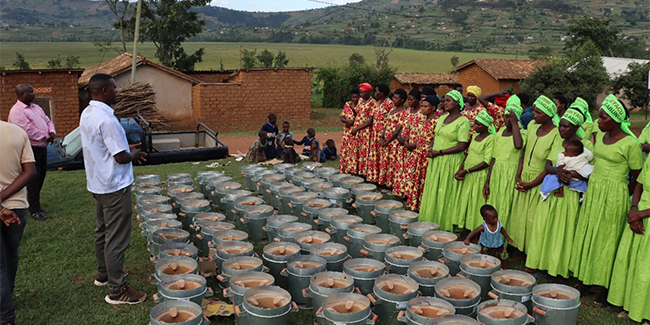
We provided Napier Grass seedlings to 559 households and provided training on its management. Two years down the road, women from some of these households could not hide their delight when asked how fodder growing has helped them. Below are examples of what they had to say:
Uwiragiye Chantal from Rusarabuye Sector: “Fodder growing saved my time. I used to spend two to three hours in the marsh harvesting grass, but for now, I have it at the comfort of my home. Our animals are well fed because we have enough fodder for them. Rugezi Marsh will recover because we have stopped harvesting grass from it.”
Uzabakiriho Jeannette from Butaro Sector: “I am very happy that the project gave us fodder. My life and that of my family has changed since we started producing fodder on our farm. Feeding my animals has become easy and less time consuming. As a result of feeding animals well, we have more milk for our children and a surplus for sale. We now have more income from milk compared to when we had to gather grass from Rugezi.”
Nyambere Celine from Rusarabuye Sector: “My family is no longer in conflict with neighbours and local leaders. In the past we used to illegally harvest grass from Rugezi, and the local leaders would run after us. At times our hungry animals would escape into our neighbours’ gardens. All this used to generate conflict, but now we are free and my animals feed well. The whole community has benefited because we are giving planting materials to other community members. Some people come to visit our gardens to learn how to grow Napier Grass.”
Ngendahimana Dative from Ruhunde sector: “My children and I no longer move long distances to harvest grass from Rugezi Marsh. We are able to feed our animals using home grown fodder and they are healthy. They are giving more milk, some of which we sell. “
These testimonies are evidence that fodder growing has relieved women of the burden of walking long distances to harvest it from Rugezi Marsh. It has reduced their daily workload and put a smile on their faces.
This work is made possible by the MacArthur Foundation and the Critical Ecosystem Partnership Fund (CEPF).


