Help protect Africa's 

Lion Collaring and Monitoring Update: Northern Kruger National Park

Lion Collaring and Monitoring Update: Northern Kruger National Park

Lion Collaring and Monitoring Update:
Northern Kruger National Park


By Marnus Roodbol, project manager, Carnivore Conservation Unit


The Endangered Wildlife Trust (EWT) conducting a lion collaring and survey operation.

The Endangered Wildlife Trust (EWT), in collaboration with SANParks and Greater Kruger Environmental Protection Foundation (GKEPF), conducted a lion collaring and survey operation in the Nxanatseni North region of northern Kruger National Park from 21–29 September 2026. The operation focused on locating, identifying and monitoring lions in an area where the population faces increasing threats from snaring, poisoning, targeted poaching and human-wildlife conflict. A total of 30 lions were observed, including adult males and females, sub-adults, juveniles and cubs. Selected lions were processed, branded and fitted with GPS collars to strengthen the ongoing monitoring of the population.

The GPS collars provide an important conservation tool by allowing the team to remotely monitor lion movements, survival and behaviour across the large northern Kruger landscape. Collar data can also help identify when lions move into high-risk areas or display unusual movement patterns, supporting more targeted responses by conservation and ranger teams. This information will contribute to a better understanding of pride movements, dispersal, habitat use and the survival of individual lions, including translocated animals.

The EWT would like to sincerely thank Painted Wolf Wines and the Lion Recovery Fund for their generous support towards the provision of GPS collars for the northern Kruger lion monitoring programme. This contribution has increased our capacity to monitor individual lions and respond to potential threats. We also thank SANParks and the veterinary and field teams for their support during the operation.

While not all of the collars deployed during the operation are fully operational yet, the team is completing activation and communication checks to ensure that the remaining units are transmitting correctly. As the collars come online, the resulting data will provide valuable information for the continued monitoring and protection of lions in Nxanatseni North.
Archives

How to count lions in Africa

How to count lions in Africa

Science Snippet:

How to count lions in Africa

By Lizanne Roxburgh and Erin Adams

Knowing how many individuals of a species exist in the wild is important for managing that species. It is also important to know the trend in the number of individuals in a population. Whether the number is increasing, stable or declining will have implications for what management interventions should be used to conserve that population. There are currently many methods that can be used to estimate population size, however, each have their own strengths and weaknesses.

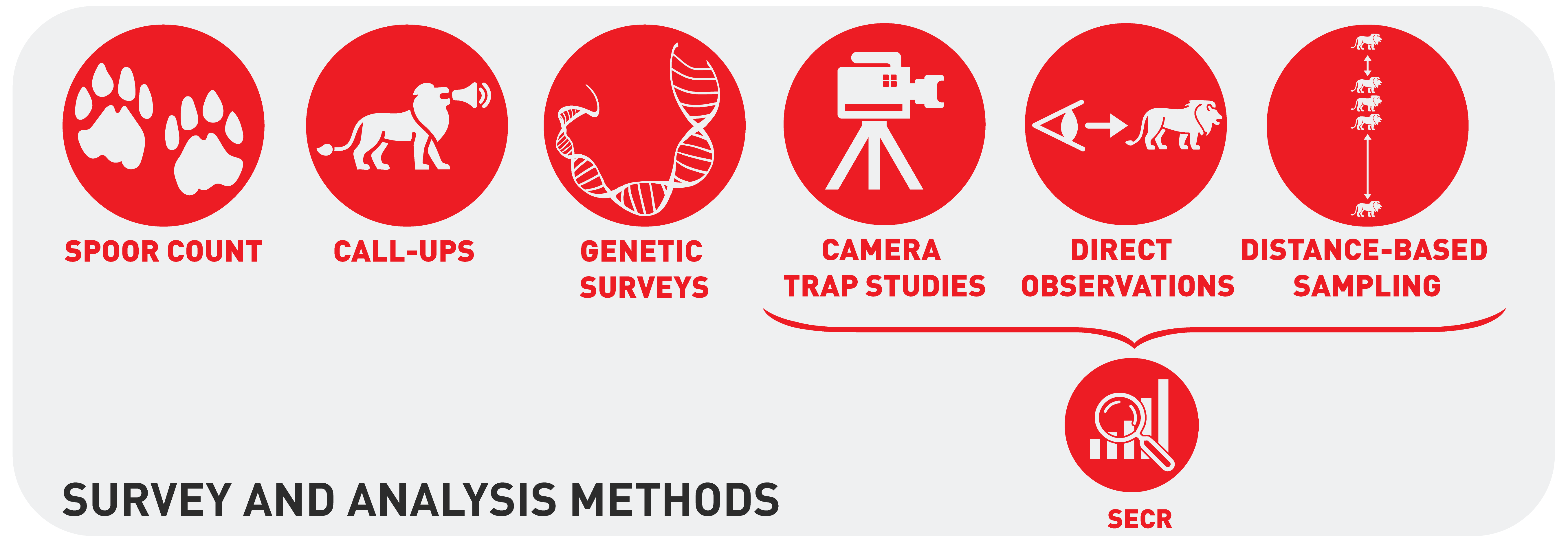
In a recent study*, scientists from the EWT, in collaboration with researchers from other institutions, reviewed all of the methods that are used to survey lion populations across Africa. They looked at 93 different studies from 1991 to 2022. Seven broad survey methods were identified. These included spoor counts, call-ups, genetic surveys, direct observations, camera trap studies, spatially-explicit capture-recapture (SECR) for both direct observations as well as camera traps, and distance-based sampling.

Pic: Eleanor Momberg

The scientists found that the most reliable methods for estimating lion population in Africa were those that included spatially-explicit capture-recapture (SECR) analysis. SECR is a method used to model animal capture-recapture data collected with a network of “detectors.” SECR takes into account both where the individual lions were captured by the detectors (such as camera traps or through direct observations) and where they were not captured. It’ s like solving a puzzle where you piece together information about where animals were detected to estimate their overall population density. Sampling techniques such as spoor counts and call-ups were found to be less reliable, as they tended to over-estimate population size.

The scientists strongly recommended that standardized methods be developed that can produce comparable estimates of the number of lions, both within and between sites and years. These methods can then be used to survey lion populations in areas where gaps in our knowledge of lion populations exist.

*Samantha K. Nicholson, David R. Mills, Erin C. Adams, David G. Marneweck, Hans Bauer, Lizanne Roxburgh, Rob Slotow. 2024. Towards effective and harmonized lion survey methodologies: A systematic review of practice across Africa. Global Ecology and Conservation.  https://doi.org/10.1016/j.gecco.2024.e02908