How did the monkey cross the road?
Courtney Maiden, Endangered Wildlife Trust MSc Student
Over 750,000 km of roads crisscross South Africa, and the country’ s natural habitats and wildlife are gravely threatened by further road development. Furthermore, with the anticipated increase of vehicles on the roads over the coming years, the likelihood of more wildlife-vehicle collisions is worrying. The Vervet Monkey (Chlorocebus pygerythrus) has adapted to thrive in human-altered landscapes. However, this also means they face many risks from humans and their activities. Vervet monkeys face daily challenges living in an urban environment due to increasing habitat loss and fragmentation. The clearing of treed areas for roads and other purposes forces monkeys to the ground, increasing their risk of being hit by vehicles. An important first step in reducing this outcome is the design of safe and cost-effective structures by which animals can safely cross the road.
Over the past two decades, wildlife crossing structures have been installed to facilitate wildlife movement over or under roads and railways to connect habitats and reduce roadkill. These structures are often custom-designed for each site and according to the needs of the targeted species. Yet, less than a handful of studies look at the effectiveness of different measures in reducing wildlife‐vehicle collisions in South Africa. Moreover, systematic assessments on designing safe and cost‐effective crossing structures for wildlife have not been carried out to date in our country, despite their importance in preventing Vervet Monkeys and other animals from becoming roadkill.
In March 2022, Courtney Maiden from the Endangered Wildlife Trust tested three different canopy bridge designs for Vervet Monkeys to identify one standardised design for the benefit of free‐ranging Vervet Monkey troops. The observational experiments took place at the Centre for the Rehabilitation of Wildlife (CROW) in Durban, where the three bridge designs were installed in two Vervet Monkey enclosures. Testing different canopy bridge designs in an ex-situ environment such as CROW allows us to establish design guidelines that can be used for free-ranging Vervet Monkeys in-situ (in their natural habitat). These ex-situ experiments are vital for understanding how Vervet Monkeys behave on different canopy bridge designs and identifying the most suitable bridge design to increase the likelihood of the bridges being used in the wild.
The bridges were made using polypropylene rope and recycled plastic. The design is adaptable to varying installation lengths, heights, and crossing environments. By observing the monkeys directly and using camera trap footage, we found that the ladder bridge was used most often and showed great potential for being the most suitable design.The positioning of any wildlife crossing structure is equally as important as its design. As the Vervet Monkey is a territorial species with daily foraging paths, installing canopy bridges along preferred movement pathways is vital for maximum benefit. Examining troop territories, crossing areas, and frequency of use can inform the best bridge location. Through the EWT-WTP student mentorship and with help from Wendy Collinson-Jonker (EWT) and Sandra Jacobson (US Forest Service Wildlife Biologist), Courtney has visited potential bridge installation sites in KwaZulu Natal and is currently studying road crossing hotspots to determine where bridges would be most likely to be used as intended.
Once suitable sites have been identified, we can begin the exciting part – testing the design identified as most suitable (the ladder bridge) on free-ranging monkeys. Watch this space for updates! All information and research updates can also be found on Instagram (@wildways_sa), Facebook (Wild Ways South Africa), and EWT platforms.
Frogs: Friends, fortune, or foes?
Dr Jeanne Tarrant, EWT Threatened Amphibian Programme Manager, jeannet@ewt.org.za
April 2022
Frogs and folklore go hand-in-hand. Countless children’ s stories and fairy tales feature frogs and toads, and these amphibians have appeared in proverbs, rituals, and myths and have been interwoven into cultures across the world for centuries. Often, these stories represent frogs as important symbols of good fortune, fertility, and abundance. For example, each year, numerous frogs appear with the flooding of the Nile. These floods were vital to agriculture because they provided water for growing crops. Frogs represented abundance and became a symbol for the number hufnu, which meant 100,000. Many native cultures place small frog coins in their purses because they believe the coins will help them keep their money. The nature of the complete transformation of frogs from tadpoles also conjures a wide range of possible representations, including the option of transforming again into something even more wonderful, as in the traditional fairies about frogs turning into princes. The idea that a frog could be a prince – or anything else – makes them excellent fictional characters. Their metamorphosis from tadpole to frog can be seen as a form of “magic” and is relatable to young readers’ transformations, from toddler to child or child to teenager. Frogs symbolise hope in these stories.
In other cultures, toads represent less favourable symbols. In medieval Europe, for example, toads were considered evil creatures whose body parts had strange powers. Some of these views were articulated by authors from Classical Rome and Greece, whose writings had an immense influence on public opinion. Shakespeare’ s play “As You Like It” alludes to a widely held superstition about a jewel that was supposed to be found inside the head of the toad. Once placed in a ring or necklace, this jewel, known as “toad-stone”, would warm up or change colour in the presence of venom, protecting the wearer from possible danger and foul play. Additionally, toads took on the role of evil spirits who assisted witches in their evil designs. In South Africa, frogs form part of similar cultural beliefs associated with witchcraft.
These myths and legends, and all stories really, are part of our journeys to better understand the world around us and are often derived as ways of protecting or warning us. Wanting to learn more about our local stories associated with frogs, we created the #FrogLore social media campaign for this year’ s Leap Day for Frogs.
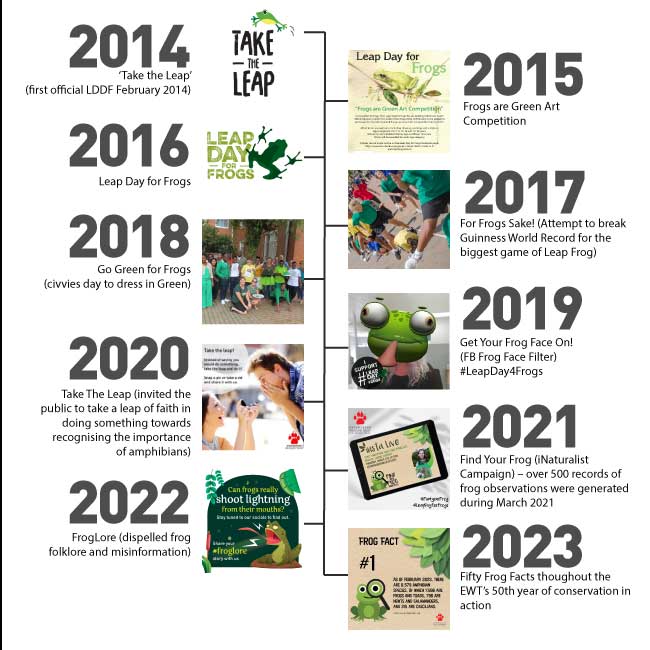
The Endangered Wildlife Trust’ s annual Leap Day for Frogs campaign has been running for eight years, highlighting how important, interesting, and under threat frogs are.
Globally, amphibians remain the most threatened backboned animals on Earth, with 41% of species threatened with extinction. This 41% is a huge proportion of an ancient group of animals that have been successful for 300 million years, inhabiting all corners of the planet – except those too cold, too hot, or inaccessible to frogs, such as the Galapagos Islands. But now, because of habitat destruction, freshwater pollution, and a deadly fungus (which incidentally is having a way bigger impact on many more species than Covid-19), amphibians are facing a very real and rapid demise. It is a warning that our changing planet cannot support life in the way it should.
These sobering statistics are not cause for celebration, so why have fun in the name of frogs? While Leap Day for Frogs does highlight the threats to these creatures, it also celebrates them and creates an appreciation for them, which is the first step towards recognising their importance. Leap Day for Frogs invites members of the public to get involved however and wherever they like – be this by creating frog art or poetry at schools, cleaning up a local wetland, learning more about frogs, or playing a game of leapfrog!

Leap Day for Frogs event in Ipithi Nature Reserve on 26 February 2022
This year, in addition to the FrogLore campaign, we were fortunate to host in-person events again. We partnered with Kloof Conservancy to run a fun day of activities and a night frog walk at Ipithi Nature Reserve in Gillitts on 26 February, with over 300 people attending! We also joined forces with Hillcrest Conservancy, where 120 people joined a frog talk and walk at Springside Nature Reserve. Both amazing turnouts demonstrate that families are ready to get out to explore their local green spaces – in many instances, for the first time. Through our multiple partnerships and independent lessons, we also engaged over 700 school learners in 2022 already.
Through the FrogLore social media campaign, we reached over 34,000 people, and we received some stories – mostly related to lightning and frogs. One event participant mentioned a belief in eSwatini that if you dig up a frog, you will be struck by lightning! There is a fairly common association between frogs and weather events, which makes sense as frogs emerge during rain, and this natural occurrence may be at the root of many similar beliefs. Frogs also have very long tongues, which may explain why some think frogs shoot lightning from their mouths! What stories or beliefs about frogs have you heard?
Please share them with us via our social media platforms with #Froglore or email ewt@ewt.org.za.
The more we know about people’ s beliefs and attitudes towards frogs, the more we can promote positive interactions and save more frogs.
LATEST STORIES
TAKING A LEAP FOR FROGS
Dr Jeanne Tarrant, Manager, EWT Threatened Amphibian Programme
JeanneT@ewt.org.za
The EWT’ s Leap Day for Frogs campaign has been running for six years, with the 2020 iteration taking place during a Leap Year. This year our theme, ‘Take the Leap’ , invited the public to take a leap of faith in doing something towards recognising the importance of our amphibious friends.
Globally, amphibians remain the most threatened back-boned animals on Earth, with the latest assessments showing 41% of species in this group as being threatened with extinction. That’ s a huge proportion of an ancient group of animals that has been successful over the past 300 million years, inhibiting all corners of the planet – except in places that are too cold, too hot or too far away (amphibians can’ t make it to some of the more isolated islands, for example the Galapagos have no amphibians). But now, because of loss of habitat, pollution of freshwater and a deadly fungus, amphibians are facing a very real and rapid demise. A warning that our changing planet is not able to support life in the way that it should.
These sobering statistics are not exactly cause for celebration, so why have fun in the name of frogs? Leap Day for Frogs is about highlighting the plight of these creatures, but creating an appreciation for them is the first step towards recognition of their importance. Leap Day for Frogs aims to do this, and invites members of the public to get involved in whichever way they see fit – be this frog art or poetry at schools, cleaning up a local wetland, learning more about frogs or playing a game of leap frog
We are relatively fortunate in South Africa where 20 of our 135 frog species are threatened, so not quite as high a proportion as globally. We are also blessed with an amazing diversity of frogs that inhabit our vast array of habitats from montane fynbos in the west, to coastal forest in the east and everything in between – rain frogs, ghost frogs, stream frogs, puddle frogs, Giant Bullfrogs, tree frog….the list goes on.
For Leap Year this year we had over 1,250 people taking part in activities around the country, ranging from Highland dancers doing a fling for frogs, frog tattoos, school groups learning about frogs and wetlands, to park runners dressing up as frogs. As the EWT, we partnered for the 6th consecutive year with Kloof Conservancy to run a fun day of activities and a night frog walk at Ipithi Nature Reserve in Gillitts on 29 February. Turnout was great, considering the cold and wet weather, with 120 people attending. Local artist, Giffy Duminy, also raised awareness by painting incredible frog murals under the Elizabeth Bridge in Kloof. In Cape Town, our project team there led an exciting walk in the Kirstenbosch Botanical Gardens, finding several frog species, including tadpoles of the Critically Endangered Table Mountain Ghost Frog – our flagship species for a conservation research project we are coordinating on the mountain.
It is wonderful to see this event growing in reach year after year and a genuine interest from young and old alike in what really are some of the most fascinating creatures we are lucky enough to share the planet with.
This work is made possible by Rand Merchant Bank, Disney Conservation Fund and Kirstenbosch Botanical Gardens.