A novel approach to conserving a Critically Endangered frog
Alouise Lynch, Bionerds PTY Ltd.
Amidst a field of agricultural development, the Klein Swartberg Mountain towers above the town of Caledon in South Africa’ s Western Cape Province. This lone mountain is home to the only known populations of the Critically Endangered (IUCN Red List 2016) Rough Moss Frog (Arthroleptella rugosa), an amphibian species restricted to this mountain. For this reason, the mountain was deemed an Alliance for Zero Extinction Site in 2017.
The Alliance for Zero Extinction (AZE) is a joint initiative of biodiversity conservation organisations from around the world working to prevent extinctions by promoting the identification and ensuring the safeguard and effective conservation of key sites that are the last remaining refuges of one or more Endangered or Critically Endangered species.
Alliance for Zero Extinction website, July 2023
Bionerds have been implementing this project for the Endangered Wildlife Trust since 2019. The Endangered Wildlife Trust’ s (EWT) Threatened Amphibian Programme (TAP) Conserving Threatened Frogs of the Western Cape Project includes the Rough Moss Frog as a species of conservation concern given its restricted range. Furthermore, it still faces grave threats within this range, including habitat loss caused by alien invasive plants and frequent unplanned fires, which have led to a severe population decline (IUCN Red List 2016). Long-term acoustic monitoring by Cape Nature and Stellenbosch University documented this decline categorically, showing how the type (original) population had all but disappeared completely.
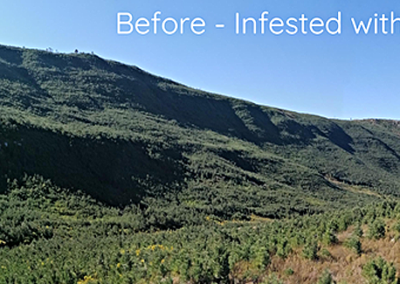
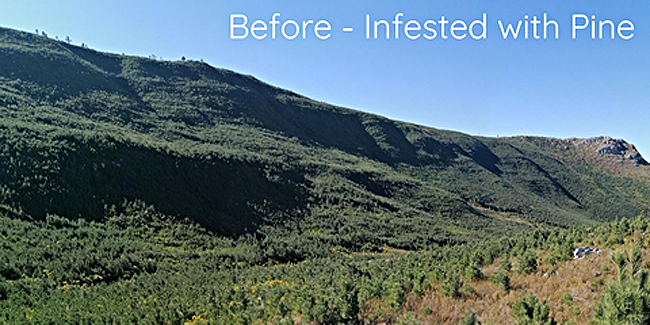
During our surveys in May 2020, a marching forest of alien vegetation, mostly Pine, was observed engulfing the then-only known populations of Rough Moss Frogs. It became evident that rapid intervention was needed to save and secure these populations. Unfortunately, the Covid-19 epidemic halted all efforts to implement interventions in 2020.
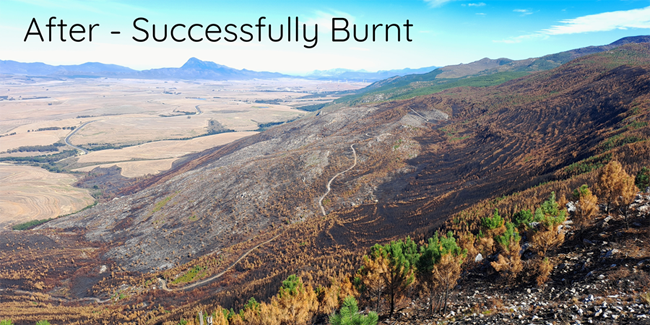
In 2021, the project was awarded a Rapid Action Grant from the IUCN Save Our Species fund and the European Union. This grant enabled us to create a firebreak around the Rough Moss Frog populations. We had limited time to implement this burn because the pine trees were starting to cone, and we had to act hastily to prevent another season for them to set seed. In March 2022, we worked with the local conservancy and landowners to implement a controlled ecological fire – the first time globally that prescribed fire was used as a management tool to reduce alien invasive vegetation threatening a frog species from extinction.
The Overberg District Municipality Fire Department and the Greater Overberg Fire Protection Association oversaw the burn and did a sterling job of ensuring all possible precautions were taken for the implementation of the burn, all permits were issued, and on the day, all hands were on deck to start, maintain, and close off the burn. Unfortunately, unforeseen windy conditions developed late in the day and the fire managed to break through several points and burnt a larger section of the mountain than was planned. Over 4,000 hectares were burnt, which is good news for pine eradication efforts but requires carefully planned follow-up management over a larger area. Bionerds have assisted with this through drone-mapping of priority areas.
Photo credit Bionerds PTY Ltd
Photo credit Bionerds PTY Ltd
A site visit following the fire in April 2022 confirmed the presence of Rough Moss Frogs, and in July 2022, we were relieved to hear the species calling at the sites of all known populations. In May 2023, multiple individuals were heard in an area where none were heard or recorded before the fire. During subsequent surveys, we discovered numerous additional populations of this species across the mountain – a big win for the project and the species!
This year, between July to September- the coldest and wettest months– when these frogs breed, we will implement acoustic surveys to determine the presence or absence of Rough Moss frogs in all previously recorded sites. These surveys use three audio devices called Song Meters – a six-microphone array deployed at each population site for roughly an hour per site. The arrays record all frog calls during that period, and we can then use the audio file to estimate density and determine how many Rough Moss Frogs are present in each specific population at that specific time. We will be doing this for five years, each breeding season, to determine the effectiveness of the fire on the preservation of the sites, as well as capturing the rate of recovery of the frog populations at each site.
The landowners that are part of the Klein Swartberg Conservancy all support the protection of this species – and Bionerds and the Fynbos Trust have developed an alien clearing plan to guide the clearing of alien invasive vegetation from the mountain over the next decade. This alien vegetation clearing operation across the mountain creates jobs for local people from the Caledon area. This project is challenging, but we are positive and excited about the future of this tiny frog due to multiple partners working together towards protecting the species and its important fynbos habitat.
This project is funded by the IUCN Save Our Species and the European Union. The IUCN Save Our Species aims to improve the long-term survival prospects of threatened species. It also focuses on supporting the species’ habitats and working with the communities sharing this habitat. It achieves success by funding and coordinating conservation projects across the globe. The Member States of the European Union have decided to combine their know-how, resources, and destinies. Together, they have built a zone of stability, democracy, and sustainable development whilst maintaining cultural diversity, tolerance, and individual freedoms. The European Union is committed to sharing its achievements and values with countries and peoples beyond its borders.
DR ANDREW TAYLOR, EWT WILDLIFE IN TRADE PROGRAMME MANAGER
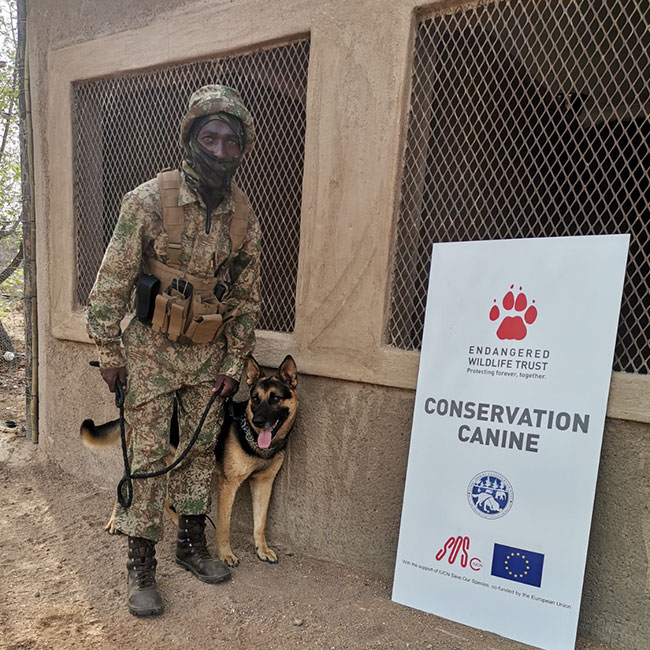
EWT Conservation K9 Bekah and handler Precious
The Endangered Wildlife Trust supports anti-poaching initiatives in game reserves using tracking and detection dogs known as conservation K9s. A project generously funded by the IUCN Save Our Species Rapid Action Grant and the European Union has enabled us to deploy six new dogs over the past year into priority reserves in Limpopo and the Eastern Cape. Although the grant period has ended, the EWT continues to support the reserves to ensure continuity and sustainability of the use of dogs to support their rangers, and our Conservation K9 Project Coordinator, Shadi Henrico, recently visited four of the dogs posted in Limpopo.
Ruger, a male Dutch Shepherd, and Bekah, a female Belgian Malinois sponsored by Global Conservation Force, were deployed to a big five reserve in June 2022. As tracking dogs, Ruger and Bekah walk daily patrols along the fence line with their handler Precious, sniffing out evidence of illegal infiltrations into the reserve that may be related to poaching activity. If someone has entered the reserve through the fence, these dogs will detect their scent and can follow the route they took, allowing Precious to find the trespasser and uncover the intentions behind their incursion.
EWT Conservation K9 Gold and handler Clifford
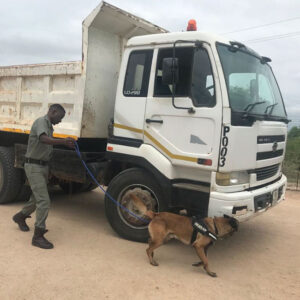
Gold, a certified detection dog, was deployed to another big five reserve in August 2022, where he is finding his feet and bonding with his newly qualified handler Clifford. Clifford was trained at Genesis K9 with support from the IUCN SOS and the EU, and works with Gold to screen vehicles at entrance gates and other locations to ensure that no contraband is smuggled into or out of the reserve. Gold’ s sharp nose can detect firearms, ammunition, rhino horn, elephant ivory, pangolin scales, and lion bones and will immediately alert Clifford if he catches a suspicious whiff so that they can investigate further.
EWT Conservation K9 Juice and handler Kaizer searching vehicles
Juice, a large male Malinois, has been deployed to a reserve in the Associated Private Nature Reserves (APNR) adjacent to Kruger National Park, where he is screening vehicles entering and leaving the reserve. He has been partnered with Kaizer, an experienced dog handler and will be working hard to catch wildlife traffickers. Like Gold, Juice will focus on detecting firearms, ammunition, and threatened wildlife species.
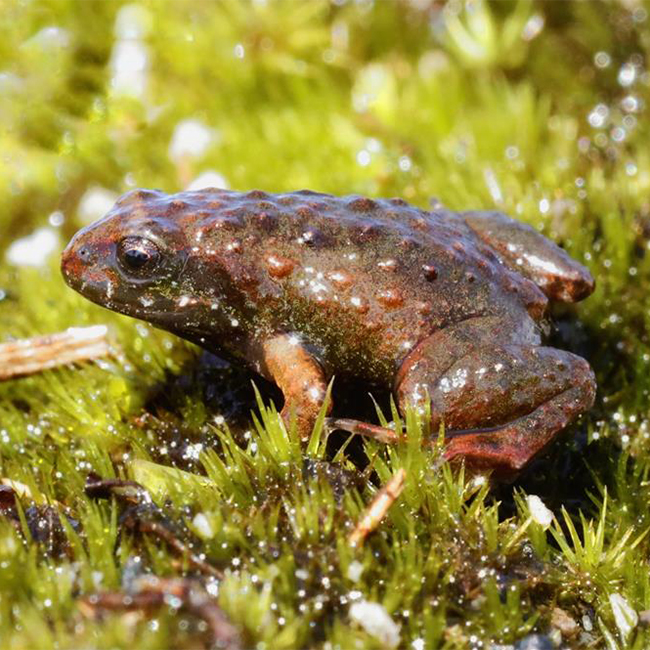
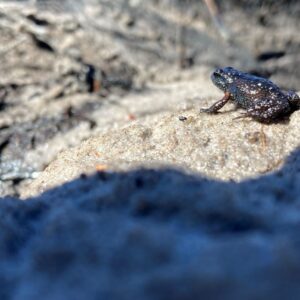
Rough Moss Frog (Arthroleptella rugosa). Photo credit: Johan du Plessis
The Rough Moss Frog (Arthroleptella rugosa) is a Critically Endangered frog species found only on a single mountain range, the Klein Swartberg, in the Overberg district of the Western Cape, South Africa. In 2020 we realized that this little frog was in big trouble. Its habitat was being degraded rapidly by alien invasive vegetation to such an extent that the survival of the only known population of this species was uncertain.
With this realization, the Endangered Wildlife Trust (EWT) approached the IUCN Save Our Species fund for support to implement a critical rapid action intervention to save this population. In 2021, the IUCN Save Our Species answered the plea for assistance with co-funding from the European Union. This support allowed us to develop a firebreak system around this original population of Rough Moss Frogs. This critical intervention supported the planning of an ecological burn in 2022 as a tool to manage an extensive pine infestation that was damaging the population’ s seepage habitat. This was a novel approach to amphibian species conservation on the Klein Swartberg Mountain, not least globally.
During the surveys supported by the SOS project, an additional three populations of this species were recorded on the Klein Swartberg by project partner Bionerds PTY Ltd. This was a welcome discovery, bringing the known populations to four. Two of these newly discovered populations were in well-managed natural habitats, also good news for the species!
On 16 March 2022, the firebreaks and planning for the ecological fire were completed by our contractor, Enviro Wildfire, through the employment of an alien vegetation clearing team from the local community of Caledon. The planned ecological burn took place during the week of 28 March 2022. The ecological burn was intended to eradicate invasive pine trees and allow for the recovery of natural fynbos vegetation, not only for the conservation of the Rough Moss Frog population but also for various other Endangered plants and animals. This intervention will also benefit the local community living in the catchment zone below the Klein Swartberg by increasing the water yield from the mountain draining into the aquatic systems in the seeps and rivers and the agricultural community reliant on these water resources.
Team preparing firebreaks in the Klein Swartberg, Western Cape, South Africa. Photo credit: Johan du Plessis
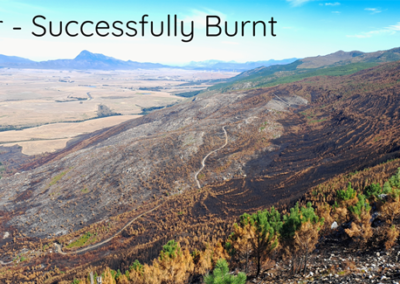
The burn was successful, with very few invasive alien pine trees remaining. And those that survived will be cleared mechanically in the coming months, alongside the development of a long-term alien vegetation clearing plan covering the full extent of the mountain and supported by project partners, the Klein Swartberg Conservancy and the Fynbos Trust. In addition to the 800 ha planned for the burn, over 4,500 ha of the mountain also burnt, including the three additional Rough Moss Frog population sites discovered during the project. Post-fire monitoring by the team has happily confirmed the presence of Rough Moss Frogs at one of the burn sites. These populations will be continuously monitored over the coming breeding season (June onwards). This monitoring will include post-fire bioacoustics monitoring (recording of frog calls) to compare with pre-fire recordings to document the recovery of these populations in the coming years as habitat is restored.
Southern slope after ecological burn in the Klein Swartberg, Western Cape, South Africa. Photo credit: Johan du Plessis
The project not only achieved its objective of significantly reducing the threat of invasive vegetation to the original population but also forged partnerships, discovered previously unknown populations of a Critically Endangered species and initiated formal habitat protection processes for five properties where the species is now known to occur.
This project is supported by IUCN Save Our Species and co-funded by the European Union. The contents of this publication are the sole responsibility of the Endangered Wildlife Trust and do not necessarily reflect the views of IUCN or the European Union.
PUSHING THE BOUNDARIES FOR RIVERINE RABBITS IN THE ANYSBERG
Bonnie Schumann, the EWT’ s Drylands Conservation Programme, bonnies@ewt.org.za
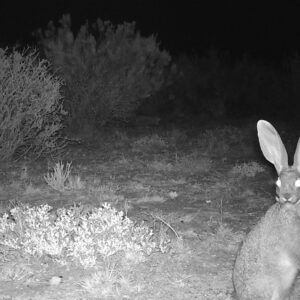
The ancient landscapes of the Karoo are home to one of South Africa’ s most elusive and Critically Endangered species, the Riverine Rabbit. Riverine Rabbits occur in three known populations in three separate regions of the Karoo. Originally thought to only occur in the Nama Karoo, where they were first discovered in 1901, rabbits were later discovered near Touwsriver in the Succulent Karoo in 2003. This discovery completely upended the applecart on what we knew about the distribution and behaviour of this species. However, at least one other surprise was awaiting us when a third population was discovered west of the Baviaanskloof in 2018.
In the 1990s, landowners and conservationists joined forces to create Riverine Rabbit conservancies in the Loxton-Fraserburgh-Beaufort West area of the Nama Karoo to conserve the species. These conservancies still exist today. Even though many of these landowners rarely, or in some cases, have never seen a Riverine Rabbit, they are passionate about conserving them on their properties. While rabbits occur in three different regions of the Karoo, their threats are the same in all three landscapes. The most severe threats are habitat loss and damage to the remaining habitat. The floodplains of the seasonal rivers in the Karoo consist of deep alluvial soil areas that make for fertile agricultural soil in an otherwise arid landscape. These areas are largely transformed into ploughed lands, which in many cases now lie fallow and abandoned. The changing economic situations and erratic rainfall make it risky to depend on rain-fed cropping and flood irrigation. In recent decades, it has not been worthwhile to grow rain-fed crops in many places across the drylands.
In the past, the riparian areas, often comprising floodplains a few kilometres wide, were densely vegetated and would have provided a unique habitat to a range of species, including the Riverine Rabbit. The loss of over 60% of the riparian vegetation was devastating for the Nama Karoo Riverine Rabbit population. Outside of the riparian zone, the vegetation does not provide enough cover for a species that relies on dense vegetation to avoid detection and capture by predators. Rabbits have disappeared from areas where the vegetation is overgrazed and “opened up” by livestock. They are an indicator species for ecosystem health, and If the riparian vegetation is managed sustainably, rabbits will persist. If not, they will continue to quietly vanish.
Following the initial discovery of rabbits in the Succulent Karoo, surveys for rabbits took place in the riparian areas, based on the assumption that the “southern” rabbits use the landscape similarly to their Nama Karoo counterparts, which are riparian habitat specialists. Here is where it became interesting. What is now clear is that rabbits in the Succulent Karoo can range more widely across the landscape, occurring outside of riparian areas where the vegetation on the gently sloping hills is often quite dense. They occur outside the riparian zones, and their range also extends into a third Biome, the Fynbos Biome, where they primarily favour the Renosterveld vegetation. The fact that the rabbits can persist in vegetation units outside the riparian zones in the Succulent Karoo is very fortunate, given that much of their riparian habitat has been lost to agriculture. This means that the gently sloping areas that are unsuitable for ploughing and are densely vegetated have provided critical refuges for rabbits. It is probably safe to speculate that Riverine Rabbits were once widely distributed along the valleys and hills of the Little Karoo. However, the extensive loss of habitat across this region has resulted in them remaining only in pockets of suitable intact vegetation. Conservationists are researching the genetics of the region’ s rabbit populations – how closely they are related to each other and their overall genetic health – to understand how viable the populations are and if any connectivity (gene-flow) between the three populations still exists.
The spectacular Anysberg Nature Reserve was officially declared in 1990 to formally protect the incredible but highly threatened biodiversity of the Succulent Karoo, an internationally recognised biodiversity “hotspot”. Riverine Rabbits were recorded in the reserve for the first time in 2013. This was the best news of the century for rabbit conservation because the discovery meant that the reserve was the first formally protected area to boast a Riverine Rabbit population. What is doubly exciting is that landowners bordering the reserve had a vision for conservation going back 25 years. Several individuals bought properties in this area to conserve the land and wildlife. Livestock was removed, and the land has been resting and recovering ever since. In 2018, one of the landowners approached the Endangered Wildlife Trust to assist him in taking his conservation efforts to the next level by declaring the property a contractual Nature Reserve. As a result, the Endangered Wildlife Trust, CapeNature (the designated authority with statutory responsibility for biodiversity conservation in the Western Cape) and six landowners are collaborating to declare a cluster of properties as nature reserves. These contractual reserves will be formally protected and attain the same status as the Provincial Reserves, effectively expanding protected areas at a national level. This essentially means that the Anysberg Nature Reserve, also a World Heritage Site, will be buffered by an additional 20,000 hectares of protected landscapes. Several additional vegetation units, each supporting unique and, in many cases, endemic plant and animal species, not yet included in the Anysberg Nature Reserve, will now also be formally protected.This initiative is testimony to what can be achieved when stakeholders combine forces to achieve a shared vision. Many species facing severe persecution outside protected areas, including Leopard, Brown Hyaena and Honey Badger, will now be able to safely roam over an increasingly vast area. And, of course, as the largest formally protected area cluster for Riverine Rabbits, it now represents the single most important stronghold for Riverine Rabbits in South Africa. In this case, size is critical, as only a small portion of the entire area will meet the habitat requirements for rabbits, so the bigger the area, the better.
Ecotourism, including adventure tourism and, in some cases, limited agricultural activities, provide a diversified income for the landowners around the Anysberg Nature Reserve. This is an extremely marginal area for extensive livestock production, and the reality is that the veld has been utilised to, and in some cases beyond, its limits and can no longer support herds of goats and sheep. Developing a “green” conservation-based economy can breathe new life into this region where poverty and unemployment are rife. Ecotourism provides jobs, supports livelihoods, and can help fund the restoration work that needs to be done in the degraded areas. The Anysberg is only approximately 260 kilometres from Cape Town, making it easily accessible as a weekend getaway. It is also easily accessible to international tourists looking for some peace and quiet in one of the most beautiful and safe regions of South Africa.
There are few undiscovered natural gems left out there. The Anysberg area is truly one of the most exciting and largely undiscovered gems in South Africa. The shared vision for this area is to develop an economy based on what the region has to offer in terms of unspoiled landscapes, wide-open skies, and incredible scenic beauty while conserving the unrivalled unique biodiversity of the Succulent Karoo. The project’ s next phase is supported by IUCN Save Our Species and co-funded by the European Union.