
Help protect Africa's 

ICF/EWT Partnership Shines at IUCN’ s first Africa Conservation Forum

ICF/EWT Partnership Shines at IUCN’ s first Africa Conservation Forum


ICF/EWT Partnership Shines at IUCN’ s first Africa Conservation Forum

By Dr Adalbert Aineo-mucunguzi, EWT/ICF Parnership East African regional manager, African Crane Conservation Programme
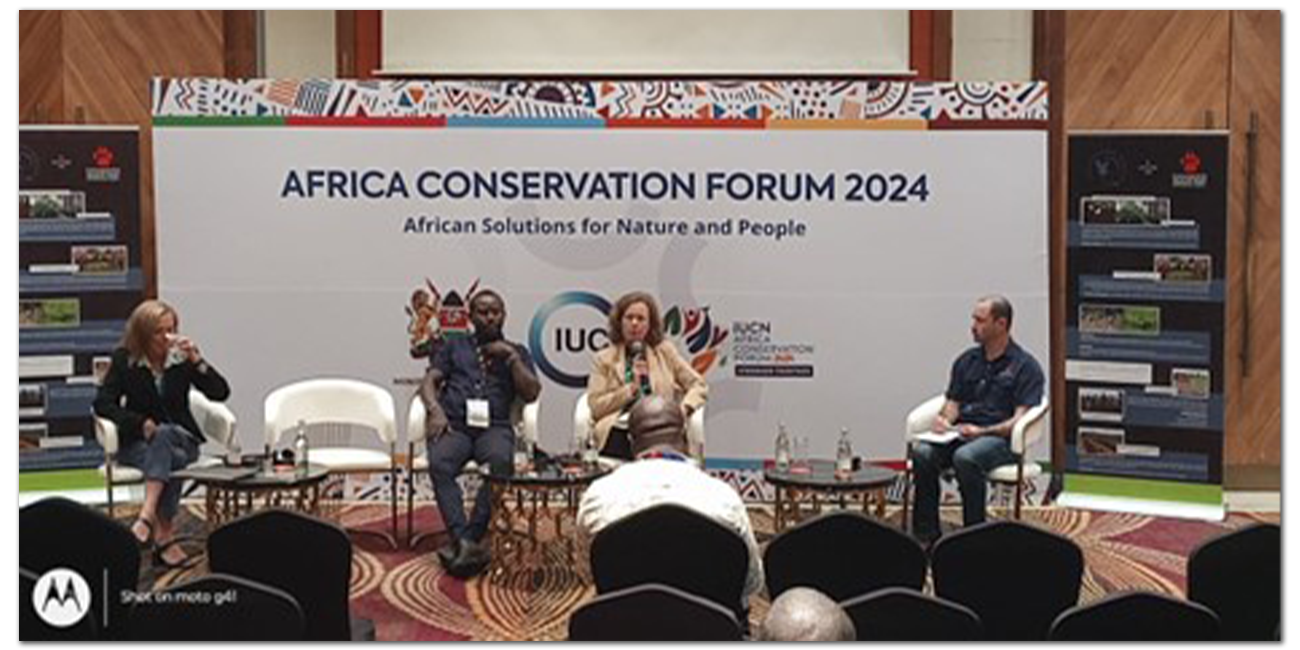
From left to right:  Dr Harriet Davies-Mostert, Dr Mwangi Joseph,  Ms Kerryn Morrison and Dr Ian Little


In June 2024, the International Union for Conservation of Nature (IUCN) convened the Africa Conservation Forum (ACF), one of the leading regional platforms to strategically influence the sustainability agenda and biodiversity conservation. The Forum provided an avenue for sharing information and knowledge, building partnerships, and connecting key stakeholders from different parts of Africa. The IUCN Africa Conservation Forum was organised by the three IUCN offices according to sub-regions in Africa: West and Central Africa (PACO), North Africa (Centre for Mediterranean Cooperation – MED), and Eastern and Southern Africa (ESARO).

During the forum, the International Crane Foundation/Endangered Wildlife Trust (ICF/EWT) Partnership hosted a side event workshop titled “Nature-based Solutions for effective community conservation and climate action”. This event brought together conservation practitioners, researchers and policy makers from ESARO, PACO and MED regions of Africa to share the benefits, challenges and lessons learnt about implementation of Nature-based Solutions (NbS) to enhance conservation and climate action.

Moderated by our own Head of Conservation, Dr. Ian Little, the one and half hour workshop was dominated by presentations from ICF/EWT staff. Our East Africa regional Director, Dr Adalbert Aine-omucunguzi gave the opening presentation on the “what and why of Nature-based Solutions in conservation, climate action and livelihoods” largely drawing examples from our work across East Africa. This was followed by a panel discussion where Dr Mwangi Joseph, our Kenya Country Manager, discussed Nature-based solutions in agricultural landscapes and how they benefit conservation and climate action, while Ms Kerryn Morrison, the VP International-Director for Africa, discussed the opportunities for scaling up Nature-based Solutions across the continent. The other panelist, Dr Harriet Davies-Mostert, former Head of Conservation at EWT, and currently the Regional Vice Chair for IUCN’ s World Commission on Protected Areas, discussed the effectiveness of Protected and Conserved Areas as Nature-based Solutions.

From left to right:  Dr Harriet Davies-Mostert, Dr Mwangi Joseph,  Ms Kerryn Morrison and Dr Ian Little

During the question and answer session, participants shared insights and experiences about scalable NbS that enhance ecosystem conservation and climate action and discussed best practices for unlocking the potential of NbS across different ecosystems on the African continent. During this discussion new collaborations within the NbS space were also formed.

The event emphasised the need for conservation organisations to acknowledge that most NbS have been practiced by local communities over generations and they thus have rich indigenous knowledge to utilise in the execution of their projects and programmes. It was also agreed that scientist should not assume that communities lack this knowledge and that, if proper community engagement is done, nature-based solutions can offer integrated avenues for addressing biodiversity loss and climate change challenges while advancing sustainable development goals. They have the potential to simultaneously address the root causes of climate change, bolster resilience against its impacts, and foster adaptability across social, environmental, and economic domains.
African Conservation Forum emerges with united voice on conservation and biodiversity

African Conservation Forum emerges with united voice on conservation and biodiversity


African Conservation Forum emerges with united voice on conservation and biodiversity

By Eleanor Momberg


The African Conservation Forum (ACF), hosted by Kenya in June this year, was an important opportunity for the continent to develop a unified and collaborative position related to its conservation requirements ahead of the 2025 IUCN World Conservation Congress.

Endangered Wildlife Trust CEO Yolan Friedmann, Head of Conservation Ian Little, Head of the African Crane Conservation Programme Kerryn Morrison and the ICF/EWT Partnership’ s East African Regional Manager Adalbert Aineo-mucunguzi were among the NGO’ s representative at the International Union for Conservation of Nature (IUCN) Africa Conservation Forum.

Held in Nairobi, Kenya, under the theme “African Solutions for Nature and People: Creating transformative responses to the biodiversity and climate crisis in Africa,” the three-day forum was attended by governments, IUCN members, international and African NGO’ s, business representatives, Indigenous Peoples and scientific experts gather to discuss biodiversity, conservation and the sustainable development challenges faced by the continent.

This was the first time that the three IUCN sub-regions in Africa, had gathered under one roof to discuss the significant challenges facing the continent as a result of biodiversity loss and climate change.

Speaking after the Forum, the EWT’ s Dr Ian Little said within the ACF the role of governments and NGO’ s are equally important. Unlike some other international conventions and forums, the NGO sector is welcomed in ACF high-level forums and are able to make a constructive contribution.

Within Africa, he said, governments play a huge role in setting policies and laws, but it is often the NGO sector that implement the work on the ground. This is largely due to a shortage of dedicated conservation funding and capacity on a continent that is faced with numerous other social challenges.

The ACF’ s role in setting the global agenda for conservation has been elevated through the hosting of a united meeting for the African sub-regions. All countries that attended are members of the global IUCN, but, because Africa is usually poorly represented at many global meetings, the 2024 ACF had allowed Africa, as a continent, to consolidate its thinking and expectations ahead of such meetings.

Kerryn Morrison, who is also the International Crane Foundation’ s (ICF) Africa director, agreed, saying Africa emerged from the ACF with a coordinated voice.

“In so many global organisations the African voice is lost and we often only hear the North American and European voice. Having a stronger voice that represents Africa means that the continent will play a more solid role at the table,” she said. “This Forum provided a platform for Africa to come together, talk about issues and show more cohesiveness. This could assist the continent in accessing financing and the capacity needed for conservation.”


The sub-regions did, however, hold separate meetings during the ACF in order to compare regionally relevant notes and then produce a clear position of what the continent requires to achieve the goals of the Global Biodiversity Framework, especially Target 3, which requires the conservation of at least 30 percent of terrestrial, inland water and coastal marine areas by 2030.

“We were able, as a continent to determine how one should approach trying to achieve this ambitious goal, which has strategic thinking, funding and capacity requirements. It was about formulating positions and identifying synergy and resultant partnership opportunities,” said Little.

“With regard to greater collaboration to reach our conservation goals, Africa is in a position where a significant amount of the driving force in conservation is in the NGOs, whether national or international, so it is important to pull them together, with government support, to achieve what needs to be done,” he said.

In a post forum statement, the IUCN said the ACF had concluded with a call for inclusive, cross-sector action to preserve nature and biodiversity.

Delegates had agreed that cooperation across countries, governments, communities and sectors was vital to effectively address the significant challenges facing the continent due to the dual crisis of climate change and biodiversity loss.
Among the key outcomes was a new call for action in preparation for the next IUCN World Conservation Congress to be held in the United Arab Emirates in 2025. The IUCN Congress in turn sets the global conservation agenda for the years ahead.

IUCN Vice President and Regional Councillor Imèn Meliane said: “We’ ve run out of time: existing actions are inadequate and true transformation means moving from transformation rhetoric to integrated actions in the biodiversity-climate-energy nexus now.”

Dr Alfred Mutua, Kenya’ s Cabinet Secretary for Tourism and Wildlife committed to the hosting of all future African Conservation Forums in Kenya.