Help protect Africa's 

A tribute to a beloved pack member – Dr Peter Mundyn

A tribute to a beloved pack member – Dr Peter Mundyn

A tribute to a beloved pack member – Dr Peter Mundy

Pioneering African Vulture Conservationist: 1941-2023

Dr John Ledger
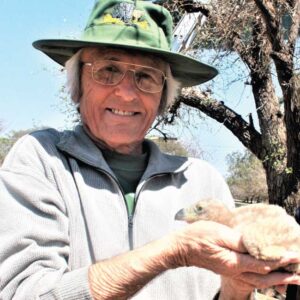
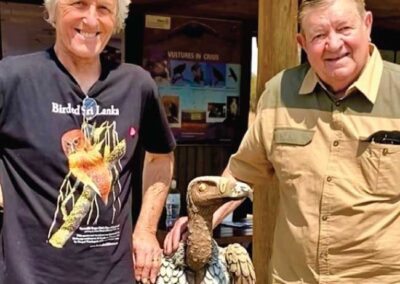
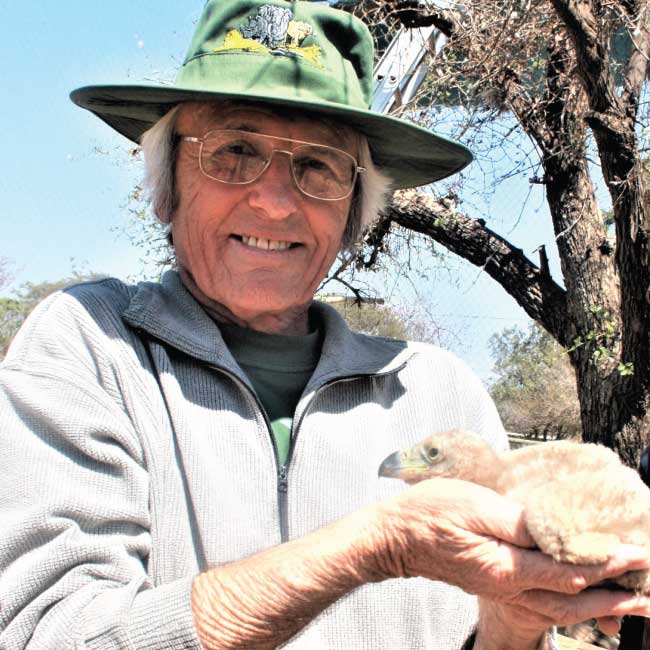
Peter Mundy cradles a baby Palm-nut Vulture hatched at Vulpro. 24 September 2021. Photo: John Ledger.

While numerous tributes to Peter have poured in following his death on 3 February, it is regrettable that he did not get to write his own story, which would have been a fascinating autobiography. This is but a brief tribute to his full and exceptional life.

Born in  London, Peter showed early signs of leadership and self-motivation. In 1957 he became a Queen’ s Scout and attended the World Jamboree. In 1960 he was a member of the British Schools Exploring Society expedition to Iceland, and in that year, he finished his schooling at the Royal Liberty School in Essex, winning a State Scholarship to Worcester College at Oxford University, where he ostensibly studied Zoology for a year.

But, in his own words, “he was not yet ready for such training”, and instead of zoology textbooks, he read Dostoevsky, learnt to play the saxophone, and had a fully wild time. Oxford divested itself of his continued presence. Thereafter followed time at the University of Life, where Peter undertook diverse types of work (including grave-digging) until he became a blues musician in the outfit called ‘Screaming Lord Sutch and the Savages’ . The band toured in Europe, and Peter’ s stories of those days were hilarious and unforgettable. But after a few years, he tired of the frenetic but jaded life of an itinerant musician and managed to get back into university, this time at King’ s College, London, whence he emerged with a BSc (Hons) in Zoology in 1969. He started birding with his university friend Clive Slater (“when we were on a rather boring entomology field course”).

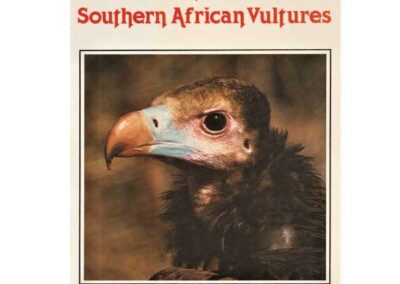
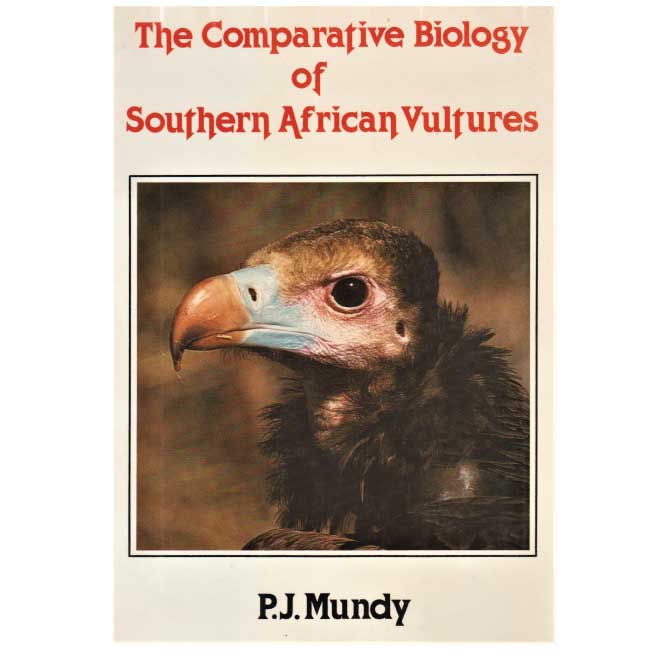
Then followed nearly three years in northern Nigeria, where he was a secondary school teacher (biology and mathematics) at the Government College in Sokoto. Here he became interested in vultures and, with another friend (Allan Cook), studied the Hooded Vultures that were abundant in the heart of the city and had developed a symbiotic relationship with the humans of Sokoto. After that, he became a junior research fellow at the University of Rhodesia in 1972 to pursue a doctoral study on the ‘Comparative Biology of Southern African Vultures’ .

He researched vultures in the north-east of Rhodesia in the Chirisa and Chizarira Game Reserves and the south-east in the Gonarezhou Game Reserve. With his young assistant Gabriel Ruguma, he worked for three years in wild areas full of large and dangerous animals, armed with only a Swiss army knife. His tales about their escapades in the bush were entertaining, to say the least! To fulfil the broad scope of his research, Peter had to include the Cape Vulture (or Cape Griffon as he liked to call it) in his studies, and that brought him to South Africa, the stronghold of the species,  where we met in 1972 and became close friends for fifty years. I had been involved with ringing Cape Vultures with the Witwatersrand Bird Club when I was a student at Wits and a member of the university Mountain Club.

The following year Peter joined our annual expedition to ring Cape Griffon nestlings at Roberts Farm in the Magaliesberg, and with his sharp wit, combative world views, and vigorous usage of strong expletives, had a powerful impact on the young students of the Wits Mountain Club who had never encountered such an unusual character! Over the next few years, ringing efforts were extended to several Cape Griffon breeding colonies at Manoutsa, Colleywobbles (then Transkei), Zastron (Free State), and Botswana.

Peter also had a galvanising effect on several local vulture enthusiasts. Many people were attracted to work for vultures with the enthusiasm that he generated about the hidden charms and unique features of the big birds. The core of the Vulture Study Group (VST) comprised Mundy, Ledger, Russel Friedman (fundraising), Steven Piper (academic/statistician), Duncan Butchart (artist)  and Marilyn Blignaut (secretary). We funded the work of the VSG mainly by selling T-shirts at shopping centres, organised by our entrepreneurial ‘cousin’ Russel, and attracting the inquisitive crowds with a real live vulture called ‘Bonaparte (because of his crippled wing).

In 1976 we started reading about Clive Walker and the Endangered Wildlife Trust in various newspapers, and Mundy said he sounded like ‘the sort of bloke who might give us some money’ . Clive was taken on a heart-stopping climb up the face of the Magaliesberg to see the vultures. He persuaded the Board that these young lunatics deserved support, and I was subsequently appointed as an EWT Trustee in 1976 with a brief to make sure the Vulture Study Group was run with business-like discipline, and it became the first ‘Working Group’ of the EWT.
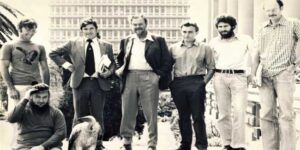
At the South African Ornithological Society (SAOS) Symposium on African Predatory Birds. Peter Mundy, John Ledger, Dr Leslie Brown, Dr Ian Newton, Russel Friedman, Dr Alan Kemp; seated: Steven Piper and ‘Timofy Vulcha’ . Photographed on the steps of the Transvaal Museum in Pretoria by John Cooper, August 1977.

At a South African Ornithological Society (SAOS) symposium on ‘African Predatory Birds’ at the Transvaal Museum in August 1977, we interacted with an audience that included leading specialists like Dr Leslie Brown from Kenya and Dr Ian Newton from Oxford University. Two years later, in 1979, Peter, Russel, and I attended and made presentations at the first International Conference on the Vultures, held in Santa Barbara, California. Our participation put the Vulture Study Group on the international map and resulted in us working with the California Condor Rescue Programme in 1981 and attending a Bird of Prey conference in Thessaloniki, Greece, in 1982.

Peter graduated with a D Phil from the University of Zimbabwe in 1981 and was employed by the EWT as its first Scientific Officer. He later joined the Department of National Parks and Wildlife in Zimbabwe as their Ornithologist and also represented his country at various international meetings such as CITES. Peter and I attended several vulture conferences around the world and met regularly on his visits to South Africa.

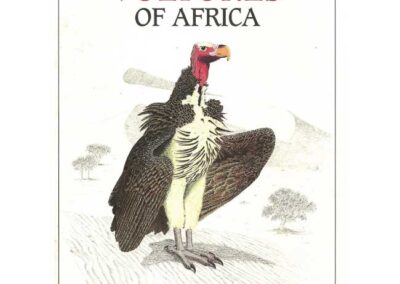
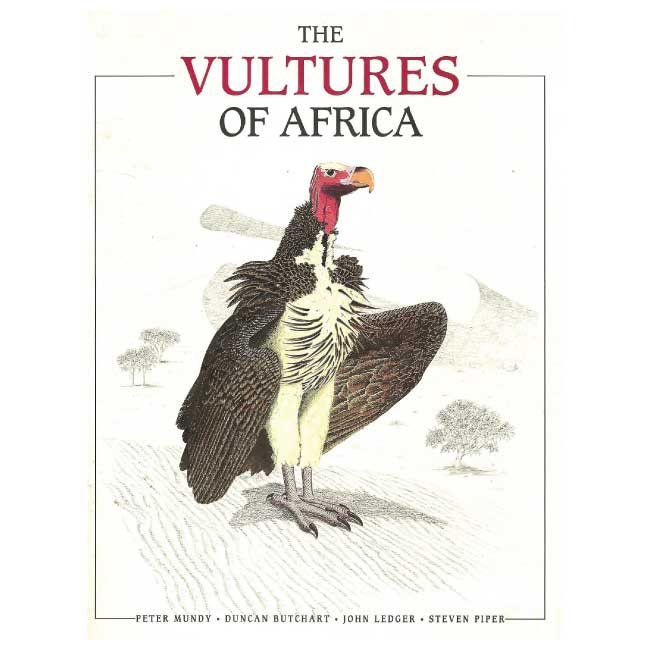
He was subsequently appointed Professor of Forestry and Wildlife at the National University of Science and Technology in Bulawayo, where he played a major role in training young Zimbabweans, many of whom went on to remarkable achievements at the tertiary level and employment in the fields of biology and conservation. He was an excellent and prolific writer and published numerous popular and scientific articles. The ultimate milestone was the publication of The Vultures of Africa in 1992, authored by Peter Mundy, Duncan Butchart, John Ledger and Steven Piper. The citation index for this large 464-page book is remarkable and continues growing to this day.

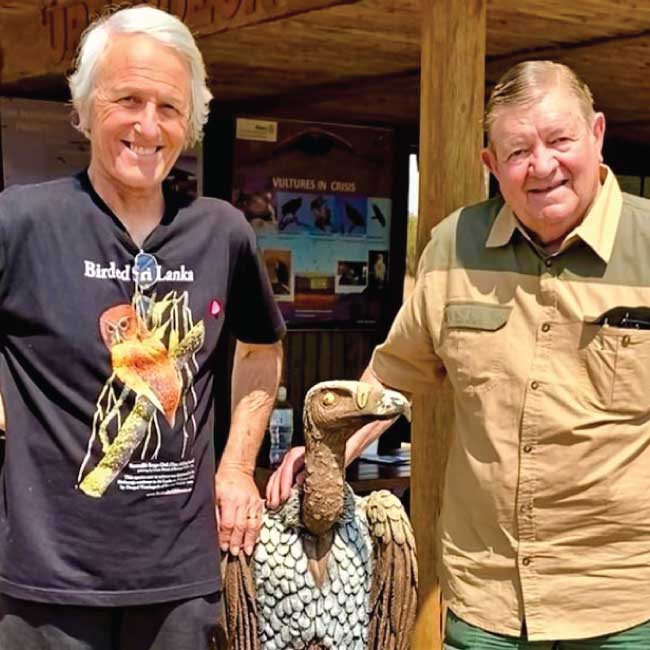
When Peter was diagnosed with cancer, he came to Johannesburg several times for treatment, where we saw one another and also made two rather nostalgic visits to the Magaliesberg in 2021, one to the Nyoka Ridge vulture restaurant on International Vulture Awareness Day on 4 September, and another to Vulpro on  Heritage Day, 24 September. What struck me about these gatherings was how Peter Mundy’ s legacy has inspired future generations of people to appreciate and treasure these great birds and go to great efforts to conserve and care for them. This is a notable achievement that will long be associated with this remarkable man and will hopefully be a solace to his wife Verity and children Matthew and Emily as they come to terms with their loss. I certainly miss him deeply.

A tribute to a beloved pack member – Pat Fletcher

A tribute to a beloved pack member – Pat Fletcher

A tribute to a beloved pack member – Pat Fletcher

Harriet Davies-Mostert

Pat Fletcher, who sadly passed away on 16 June 2022, was a dedicated conservationist who, working behind the scenes, made an indelible mark on the conservation of large carnivores in South Africa. I first met Pat in Johannesburg in April 1999, when I was fresh off the train from Zimbabwe, and on my way to Kruger National Park to start work on the Third Wild Dog Photographic Census. Pat had sourced and kitted out a project vehicle and secured the loan of the palatial Jurgens caravan that was to be my home for the next two years. I quickly came to learn that Pat was the quintessential go-to guy; someone you could always rely on in a bind.

Pat’ s passion for nature and enthusiastic commitment to the Endangered Wildlife Trust belied the fact that he only joined the formal conservation sector in his retirement, after a successful career as a high-end motor vehicle salesman. However, it was his business acumen and worldly perspective that set him apart from the rest of us who had come to conservation through the more traditional channels. Pat was always hunting for the best deals and was never afraid to ask for a discount (or push you to ask for one!). This made an enormous contribution to the sustainability of the (then) Carnivore Conservation Group – first under the leadership of Dr Gus Mills, and later when I had the good fortune of managing the programme. Pat also cared deeply about people: he took the time to get know everyone – from the most junior staff to the wealthiest donors – and he was always genuine and authentic. There was always a long line of people outside his office hoping to get some advice; much of the time this had nothing to do with our work!

Pat could also put up a good fight, and I remember several occasions when we would storm off in opposite directions to cool off after an unsettled altercation. But he also moved quickly to reconciliation, citing the maxim: “if two people always agree then one of them is redundant”. I regularly repeat this piece of wisdom to myself – and every time I do, I think of Pat and the lasting legacy he left on myself and so many others.

I am saddened deeply by the fact that Pat is no longer with us.

Wendy Collinson

I first met Pat in 2006 when I interviewed for a volunteer position working on the Venetia Limpopo Wild Dog Project. We sat on a bench by the zebra pen at the old EWT premises at the Joburg Zoo. Pat spent most of the interview chatting about English football. I was amazed that I got the position as I told Pat I didn’ t like football. Pat was so welcoming to me when I joined the EWT and I remember him fondly.

From all of us at the EWT, those who knew him and those who have heard the legends, we salute you Pat. Our sincerest condolences to Pat’s friends and family – he will be remembered fondly as someone who left a true legacy for life.

Leaving a legacy of life – Remembering Melanie Kwan

Leaving a legacy of life – Remembering Melanie Kwan

LEAVING A LEGACY FOR LIFE – Remembering Melanie Kwan

On 2 May three years ago, Melanie Kwan passed on but made sure that the EWT was included in her will. Her nephew Jayden, aged 12, wrote these wonderful words of tribute to Melanie.

“Melanie always loved animals and saving them! She had cancer but that did not stop her from loving animals. She always appreciated animals just the way they were, and not the way she wanted them to be. Every week she would go to the animal shelter and take a few hours out of her day to help them even though she was not well. She loved going to the Kruger National Park and the Kgalagadi Transfrontier Park when she was well enough to go. She was brave and independent and her very last trip to the Kgalagadi Transfrontier Park was on her own.

When the time came to write down her will, Melanie decided to donate everything for the love of animals and dogs. She chose the EWT because she wanted to forever take care of animals in the wild even though she knew she could not do that herself. The money will help those animals who are always being killed. I want my own children one day to be able to see those animals that God created.

We love you Aunty Melanie and appreciate all the time and effort and money that you put into animals. Thank you Aunty Melanie!”

LATEST STORIES

A legacy of life – in memory of Phil Roberts

A legacy of life – in memory of Phil Roberts

LEAVING A LEGACY OF LIFE – IN MEMORY OF PHIL ROBERTS

Oldrich van Schalkwyk

We met Phil and Sue Roberts in 2012 when they came to the Soutpansberg on an Earthwatch Expedition, and it was immediately apparent that they had a great love for nature, in particular, big cats like Leopards, and a great love for South Africa – Sue has family in South Africa, an aunt and uncle who they used to visit, they also had a great love for people. We visited some local schools where Phil entertained the small kids by shaking a pencil up and down, so it looks like it was made out of rubber, and they just loved that. One night we got talking around a campfire about conservation and the plight of the Leopards on the mountain, and it was quite apparent that they were concerned and looking for solutions to stop the decline in large predator numbers, and to protect the mountain. We stayed in contact and shortly after that they asked us to start searching for land because they were excited about the prospect of putting some money together so that we could conserve large conservation areas in the Soutpansberg, and so we became great friends. On their subsequent visits to the mountain, their lust for life and their care for the environment and people was incredibly infectious, and through their tenacity to get more people to contribute towards the conservation of the mountain, they became the catalyst of what is now known as the Soutpansberg Protected Area. We were incredibly blessed to have met them and privileged to know them. Judy and I will sorely miss Phil – he was such an inspiration to us all with his energy and love for life. Phil’ s contribution to catalysing the Soutpansberg Protected Area will be a lasting and living legacy and the people and wildlife reliant on this unique and beautiful landscape and who call it home are forever in his debt.

In memory of Brian Bradford Goodall

In memory of Brian Bradford Goodall

IN MEMORY OF BRIAN BRADFORD GOODALL


On Sunday 27th June 2021, Brian Goodall, Chair of the Lewis Foundation, loving husband to Lesley, father to Tiffany, Andrew and Peter-John and an adoring grandfather, passed away at the age of 78.

Brian was born on March 27th, 1944.  He matriculated from Jeppe High School for Boys with a first-class pass.  His leadership skills were already apparent as Head Prefect, Captain of the Rowing, House Athletics and Cricket with a basket of leadership and academic prizes.  He attended three universities, graduating with a BA from the University of Natal, a first-class Honours from Wits and an MA from UNISA.  He was a life-long learner and always willing to share and teach.

Brian joined Standard Bank in 1966, where his passion for finance and investment was kindled.  He moved from there to ESE Financial Services and in 1970, Brian and two colleagues formed their own economics and financial consultancy company.  Five years later they sold out to join Syfrets Trust.  Alongside his passion for finance and investment, Brian was developing a career in politics.  His charm and people skills, combined with an intense aversion to the apartheid regime resulted in him winning the Edenvale Parliamentary seat for the Progressive Federal Party in 1979.  This was the first Parliamentary by-election defeat for the National Party. He resigned from Syfrets to pursue a full-time political career and held the seat till 1987 when he lost to Joan Hunter. Undeterred he retook the seat in 1989 and held it until he was elected to the Provincial Parliament of Gauteng as Leader of the DA Caucus and spokesperson on Economic Affairs.

His interest and love for finance could not be ignored however and in 1985 Brian founded Investment Management Services (IMS).  Alongside this he wrote and published several articles on investments and tax.  He was the author of textbooks on investment planning and co-author of the “Momentum Tax and Investment Easiguide” and the “South African Financial Planning Handbook.”

Brian remained actively involved in his company and his writing until his death.  Andrew, his son, joined the company a few years ago and will continue to grow and build on his father’ s impressive legacy.

Brian was a man of many facets.  He loved wildlife and the bush and would spend time with his family and friends at his game lodge whenever his schedule allowed.  So, when the opportunity arose in 2002 to join the Lewis Foundation as a Trustee, he was delighted.  He shaped the Foundation’ s investment policies resulting in significant growth of the endowment.  He took the helm as Chair in 2010, bringing his insight, creativity and lateral thinking to the table and broadened the outlook of the Foundation.  His greatest contribution was himself.  He was passionate, enthusiastic, positive, forward-thinking, empathetic and committed.  No matter what the organisation or the Foundation had to face, with Brian at the helm, we knew he would see the silver lining and there would be a way through, a plan and a strategy to overcome.  He served the Lewis Foundation for 20 years and will be sorely missed. But his legacy will live on through the programmes and projects of the Foundation and the many young people it has funded and nurtured.  Our thoughts and prayers are with his wife Lesley and the Goodall Family.

The Conservation sector has lost a great champion but his legacy will continue.

Dr Pete Zacharias – Trustee and Chair

Dr Shafika Isaacs – Trustee

Derek Engelbrecht – Trustee

Lindy Rowell van Hasselt – Relationship Director