South Africa’s National Crane Census 2026
547 people took part in South Africa’s
National Crane Census in July 2026

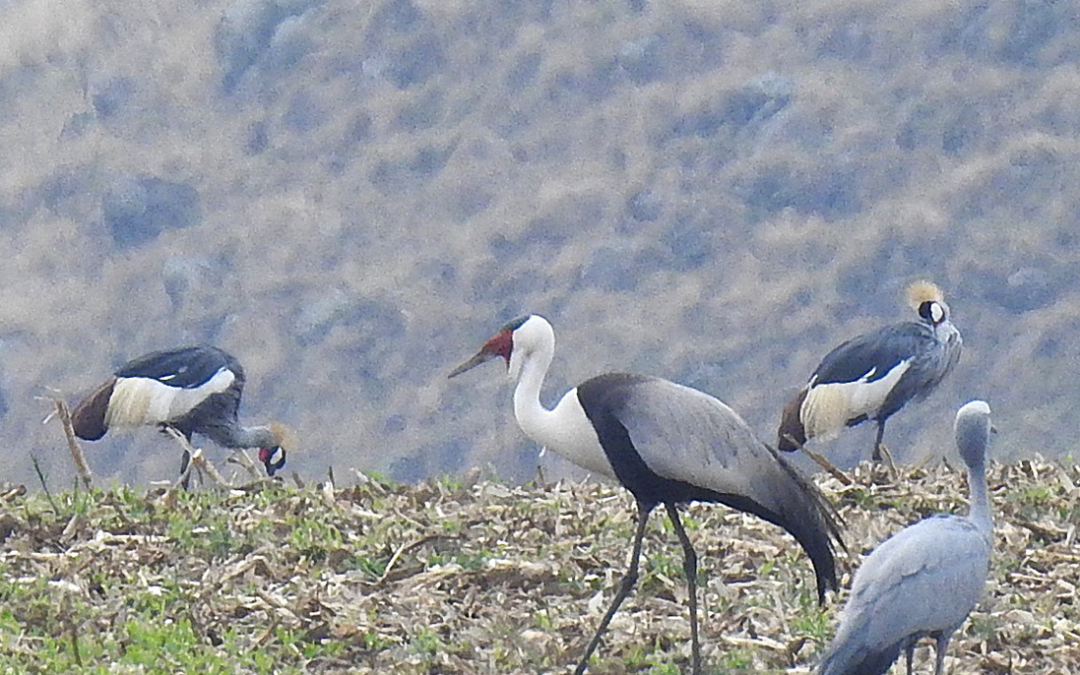
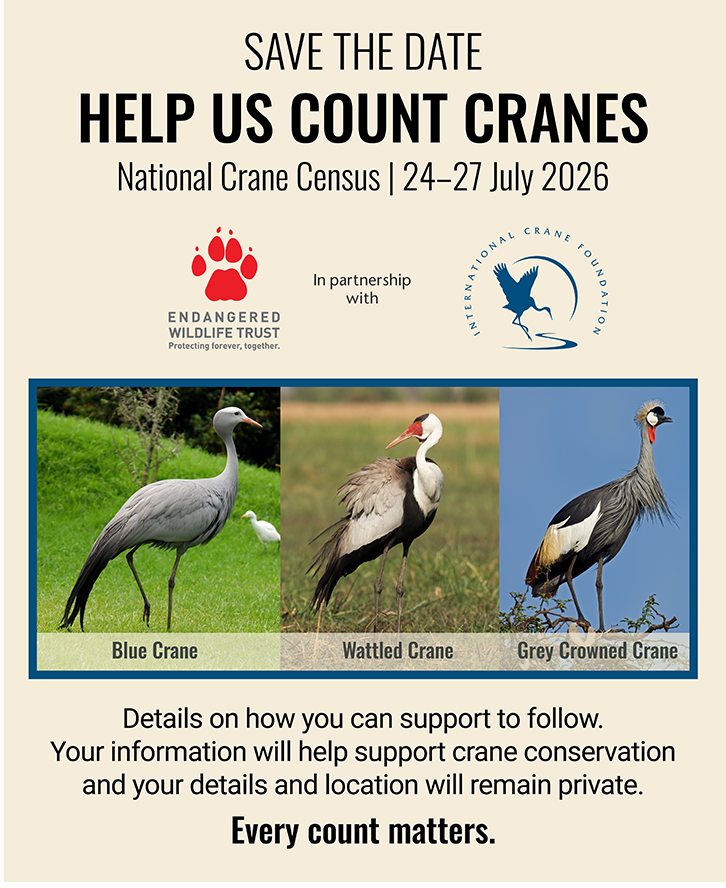
Left: Wattled Crane and Right: Grey Crowned Crane
A total of 547 South Africans took part in South’s Africa’s first National Crane Census in 20 years in July, reporting sightings of 18,888 Blue, Wattled and Grey Crowned Cranes on farmlands, in wetlands, open spaces and conservation areas across the country.
These sightings were recording during the Endangered Wildlife Trust / International Crane Foundation National Crane Census in July 2026 under the banner of “Every Count Matters”.
The National Crane Census in South Africa relied on citizen science to provide vital information to estimate population size and to update distribution maps across the different species ranges. Unlike in the past where participants had to complete forms that were only available in certain places, or posted, people were thus time able to make use of their cellphones to submit the number of cranes together with a location. This made it easier for any member of the public to participate in the 2026 census.
South Africa’s crane species
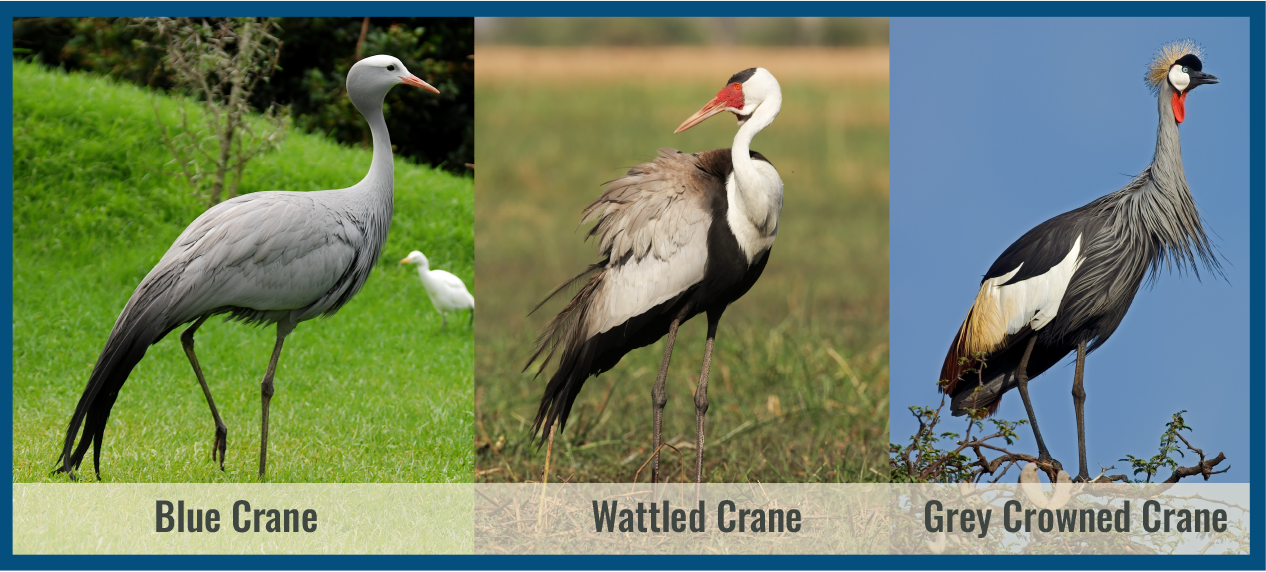
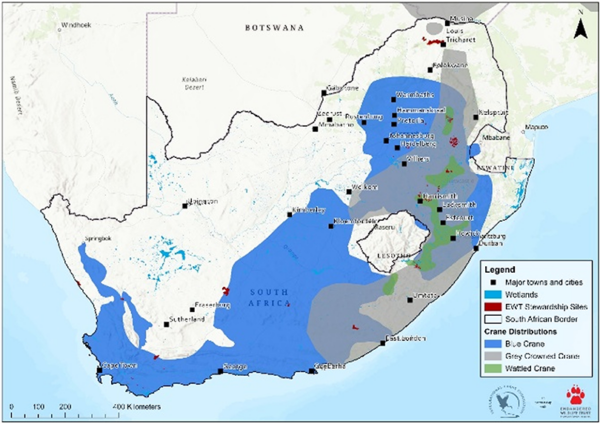
South Africa is home to three crane species – the Blue Crane, Wattled Crane and Grey Crowned Crane – with the Drakensberg range being a global hotspot for all three species. Since the last National Crane Census 20 years ago, the EWT/ICF partnership has been conducting localised aerial surveys that indicate that the populations of the three species are increasing in KwaZulu-Natal, but that all three species are declining in other areas. The Blue Crane, South Africa’s National Bird, was uplisted from Near Threatened to Vulnerable in the 2025 Red Data Book of Birds of South Africa, Lesotho and Eswatini reflecting growing concern about the species’ future. Concerted and targeted conservation efforts in the Drakensberg have seen the Wattled Crane downlisted from Critically Endangered to Endangered, while the Grey Crowned Crane is listed as Vulnerable in the SA Red Data Book.
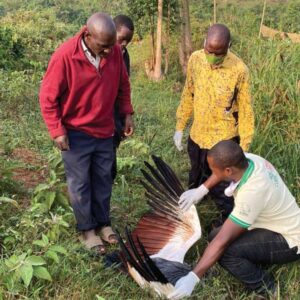
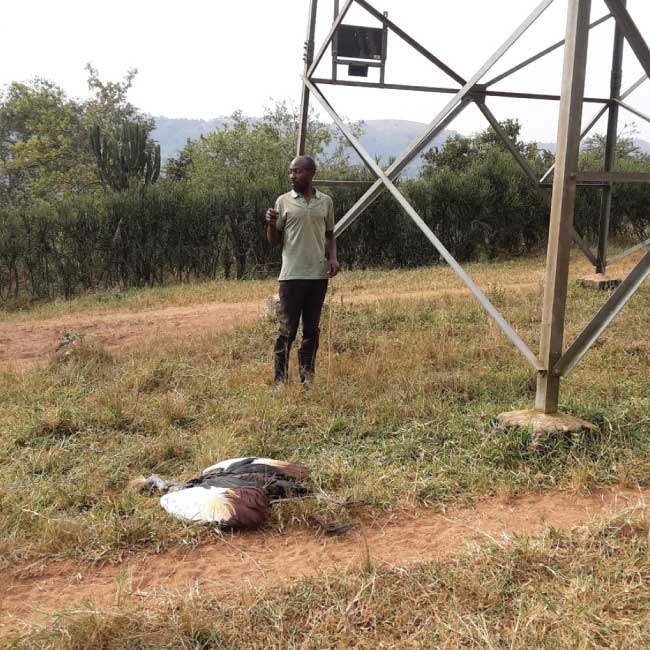
Wattled Cranes are good indicators of the health of the environment, particularly wetlands and grasslands. Cranes are among the world’s most culturally significant birds, including in South Africa. They are widely associated with longevity, wisdom, fidelity, peace, vigilance, and hope, making them powerful ambassadors for both natural and cultural heritage. Considered a flagship species for conservation, the habitat for these majestic birds is being destroyed by mining, development and overuse. This includes collisions with power lines and other infrastructure.

Left: Wattled Crane and Right: Blue Crowned Crane
What did Citizen Scientists see?
The largest flock of more than 500 Blue Cranes was spotted on a harvested pivot field near Groot Brak Rivier in the Western Cape, while a flock of more than 150 Grey Crowned Cranes was recorded at Himeville in KwaZulu-Natal.
In KwaZulu-Natal, Mpumalanga, Free-State and Eastern Cape where more than one species of crane occur, 22 people were lucky enough to see all three South African crane species during the census. Ninety-six people saw two crane species, mainly Grey Crowned Cranes and Blue Cranes.
One person was lucky enough to see the hybrid Blue Crane-Wattled Crane juvenile, which was incredibly useful information as we did not know where the juvenile had gone since being colour-ringed. It was sighted 200km from the site where it was raised by mixed species parents – a Blue Crane and a Wattled Crane.
In addition, three colour-ringed cranes were recorded during the census – one in Mpumalanga, one in KwaZulu-Natal and one in the Free State. This information is important for us to understand the movement of cranes, which is possible by comparing the areas where the colour rings were first placed on the cranes and where they were located during the census. The EWT has been placing colour rings on the legs of some cranes over the years, but it has been challenging to sight them again due to the distances that cranes can move after ringing has taken place.
The census has got South Africa talking about and caring about cranes. This is important to the conservation of species that occur almost entirely on privately owned land. The data itself has given us information about where cranes occur. collected has provided us with valuable data to guide future conservation actions and management decisions for the benefit of cranes. This was especially useful for the rare Wattled Crane, where the sightings submitted have shown us new areas where Wattled Cranes occur, helping us direct conservation attention to this Endangered species.
The results
There was a total of 970 sightings submitted to the EWT/ICF census, 300 of which were sent before and after the four-day census period of 24 to 27 July. We were able to map 824 sightings that were accompanied by coordinates. Unfortunately, some of the records had to be removed, if the species or location information was missing or incorrect.
In the final dataset, Blue Crane sightings numbered 13,172, Grey Crowned Cranes 4,944 and Wattled Cranes 384. Although South Africa counted a total of 18,888 cranes across the country, 388 cranes had to be left out as their species was not specified. The majority of cranes were counted in KwaZulu-Natal with5,913 cranes, followed by the Eastern Cape with 4,161 and the Western Cape with 3,441.
Records by Province:
| Province | Blue Crane | Grey Crowned Crane | Wattled Crane |
| Eastern Cape | 3,399 | 743 | 6 |
| Free State | 1,362 | 251 | 9 |
| KwaZulu-Natal | 2,345 | 3,321 | 245 |
| Mpumalanga | 440 | 109 | 6 |
| North West | 2 | ||
| Northern Cape | 287 | ||
| Western Cape | 3,322 |

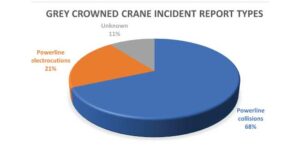 The percentage contribution of incidents by various electricity power line categories. The