Help from above: Feathered rangers take to the sky
Help from above: Feathered rangers take to the sky
By Dr Gareth Tate, manager: Birds of Prey Programme
A critical challenge in wildlife conservation is swiftly locating and responding to poisoning events. Early detection and prompt decontamination can dramatically reduce further wildlife loss, save surviving animals, and enable law enforcement to act quickly. To combat this threat in southern and east Africa, the Endangered Wildlife Trust (EWT) has harnessed the natural behavior of vultures and cutting-edge GPS-tracking technology to create a rapid poisoning detection system called Eye in the Sky.
This innovative system monitors the movements of GPS-tracked vultures to remotely detect poison sources and feeding events linked to poached or poison-laced carcasses. By reducing the time between detection and response, we aim to enhance the efficiency of law enforcement and response teams, ultimately protecting more wildlife.
Now in its third official year, the Eye in the Sky project leverages the extraordinary foraging lifestyle of African vultures and state-of-the-art GPS tracking technology to protect these vital scavengers and other threatened species. Our Birds of Prey Programme team monitors over 120 tracked vultures across the Greater Limpopo Transfrontier Conservation Area, using near-real-time alerts to respond to feeding events and immobility alarms. The impact of our feathered rangers has been remarkable.

The capture locations and GPS tracks of the GPS-tagged vultures, deployed as part of our Eye in the sky project, across poisoning hotspots of southern Africa.

Above: A heatmap showcasing the current coverage obtained from our GPS tracked sample of vultures deployed as part of our Eye in the sky project, across poisoning hotspots of southern Africa.

Above: Our Eye in the Sky system has reached a significant milestone with its seamless integration into the EarthRanger platform. Above is a screenshot of the EWT EarthRanger instance shared across partners, with a basic visual and geographic summary of partners set up and using the Eye in the Sky system effectively across our target project sites.
Over the past year, a significant effort has been devoted to detecting poisoning events and poison bait sources using our system’s immobility and feeding alerts. Since May 2023, we have identified 37 poison sources across our project sites. Early detection and prompt decontamination have been crucial in safeguarding many scavenging wildlife species. We have rescued, rehabilitated, and released over 80 vultures back into the wild — birds that would have otherwise succumbed to ingested poisons.
Despite these successes, challenges remain. In early March 2024, over 80 vultures were poisoned in northern Kruger National Park due to delays in response. This tragic event underscores the need for continued improvements in our rapid detection system and response protocols.

Results from follow-ups to alerts generated by our Eye in the Sky system from January 2023 to December 2023 offer compelling evidence of the system’s effectiveness in identifying crucial illegal wildlife activities and points of interest. This includes the detection of 37 poison sources/events,36 poaching camps, as well as the detection and removal of 3,049 snares across our project sites. Notably, 1,937 of these snares were found still set and untriggered, underscoring the potential threat posed to wildlife. The system has proven instrumental in mitigating harm, showcasing its vital role in conservation efforts.
However, the effectiveness of our rapid detection system has been demonstrated by our ability to intercept potential mass poisoning events. At eight vulture alert sites, poison sources were detected before any wildlife fatalities occurred, showcasing the robustness of our monitoring and alert systems in protecting wildlife.
Besides enhancing our ability to detect snare lines so they can be removed, we have in the past year also detected 36 poaching camps where rangers have seized bushmeat, equipment, and poisons, disrupting illegal activities and trade.
At a time when there appears to be an increase in the targeted snaring and poisoning of lions and hyenas for their body parts, used in traditional medicines, the Eye in the Sky system is making a significant impact on lion and hyena conservation efforts, either by augmenting or improving existing initiatives.
Throughout the past year, the Eye in the Sky system has led to the detection and removal of 3,049 snares across our project sites.
Our teams’ persistent presence in landscapes the Greater Kruger has led to a discernible reduction in illegal wildlife activities, marked by fewer instances of poisoning and snaring events. This ongoing commitment reflects our dedication to fostering a safer environment for the region’s wildlife and underscores the positive impact of sustained conservation efforts.
A significant emphasis has been placed on rescuing vultures that survive poisoning events within Kruger National Park. Thanks to a growing network of veterinarians and a partnership with the Moholoholo Animal Rehabilitation Centre in Hoedspruit, we have rescued over 120 vultures since 2017. Over the past year, we achieved a 100% survival rate for vultures rescued from poisoning events, demonstrating marked improvements in our response, treatment protocols, and rehabilitation processes. This success is complemented by our first vulture ambulance, currently deployed in the Greater Kruger.
The Eye in the Sky project is a testament to the power of innovation and collaboration in wildlife conservation, offering hope for the future of southern Africa’s endangered species.
** The EWT would like to thank our donors, the Mohamed bin Zayed Species Conservation Fund, National Geographic Society, Alu-Cab, the Charl van der Merwe Tryst and the Briandez Legacy Trust for your support on this programme.

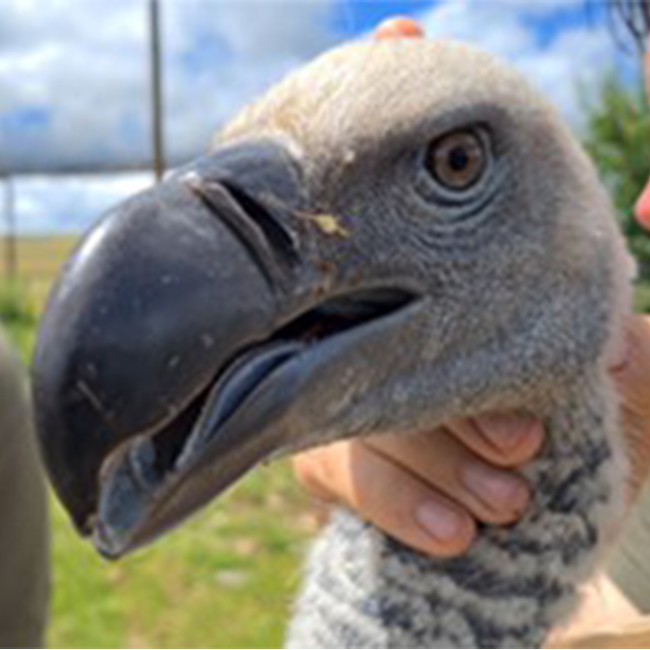
A white-backed vulture fitted with a tracking unit and deployed as one of our Eye in the Sky feathered rangers.

An adult Cape Vulture fitted with a GPS tracking device, ready to be deployed for the Eye in the Sky system
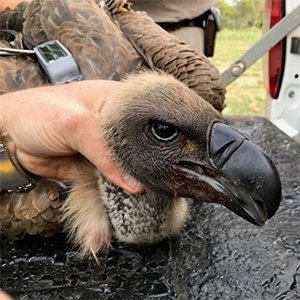
A white-backed vulture fitted with a tracking unit and deployed as one of our Eye in the Sky feathered rangers.