TALE FROM THE FIELD
The impact of roads through Zululand’ s protected areas: A two-year tale
Cameron Cormac, EWT’s Wildlife and Transport Programme and University of KwaZulu-Natal
The Zululand region of South Africa’ s KwaZulu-Natal Province is home to several historically important game parks. South Africa’ s conservation history has its origins in this region, with many of the country’s nature protection agencies stemming from the original parks board created to oversee South Africa’ s original game parks. Rhino protection activities also originated from this area, with global rhino protection following the region’ s example. Furthermore, these game parks are important to the Zulu people, as many house culturally significant locations. In addition to many of the reserves in Zululand being of historical and cultural importance, they act as a major source of income for this relatively poor region of South Africa.
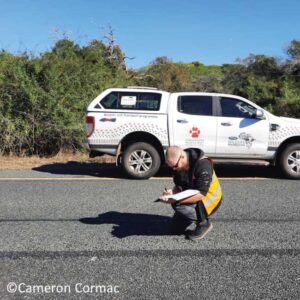
Collecting carcass information during road surveys.
My PhD research, through the University of KwaZulu-Natal, working with the Endangered Wildlife Trust and Ezemvelo KwaZulu-Natal Wildlife, examined the effects of linear infrastructure on wildlife. I spent over 1,000 hours between February 2021 and April 2023 surveying two provincial roads that pass through Hluhluwe-iMfolozi Park (HIP) and iSimangaliso Wetland Park (ISWP). These surveys aimed to determine how animals were affected by these roads, to find out what species had the highest death tolls, and how the roads could be adapted to reduce the number of animals killed on the roads.
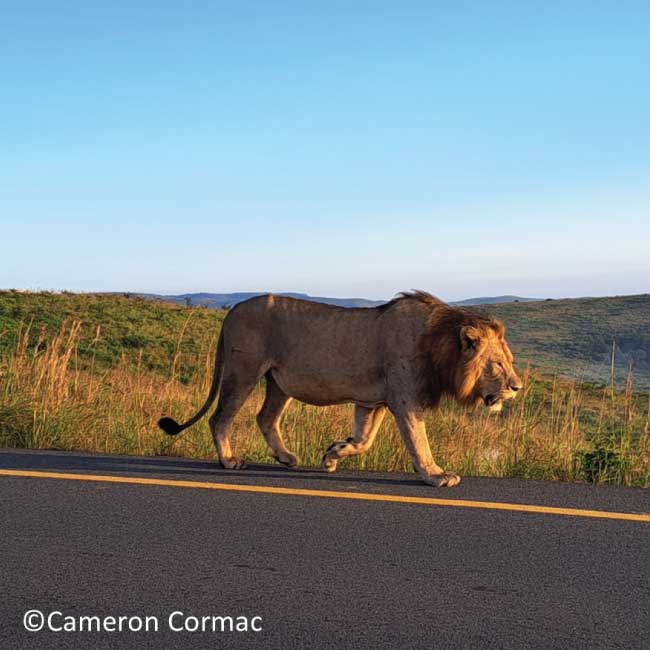
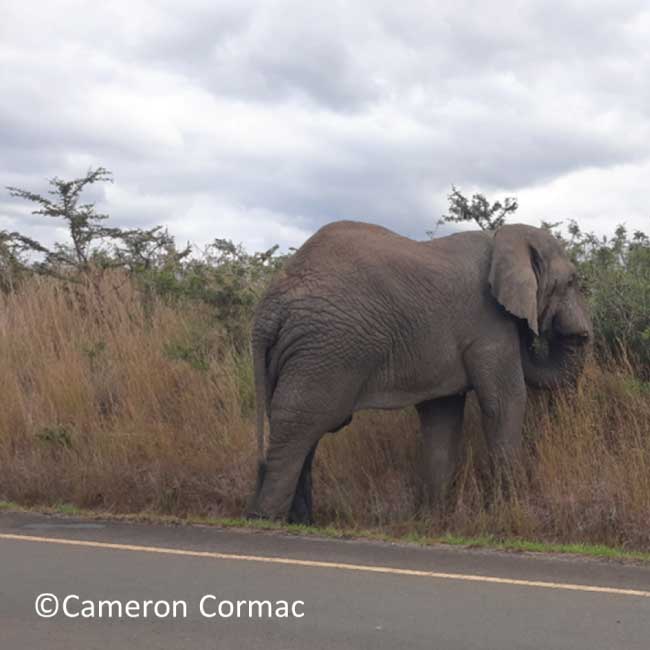
In HIP, South Africa’ s oldest protected area, the R618 passes through the younger section of the reserve, which was created to serve as a corridor to conjoin the previously separate Hluhluwe and iMfolozi Parks. Currently, the road serves as the boundary between the two sections of the park, gaining the nickname ‘Corridor Road’ . The R618 also joins the Zululand municipalities of Mtubatuba and Hlabisa and is the connection point for entry through HIP’ s Nyalazi gate. Overall, approximately 18 km of the R618 falls within the park’s boundaries and experiences a relatively high frequency of vehicle traffic. When travelling on this road, motorists are regaled by the stunning landscapes within the mostly mountainous portion of HIP and have the chance to glimpse some of South Africa’ s most iconic species, such as Lions (Panthera leo) and African Elephants (Loxodonta africana).
-

Lion on the road in Hluhluwe-iMfolozi Park
-

Bull African Elephant eating grass on the road verge in Hluhluwe-iMfolozi Park
However, because the road is a man-made barrier across what would otherwise be a single continuous ecosystem, there are incidents of wildlife-vehicle collisions along its length. Most of these encountered during my surveys were vehicle collisions with small species (below 1 kg in body mass). However, the incidents did include animals of all sizes, from frogs as tiny as a thumbnail to fully grown bull Cape Buffalos (Syncerus caffer caffer). Over two years, I encountered many live animals on the ‘Corridor Road’ , some slightly too close for comfort. However, I also found over 500 animal road mortalities. Thanks to road maintenance activities that ended in September of 2022, I saw first-hand how effective smartly placed speed bumps, a properly maintained road surface, and drivers being forced to obey speed limits can reduce animal mortalities.
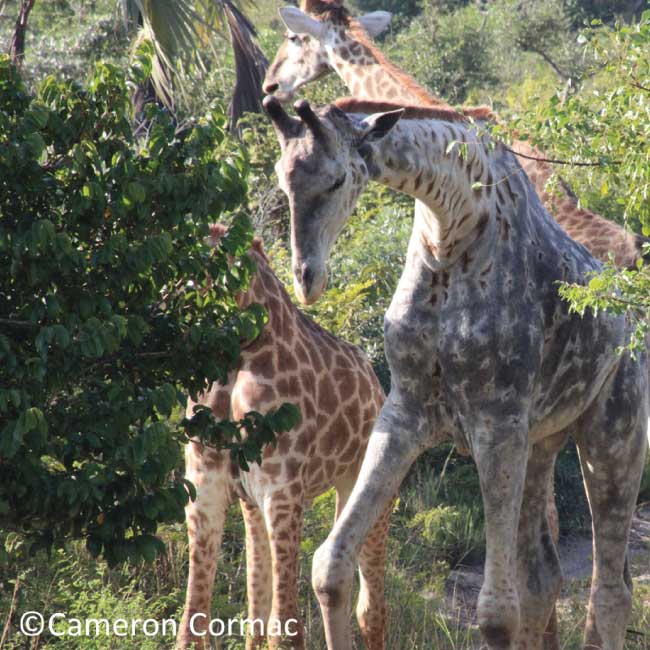
A very different tale unfolded in ISWP, one of South Africa’ s largest reserves, a UNESCO World Heritage Site, and a wetland of global significance. The KwaJozana section of ISWP that borders Phinda Private Game Reserve is split by the R22, another important provincial road that is one of the main connection points between South Africa and Mozambique. Approximately 15 km of the R22 lies between the boundary fences of ISWP, although, unlike the road in HIP, there are no speed bumps, hills, scenic vistas, or large iconic mammals to entice drivers to slow down or pay attention to the road. However, a collection of various below-surface structures, such as culverts and bridges, do allow animals to cross safely and are placed roughly every 400 m. The route also passes next to, and straight through, multiple seasonal wetlands. Despite the road being monotonous in the surrounding habitat and devoid of easily visible wildlife, I had a few exciting animal sightings, such as a rare partially leucistic giraffe (Giraffa camelopardalis). However, I was often met with animal road mortalities. Over 1,000 animal mortalities were found, with multiple mass frog death events observed during the surveys in this area.
-

Partially leucistic giraffe (Giraffa camelopardalis) seen in iSimangaliso Wetland Park.
-

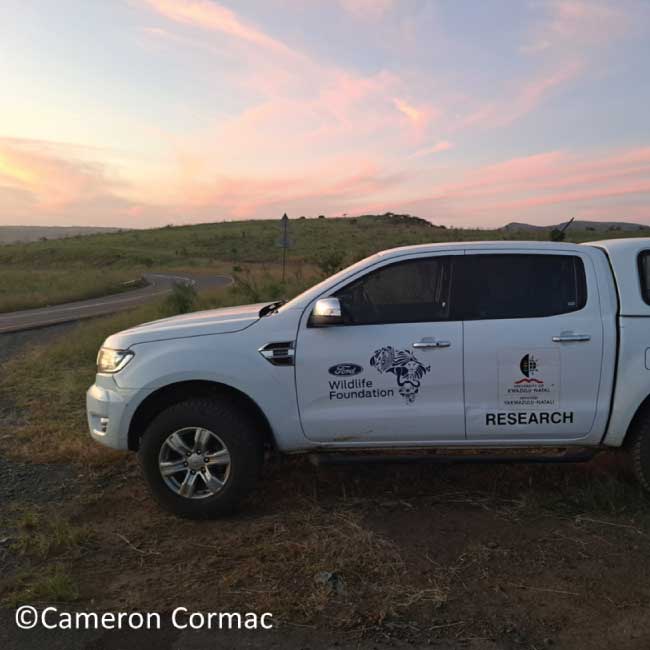
Ford Wildlife Foundation sponsored research vehicle
With over 1,500 collective wildlife-vehicle collisions recorded, there is an apparent need for intervention, particularly along the ISWSP section of the R22. The next step of my project is to collate all my data and determine what type of interventions would most effectively mitigate the threat of passing vehicles to animals when they attempt to cross these roads. Although the example of the newly placed speed bumps and resurfaced road in HIP provides hope, it does not take drastic enough measures to have a noticeable effect on the number of animals that die along the route. The simplest solution would be for all drivers to be more aware of their surroundings and obey the speed limit, giving crossing animals more time to avoid passing vehicles.
This project would not have been possible without the generous support from the Ford Wildlife Foundation and the National Research Foundation. Consider contributing to the Endangered Wildlife Trusts’ ongoing attempts to understand and reduce the threats posed by roads on South Africa’ s wildlife using the EWT Road Watch South Africa app (found in the Google Play Store and the iStore). You can help conserve our wildlife by recording wildlife-vehicle collision events and uploading photographs and locations of roadkill you find along South Africa’ s roads on the App.