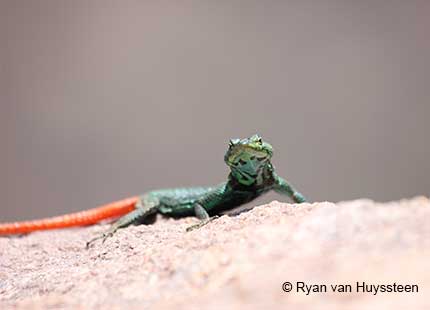
Reptile Awareness Day Shines Spotlight on Western Cape’s Scaled Biodiversity
This Reptile Awareness Day, we celebrate the remarkable diversity found at Lettas Kraal Private Nature Reserve in the Anysberg region. The Western Cape boasts 155 reptile species, with 22 found nowhere else on Earth. Situated in the transitional zone between mountain fynbos and Klein Karoo veld, Lettas Kraal’s 7,000 hectares provide critical habitat for 54 reptile species – 31 of which were recorded during a 2020 survey by EWT’s Drylands Conservation Programme.
Notable Species at Lettas Kraal
The reserve protects both common and threatened reptiles including:
- Endangered Karoo Dwarf Tortoise (Chersobius boulengeri) – IUCN Red Listed
- Karoo Sand Snake (Psammophis notostictus)
- Western Sandveld Lizard (Nucras tessellata)
- Bibron’s Thick-Toed Gecko (Chondrodactylus bibronii)
- Karoo Dwarf Chameleon (Bradypodion gutturale)
Reptile Awareness Day Initiatives
Our educational event for Anysberg landowners and farmworkers covered:
Identification of local reptile families
- Venomous snake awareness and bite first aid
- Myth-busting about snake behaviour
- Dangerous arachnid recognition (spiders/scorpions)
- Hands-on encounters with common species
Why This Matters
As former EWT Field Officer Jean-Pierre Le Roux notes, Lettas Kraal’s size makes it invaluable for reptile conservation. The reserve:
- Protects vulnerable endemic species
- Provides corridors between habitats
- Offers research opportunities
- Educates local communities
This Reptile Awareness Day, we encourage everyone to appreciate these often-misunderstood creatures that play vital roles in our ecosystems.
Learn more:
Lettas Kraal Nature Reserve
EWT Drylands Programme
Water for Life: Transforming Health and Conservation in Kutama
The Water for Life initiative, a partnership between the Endangered Wildlife Trust and Coca-Cola Foundation’s RAIN programme, is tackling critical water, health and sanitation challenges in Kutama near the Soutpansberg mountains. This holistic project addresses two fundamental needs: clean water access and menstrual health education.
The Twin Crises We’re Addressing
- Water and Sanitation
- Diarrhoeal diseases caused 1.6 million deaths globally in 2017 (Our World in Data)
- Many communities lack clean water for basic handwashing
- Our school programmes teach germ transmission and proper hygiene
- Menstrual Health
- 400 secondary school girls receiving reusable sanitary pads
- Focus groups providing vital health education
- Combating stigma while reducing waste (Ecological impact research)
Water for Life: Environmental Benefits
The initiative extends beyond immediate human needs:
- Alien plant clearing improves watershed function
- Reduced sanitary waste protects ecosystems
- Healthier communities support conservation efforts
See EWT’s Work in Action
Discover more about our Soutpansberg conservation work in our Forgotten Mountain video.
For project details, contact Dr Jenny Botha: jennyb@ewt.org.za

FUTURE FIELD GUIDES FOR NIEUWOUDTVILLE
JP le Roux, EWT’ s Drylands Conservation Programme Field Officer, jeanpierrel@ewt.org.za
The town of Nieuwoudtville is situated in South Africa’ s Northern Cape, on the Bokkeveld Plateau. This region is known as the “bulb capital of the world” because it has the highest number of indigenous bulbous flower species on Earth. The Bokkeveld Plateau is also home to Papkuilsfontein, https://papkuilsfontein.com/, a farm in the process of being declared a Protected Environment. This initiative is part of the GEF 5 Sustainable Land Management (SLM) Project.
Although Papkuilsfontein is a commercial sheep and rooibos tea farm, the Van Wyk family farm has always put conservation at the forefront of farming activities. The family also diversified their income by venturing into tourism, renovating several historical buildings into quiet retreats for guests, and more recently developing hiking and mountain bike trails in collaboration with the EWT. While sustainable land management and biodiversity conservation are priorities, providing employment opportunities is also high on Papkuilsfontein’ s agenda, as this is an important function in rural regions such as this, where employment opportunities are limited.
As part of the project, the EWT and Papkuilsfontein are training two local community members, Dustin Gouws and Jeraldo Skippers, as Apprentice Field Guides (NQF2) through FGASA. We have provided them with tablets and guiding books, are mentoring the aspiring guides to get their qualifications, and doing weekly contact sessions to ensure their studies stay on track.
Aside from the theory component, Apprentice Field Guides need to have sound knowledge of the history, geology, plants and animals in the specific area of their guiding operation. To achieve this, we assist the guides with various training events and take them on practical excursions in and around the Nieuwoudtville area. The trainee guides have had an action-packed year and completed a diverse range of training interventions, including their Introduction to Guiding, First Aid (Level 1 and 2), Plant Identification, photography, and planning guided tours.
On 5 August 2021, Bonnie Schumann, EWT’ s Nama Karoo Coordinator, hosted a practical training session for the two trainee guides at Papkuilsfontein. The training focused on using camera traps to assess animal biodiversity in the area so that the aspiring guides can learn which mammals occur there. Camera traps are great as they offer an effective non-invasive monitoring method to assess the species richness of medium to large terrestrial mammals and capture images of elusive nocturnal species. The camera trap survey will be aimed at capturing images of the 36 mammal species that can be found on the farm, which include Leopards, Black-backed Jackals, Silver Foxes, Bat-eared Foxes, Smith’ s Red Rock Rabbits, Porcupines, duikers, Cape-clawless Otters, Pole Cats, baboons, Rock Hyraxes, Klipspringer, and Aardvarks. The training started early at the Papkuilsfontein reception. The large and informative map details the vegetation types, topography found on the farm, points of interest, and the hiking and biking trails. Bonnie used this as an opportunity to discuss where best to place cameras, taking into account what animals might be found in the different habitats. It is important to cover all the different vegetation and habitat types when placing cameras as these determine which species occur where. After a quick cup of Outliers coffee, http://outlierscoffee.co.za/product/endangered/, an introduction to using a GPS and setting up a camera trap followed.
We spent the whole day on the farm placing ten cameras in the different areas. Being out in the field offered great opportunities to explore, interpret what we found, and discuss the patterns and processes such as nutrient cycling and the role of pioneer plants. A lucky sighting of a Black Spitting Cobra opened a great discussion on snakes, their role in the environment and relevant first aid. The cameras will be left for about eight weeks, after which the guides will assess the footage and learn to use Google Pro to plot their discoveries. The camera trap survey will also directly contribute to a better understanding of the biodiversity richness of the area. Stay tuned to find out what we capture. The GEF 5 Sustainable Land Management Project https://karooforever.org.za/ is implemented by the Endangered Wildlife Trust’ s Dryland Conservation Programme (EWT) and is funded by the United Nations Development Programme in partnership with the Department of Environment, Forestry, and Fisheries and Department of Agriculture, Land Reform, and Rural Development. The GEF 5 SLM project promotes innovative approaches to protecting vulnerable ecosystems in dryland areas.
LATEST STORIES
