Drone technology is successfully used to attach bird flight diverters to a live powerline
DRONE TECHNOLOGY IS SUCCESSFULLY USED TO ATTACH BIRD FLIGHT DIVERTERS TO A LIVE POWERLINE
Lourens Leeuwner, EWT’ s Wildlife and Energy Programme Manager, lourensl@ewt.org.za You may remember the article we published in February entitled Technology taking conservation to new heights celebrating the granting of EWT’ s license to operate remotely piloted aircraft systems (RPAS), commonly referred to as drones, by the South African Civil Aviation Authority (SACAA) in January of this year. The article detailed some of the potential applications for RPAS in conservation and detailed the aerial imagery support we provided to the Gauteng Department of Agriculture and Rural Development (GDARD) in February for the continuous monitoring of a Hippopotamus seen moving in and around residential areas in northern Johannesburg. However, the primary purpose behind our application for the license was to fulfil the vision shared by the ESKOM/EWT Strategic Partnership to enhance the efficiency of our existing interventions to reduce wildlife mortality resulting from linear infrastructure such as power lines while ensuring the safety of our technicians.
Collision with overhead power lines is a significant cause of mortality for several large bird species. Line markers are the preferred and most widely implemented approach to preventing bird collisions with power lines and can reduce mortality by up to 92% for certain species. In South Africa, line markers are currently attached to power lines by hand, via helicopter for larger transmission lines, and a bucket truck for smaller distribution lines, which all present significant safety concerns. However, drone technology now provides an alternative that negates the need to bring linemen into contact with power line cables while potentially saving millions of Rands in helicopter time and other live line equipment usually required to perform the task. Eskom’s distribution and transmission overhead power lines have a well-documented negative impact on South Africa’s threatened and protected avifauna, and therefore improving the marking efficiency and cost-effectiveness will help streamline powerline mitigation efforts to the benefit of thousands of birds.
The Endangered Wildlife Trust’s Wildlife and Energy Programme, in partnership with Eskom Holdings SOC Limited, has designed and developed a unique drone-operated system to carry and deploy bird flight diverters, or ‘flappers’, which serve as markers to improve the visibility of power line cables to birds in flight. Drones, also known as remotely piloted aircraft systems (RPAS), are revolutionising technician safety and efficiency in several spheres of industry. The main practical advantage of a drone is its ability to go places that humans and their traditional modes of transport cannot, and the most significant benefit is that it can safely perform the same tasks by eliminating the need for people to get into dangerous situations whilst reducing overall costs.
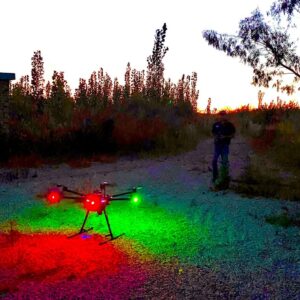
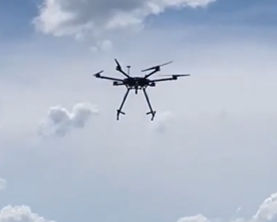
Through innovative 3D design and printing technology, the EWT developed a working prototype of a remote attachment system mounted on a drone that can attach flappers to powerlines safely. This custom-built first of its kind system can carry one magazine, holding four flappers at a time, and multiple magazines can be printed for quick reloading in the field. The magazine is suspended safely below the drone by an insulated rod, so that the pilot can position the drone away from live energy components while the magazine makes contact with the line and dispenses the flapper. The concept was successfully demonstrated to the South African Civil Aviation Authority (SACAA) in December 2020 and subsequently approved for commercial application, subject to rigorous safety and operational procedures. Following this important milestone, the system was tested in a controlled environment under the supervision of the Eskom Distribution North West Operating Unit Platinum Live Work department before a field trial was completed in the Zeerust area early in March 2021. Marking the line selected for the trial formed part of Eskom Distribution’s bird mitigation strategy, as several vultures had collided with the line previously.
Constant Hoogstad, the EWT’s Senior Manager: Industry Partnerships, initiated the project in 2016 and had this to say about the recent field trials: “What an incredible achievement for the Eskom/EWT strategic partnership to mark the first powerline in Africa with an RPAS system. This has taken years of hard work and dedication from a very committed team to ensure that history was made and is a huge win for bird species affected by collisions with powerlines. The system will enable utilities to mark power lines in a more cost-effective way from now on, which will save millions of Rands“.
Lourens Leeuwner, the EWT’s Wildlife and Energy Programme Manager, said: “The successful demonstration of this system is a major milestone for the Strategic Partnership. It simply would not have been possible without the assistance of the Eskom North West Operating Unit and the many individuals from Eskom’s Live work department who took time out of their busy schedules to assist us on the day.”
The Eskom/EWT strategic partnership is an example of what can be achieved when business and conservationists work together towards a common goal to address electricity infrastructure impacts on wildlife in South Africa for the last 24 years.
The Endangered Wildlife Trust set out to become a legal, commercial drone operator in South Africa in 2017. The non-profit, corporate, and commercial use of drones is regulated by the South African Civil Aviation Authority (SACAA), and organisations looking to operate within the legal framework enforced by the SACAA must obtain an RPAS Operating Certificate (ROC). Getting an ROC is quite onerous in terms of the various licences, registrations, and certifications an organisation must acquire – so much so that, unfortunately, many drone pilots are put off by this process and choose to operate illegally.
Should you require the services of the EWT’s drone unit for any of the activities listed above, please contact our RPAS Operations Manager, Lourens Leeuwner (lourensl@ewt.org.za ). Our RPAS are always ready to take flight for conservation.