
Help protect Africa's 

Rhino Peak Challenge 2026 — Conquering the ’Berg for Conservation

Rhino Peak Challenge 2026 — Conquering the ’Berg for Conservation

In the Field

Rhino Peak Challenge 2026 — Conquering the ’Berg for Conservation

By Tammy Baker, EWT donor relations officer
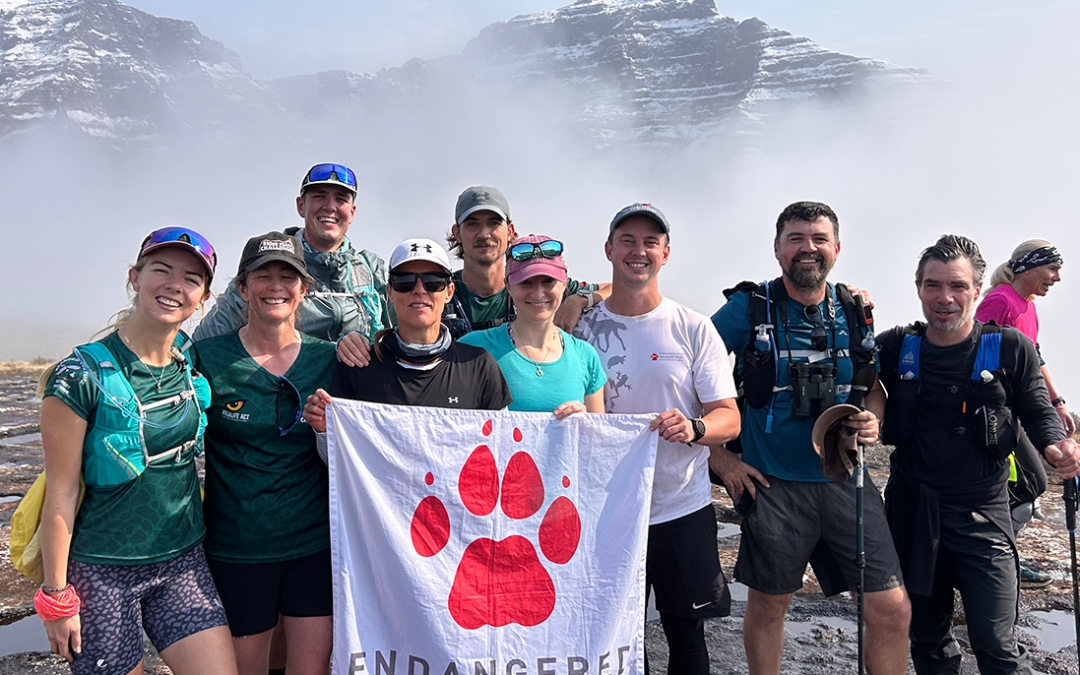
Rhino Peak Challenge 2026 ambassadors climbing in the snow-covered Drakensberg for conservation

In September, 30 trail, mountain and conservation enthusiasts made their way to the Drak Gooderson Hotel in the Underberg in cold, wet and windy weather, all a little unsure of what the weekend would hold.

As was the case last year,  we were again unable to reach the Rhino Peak because of dangerous weather and climbing conditions.

On 18 September we received a pre-race safety briefing from Rhino Peak Challenge Founder and Race Director, Spurgeon Flemington from Running Man Adventures, the driving force behind the event since its inception 11 years ago. As is tradition, Spurgeon headed out early on the morning of the challenge to mark the route and find an alternative, if it proved too dangerous.

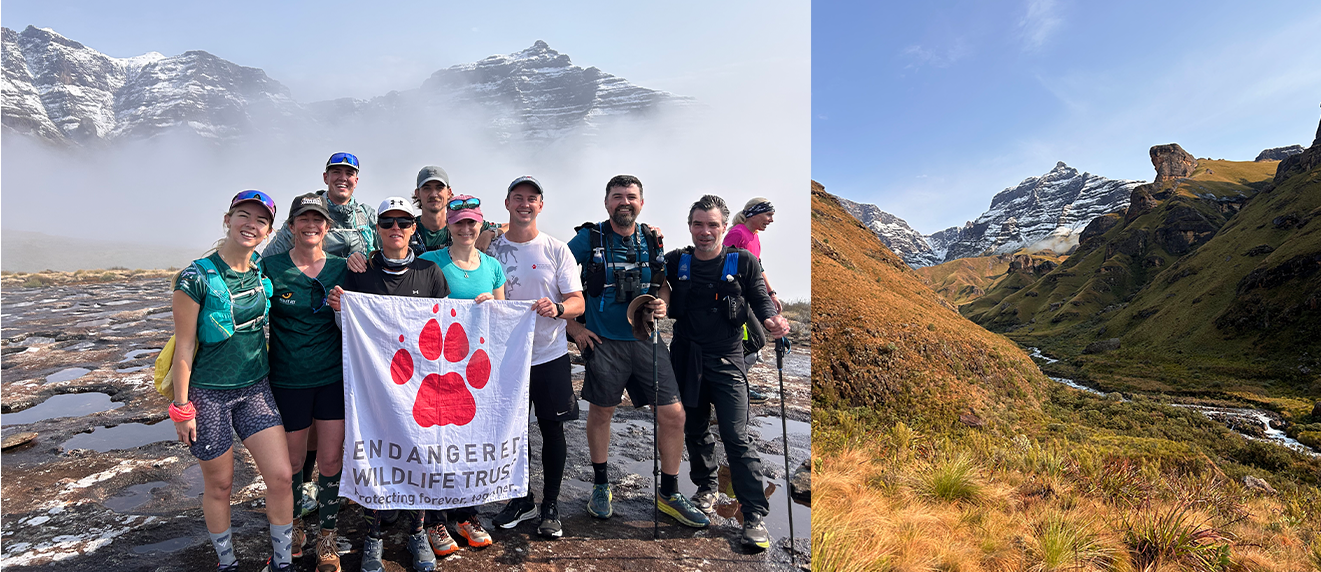
When we gathered on Saturday morning, the weather was clearing.  Despite that, Chris Kelly from Wildlife ACT, co-beneficiaries of the event, confirmed at the start line that the river was far too dangerous to cross and that we would be doing an alternative route – one involving a lot of climbing to an alternate peak in the ‘Berg.

The different route gave us a full view of the magnificent Drakensberg and the iconic Rhino Peak covered in snow. It was truly beautiful. After a very challenging and often hairy steep climb, I eventually arrived at our peak. After waiting for other ambassadors to arrive and sharing some laughs, fuel for the body and many photos, we started the long journey back down.

The finish line at RPC is always festive, as supporters welcome and cheer participants in and everyone enjoys some well-deserved refreshments.

At prize giving we were all reminded why we are there. This is not a competitive race. It is much more than that. This is for conservation.

All ambassadors had worked hard to reach their minimum target of R20,000 each, with some far surpassing that. While 2026 was not our biggest year in terms of ambassador numbers, we nonetheless raised R1.2 million for the conservation work of the Bearded Vulture Recovery Programme, Wildlife ACT and the Endangered Wildlife Trust.

Thank you to every ambassador, donor, supporter and to Spurgeon, Wildife ACT, Ford Wildlife Foundation, Kula bars (for providing fuel for our ambassadors) for another unforgettable weekend.

The 2027 date has been set for 18 September. If you would like to join this incredible and meaningful, life-changing weekend, contact TammyB@ewt.org.za.
Caring for cranes

Caring for cranes

CARING FOR CRANES

Dr Lara Jordan, Drakensberg Project Coordinator, EWT African Crane Conservation Programme
LaraJ@ewt.org.za
Although hard to believe in the current climate, with the world’ s attention focused on COVID-19, some things remain the same, and this means Grey Crowned Cranes are in their breeding season. In South Africa, Grey Crowned Cranes are most densely populated in the Drakensberg, which often means that they congregate in large flocks. Due to this, people often don’ t realise that the species is globally Endangered. As such, they are afforded a great deal of protection by South African law. Within KwaZulu-Natal, Grey Crowned Cranes are protected in terms of the Natal Nature Conservation Ordinance, 15 of 1974 and the Threatened or Protected Species Regulations, issued in terms of the National Environmental: Biodiversity Act, 20 of 2004 (as amended). This provides the species with a great deal of protection, in that no person may possess, disturb, capture or transport such without the necessary permits.

Every year, a few Grey Crowned Crane chicks are brought into captivity by well-meaning individuals, who discover what they think is an abandoned chick. However, you may be surprised to learn that the ecology of the species means that the adults leave chicks in the wetlands on purpose. They do this because until the chick can fly, it is very vulnerable to predators and other dangers. The parents hide the chick and return after the danger has passed. That danger could be as simple as somebody walking their dog. This can often look like abandonment, but it is not necessarily the case, and often happens well before you observe the birds.

Unfortunately, a chick that is removed from the wild and reared by untrained personnel has a very low chance of survival. Crane chicks, due to their long legs, require a very specific diet rich in calcium and a very specific balance of nutrients and protein. Another important aspect of crane rearing is imitating the amount of exercise the chicks would naturally walk a day in the wild. If either of these aspects are absent from their rearing, this often causes the bones to bend later in the development process. These bones eventually break, and the chick then needs to be euthanised. Alternatively, the malnutrition of the chicks leads to organ failure and the chicks die. These chicks can also suffer from badly developed feather growth, which would prevent their immediate release. Unfortunately, 80% of the rescued chicks we have seen this season have died or had to be humanely euthanised. Those that do survive are at risk of having been compromised.

Should you find a chick that you feel may be abandoned, here are some tips on what to do:

  • Take a picture of the chick to confirm species
  • Leave the chick exactly where you found it
  • Move away from the site as quickly as possible
  • Find a place where you can safely watch from without being seen by the adults, remember their eyesight is a lot better than ours
  • You should see that if you are properly hidden, the adults will return to the chicks
  • Should you be concerned that this has not happened, or if you feel that the chick is in imminent danger, please call the below numbers:
  • FreeMe Wildlife: 033 330 3036, Endangered Wildlife Trust: Dr Lara Jordan 0719035880 ,or Janine Rennie 0825327836, or your local Ezemvelo KwaZulu-Natal Wildlife District Conservation Officer.
  • The only people that can remove the chick are those that are permitted by Ezemvelo KwaZulu-Natal Wildlife to do so.
Tackling the Rhino Peak Challenge

Tackling the Rhino Peak Challenge

TACKLING THE RHINO PEAK CHALLENGE

On Saturday, 5 October, a small group of intrepid adventurers tackled the Rhino Peak Challenge, ascending the iconic Rhino Peak in the Southern Drakensberg to raise funds for rhinos, cranes and vultures.

This unique conservation fundraiser supports three beneficiaries – the EWT, Wildlife ACT, and Ezemvelo KZN Wildlife – all of whom are working tirelessly to protect the futures of these incredible species. This year, the event raised a whopping R834,000 in pledges! That’ s double what was raised in 2018 (R383,938) and 2017 (R303,788).

Our heartfelt thanks go to Spurgeon Flemington and the team from Running Man Adventures for their commitment to conservation and organising this event each year, to the runners for their willingness to take on this challenge, and to the people who made pledges in support of this wonderful fundraiser.

Thanks also to Cape Union Mart and K-Way, who sponsored gear for our CEO, Yolan Friedmann. A special mention must also go to EWT field officer, Thabo Madlala, who was the first non-elite athlete home, with an impressive time of 3 hrs 27 minutes!